Market Summary
Executive Summary and Global Market Analysis
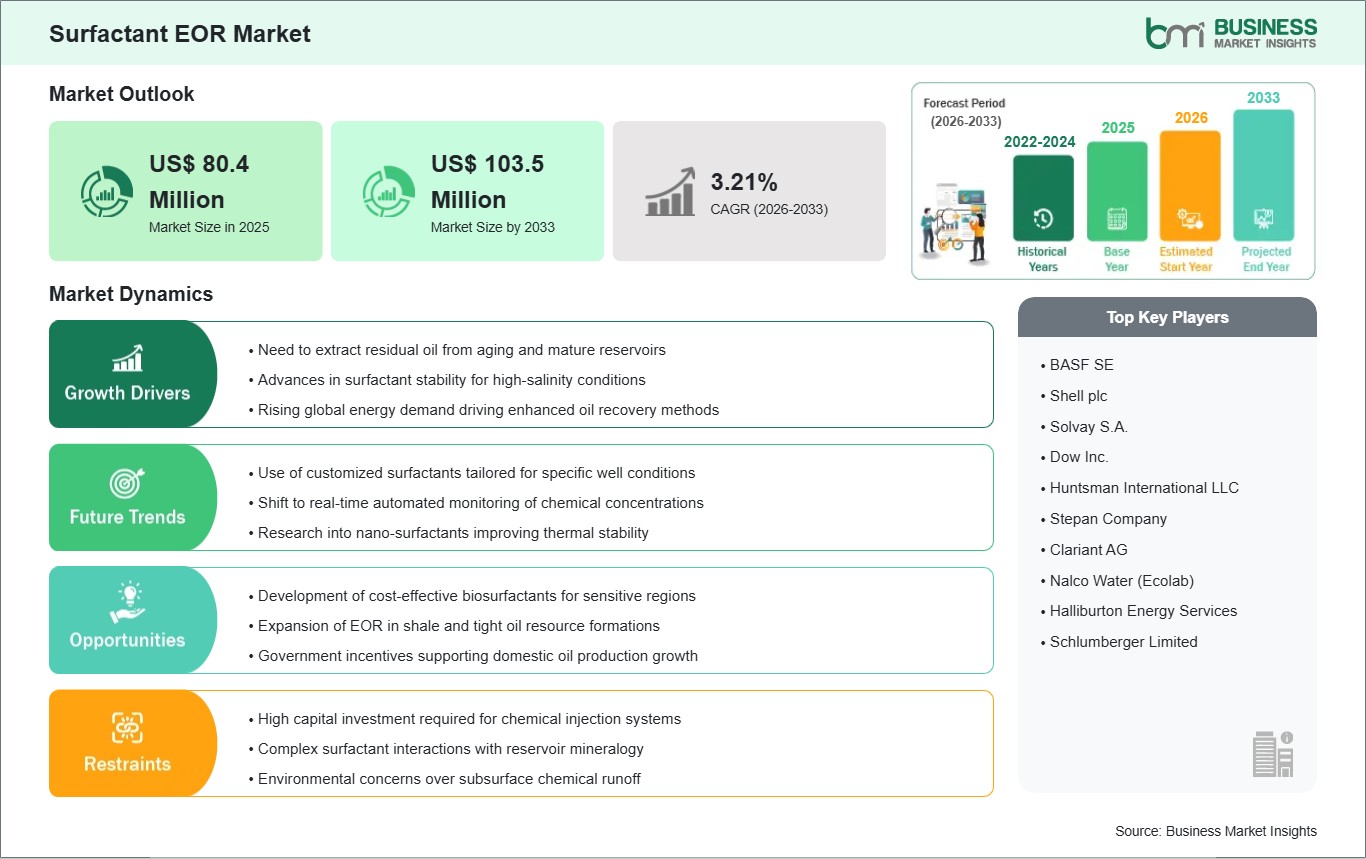
Surfactants are key to enhancing recovery rates from existing oil reserves, so as conventional sources plateau due to high production rates. The industry's efforts have focused on finding ways of recovering oils that can’t be extracted using traditional means by injecting chemicals into the ground. Surfactants change how liquid flows through porous materials (such as reservoir rock) via reducing the interfacial tension of fluids. When they are used with additional materials (such as polymers and alkalis), surfactants have become increasingly important both for displacing crude oil and for developing the complex flooding techniques that are being increasingly employed in order to optimize crude oil displacement.
The landscape is currently shaped by a dual focus on economic efficiency and technical innovation. Onshore applications remain the largest market segment due to lower logistical hurdles, but technological advancements are slowly making chemical EOR more feasible in offshore environments. While synthetic surfactants currently lead the market, there is a clear movement toward the development of sustainable biosurfactants. Despite the challenges of high initial costs and geological complexities, the market continues to expand as energy companies seek to maximize the value of their mature assets and ensure a steady supply of energy in an increasingly resource-constrained world.
Segment Analysis
Surfactant EOR Market Segmentation
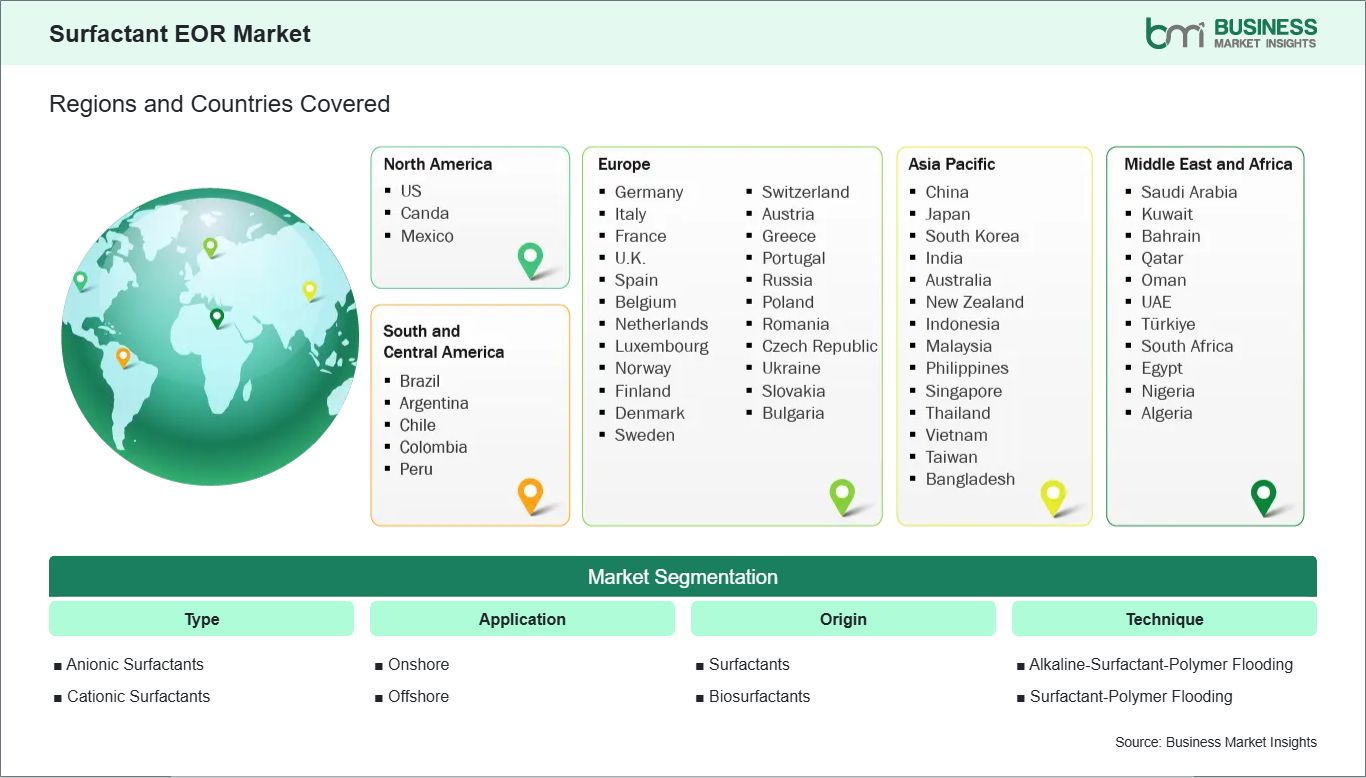
Key segments that contributed to the derivation of the Surfactant EOR market analysis are type, application, origin, and technique.
- By type, the surfactant EOR market is segmented into Anionic Surfactants and Cationic Surfactants. The Anionic Surfactants segment dominated the market.
- By application, the surfactant EOR market is segmented into Onshore and Offshore. The Onshore segment dominated the market.
- By origin, the surfactant EOR market is segmented into Surfactants and Biosurfactants. The Surfactants segment dominated the market.
- By technique, the surfactant EOR market is segmented into Alkaline-Surfactant-Polymer Flooding and Surfactant-Polymer Flooding. The Alkaline-Surfactant-Polymer Flooding segment dominated the market.
Market Forces
Surfactant EOR Market Drivers and Opportunities
Growing necessity to extract residual oil from mature and aging reservoirs
The primary driver for the surfactant EOR market is the urgent requirement to recover remaining oil trapped in mature fields that have moved past their primary and secondary production phases. Traditional extraction methods typically leave behind more than half of the original oil in place due to high capillary forces and poor sweep efficiency. Surfactants address this challenge by drastically reducing the interfacial tension between the reservoir water and the trapped oil droplets. This chemical alteration allows the oil to deform and flow through narrow pore throats that were previously impassable, effectively mobilizing stagnant resources and extending the commercial life of established assets.
Furthermore, the revitalization of brownfields is often more economically viable than the exploration and development of entirely new frontier basins. By utilizing surfactant-enhanced recovery, operators can leverage existing wellbore infrastructure and surface facilities to boost output. This focus on maximizing the "recovery factor" is essential as global energy demand remains high while new, easy-to-access discoveries become increasingly rare. The ability of specialized surfactants to perform in harsh downhole conditions ensures that even the most stubborn residual oil can be reached, providing a critical buffer for global energy security.
Development of cost-effective biosurfactants for eco-sensitive regions
The development and commercialization of biosurfactants represent a significant growth opportunity for the market, particularly as environmental regulations become more stringent. Unlike synthetic surfactants derived from petrochemicals, biosurfactants are produced by microorganisms and are inherently biodegradable and less toxic. This makes them ideal for use in environmentally sensitive areas, such as offshore platforms near protected marine life or onshore fields located close to groundwater sources. As the industry faces increasing pressure to reduce its chemical footprint, the transition to biological alternatives offers a path toward more sustainable oil production.
In addition to their environmental benefits, biosurfactants often exhibit superior performance in extreme conditions, such as high temperature and varying pH levels, which can degrade traditional synthetic chemicals. Recent breakthroughs in fermentation technology and the use of agricultural waste as a feedstock are helping to bring down the production costs of these biological agents. As the price gap between synthetic and bio-based options narrows, oil companies are likely to adopt these green alternatives to enhance their corporate social responsibility profiles while maintaining high recovery rates in complex geological formations.
Size and Share Analysis
Surfactant EOR Market Size and Share Analysis
The global Surfactant EOR market is experiencing steady growth, with market size and share analysis reflecting evolving treatment preferences and competitive dynamics among key players. The report evaluates important subsegments categorized within type, application, origin, and technique, highlighting their respective contributions to overall market performance.
By type, the Anionic Surfactants subsegment dominated the market due to its excellent ability to lower interfacial tension between oil and water while exhibiting low adsorption rates on sandstone reservoir rocks, making it the most efficient choice for maximizing oil recovery.
By application, the Onshore subsegment dominated the market because terrestrial oil fields are more accessible for the heavy equipment required for chemical injection, and the lower operational costs compared to offshore environments allow for more frequent EOR implementations.
By origin, the Surfactants subsegment dominated the market due to the established large-scale chemical manufacturing processes that ensure a steady, cost-effective supply of synthetic surfactants capable of withstanding the diverse temperature and salinity profiles found in deep reservoirs.
By technique, the Alkaline-Surfactant-Polymer Flooding subsegment dominated the market as it offers a synergistic approach where the alkaline agent reacts with crude oil acids to create in-situ soap, significantly reducing the amount of expensive surfactant needed for effective displacement.
Report Coverage
Surfactant EOR Market Report Coverage and Deliverables
The "Surfactant EOR Market Size and Forecast (2022 - 2033)" report provides a detailed analysis of the market covering below areas:
- Surfactant EOR market size and forecast at the regional and country levels for segments covered under the scope
- Surfactant EOR market trends, as well as drivers, restraints, and opportunities
- Surfactant EOR market analysis covering key trends, regional framework, major players, regulations, and recent developments
- Industry landscape and competition analysis covering market concentration, heat map analysis, prominent players, and recent developments for the Surfactant EOR market
- Detailed company profiles, including SWOT analysis
Geographic Insights
Surfactant EOR Market Geographic Insights
The geographical scope of the Surfactant EOR market report is divided into: North America, Asia Pacific, Europe, Middle East & Africa, and South & Central America. North America held the largest share in 2025.
North America stands as the dominant region in the surfactant EOR market, largely due to the extensive presence of mature oil fields in the Permian Basin and other major U.S. shale plays. The region has a long history of EOR experimentation and a highly developed service sector that provides the necessary chemical expertise and injection infrastructure. Significant investments from both major integrated oil companies and independent operators have fostered a climate of innovation, particularly in the development of customized surfactant blends tailored to the unique mineralogy of North American reservoirs. This technical maturity ensures that the region remains at the forefront of the global market.
The dominance of North America is further supported by a favorable technological ecosystem and the availability of low-cost chemical feedstocks. The presence of leading chemical manufacturers and research institutions allows for rapid testing and deployment of new surfactant formulations. Additionally, the well-established regulatory framework and the push for energy independence provide a stable environment for long-term EOR projects. While other regions like the Middle East are expanding their chemical recovery efforts, North America`s combination of aging infrastructure, technical know-how, and aggressive recovery targets maintains its leading position in the global surfactant EOR landscape.
Industry Activity
Recent Developments
The Surfactant EOR market is evaluated by gathering qualitative and quantitative data post primary and secondary research, which includes important corporate publications, association data, and databases. A few of the key developments in the Surfactant EOR market are:
- In December 2025, Stepan Company announced that it had expanded its oilfield solutions portfolio by introducing new surfactant formulations designed for chemical EOR applications in mature reservoirs, focusing on improved efficiency and reduced environmental impact.
- In September 2024, BASF announced that it had launched a next-generation surfactant technology for EOR, emphasizing higher tolerance to salinity and temperature in challenging oilfield conditions, thereby enhancing recovery rates in offshore and onshore projects.
- In May 2023, Solvay announced that it had strengthened its oil & gas chemicals division by introducing specialty surfactants tailored for EOR, highlighting their role in reducing interfacial tension and improving mobility control in heavy oil reservoirs.
Trust & Transparency
Research Methodology
The market analysis combines proprietary research with secondary data from government agencies, company disclosures, regulatory filings, industry databases and expert interviews. Market estimates are validated through data triangulation, cross-market benchmarking and analyst
review.
View Full Research Methodology
Key Sources Referred:
American Petroleum Institute (API) Society of Petroleum Engineers (SPE) International Energy Agency (IEA) International Association of Oil & Gas Producers (IOGP) Company Websites Company Annual Reports Company Investor Presentations