Market Summary
Executive Summary and Global Market Analysis
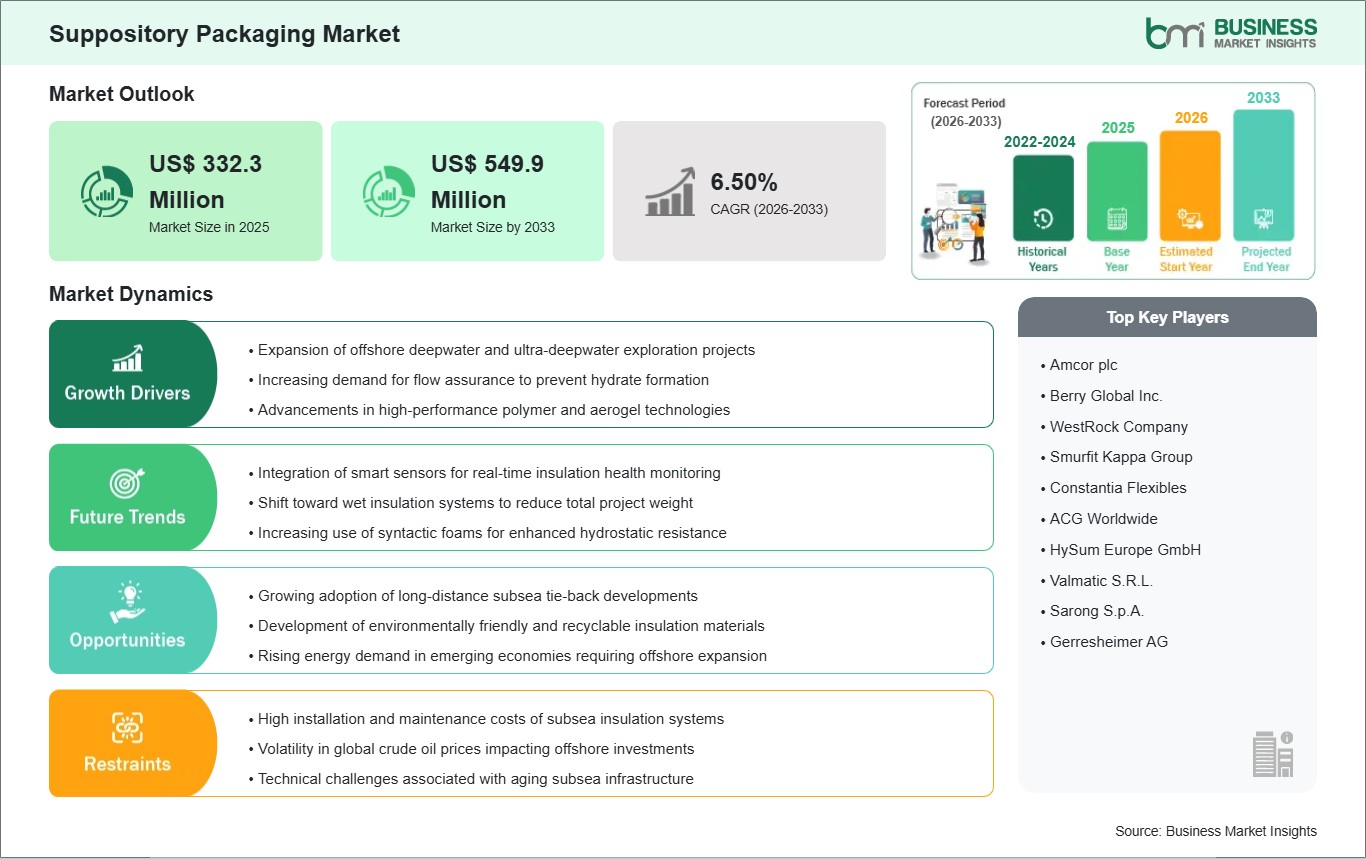
The global suppository packaging market is an integral part of the pharmaceutical sector, which offers specialized packaging solutions for temperature-sensitive drug formulas. As of 2025, this market is dominated by a strong trend in plastic-based blister packaging, owing to the need for cost-effective and high-barrier packaging solutions. At its core, this market is driven by an increase in global cases of chronic diseases, especially in the rectal and vaginal regions, where suppository packaging is considered the gold standard in treatment modalities. Furthermore, an increase in the geriatric population, which often requires non-oral routes of treatment, is a stable market force in this sector.
In addition, innovation in material science is also a key focus, and there is a clear trend towards sustainable and PVC-free materials to accommodate changing environmental regulations without affecting stability in the product. Although North America is a leading region in this market, with advanced healthcare facilities and high healthcare spending, there is a clear expansion of this market in Asia Pacific. Looking ahead to 2026, this market is likely to evolve further with the incorporation of automated production lines and smart packaging solutions. Although there are certain issues affecting stability and consumer stigma, this market is still strong and adapting to changing needs in patient-centric drug delivery solutions.
Segment Analysis
Suppository Packaging Market Segmentation
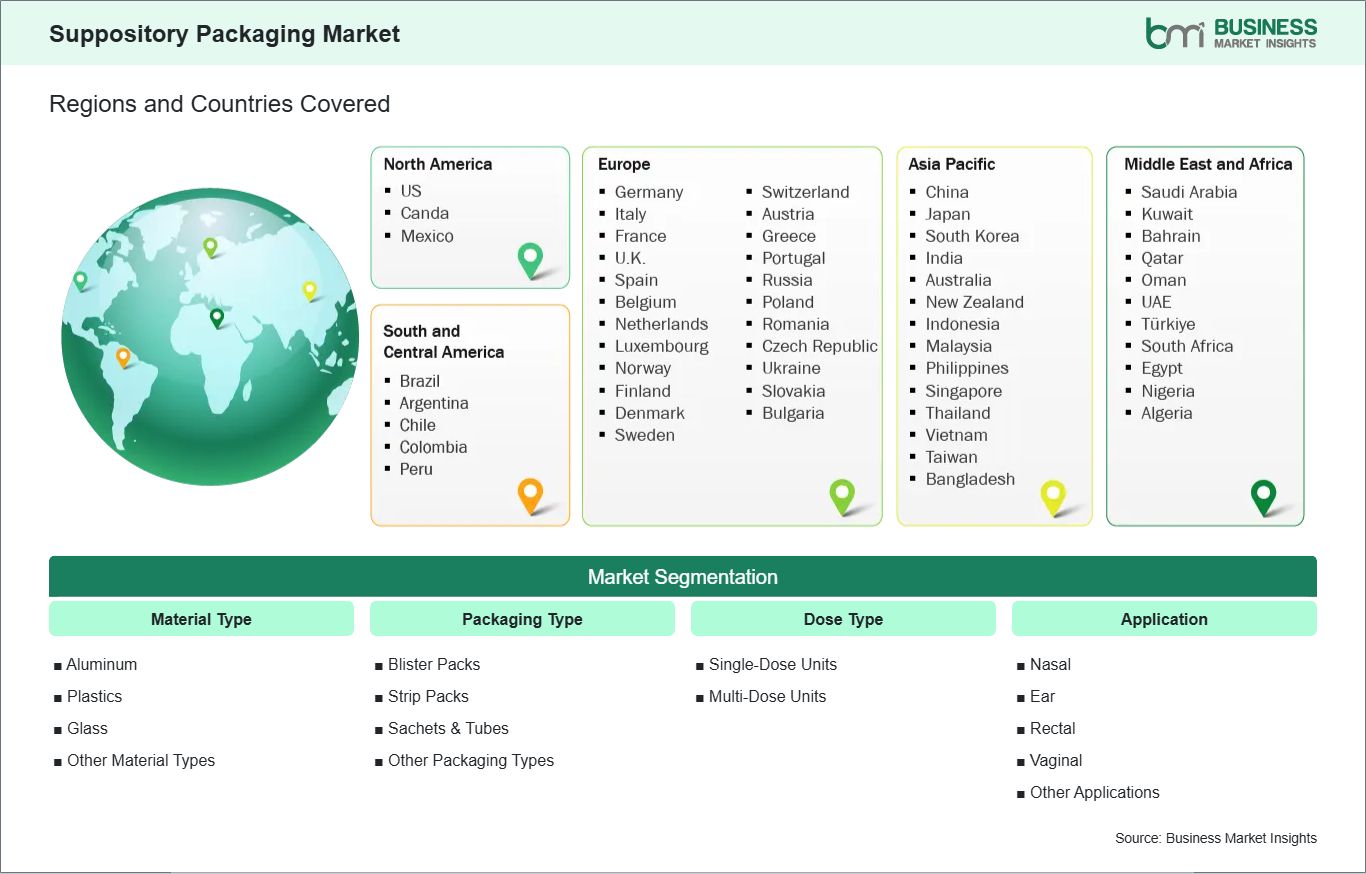
Key segments that contributed to the derivation of the Suppository Packaging market analysis are material type, packaging type, dose type, and application.
- By material type, the suppository packaging market is segmented into Aluminum, Plastics, Glass, and Others. The Plastics segment dominated the market in 2025.
- By packaging type, the suppository packaging market is segmented into Blister Packs, Strip Packs, Sachets & Tubes, and Others. The Blister Packs segment dominated the market in 2025.
- By dose type, the suppository packaging market is segmented into Single-Dose Units and Multi-Dose Units. The Single-Dose Units segment dominated the market in 2025.
- By application, the suppository packaging market is segmented into Nasal, Ear, Rectal, Vaginal, and Others. The Rectal segment dominated the market in 2025.
Market Forces
Suppository Packaging Market Drivers and Opportunities
Rising demand for non-oral drug delivery in geriatric and pediatric care
The main driver for the suppository packaging market is the major change occurring in non-oral drug delivery systems, especially for geriatric and pediatric patients. In the case of geriatric patients, elderly people face a problem known as dysphagia, where they face difficulties in swallowing drugs in the form of tablets or capsules. In the case of pediatric patients, suppositories provide a reliable solution to deliver drugs when a child is not in a position to take drugs orally due to nausea, vomiting, or refusal to take drugs.
Additionally, the pharmacokinetic benefits of suppositories, which include bypassing the "first-pass effect" in the liver, have encouraged prescribers to increase their use for acute conditions like high fever or seizures. As the world is moving towards a patient-centric healthcare system, the package manufacturers are also responding to the changing demands of the market, where the focus is on the development of unit-dose systems that provide improved hygiene and dosing accuracy. This demographic trend is forcing pharmaceutical companies to invest heavily in strong, high-barrier packaging systems to ensure the efficacy of the drugs until they are used
Integration of smart packaging with RFID for real-time temperature tracking
Smart technologies, which include Radio Frequency Identification (RFID) and Near Field Communication (NFC), can help to provide an innovative way to improve suppository packaging. Since suppositories need to be maintained at the proper temperature, manufacturers will be able to use smart sensors or indicators embedded directly within the blister or strip packaging to gain access to live data as it relates to the conditions of their products while in storage through the entire cold chain, making it necessary for companies to know about their products and how they have been handled in order to protect themselves from liability in todays' shipping environment with numerous complex global supply chains that cross borders.
This technology not only helps in maintaining product integrity but also serves as a powerful tool for anti-counterfeiting and patient adherence. Patients can use their smartphones to scan the packaging to verify the authenticity of the medication or receive digital instructions on proper administration. For healthcare providers, the ability to track the thermal history of a batch ensures that only viable, safe products reach the end-user. As the cost of smart labels continues to decrease, the adoption of these intelligent systems in high-value suppository segments will likely become a major competitive differentiator for packaging firms.
Size and Share Analysis
Suppository Packaging Market Size and Share Analysis
The global Suppository Packaging market is experiencing steady growth, with market size and share analysis reflecting evolving treatment preferences and competitive dynamics among key players. The report evaluates important subsegments categorized within material type, packaging type, dose type, and application, highlighting their respective contributions to overall market performance.
By material type, the Plastics subsegment dominated the market in 2025 due to its high compatibility with Form-Fill-Seal (FFS) technology, cost-effectiveness, and superior moisture barrier properties which are essential for maintaining the structural integrity of temperature-sensitive suppository formulations.
By packaging type, the Blister Packs subsegment dominated the market in 2025 due to its ability to provide individual cavity protection, ensuring product sterility and ease of dispensing while offering a robust shield against mechanical stress during transportation.
By dose type, the Single-Dose Units subsegment dominated the market in 2025 due to the rising demand for hygienic, convenient, and travel-friendly formats that eliminate the risk of cross-contamination and provide patients with precise, pre-measured medication amounts.
By application, the Rectal subsegment dominated the market in 2025 due to the high prevalence of gastrointestinal disorders and the widespread use of rectal suppositories for localized treatment of hemorrhoids, constipation, and systemic delivery in pediatric and geriatric care.
Report Coverage
Suppository Packaging Market Report Coverage and Deliverables
The "Suppository Packaging Market Size and Forecast (2022 - 2033)" report provides a detailed analysis of the market covering below areas:
- Suppository Packaging market size and forecast at the regional and country levels for segments covered under the scope
- Suppository Packaging market trends, as well as drivers, restraints, and opportunities
- Suppository Packaging market analysis covering key trends, regional framework, major players, regulations, and recent developments
- Industry landscape and competition analysis covering market concentration, heat map analysis, prominent players, and recent developments for the Suppository Packaging market
- Detailed company profiles, including SWOT analysis
Geographic Insights
Suppository Packaging Market Geographic Insights
The geographical scope of the Suppository Packaging market report is divided into: North America, Asia Pacific, Europe, Middle East & Africa, and South & Central America. North America held the largest share in 2025.
North America leads the suppository packaging market, a position it solidified in 2025 through its advanced pharmaceutical manufacturing sector and a robust regulatory framework that mandates high-quality packaging standards. The United States, in particular, accounts for the lion's share of regional demand, driven by a high prevalence of chronic conditions such as Inflammatory Bowel Disease (IBD) and hemorrhoids. The presence of major pharmaceutical giants and contract packaging organizations (CPOs) in the region facilitates the rapid adoption of new packaging technologies, such as advanced aluminum-plastic laminates and child-resistant blister designs.
Furthermore, North American consumers show a high preference for single-dose units, which offer convenience and reduce the risk of contamination. The regional market is also benefiting from a significant increase in healthcare R&D spending, focused on enhancing the bioavailability of drugs administered through rectal and vaginal routes. This research often necessitates the development of specialized, multi-layer packaging films that can withstand variable storage conditions. While sustainability is a growing concern, the primary focus in North America remains on product safety and tamper-evidence, as required by the FDA. As the region moves into 2026, the integration of digital serialization and smart tracking within the supply chain is expected to further strengthen North America's leadership in the global landscape.
Industry Activity
Recent Developments
The Suppository Packaging market is evaluated by gathering qualitative and quantitative data post primary and secondary research, which includes important corporate publications, association data, and databases. A few of the key developments in the Suppository Packaging market are:
- In September 2025, IMA Group announced that it had expanded its pharmaceutical packaging portfolio by introducing new automated suppository packaging machinery, designed to improve efficiency and compliance with global GMP standards.
- In July 2024, Syntegon Technology announced that it had launched an advanced suppository packaging line featuring enhanced sealing and dosing accuracy, aimed at supporting pharmaceutical companies in Europe and Asia with high-volume production.
- In March 2023, Marchesini Group announced that it had strengthened its pharmaceutical machinery offerings with new packaging solutions for suppositories, highlighting sustainability features such as reduced material waste and energy consumption.
Trust & Transparency
Research Methodology
The market analysis combines proprietary research with secondary data from government agencies, company disclosures, regulatory filings, industry databases and expert interviews. Market estimates are validated through data triangulation, cross-market benchmarking and analyst
review.
View Full Research Methodology
Key Sources Referred:
WPO (World Packaging Organisation) SPC (Sustainable Packaging Coalition) FPA (Flexible Packaging Association) PMMI (The Association for Packaging and Processing Technologies) FEFCO (European Federation of Corrugated Board Manufacturers) AIPIA (Active & Intelligent Packaging Industry Association) IAPRI (International Association of Packaging Research Institutes) APR (Association of Plastic Recyclers) GPI (Glass Packaging Institute) Company Websites Company Annual Reports Company Investor Presentations