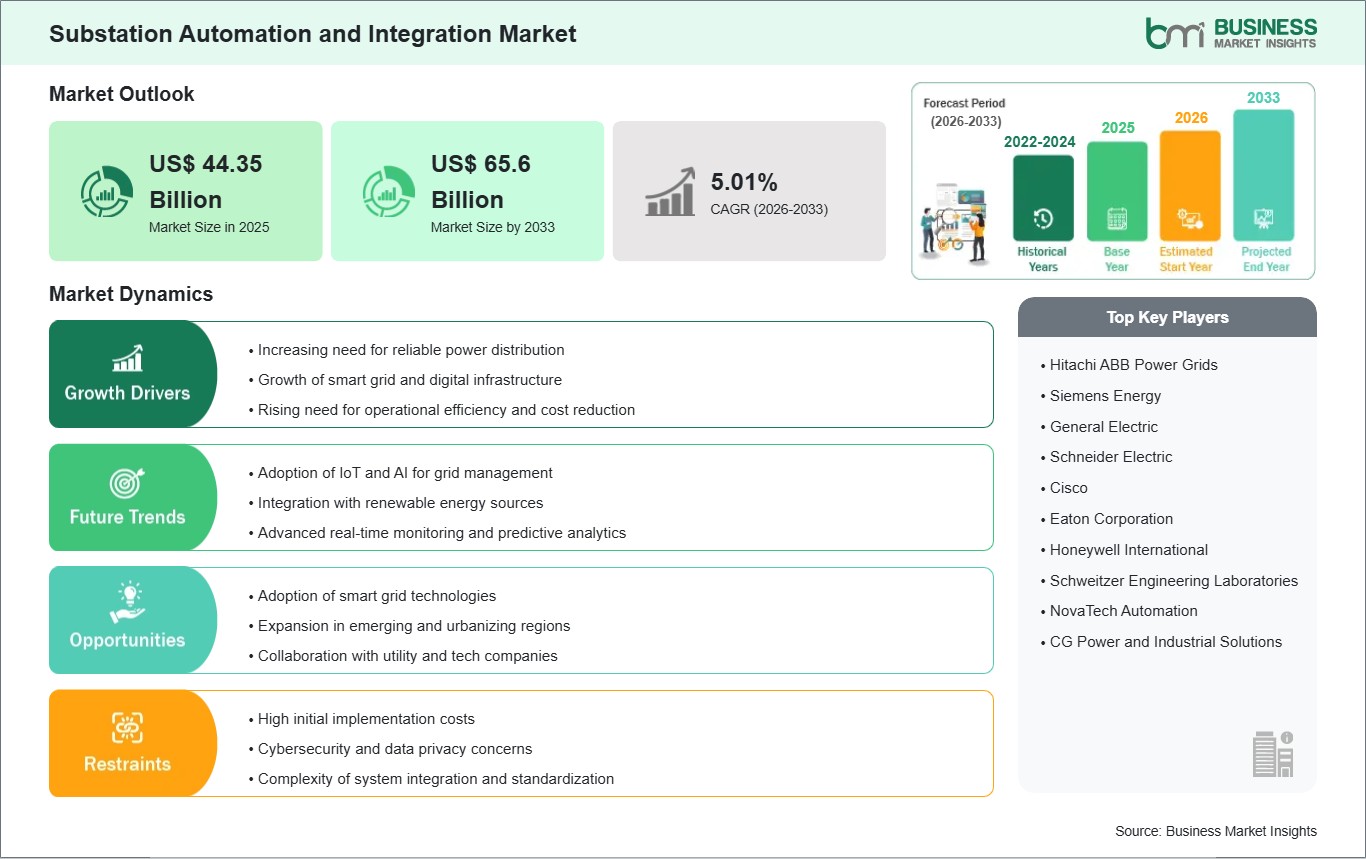
The Substation Automation and Integration Market size is expected to reach US$ 65.6 billion by 2033 from US$ 44.35 billion in 2025. The market is estimated to record a CAGR of 5.01% from 2026 to 2033.
The global substation automation and integration market is growing rapidly. Utilities and industrial operators are working to improve grid reliability, operational efficiency, and real-time monitoring. Substation automation involves using smart devices, communication networks, and software to monitor, control, and optimize substation operations. Integrating these systems allows better coordination between transmission and distribution networks. This leads to faster fault detection, load management, and predictive maintenance. Technological improvements, such as intelligent electronic devices (IEDs), advanced SCADA systems, IEC 61850 communication protocols, and IoT-enabled monitoring, are changing how substations operate. These technologies allow for remote control, data analysis, and real-time reporting. They improve system efficiency, reduce downtime, and help integrate renewable energy sources like solar and wind. Cloud-based platforms and AI-driven predictive maintenance solutions are becoming more common to enhance grid performance, reduce energy losses, and extend the life of assets. Government initiatives for smart grid development and regulations for reliable power distribution support this market.
There is also a growing demand for energy-efficient infrastructure. As utilities work on upgrading old substation networks, integrating renewable energy sources, and improving cybersecurity, substation automation and integration solutions are becoming essential for modern power systems. They enable better operational resilience and sustainable energy management.

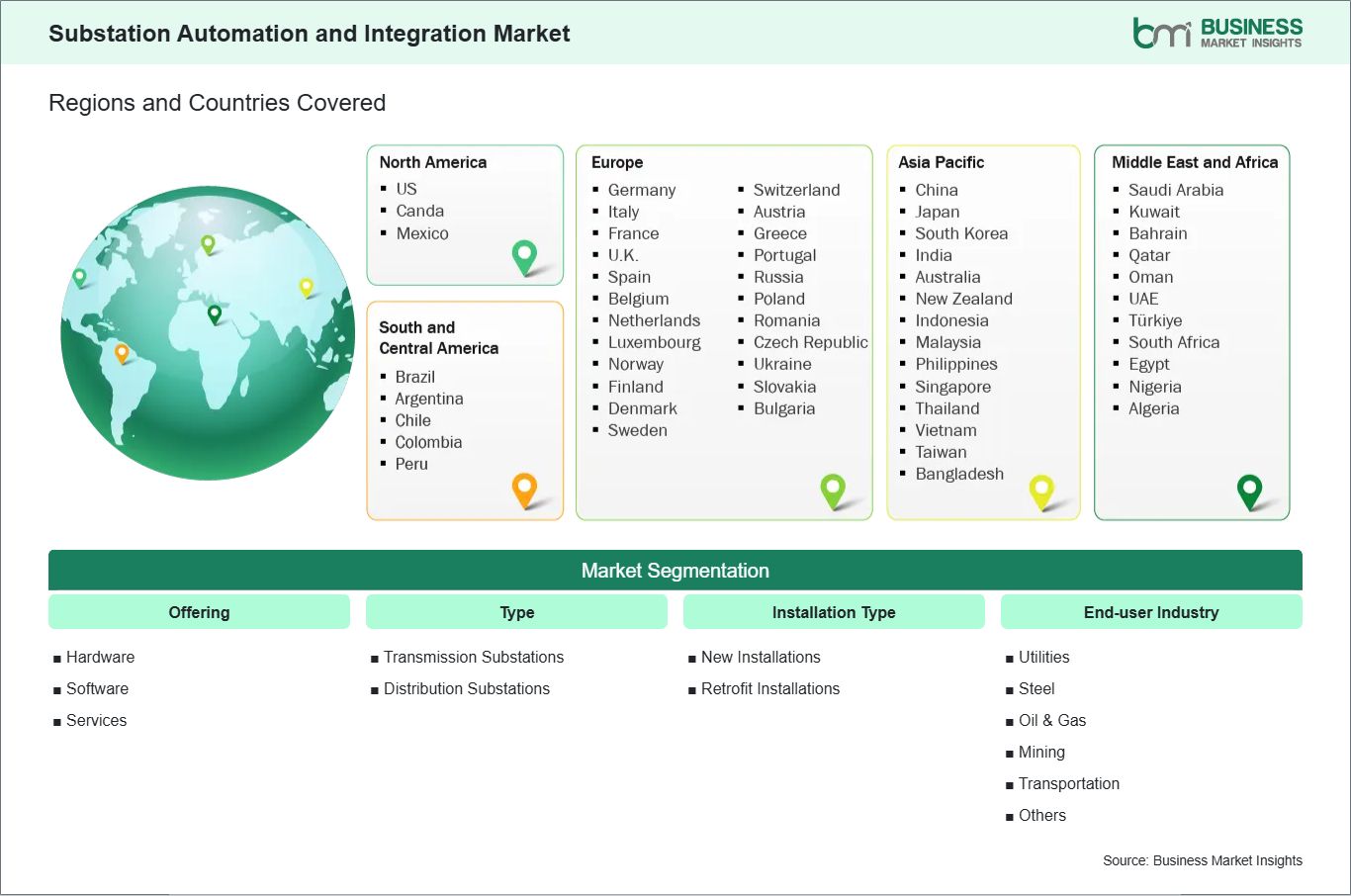
Key segments that contributed to the derivation of the substation automation and integration market analysis are offering, type, installation type, end‑user industry, component, and communication.
The global substation automation and integration market is driven by the growing demand for reliable and uninterrupted power distribution. As energy consumption increases worldwide, utilities and grid operators are upgrading traditional substations with advanced monitoring, control, and protection systems. These automated solutions help detect faults quickly, isolate affected sections, and maintain continuous electricity supply, ensuring network stability for industrial, commercial, and residential users. Modern power systems face increasing complexity due to higher load demands and distributed energy sources. Substation automation enables better load management, reduces technical losses, and enhances operational efficiency, making the power network more resilient and capable of handling evolving energy requirements. Additionally, integrated automation systems support predictive maintenance and real-time monitoring, allowing operators to identify potential issues before they cause disruptions. This improves overall service quality, reduces operational costs, and ensures that electricity distribution remains consistent, safe, and efficient across the global network.
The global adoption of smart grid technologies is a key driver for substation automation and integration. Intelligent substations equipped with advanced sensors, communication systems, and automated controls enable real-time monitoring, improved fault detection, and efficient energy management. These systems play a critical role in modernizing power networks and ensuring reliable operation. Integration with smart grid platforms allows operators to manage distributed energy resources, optimize load flow, and maintain voltage stability despite fluctuating generation from renewable sources. Automated substations enhance grid flexibility and responsiveness, ensuring consistent electricity delivery across complex networks. Furthermore, predictive analytics and advanced control strategies within smart grid systems improve operational efficiency, reduce maintenance costs, and enhance overall network reliability. By combining automation with smart grid capabilities, power operators can create resilient, future-ready infrastructure that meets growing global energy demands while supporting the transition to sustainable energy systems.
The Substation Automation and Integration Market demonstrates steady growth, with size and share analysis highlighting evolving trends and competitive dynamics among key players. The report examines subsegments categorized within offering, type, installation type, end‑user industry, component, and communication, offering insights into their contribution to overall market performance.
By Offering, the hardware subsegment dominated the market in 2025, driven by increasing adoption of intelligent devices and automation equipment.
Based on Type, the transmission Substations subsegment dominated the market in 2025, driven by expansion and modernization of high-voltage transmission networks.
In terms of Installation Type, the new installations subsegment dominated the market in 2025, driven by growing investments in greenfield substations and infrastructure upgrades.
On the Basis of End‑user Industry, the utilities subsegment dominated the market in 2025, driven by large-scale grid modernization and smart grid projects.
By Component, the IEDs subsegment dominated the market in 2025, driven by high demand for protection, monitoring, and control solutions.
Based on Communication, the ethernet subsegment dominated the market in 2025, driven by reliable, high-speed connectivity requirements for substation automation.
| Report Attribute | Details |
|---|---|
| Market size in 2025 | US$ 44.35 Billion |
| Market Size by 2033 | US$ 65.6 Billion |
| Global CAGR (2026 - 2033) | 5.01% |
| Historical Data | 2022-2024 |
| Forecast period | 2026-2033 |
| Segments Covered | By Offering
|
|
Regions and Countries Covered
| |
| North America | US, Canada, Mexico |
| Europe | Belgium, Austria, Finland, Denmark, Greece, Poland, Romania, Russia, Ukraine, Czech Republic, Slovakia, Bulgaria, Italy, Luxembourg, Germany, Switzerland, France, Netherlands, Norway, Portugal, Spain, Sweden, United Kingdom |
| Asia-Pacific | Australia, China, India, Japan, South Korea, Indonesia, Malaysia, Philippines, Singapore, Thailand, Vietnam, Bangladesh, New Zealand, Taiwan |
| South and Central America | Brazil, Argentina, Peru, Chile, Colombia |
| Middle East and Africa | Bahrain, Kuwait, Oman, Qatar, Saudi Arabia, United Arab Emirates, Turkiye, South Africa, Egypt, Algeria, Nigeria |
| Market leaders and key company profiles |
|
The "Substation Automation and Integration Market Size and Forecast (2022 - 2033)" report provides a detailed analysis of the market covering below areas:
The geographical scope of the Substation Automation and Integration Market report is divided into North America, Asia Pacific, Europe, Middle East & Africa, and South & Central America. North America held the largest share in 2025.
Regional adoption of substation automation and integration solutions is influenced by power grid modernization, renewable energy integration, and industrial electrification. North America dominates the market due to advanced grid infrastructure, high smart grid adoption, and robust investments in digital substation technologies. The United States and Canada are leading in deploying IEC 61850-compliant IEDs, SCADA integration, and cloud-based monitoring systems across transmission and distribution networks.
Asia Pacific is a fast-growing region driven by increasing electricity demand, industrial expansion, and renewable energy development. China, India, Japan, and South Korea are implementing automated substations to improve grid reliability, manage variable renewable energy inputs, and enhance urban power distribution systems.
Europe emphasizes energy efficiency, grid resilience, and regulatory compliance. Germany, France, and the United Kingdom are adopting substation automation to support renewable integration, smart grid projects, and advanced energy management systems.
Middle East & Africa is gradually deploying automated substations for industrial, utility, and urban electrification projects, with the UAE, Saudi Arabia, and South Africa focusing on modernizing aging infrastructure and supporting large-scale solar and wind integration.
South & Central America is expanding adoption in transmission and distribution networks to enhance grid stability, optimize power quality, and support renewable energy integration, with Brazil, Mexico, and Chile driving modernization projects across the region.

The Substation Automation and Integration Market is evaluated by gathering qualitative and quantitative data post primary and secondary research, which includes important corporate publications, association data, and databases. A few of the key developments in the spatial light Modulator market are:
The Substation Automation and Integration Market is valued at US$ 44.35 Billion in 2025, it is projected to reach US$ 65.6 Billion by 2033.
As per our report Substation Automation and Integration Market, the market size is valued at US$ 44.35 Billion in 2025, projecting it to reach US$ 65.6 Billion by 2033. This translates to a CAGR of approximately 5.01% during the forecast period.
The Substation Automation and Integration Market report typically cover these key segments-
The historic period, base year, and forecast period can vary slightly depending on the specific market research report. However, for the Substation Automation and Integration Market report:
The Substation Automation and Integration Market is populated by several key players, each contributing to its growth and innovation. Some of the major players include:
The Substation Automation and Integration Market report is valuable for diverse stakeholders, including:
Essentially, anyone involved in or considering involvement in the Substation Automation and Integration Market value chain can benefit from the information contained in a comprehensive market report.
Please tell us your area of interest
(Market Segments/ Regions and Countries/ Companies)