Market Summary
Executive Summary and Global Market Analysis
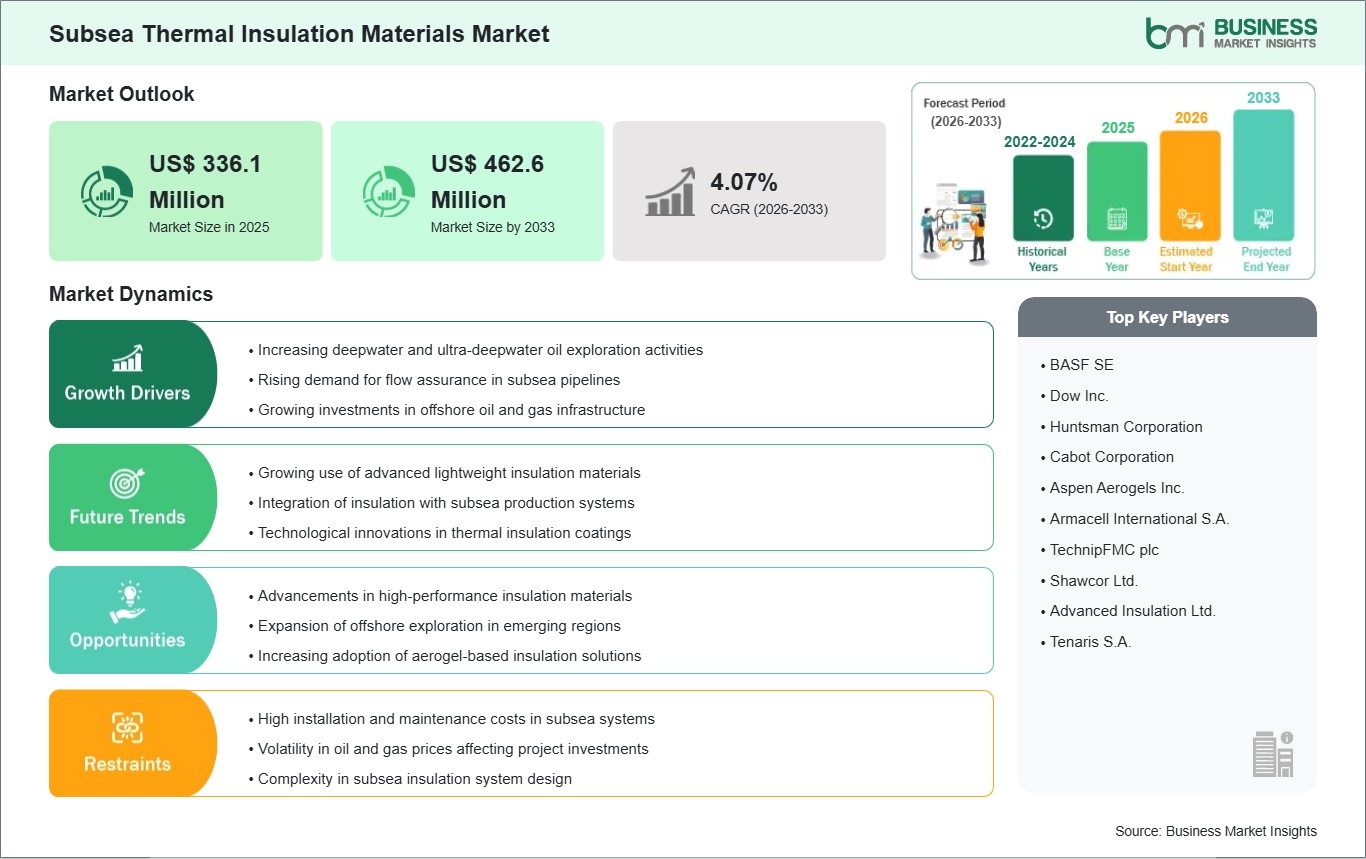
The subsea thermal insulation materials industry is currently witnessing moderate-paced growth driven primarily by rising offshore oil/gas exploration activity, most notably in deeper and ultra-deepwater regions. These materials play a critical role in ensuring that fluid temperatures can be maintained; they also prevent flow assurance problems; they help to ensure efficient transport of hydrocarbons under challenging subsea conditions. Polyurethane remains the leading subsea thermal insulation material because of its low cost and excellent insulating capability; pipe-in-pipe systems dominate applications because they provide the best thermal efficiency. The subsea thermal insulation materials market will be impacted by increasing investment in offshore infrastructure projects and continued development of insulation technology.
However, the high price of insulation materials, combined with volatility in the price of oil, is likely to limit the growth potential of this industry. While these factors will continue to limit the growth prospects of the subsea thermal insulation materials market, innovation (e.g., new high-performing materials such as aerogels) and increasing subsea exploration activity in developing areas will help to relieve some of these constraints and set a stage for growth over the longer term. As a result, it is anticipated that the subsea thermal insulation materials market will continue to develop as a result of technological advancements and due to the increasing need for more efficient subsea production systems.
Segment Analysis
Subsea Thermal Insulation Materials Market Segmentation
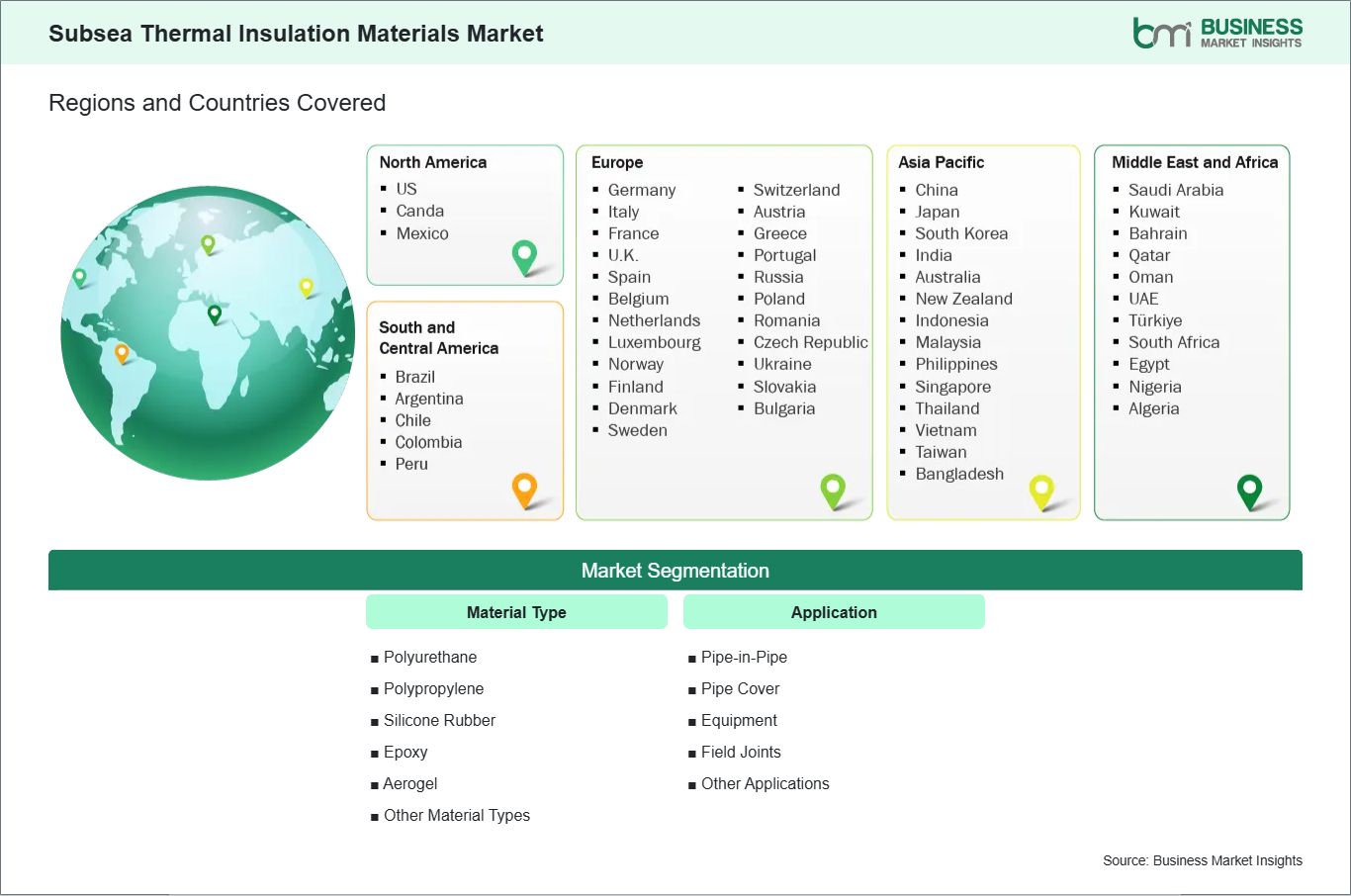
Key segments that contributed to the derivation of the Subsea Thermal Insulation Materials market analysis are material type and application.
- By material type, the market is segmented into Polyurethane, Polypropylene, Silicone Rubber, Epoxy, Aerogel, and Others. The Polyurethane segment dominated the market in 2025.
- By application, the market is segmented into Pipe-in-Pipe, Pipe Cover, Equipment, Field Joints, and Others. The Pipe-in-Pipe segment dominated the market in 2025.
Market Forces
Subsea Thermal Insulation Materials Market Drivers and Opportunities
Increasing deepwater and ultra-deepwater oil exploration activities
The increasing deepwater and ultra-deepwater oil exploration activities are a major driver of the subsea thermal insulation materials market. As easily accessible oil reserves decline, energy companies are shifting their focus toward offshore reserves located in deeper waters. In such environments, maintaining the temperature of transported fluids is critical to prevent issues such as hydrate formation and wax deposition. Subsea thermal insulation materials play a vital role in ensuring flow assurance, improving operational efficiency, and reducing production risks in these challenging conditions. Additionally, growing global energy demand is encouraging investments in offshore exploration projects, particularly in regions such as the Gulf of Mexico, Brazil, and West Africa. This is driving the adoption of advanced insulation materials that can withstand extreme pressures and temperatures, thereby supporting market growth.
Advancements in high-performance insulation materials
Advancements in high-performance insulation materials present significant opportunities for the subsea thermal insulation materials market. Continuous research and development efforts are focused on enhancing thermal efficiency, durability, and resistance to harsh subsea conditions. Materials such as aerogels and advanced polymers are gaining attention due to their superior insulation capabilities and lightweight properties. These materials help improve flow assurance while reducing installation complexities and operational costs in offshore projects. Furthermore, increasing demand for efficient and reliable subsea systems is encouraging the adoption of innovative insulation solutions. Manufacturers are investing in new material technologies to meet evolving industry requirements, creating opportunities for product differentiation and long-term market growth.
Size and Share Analysis
Subsea Thermal Insulation Materials Market Size and Share Analysis
The global Subsea Thermal Insulation Materials market is experiencing steady growth, with market size and share analysis reflecting evolving treatment preferences and competitive dynamics among key players. The report evaluates important subsegments categorized within material type and application highlighting their respective contributions to overall market performance.
By material type, the Polyurethane subsegment dominated the market in 2025 due to its strong insulation efficiency, durability, and cost advantage, making it highly suitable for subsea pipeline and equipment insulation.
By application, the Pipe-in-Pipe subsegment dominated the market in 2025 due to its ability to provide high thermal resistance and maintain fluid temperature in challenging subsea environments, ensuring efficient oil and gas transportation.
Report Coverage
Subsea Thermal Insulation Materials Market Report Coverage and Deliverables
The "Subsea Thermal Insulation Materials Market Size and Forecast (2022 - 2033)" report provides a detailed analysis of the market covering below areas:
- Subsea Thermal Insulation Materials market size and forecast at the regional and country levels for segments covered under the scope
- Subsea Thermal Insulation Materials market trends, as well as drivers, restraints, and opportunities
- Subsea Thermal Insulation Materials market analysis covering key trends, regional framework, major players, regulations, and recent developments
- Industry landscape and competition analysis covering market concentration, heat map analysis, prominent players, and recent developments for the Subsea Thermal Insulation Materials market
- Detailed company profiles, including SWOT analysis
Geographic Insights
Subsea Thermal Insulation Materials Market Geographic Insights
The geographical scope of the Subsea Thermal Insulation Materials market report is divided into: North America, Asia Pacific, Europe, Middle East & Africa, and South & Central America. North America held the largest share in 2025.
North America dominates the subsea thermal insulation materials market due to significant offshore oil and gas exploration activities, particularly in the Gulf of Mexico. The region benefits from advanced technological capabilities, strong industry presence, and substantial investments in deepwater projects. The demand for efficient subsea insulation systems is driven by the need to maintain flow assurance and optimize production in challenging offshore environments. Additionally, the presence of major oil and gas companies and continuous advancements in subsea technologies support market growth in the region.
Regulatory frameworks and safety standards also encourage the adoption of high-performance insulation materials. Meanwhile, regions such as Europe and Asia-Pacific are witnessing growth due to increasing offshore exploration activities in the North Sea and Southeast Asia. Expanding energy demand and investments in offshore infrastructure in these regions are expected to create new opportunities for market expansion.
Industry Activity
Recent Developments
The Subsea Thermal Insulation Materials market is evaluated by gathering qualitative and quantitative data post primary and secondary research, which includes important corporate publications, association data, and databases. A few of the key developments in the Subsea Thermal Insulation Materials market are:
- In December 2025, Aspen Aerogels announced that it had advanced its subsea thermal insulation materials portfolio with new aerogel-based solutions designed to prevent hydrate and wax formation in deepwater pipelines, emphasizing improved thermal efficiency and durability.
- In August 2025, Kingspan Group announced that it was strengthening its subsea insulation business by introducing eco-friendly polyurethane and polypropylene systems, positioning itself as a leader in sustainable subsea thermal insulation solutions for offshore energy projects.
- In August 2025, Cabot Corporation announced that it had expanded its global reach in subsea thermal insulation by integrating advanced aerogel technologies into pipeline coatings, aiming to enhance flow assurance and reduce operational risks in ultra-deepwater environments.
Trust & Transparency
Research Methodology
The market analysis combines proprietary research with secondary data from government agencies, company disclosures, regulatory filings, industry databases and expert interviews. Market estimates are validated through data triangulation, cross-market benchmarking and analyst
review.
View Full Research Methodology
Key Sources Referred:
American Petroleum Institute (API) Society for Underwater Technology (SUT) International Marine Contractors Association (IMCA) Offshore Technology Conference (OTC) ASTM International - Committee on Insulation and Offshore Materials International Organization for Standardization (ISO) European Federation of Corrosion (EFC) Materials Research Society (MRS) Company Websites Company Annual Reports Company Investor Presentations