Market Summary
Executive Summary and Global Market Analysis
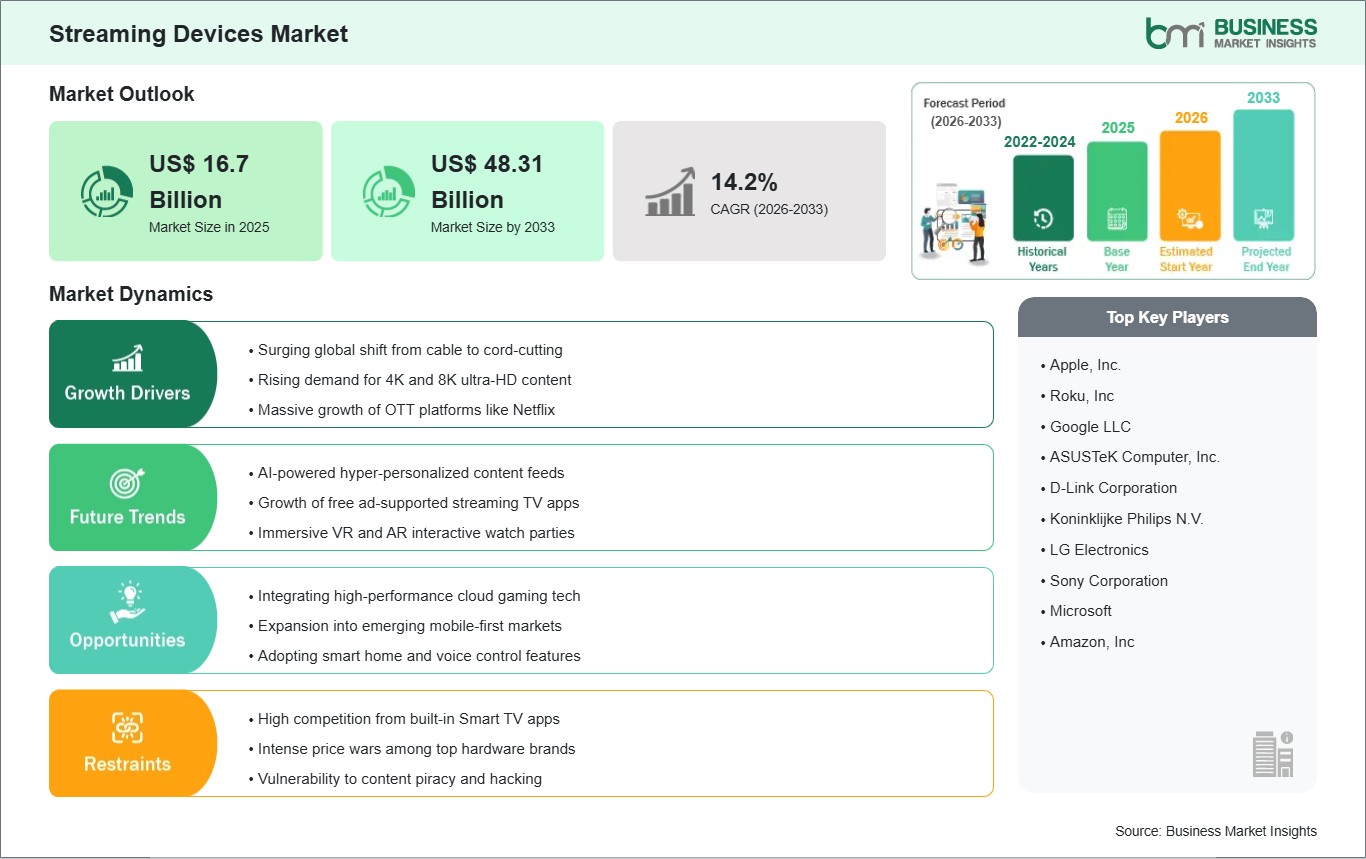
Streaming devices are integral to the modernization of home entertainment, serving as the primary interface between the internet and television screens to deliver high-quality, on-demand content. These devices are fundamental for platforms such as Over-The-Top (OTT) services (e.g., Netflix, Disney+), cloud gaming, and smart home integration. Key advantages include intuitive user interfaces, regular hardware and software updates, and support for "cord-cutting," which refers to the transition from traditional cable subscriptions. Market growth is driven by the rapid increase in global OTT subscriptions, rising consumer demand for 4K and 8K Ultra HD content, and the widespread deployment of high-speed internet and 5G networks. Additionally, the integration of Artificial Intelligence (AI) for personalized content curation and voice control capabilities is significantly enhancing the user experience.
However, several challenges can restrain market growth: intense competition and price wars among major manufacturers (Roku, Amazon, Google, Apple) often lead to reduced profitability and a shorter product lifecycle. Network infrastructure limitations and bandwidth constraints in emerging markets also pose a barrier to the adoption of high-resolution streaming. Furthermore, growing concerns regarding data privacy and security related to the vast user data collected by these interconnected devices can deter consumers. Despite these hurdles, the market holds significant opportunities as a result of the expansion into price-sensitive emerging economies (Asia-Pacific and Latin America) with low-cost stick devices, the increasing demand for live-streamed content and video gaming, and the opportunity to bundle devices with telecommunication and smart home services.
Segment Analysis
Streaming Devices Market Segmentation
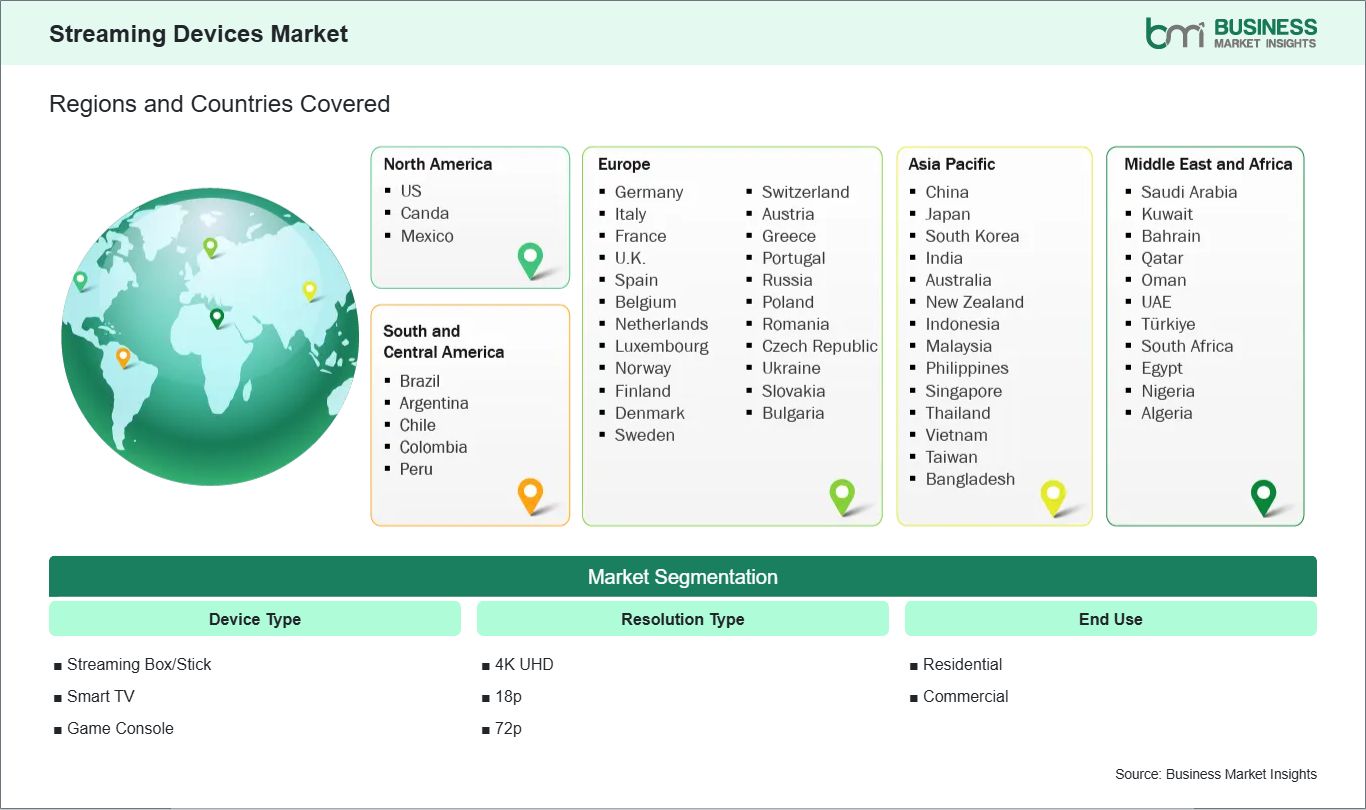
Key segments that contributed to the derivation of the Streaming Devices market analysis are device type, resolution type, and end use.
- By Device Type, the market is segmented into Streaming Box/Stick, Smart TV, and Game Console.
- By Resolution Type, the market is segmented into 4K UHD, 1080p, and 720p.
- By End Use, the market is segmented into Residential and Commercial.
Market Forces
Streaming Devices Market Drivers and Opportunities
Shift from Cable to OTT and Cord-Cutting
The primary factor driving the streaming devices market is the global shift of consumers from traditional pay-TV services, such as cable and satellite, to Over-The-Top (OTT) streaming platforms. This widespread trend, referred to as "cord-cutting," is significantly transforming media consumption patterns. Consumers now prioritise flexible, on-demand content and personalised viewing experiences over adhering to fixed broadcast schedules and costly channel bundles. Streaming devices, including dedicated sticks, boxes, and smart TVs, function as essential hardware gateways facilitating this transition. They provide a simple, cost-effective way to access a multitude of subscription and ad-supported services, such as Netflix, Disney+, and regional platforms. The continued creation of high-quality, exclusive original content by these streaming platforms intensifies consumer reliance on streaming devices to access their preferred entertainment ecosystem.
Smart Home Integration and Gaming
A major growth opportunity exists in the integration of streaming devices within the expanding smart home ecosystem and the development of cloud gaming services. Contemporary streaming devices are transitioning from basic media players to central hubs for connected households. The incorporation of advanced voice assistants such as Alexa and Google Assistant, Internet of Things (IoT) control functions, and seamless connectivity enables users to manage home lighting, security cameras, and other devices directly through their television screens. This convergence elevates streaming devices from entertainment accessories to essential utilities. Additionally, the increasing demand for cloud gaming and gaming subscription services necessitates more powerful, low-latency streaming hardware. In response, manufacturers are designing devices with enhanced processing capabilities and dedicated gaming features to address this rapidly growing market, thereby positioning streaming devices as comprehensive home entertainment and computing platforms.
Size and Share Analysis
Streaming Devices Market Size and Share Analysis
The Streaming Devices market demonstrates steady growth, with size and share analysis revealing evolving trends and competitive positioning among key players. The report further examines subsegments categorized within device type, resolution type, and end use, offering insights into their contribution to overall market performance.
For instance, Streaming Box/Sticks continue to be a significant segment, particularly for consumers looking for affordable "cord-cutting" solutions or upgrading older televisions. These devices, frequently available in 1080p for budget-conscious buyers and 4K UHD for premium users, are widely used in the Residential segment. However, they are also witnessing increased adoption in the Commercial sector, where they serve as cost-effective tools for digital signage and guest entertainment in the hospitality industry.
Report Coverage
Streaming Devices Market Report Coverage and Deliverables
The "Streaming Devices Market Size and Forecast (2022 - 2033)" report provides a detailed analysis of the market covering below areas:
- Streaming Devices market size and forecast at global, regional, and country levels for all the key market segments covered under the scope
- Streaming Devices market trends, as well as market dynamics such as drivers, restraints, and key opportunities
- Streaming Devices market analysis covering key market trends, global and regional framework, major players, regulations, and recent market developments
- Industry landscape and competition analysis covering market concentration, heat map analysis, prominent players, and recent developments for the Streaming Devices market
- Detailed company profiles, including SWOT analysis
Geographic Insights
Streaming Devices Market Geographic Insights
The geographical scope of the Streaming Devices market report is divided into five regions: North America, Asia Pacific, Europe, Middle East & Africa, and South & Central America.
The Asia-Pacific Streaming Devices Market is segmented into China, Japan, South Korea, India, Australia, New Zealand, Indonesia, Malaysia, the Philippines, Singapore, Thailand, Vietnam, Taiwan, Bangladesh, and the Rest of Asia. The market is primarily driven by the region's massive internet user base and the rapid rollout of 5G networks.
Growth is bolstered by the rising penetration of Smart TVs and the increasing popularity of live gaming and e-sports streaming. The shift from traditional cable to cord-cutting solutions, along with the availability of low-cost streaming sticks and dongles, makes Asia-Pacific the key global engine for future streaming device consumption.
Industry Activity
Recent Developments
The Streaming Devices market is evaluated by gathering qualitative and quantitative data post primary and secondary research, which includes important corporate publications, association data, and databases. A few of the key developments in the Streaming Devices market are:
- In June 2025, Apple announced tvOS 26, making Apple TV even more immersive, enjoyable, and convenient. Featuring a stunning new design with Liquid Glass, tvOS 26 is designed to keep the focus on what’s playing so users never miss a moment. The Apple TV app also now showcases cinematic poster art that makes it fun and easy to discover what to play next. Enhancements to profile-switching and a streamlined way to log in to apps make it easier than ever to access entertainment, while updates to Apple Music Sing bring users new ways to enjoy singing along with friends using iPhone.
- In April 2025, Roku, Inc. (NASDAQ: ROKU), the #1 TV streaming platform in the U.S., Canada, and Mexico, unveiled a powerful new device lineup and software updates designed for streamers. With a growing global footprint, Roku continues to lead the way in delivering innovative devices that make TV delightfully simple, enjoyable, and better for everyone.
Trust & Transparency
Research Methodology
The market analysis combines proprietary research with secondary data from government agencies, company disclosures, regulatory filings, industry databases and expert interviews. Market estimates are validated through data triangulation, cross-market benchmarking and analyst
review.
View Full Research Methodology
Key Sources Referred:
World Bank - Global Trade IndicatorsWorld Trade Organization (WTO)International Monetary Fund (IMF)International Trade Administration (ITA)Company WebsitesCompany Annual ReportsCompany Investor Presentations