Market Summary
Executive Summary and Global Market Analysis
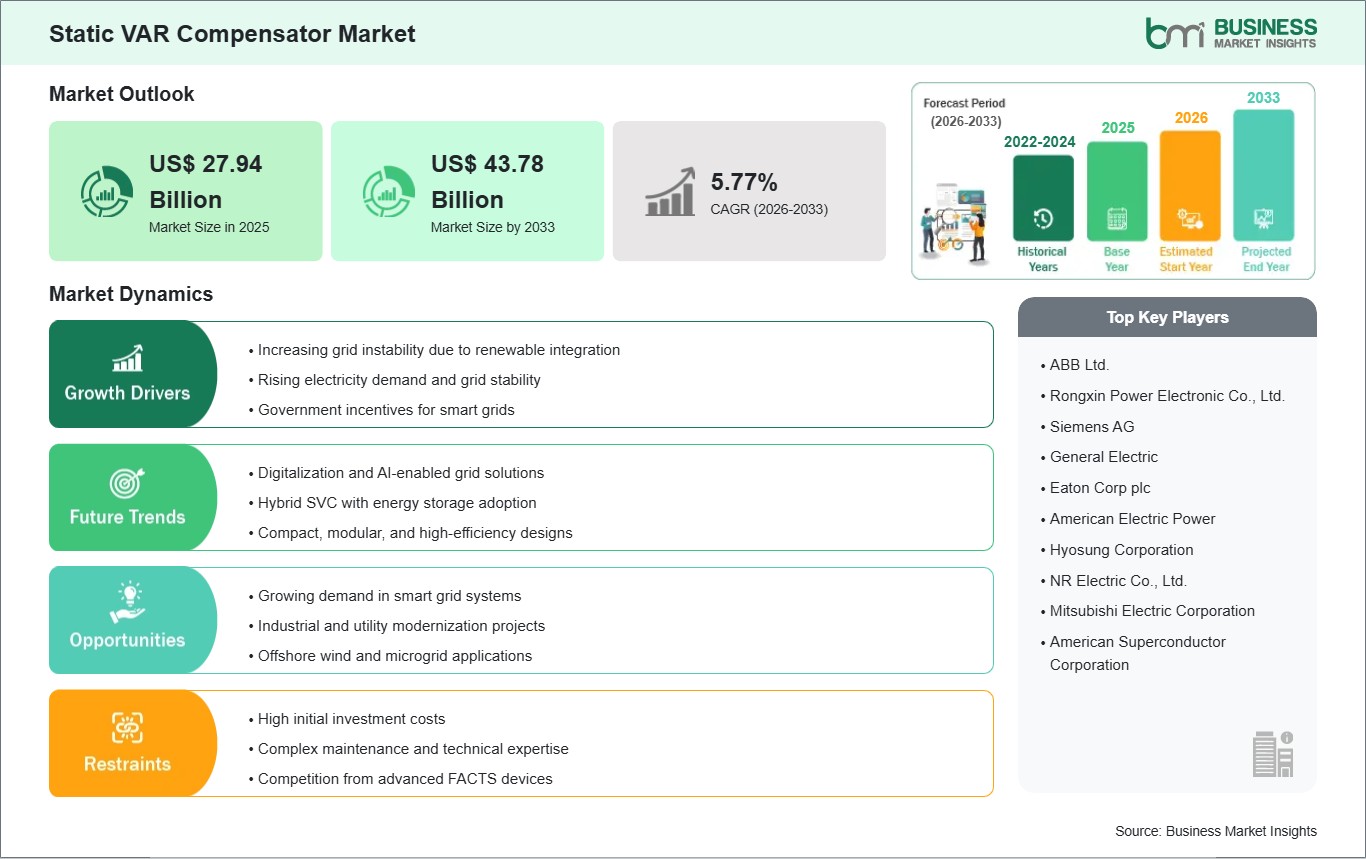
The global static VAR compensator (SVC) market is experiencing significant growth as power utilities and industrial sectors focus on improving grid stability, voltage regulation, and reactive power management. SVCs are essential devices in electrical power systems that dynamically control reactive power, reduce transmission losses, and enhance system reliability. They are widely used in high-voltage transmission networks, renewable energy integration, heavy industrial plants, and urban power distribution systems to maintain voltage stability and prevent grid disturbances. Technological advancements are driving market development, with modern SVC systems incorporating thyristor-controlled reactors, capacitors, and advanced control algorithms to optimize reactive power compensation in real-time. Integration with digital monitoring systems, SCADA platforms, and IoT-enabled energy management tools allows operators to enhance grid performance, predict potential voltage fluctuations, and minimize downtime.
Market growth is supported by increasing investments in renewable energy, smart grid deployment, and modernization of aging power infrastructure globally. Industrial sectors with high inductive loads, such as steel, cement, and chemical plants, are adopting SVCs to improve power quality and operational efficiency. Government initiatives targeting grid stability, energy efficiency, and integration of wind and solar power into transmission networks are further fueling adoption. Overall, the SVC market is evolving toward highly efficient, automated, and digitally integrated solutions for modern power systems.
Segment Analysis
Static VAR Compensator Market Segmentation
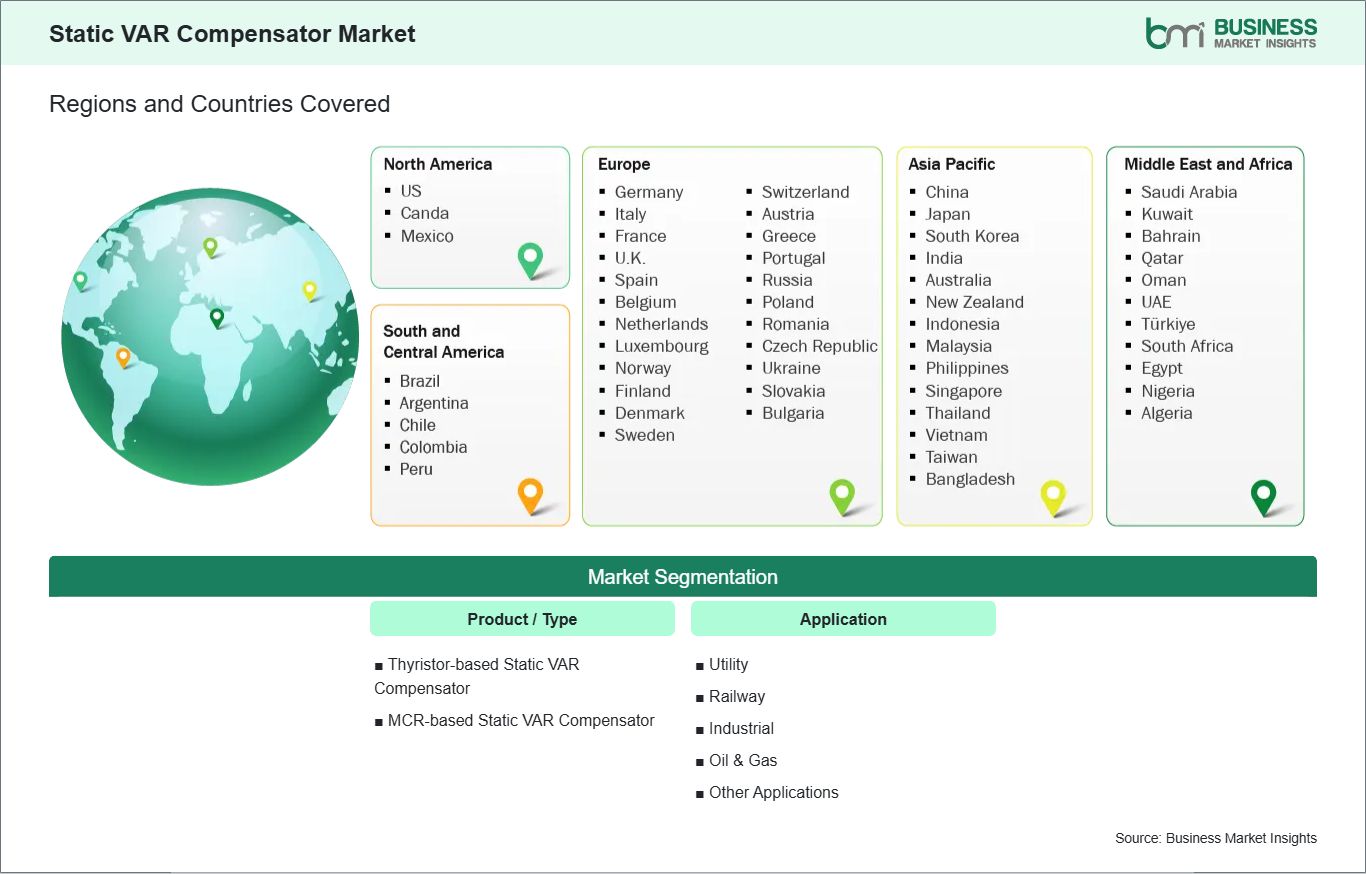
Key segments that contributed to the derivation of the Static VAR Compensator market analysis are product/type and application.
- Product / Type, the Static VAR Compensator market is segmented into thyristor‑based static var compensator and mcr‑based static var compensator. The thyristor‑based segment dominated the market in 2025.
- Application, the Static VAR Compensator market is categorized into utility, railway, industrial, oil & gas, and others. The utility segment dominated the market in 2025.
Market Forces
Static VAR Compensator Market Drivers and Opportunities
Increasing grid instability due to renewable integration
The global Static VAR Compensator market is witnessing growth as grid operators worldwide struggle with voltage instability triggered by higher shares of renewable energy sources. Renewables such as solar and wind introduce rapid fluctuations in generation levels, causing imbalance between reactive and active power on transmission networks. SVC systems are increasingly deployed to dynamically regulate voltage and maintain power quality, helping to prevent disturbances that can lead to outages or equipment stress. This trend is a core driver for utilities and grid planners prioritizing grid stability. Advances in renewable deployment have highlighted limitations of traditional fixed reactive power compensation devices. In response, grid planners are integrating fast‑acting SVCs that adjust in real time to changing conditions. These dynamic compensators reduce the impact of intermittent generation, enabling power networks to adapt without sacrificing reliability. As renewable capacities continue to increase on a global scale, demand for SVC solutions that support grid robustness is expected to grow accordingly.
Furthermore, power quality requirements from industrial customers and critical infrastructure sectors are driving investments in reactive power support. Industries reliant on sensitive electronic equipment demand stable voltage profiles, while critical facilities such as data centers and hospitals require uninterrupted power quality. The combination of these factors reinforces the importance of SVC installations in a power landscape with high renewable penetration and evolving reliability expectations.
Growing demand in smart grid systems
The global transition toward smart grid systems is fueling demand for Static VAR Compensators as part of comprehensive grid modernization strategies. Smart grids incorporate advanced sensing, communication, and control technologies to optimize electricity flow and improve reliability. In these digital grid environments, SVCs function as key assets that provide real‑time reactive power control, enhance voltage regulation, and support automated grid operations. Their rapid response capabilities make them well‑suited for integration into intelligent network management platforms. Smart grid deployments emphasize automated monitoring and distributed control features, which rely on dynamic compensators to stabilize voltage fluctuations caused by rapidly changing load patterns and distributed energy resources. With automated dispatch and control algorithms guiding reactive power adjustments, SVCs help ensure stable power delivery even as electrical networks become more complex. The interoperability of these systems with grid management software enhances visibility and operational flexibility at a global scale.
In addition, predictive maintenance and asset optimization strategies within smart grids are increasing the value proposition for SVC technologies. By integrating sensors and diagnostics, grid operators can anticipate performance issues and maintain optimal reactive support levels throughout the network. This shift toward data‑driven grid operations reinforces the role of SVCs not only as stabilization tools but also as critical components of a digital, efficient, and resilient power infrastructure.
Size and Share Analysis
Static VAR Compensator Market Size and Share Analysis
The Static VAR Compensator Market demonstrates steady growth, with size and share analysis highlighting evolving trends and competitive dynamics among key players. The report examines subsegments categorized within product/type and application, offering insights into their contribution to overall market performance.
Product / Type, the thyristor‑based static var Compensator subsegment dominated the market in 2025, driven by high efficiency, flexibility in reactive power compensation, and widespread adoption in modern power transmission networks.
In terms of Application, the utility subsegment dominated the market in 2025, driven by growing electricity demand, grid modernization projects, and the need to maintain voltage stability in transmission and distribution networks.
Report Coverage
Static VAR Compensator Market Report Coverage and Deliverables
The "Static VAR Compensator Market Size and Forecast (2022 - 2033)" report provides a detailed analysis of the market covering below areas:
- Static VAR Compensator Market size and forecast at global, regional, and country levels for all the key market segments covered under the scope
- Static VAR Compensator Market trends, as well as drivers, restraints, and opportunities
- Static VAR Compensator Market analysis covering key trends, global and regional framework, major players, regulations, and recent developments
- Industry landscape and competition analysis covering market concentration, heat map analysis, prominent players, and recent developments for the Static VAR Compensator Market
- Detailed company profiles, including SWOT analysis
Geographic Insights
Static VAR Compensator Market Geographic Insights
The geographical scope of the Static VAR Compensator Market report is divided into North America, Asia Pacific, Europe, Middle East & Africa, and South & Central America. North America held the largest share in 2025.
Regional adoption of SVC systems is influenced by grid infrastructure modernization, renewable energy integration, and industrial electricity demand. North America dominates the market, with the United States and Canada leading in deploying SVCs across transmission networks and heavy industrial plants. High investments in smart grids, renewable energy integration, and voltage stability projects are key drivers for adoption. Asia Pacific is a high-growth region due to rapid urbanization, industrial expansion, and large-scale renewable energy projects.
China, India, Japan, and South Korea are implementing SVC systems to manage voltage fluctuations in power grids, stabilize wind and solar power output, and reduce transmission losses in high-load urban and industrial areas. Europe focuses on grid reliability and renewable integration, with Germany, France, and the United Kingdom investing in SVC solutions for urban power networks, industrial parks, and high-voltage transmission lines.
Advanced control technologies and regulatory incentives are driving adoption in the region. Middle East & Africa is gradually deploying SVCs to support industrial electrification, oil and gas operations, and growing urban power demands, particularly in the UAE, Saudi Arabia, and South Africa. South & Central America is expanding SVC deployment in power transmission and industrial sectors, with Brazil, Mexico, and Chile investing in reactive power compensation to improve grid stability and support increasing renewable energy penetration.
Industry Activity
Recent Developments
The Static VAR Compensator Market is evaluated by gathering qualitative and quantitative data post primary and secondary research, which includes important corporate publications, association data, and databases. A few of the key developments in the spatial light Modulator market are:
- In January 2026, Hyosung Heavy Industries signed an MOU with Germany’s Skeleton Technologies and Japan’s Marubeni Corporation to co‑develop an advanced e‑STATCOM platform (next‑generation static compensator systems), combining Hyosung’s power‑electronics tech with ultra‑fast supercapacitor solutions for global power‑grid applications.
- In December 2025, Siemens Energy progressed construction of a next‑generation E‑STATCOM system (enhanced reactive power compensator leveraging supercapacitors) in Germany, entering its final testing phase ahead of commercial operation to support voltage and frequency stability on the grid.
Trust & Transparency
Research Methodology
The market analysis combines proprietary research with secondary data from government agencies, company disclosures, regulatory filings, industry databases and expert interviews. Market estimates are validated through data triangulation, cross-market benchmarking and analyst
review.
View Full Research Methodology
Key Sources Referred:
World Health Organization (WHO) Organisation for Economic Cooperation and Development (OECD) The World Bank Group Worldometer The Lancet International Bar Association International Trade Administration