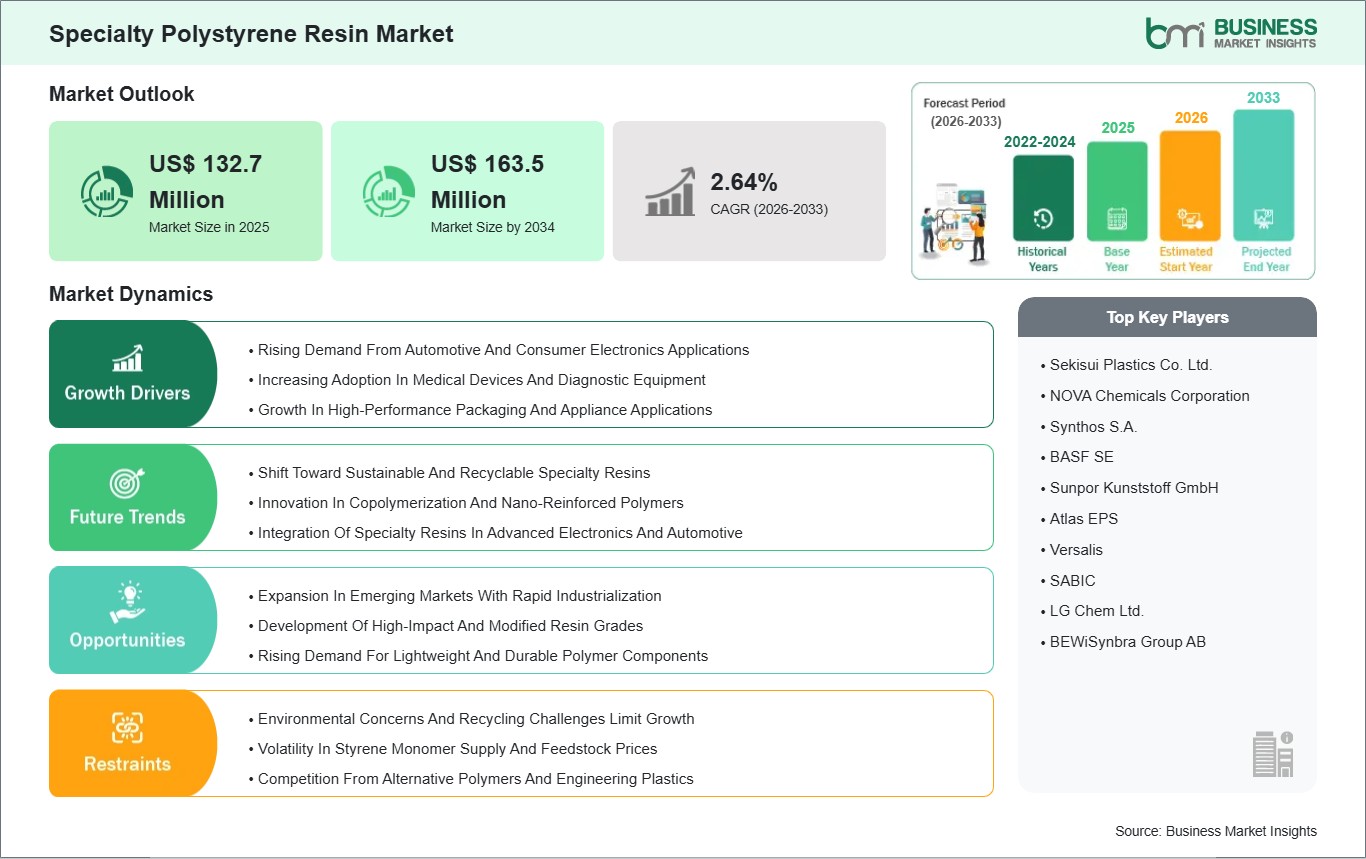
The Specialty Polystyrene Resin Market size is expected to reach US$ 163.5 million by 2033 from US$ 132.7 million in 2025. The market is estimated to record a CAGR of 2.64% from 2026 to 2033.
Advanced applications that require superior performance beyond standard polystyrene performance capabilities use global specialty polystyrene resin market research, which demonstrates its wide range of applications. High-impact polystyrene (HIPS) and modified polystyrene variants and copolymer blends create specialty polystyrene resins which provide improved mechanical strength, impact resistance and thermal stability and aesthetic properties. The specially designed properties of these materials serve essential functions across multiple industries including consumer electronics, medical devices, automotive components, appliances and premium packaging solutions. Specialty formulations achieve precise performance requirements through their combination of materials, which provides engineered products with exacting durability and aesthetic and operational capabilities that surpass basic packaging needs of commodity polystyrene.
The growing need for superior materials that combine performance with cost efficiency in customer industries drives the global specialty polystyrene resin market. Specialty polystyrene resins find application in the electronics industry through their use in housings, connectors and insulation components, which require precise dimensional stability and surface finish qualities. The automotive sector employs impact-modified polystyrene grades to manufacture interior and exterior trim components, which need to endure different loading conditions and changing environmental factors. Diagnostic equipment and device housings selected specialty resins because they needed materials that would deliver reliable performance with processing ease. The market experiences strong demand yet encounters crucial limitations that restrict its growth.
In multiple areas European and Asian Pacific regions face environmental problems and regulatory controls that impact their styrene monomers and polystyrene recycling procedures. The industry has engaged in a discussion about end-of-life management and recycling pathways for polystyrene products because stakeholders demand sustainable and circular solutions. The chemical industry faces a substitution threat from engineering plastics and polypropylene as they deliver superior performance in certain applications. Specialty resin manufacturers experience feedstock cost fluctuations and supply chain interruptions, which impact their pricing and product availability. The development of new polymer modification methods, which include blending and nano-reinforcement and copolymerization methods allows researchers to use specialty polystyrene resins in new fields of study.
The manufacturers are working to enhance their mechanical properties, aesthetic adaptability and processing efficiency to meet the new requirements that have emerged in their industry. The specialty polystyrene resin market operates as an active market within the overall plastics industry because performance needs and industrial growth, and material science innovations create new business opportunities.

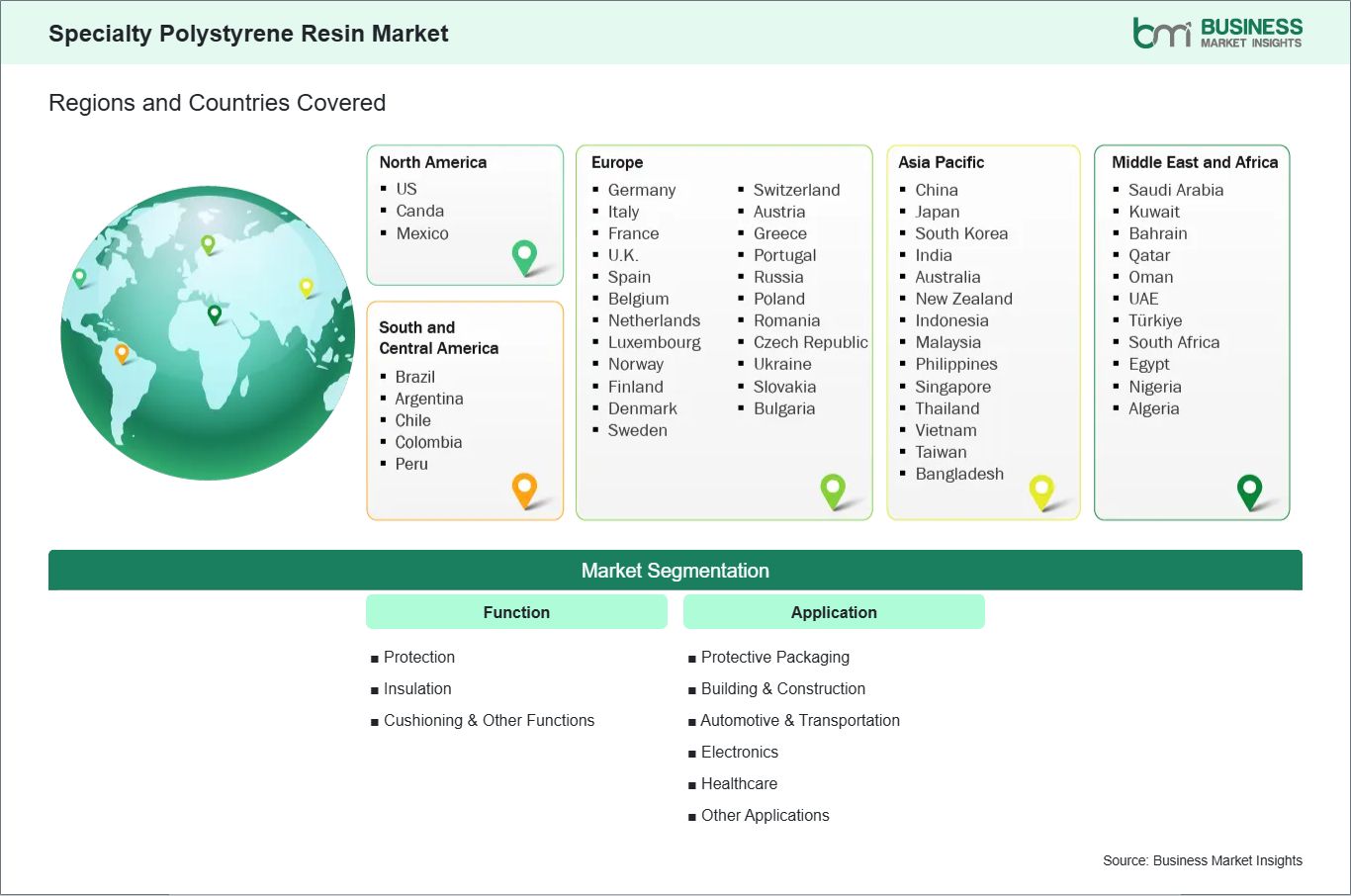
Key segments that contributed to the derivation of the specialty polystyrene resin market analysis are function and application.
The specialty polystyrene resin market is significantly driven by rising demand in the automotive and consumer electronics sectors, where performance, aesthetic appeal, and cost‑efficiency are essential. In automotive manufacturing, specialty grades such as high‑impact polystyrene and modified copolymers are increasingly used for interior trims, instrument panels, and non‑structural exterior components. These resins provide reliable impact strength and dimensional stability under variable temperatures, meeting automakers’ requirements for lightweight and durable materials. Regions like North America and Europe, with established automotive industries, are leading adopters, while Asia Pacific`s rapidly expanding production capacity strengthens global demand for specialized resin grades.
Consumer electronics also contribute prominently to specialty resin consumption. Device housings, bezels, and internal structural elements benefit from polystyrene`s ease of molding, surface finish quality, and compatibility with coatings and adhesives. Manufacturers in China, Japan, and South Korea — global electronics hubs — specify tailored polystyrene formulations to achieve precise mechanical and aesthetic performance. This trend extends to North American and European OEMs prioritizing lightweight, cost‑effective materials that support sleek product designs and robust functionality.
Emerging markets are becoming pivotal to the global specialty polystyrene resin landscape as industrialization and manufacturing expansion accelerate across Asia Pacific, Latin America, and parts of the Middle East. In Asia Pacific, countries such as India, Indonesia, and Vietnam are investing heavily in automotive assembly, consumer appliances, and electronics manufacturing. These sectors increasingly incorporate specialty polystyrene resins into components requiring consistent quality and performance. Local manufacturers are responding by upgrading material specifications and partnering with resin suppliers to secure tailored formulations that support product competitiveness and compliance with international quality standards.
Latin America`s automotive, consumer goods, and packaging industries are also contributing to resin demand. Brazil and Mexico, in particular, are expanding their industrial bases, with domestic manufacturers intensifying the use of polystyrene resins in molded consumer products, electrical enclosures, and durable goods. As these economies invest in infrastructure and technical expertise, the region`s appetite for specialty polymers that enhance product performance and reduce production costs continues to grow. Resin producers are strengthening distribution and technical support networks to capture this rising demand and enhance regional supply resilience.

The specialty polystyrene resin market demonstrates steady growth, with size and share analysis highlighting evolving trends and competitive dynamics among key players. The report examines subsegments categorized within function and application, offering insights into their contribution to overall market performance.
By function, the protection subsegment dominated the market in 2025, driven by high demand for impact-resistant and protective materials in packaging, electronics, and consumer goods.
Based on application, the protective packaging subsegment dominated the market in 2025, driven by the extensive use of specialty polystyrene resins in cushioning and shock-absorbing packaging solutions for fragile and high-value products.
| Report Attribute | Details |
|---|---|
| Market size in 2025 | US$ 132.7 Million |
| Market Size by 2034 | US$ 163.5 Million |
| Global CAGR (2026 - 2033) | 2.64% |
| Historical Data | 2022-2024 |
| Forecast period | 2026-2033 |
| Segments Covered | By Function
|
|
Regions and Countries Covered
| |
| North America | US, Canada, Mexico |
| Europe | Belgium, Austria, Finland, Denmark, Greece, Poland, Romania, Russia, Ukraine, Czech Republic, Slovakia, Bulgaria, Italy, Luxembourg, Germany, Switzerland, France, Netherlands, Norway, Portugal, Spain, Sweden, United Kingdom |
| Asia-Pacific | Australia, China, India, Japan, South Korea, Indonesia, Malaysia, Philippines, Singapore, Thailand, Vietnam, Bangladesh, New Zealand, Taiwan |
| South and Central America | Brazil, Argentina, Peru, Chile, Colombia |
| Middle East and Africa | Bahrain, Kuwait, Oman, Qatar, Saudi Arabia, United Arab Emirates, Turkiye, South Africa, Egypt, Algeria, Nigeria |
| Market leaders and key company profiles |
|
The "Specialty Polystyrene Resin Market Size and Forecast (2022 - 2033)" report provides a detailed analysis of the market covering below areas:
The geographical scope of the Specialty Polystyrene Resin Market report is divided into North America, Asia Pacific, Europe, Middle East & Africa, and South & Central America. North America held the largest share in 2025.
North America controls the worldwide specialty polystyrene resin market because its established industries, modern production systems and strong need for advanced polymers in automotive, electronics and healthcare and consumer goods markets. The United States leads in the adoption of impact-modified, high-clarity, and copolymer polystyrene resins for applications such as automotive interior trims, appliance housings, diagnostic equipment, and electronic enclosures, where these materials achieve optimal performance through their specific dimensional stability, surface finish and mechanical properties. The region's strong research and development capabilities enable manufacturers to create unique resin products that satisfy changing industrial demands, thus maintaining North America's dominant position. In Asia Pacific, rapid industrialization, urbanization, and expanding electronics, automotive, and packaging industries drive specialty polystyrene resin consumption, particularly in China, Japan, South Korea, and India. The region's manufacturers now use high-performance grades because customers increasingly want products that are both durable and visually appealing and fully functional. Europe operates as a developed market which enforces strict quality standards and environmental protection laws while Germany, France and Italy require sustainable material sourcing and recycling practices and specialty resin usage in their automotive, electronics and healthcare fields to achieve regulatory compliance. The Middle East and Africa market is developing as customers seek specialized resins that improve product durability and manufacturing efficiency for building materials, consumer items and industrial production, although the region's market development lags behind established markets. Brazil and Mexico, together with South and Central America, will expand their use of specialty polystyrene resin through its application in automotive manufacturing, packaging production and electronics manufacturing, which will become possible due to their increasing industrial capabilities and urban development activities. The North American region maintains its market leadership through its technological capabilities and complete supply chain networks, and its adoption of applications that require advanced performance, while both Asia Pacific and Europe experience growth through their industrial development and new innovations that emerge from their regulatory framework, which creates new business prospects for the Middle East and Africa and South and Central America regions.

The Specialty Polystyrene Resin Market is evaluated by gathering qualitative and quantitative data post primary and secondary research, which includes important corporate publications, association data, and databases. A few of the key developments in the specialty polystyrene resin market are:
The Specialty Polystyrene Resin Market is valued at US$ 132.7 Million in 2025, it is projected to reach US$ 163.5 Million by 2034.
As per our report Specialty Polystyrene Resin Market, the market size is valued at US$ 132.7 Million in 2025, projecting it to reach US$ 163.5 Million by 2034. This translates to a CAGR of approximately 2.64% during the forecast period.
The Specialty Polystyrene Resin Market report typically cover these key segments-
The historic period, base year, and forecast period can vary slightly depending on the specific market research report. However, for the Specialty Polystyrene Resin Market report:
The Specialty Polystyrene Resin Market is populated by several key players, each contributing to its growth and innovation. Some of the major players include:
The Specialty Polystyrene Resin Market report is valuable for diverse stakeholders, including:
Essentially, anyone involved in or considering involvement in the Specialty Polystyrene Resin Market value chain can benefit from the information contained in a comprehensive market report.
Please tell us your area of interest
(Market Segments/ Regions and Countries/ Companies)