Market Summary
Executive Summary and Global Market Analysis
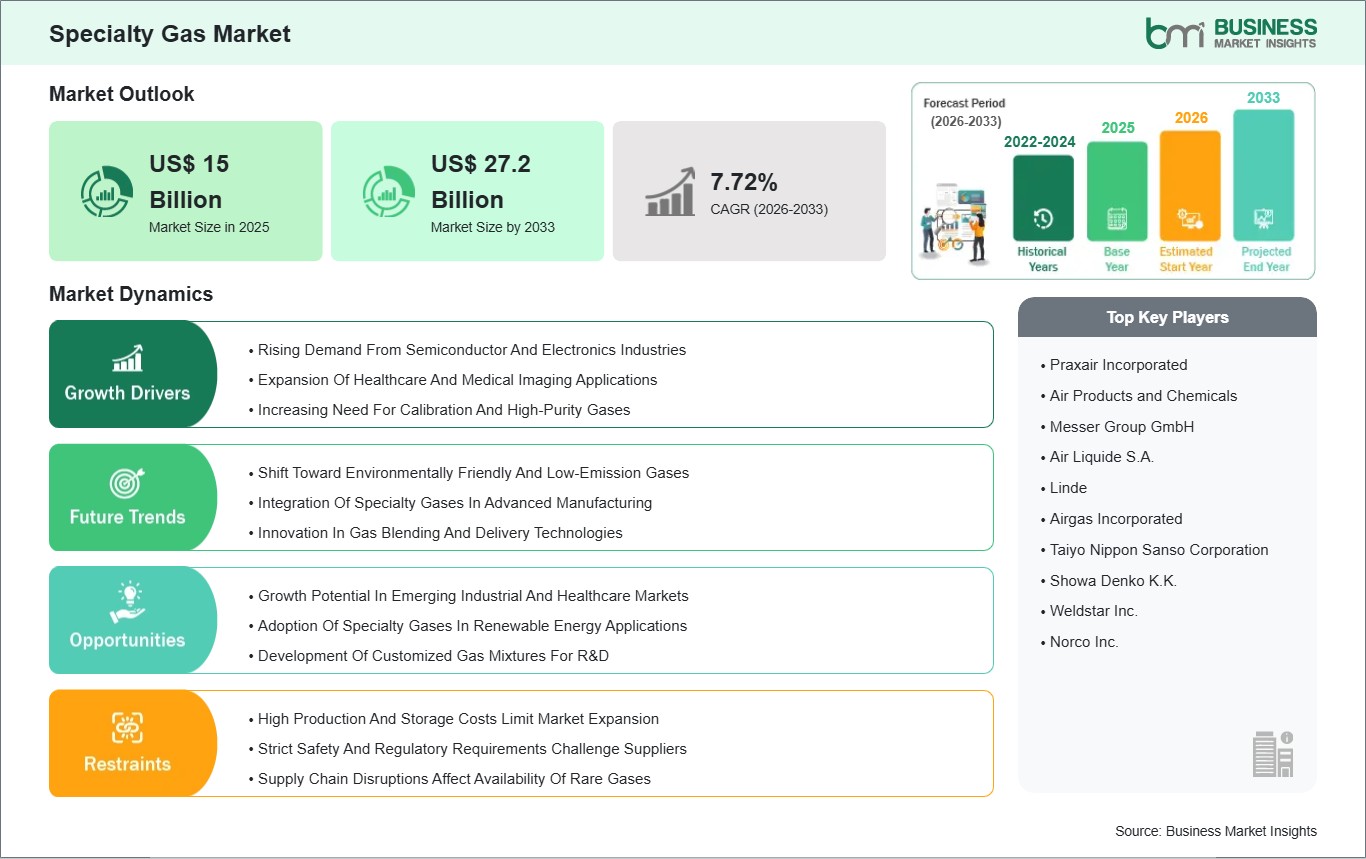
The global specialty gas market encompasses a diverse range of high‑purity, ultra‑high‑purity, and specialty gas mixtures designed for precise applications in critical industries such as healthcare, electronics, chemicals, energy, research, and manufacturing. Specialty gases including calibration gases, medical gases, high‑purity industrial gases, rare gases, and gas mixtures are engineered to stringent quality standards, often tailored to specific end‑use environments where ordinary industrial gases cannot meet performance, purity, and reliability requirements. These gases serve essential roles in semiconductor fabrication, analytical laboratories, pharmaceutical synthesis, PET imaging, leak detection, and environmental monitoring, making them indispensable in the modern technological ecosystem. A primary driver for the global specialty gas market is the rapid proliferation of advanced manufacturing and high‑technology industries worldwide.
For instance, the semiconductor sector`s move toward smaller process nodes and more complex architectures has heightened the demand for ultra‑purity gases used in lithography, etching, and deposition processes. Similarly, the healthcare sector`s expanding use of medical imaging, respiratory therapies, and specialty surgical procedures has stimulated demand for medical grade oxygen, nitrous oxide, and anesthesia mixtures that adhere to strict quality benchmarks. Additionally, specialty gases are critical in environmental monitoring and calibration systems, where precise gas mixtures support air quality assessments, emissions tracking, and regulatory compliance, reinforcing their strategic importance in public health and environmental governance.
Despite robust demand, the market faces certain restraints. The production and handling of specialty gases require significant technical expertise, specialized containment infrastructure, and stringent safety protocols. Purification, blending, and quality assurance processes are capital‑intensive and must align with complex regulatory frameworks governing transportation, storage, and end‑use safety, especially for toxic, flammable, or corrosive gases. Supply chain disruptions in rare gases or precursor chemicals can also introduce volatility in availability and pricing, particularly in regions dependent on imports.
Furthermore, regulatory landscapes related to greenhouse gas emissions and industrial safety can both restrict and reshape market dynamics, requiring producers to invest in cleaner production methods, leak mitigation technologies, and compliant distribution networks. Nonetheless, ongoing technological advancement and cross‑industry integration continue to expand the role of specialty gases. Their indispensable role in cutting‑edge industries makes them a cornerstone of global industrial and scientific progress.
Segment Analysis
Specialty Gas Market Segmentation
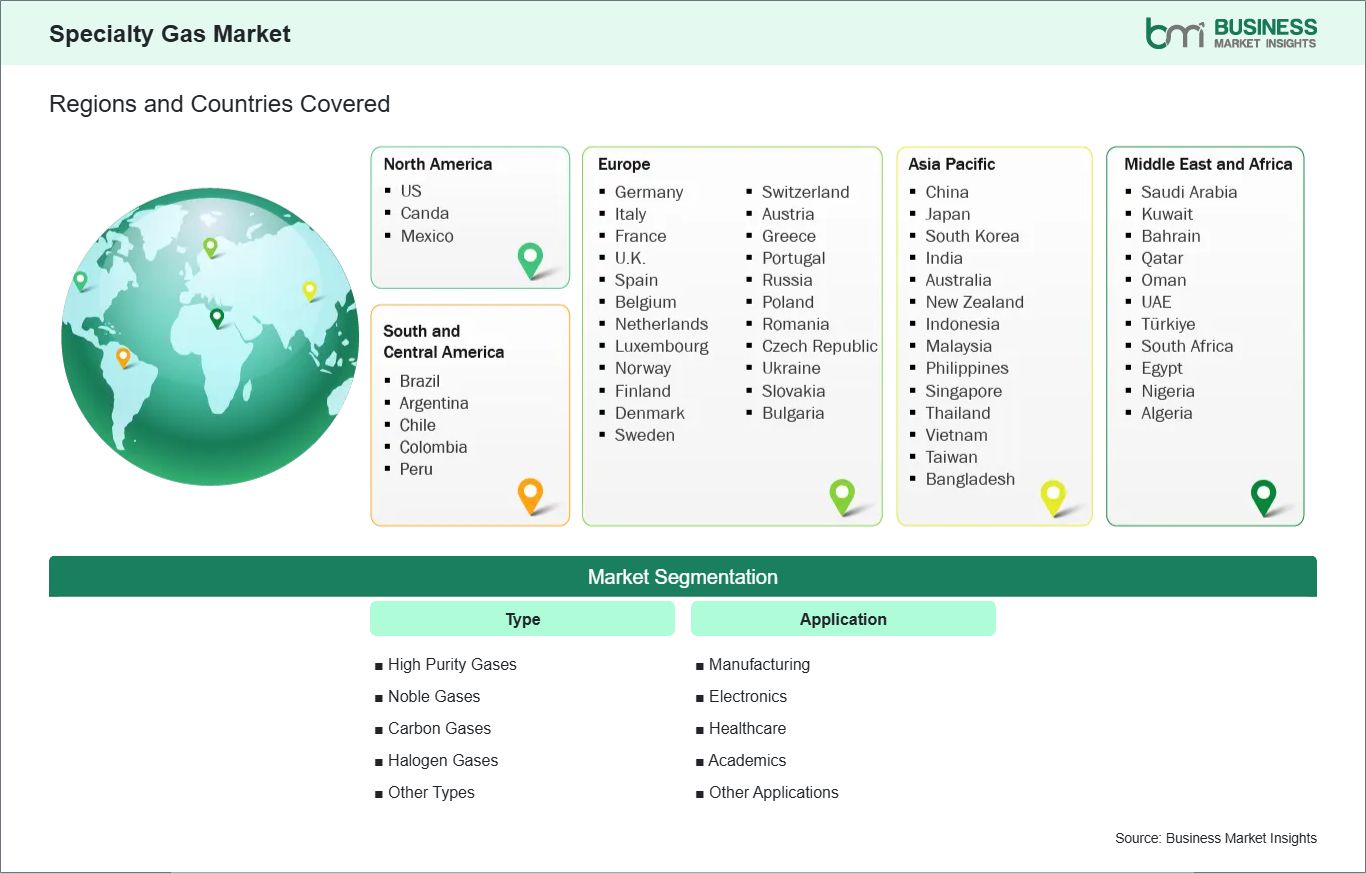
Key segments that contributed to the derivation of the specialty gas market analysis are type and application.
- By type, the specialty gas market is segmented into high purity gases, noble gases, carbon gases, halogen gases, other types. The carbon gases segment dominated the market in 2025.
- Based on application, the specialty gas market is categorized into manufacturing, electronics, healthcare, academics, other applications. The healthcare segment dominated the market in 2025.
Market Forces
Specialty Gas Market Drivers and Opportunities
Rising Demand From Semiconductor And Electronics Industries
The specialty gas market is expanding because semiconductor and electronics industries are increasing their need for specialized gases. High-purity gases, which include nitrogen, argon and silane and specialty gas mixtures function as essential materials for semiconductor fabrication processes which require deposition and etching and wafer cleaning. Manufacturers in North America, Japan and South Korea are increasingly using ultra-high-purity gases to develop next-generation chips which require smaller process nodes and greater complexity. The industry requires precise gas composition control which results in operational reliability and product quality for electronics assembly, LED production and display technologies.
Specialty gases have become more essential for research and development work because the world demands better electronics and digital technologies. Semiconductor foundries need consistent and dependable gas supplies that help them sustain their production output and decrease product defects. Production yields suffer when high-purity gas supply faces interruptions because reliable suppliers hold strategic value for operations. The market development continues to advance because electronics testing, calibration and quality assurance procedures need specialty gases.
The electronics industry requires specialized gases because it develops flexible displays, 5G devices and IoT-enabled components. Manufacturers are developing customized gas blends to achieve specific chemical reactions and material deposition which creates new business opportunities for suppliers to create innovative solutions. The growing semiconductor infrastructure investments across North America Europe and Asia Pacific maintain a direct connection between specialty gas market development and global electronic semiconductor production growth which establishes the market as essential for high-tech industrial progress.
Growth Potential In Emerging Industrial And Healthcare Markets
Specialty gases worldwide find great potential to expand their market reach through new industrial sectors and healthcare markets. Industrial processes rely on gases like carbon dioxide and oxygen together with specialized gas mixtures for manufacturing metal products, conducting welding operations and performing chemical reactions and handling food and beverages. High-purity and specialty gas adoption has increased across Asia Pacific, South America and the Middle East because these regions experience rapid industrial growth, which needs these gases for efficient production processes and high-quality product outcomes. Industrial users increasingly prefer gases with precise composition and traceable standards to meet both production and regulatory requirements.
The healthcare and pharmaceutical industries are major contributors to specialty gas consumption. Medical gases such as oxygen and nitrous oxide, and specialty anesthetic mixtures play crucial roles in patient treatment and surgical operations and diagnostic imaging procedures. Emerging economies develop their hospital infrastructure while they allocate funds for advanced imaging technologies such as MRI and PET-CT scans, which increases the need for specialty gases. Pharmaceutical manufacturing uses specialty gases for three purposes, which include maintaining controlled environments, conducting chemical synthesis and operating analytical instruments.
The global market demand for products exists because laboratory research and biotechnology fields continue to develop new technological solutions. Research institutes, universities and private laboratories around the world increasingly use gas chromatography, mass spectrometry and analytical testing which requires specialty gases as their essential component. The specialty gas market expands because developing regions industrial and healthcare sectors require these gases, which suppliers fulfill through their ability to provide locally produced gases and technical assistance with customized gas solutions.
Size and Share Analysis
Specialty Gas Market Size and Share Analysis
The specialty gas market demonstrates steady growth, with size and share analysis highlighting evolving trends and competitive dynamics among key players. The report examines subsegments categorized within type and application, offering insights into their contribution to overall market performance.
By type, the carbon gases subsegment dominated the market in 2025, driven by their extensive use in industrial processes, food & beverage carbonation, welding, and chemical manufacturing.
Based on application, the healthcare subsegment dominated the market in 2025, driven by the critical demand for medical gases like oxygen, nitrous oxide, and medical air in hospitals, clinics, and emergency care worldwide.
Report Coverage
Specialty Gas Market Report Coverage and Deliverables
The "Specialty Gas Market Size and Forecast (2022 - 2033)" report provides a detailed analysis of the market covering below areas:
- Specialty Gas Market size and forecast at global, regional, and country levels for all the key market segments covered under the scope
- Specialty Gas Market trends, as well as drivers, restraints, and opportunities
- Specialty Gas Market analysis covering key trends, global and regional framework, major players, regulations, and recent developments
- Industry landscape and competition analysis covering market concentration, heat map analysis, prominent players, and recent developments for the Specialty Gas Market
- Detailed company profiles, including SWOT analysis
Geographic Insights
Specialty Gas Market Geographic Insights
The geographical scope of the Specialty Gas Market report is divided into North America, Asia Pacific, Europe, Middle East & Africa, and South & Central America. North America held the largest share in 2025.
North America leads the worldwide specialty gas market because its industrial facilities have reached full development, and its semiconductor and electronics manufacturing industries and its healthcare and research sectors maintain strong growth. The United States functions as a primary center for producing high-purity gases, which semiconductor fabrication facilities, medical centers and analytical laboratories need to obtain ultra-high-purity and calibration gases for their specialized functions. Industrial facilities, medical establishments and environmental monitoring systems use specialty gases because of strong safety regulations, quality control standards and environmental protection requirements.
The Asia Pacific region experiences economic expansion because of its fast industrial development, growing electronics and chemical production and rising healthcare expenditures with China, Japan and South Korea and India becoming important markets for high-purity gases used in industrial and medical applications.
Europe has established itself as a developed market which uses specialty gases extensively in advanced manufacturing and pharmaceutical production and research activities particularly in Germany, France and the UK where strict quality regulations and environmental standards drive the need for calibration gases and specialty gas mixtures.
The Middle East and Africa region is experiencing increased demand from the oil and gas, petrochemical and refining sectors because Saudi Arabia, the UAE and South Africa are starting to use specialty gases for their analytical, industrial and healthcare needs while they develop their infrastructure and technical skills.
In South & Central America, countries such as Brazil and Mexico are expanding industrial and healthcare sectors, creating incremental demand for specialty gases in applications such as medical oxygen, laboratory testing, and food-grade gases, although market penetration is still developing compared to North America.
The regional dynamics show North America as the leading region for technology adoption and innovative development, while Asia Pacific and Europe proceed to develop their industrial sectors and technological systems, and the Middle East, Africa, and South & Central America emerge as new markets that will drive specialty gas growth across various industrial sectors.
Industry Activity
Recent Developments
The Specialty Gas Market is evaluated by gathering qualitative and quantitative data post primary and secondary research, which includes important corporate publications, association data, and databases. A few of the key developments in the specialty gas market are:
- In May 2024, Tyczka Air Gases GmbH announced that it had opened a modern specialty gases production plant in Würzburg, Germany, enabling the company to produce pure gases and gas mixtures (including pure and calibration specialty gases) from its own filling facilities, enhancing flexibility and responsiveness to customer requirements across Europe.
- In February 2026, Inhance Technologies announced that it had begun offering a new U.S.‑based supply of packaged fluorine and fluorine gas mixtures from its Catoosa, Oklahoma facility, expanding domestic availability of specialty fluorine gases and custom gas blends for semiconductor, pharmaceutical, industrial, and specialty chemical applications. This development follows strategic investments in the site to broaden specialty gas capabilities and strengthen supply chain resilience.
Trust & Transparency
Research Methodology
The market analysis combines proprietary research with secondary data from government agencies, company disclosures, regulatory filings, industry databases and expert interviews. Market estimates are validated through data triangulation, cross-market benchmarking and analyst
review.
View Full Research Methodology
Key Sources Referred:
World Health Organization (WHO) Organisation for Economic Cooperation and Development (OECD) The World Bank Group Worldometer The Lancet International Bar Association International Trade Administration