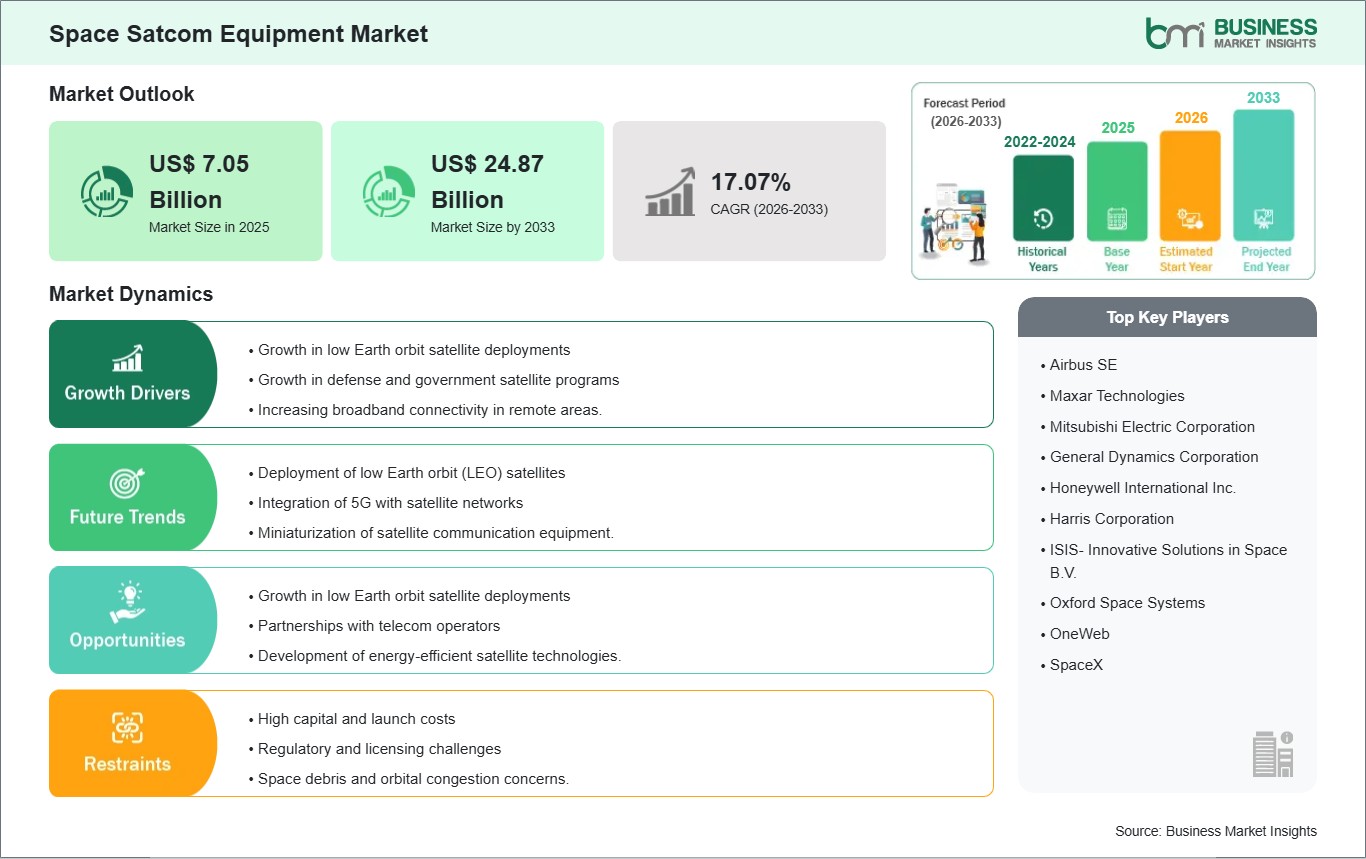
The Space Satcom Equipment Market size is expected to reach US$ 24.87 billion by 2033 from US$ 7.05 billion in 2025. The market is estimated to record a CAGR of 17.07% from 2026 to 2033.
The global space satellite communication (satcom) equipment market is advancing significantly due to the rising demand for high-throughput connectivity, real-time data transmission, and secure communication across commercial, defense, and government sectors. The increasing deployment of low Earth orbit (LEO) and medium Earth orbit (MEO) satellite constellations is reshaping infrastructure requirements, which creates a need for advanced ground equipment and phased-array antennas and compact user terminals.
The market participants are developing solutions that improve bandwidth utilization, enhance signal dependability and enable various network systems to work together through multiple orbital paths. Organizations now maintain satellite communication systems through software-defined networking and virtualization, which allows them to allocate system capacity in response to operational requirements. The combination of satellite communication systems with fifth-generation and upcoming sixth-generation systems is producing new development opportunities that benefit remote areas that lack basic services. The defense modernization programs create a rising demand for secure communication systems that can withstand jamming attacks. The competitive environment exists because satellite operators and equipment manufacturers, and telecom providers use strategic partnerships to create new innovations that extend their international business reach. The satcom equipment market will reach crucial importance because digital transformation efforts throughout the world require dependable high-speed communication systems.

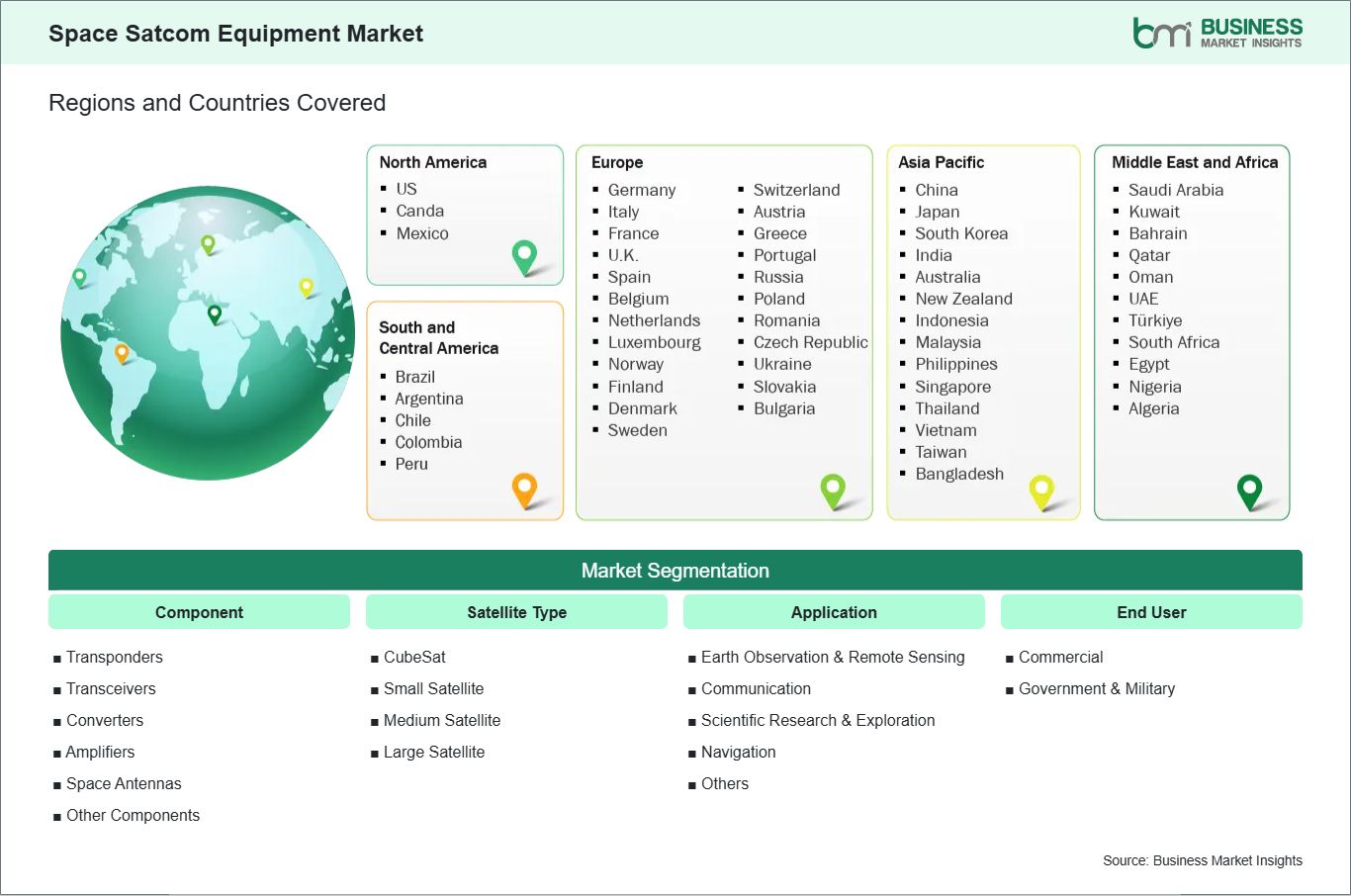
Key segments that contributed to the derivation of the space SATCOM equipment market analysis are component, satellite type, application, and end user.
The worldwide market for satellite communication equipment is experiencing strong growth because various industries need dependable satellite internet services that work without interruptions. The need for continuous communication in remote areas, maritime regions and aerial environments has increased because digital transformation is spreading across the globe. Satellite communication systems need antennas and transceivers, and modems to provide worldwide connectivity, which enables clients to access broadband services, navigation tools and real-time data services. The worldwide need for advanced satellite communication equipment has increased because more people depend on satellite-based communication systems. The expansion of data-intensive applications, such as video streaming, cloud services, and real-time analytics, is further increasing bandwidth requirements.
Satellite networks require advanced communication equipment to achieve their goal of increased data handling capacity. The system includes electronically steered antennas and high-frequency transceivers, which provide users with expedited network access and decreased latency according to current user requirements. Satellite communication has become essential for critical operations in defense and disaster management and the transportation industries. Organizations are investing in next-generation satellite communication systems because they require secure and dependable communication systems that operate continuously. The global market experiences ongoing growth because technological innovations and satellite connectivity remain essential for modern communication networks.
The rapid growth of low Earth orbit (LEO) satellite deployments is creating significant opportunities in the global space satcom equipment market. LEO satellites operate at lower altitudes, enabling reduced latency and improved data transmission speeds compared to traditional systems. This shift is driving demand for specialized ground equipment, including advanced tracking antennas and adaptive communication systems that can maintain connectivity with fast-moving satellite constellations. As LEO constellations expand, there is an increasing need for scalable and flexible satcom infrastructure capable of handling dynamic network architectures. Equipment manufacturers are developing solutions that support seamless handovers between satellites, ensuring continuous connectivity for users. These innovations are particularly important for applications such as broadband internet delivery, autonomous systems, and connected transportation, where uninterrupted communication is essential.
Moreover, advancements in miniaturization and software-defined technologies are enhancing the efficiency and performance of satcom equipment used in LEO networks. Software-defined radios, phased-array antennas, and integrated ground systems are enabling more agile and cost-effective communication solutions. This technological evolution is not only reducing deployment costs but also accelerating adoption, positioning LEO satellite expansion as a major growth catalyst in the global space satcom equipment market.
The space Satcom equipment market demonstrates steady growth, with size and share analysis highlighting evolving trends and competitive dynamics among key players. The report examines subsegments categorized within component, satellite type, application, and end user, offering insights into their contribution to overall market performance.
By Component, the transponders subsegment dominated the market in 2025, driven by their critical role in satellite communication payloads.
Based on Satellite Type, the small satellite subsegment dominated the market in 2025, owing to the rapid increase in LEO satellite constellations and reduced launch costs.
On the Basis of Application, the communication subsegment dominated the market in 2025, propelled by rising demand for broadband connectivity and secure satellite communications.
By End User, the government & military subsegment dominated the market in 2025, supported by strategic defense programs and national security satellite initiatives.
| Report Attribute | Details |
|---|---|
| Market size in 2025 | US$ 7.05 Billion |
| Market Size by 2033 | US$ 24.87 Billion |
| Global CAGR (2026 - 2033) | 17.07% |
| Historical Data | 2022-2024 |
| Forecast period | 2026-2033 |
| Segments Covered | By Component
|
|
Regions and Countries Covered
| |
| North America | US, Canada, Mexico |
| Europe | Belgium, Austria, Finland, Denmark, Greece, Poland, Romania, Russia, Ukraine, Czech Republic, Slovakia, Bulgaria, Italy, Luxembourg, Germany, Switzerland, France, Netherlands, Norway, Portugal, Spain, Sweden, United Kingdom |
| Asia-Pacific | Australia, China, India, Japan, South Korea, Indonesia, Malaysia, Philippines, Singapore, Thailand, Vietnam, Bangladesh, New Zealand, Taiwan |
| South and Central America | Brazil, Argentina, Peru, Chile, Colombia |
| Middle East and Africa | Bahrain, Kuwait, Oman, Qatar, Saudi Arabia, United Arab Emirates, Turkiye, South Africa, Egypt, Algeria, Nigeria |
| Market leaders and key company profiles |
|
The "Space Satcom Equipment Market Size and Forecast (2022 - 2033)" report provides a detailed analysis of the market covering below areas:
The geographical scope of the Space Satcom Equipment Market report is divided into North America, Asia Pacific, Europe, Middle East & Africa, and South & Central America. North America held the largest share in 2025.
North America dominates the space satcom equipment market, driven by strong investments in space technology, defense communication systems, and commercial satellite networks. The United States leads in the development and deployment of advanced satcom infrastructure, including next-generation ground stations and electronically steered antennas, supported by a robust ecosystem of private space companies and government agencies.
Asia Pacific is emerging as a high-growth region, with countries such as China, India, Japan, and South Korea investing heavily in satellite programs to enhance national connectivity, disaster management, and defense capabilities. Regional governments are promoting indigenous satellite manufacturing and ground equipment development to reduce dependency on external suppliers.
Europe focuses on collaborative space initiatives, regulatory harmonization, and technological innovation, with countries like Germany, France, and the UK emphasizing secure communication networks and integration with terrestrial telecom systems. Public-private partnerships are playing a key role in advancing satcom capabilities.
The Middle East and Africa are gradually expanding their satellite communication infrastructure to support remote connectivity, energy sector operations, and national security applications, particularly in geographically challenging areas.
South and Central America are witnessing steady adoption, with countries investing in satellite-based broadband and communication systems to bridge digital gaps and improve connectivity in rural and underserved regions.

The Space Satcom Equipment Market is evaluated by gathering qualitative and quantitative data post primary and secondary research, which includes important corporate publications, association data, and databases. A few of the key developments in the spatial light Modulator market are:
The Space Satcom Equipment Market is valued at US$ 7.05 Billion in 2025, it is projected to reach US$ 24.87 Billion by 2033.
As per our report Space Satcom Equipment Market, the market size is valued at US$ 7.05 Billion in 2025, projecting it to reach US$ 24.87 Billion by 2033. This translates to a CAGR of approximately 17.07% during the forecast period.
The Space Satcom Equipment Market report typically cover these key segments-
The historic period, base year, and forecast period can vary slightly depending on the specific market research report. However, for the Space Satcom Equipment Market report:
The Space Satcom Equipment Market is populated by several key players, each contributing to its growth and innovation. Some of the major players include:
The Space Satcom Equipment Market report is valuable for diverse stakeholders, including:
Essentially, anyone involved in or considering involvement in the Space Satcom Equipment Market value chain can benefit from the information contained in a comprehensive market report.
Please tell us your area of interest
(Market Segments/ Regions and Countries/ Companies)