Analysis - by Base Oil (Mineral Oil, Synthetic Oil, and Others), Product Type (Hydraulic Oil, Gear Oil, and Grease), and End Use Industry (Automotive, Food and Beverage, Medical and Healthcare, Electrical and Electronics, Metals, and Other Manufacturing Industries)
No. of Pages:120
Report Code:
BMIRE00028699
Category:
Chemicals and Materials
South & Central America Robotics Lubricants Market
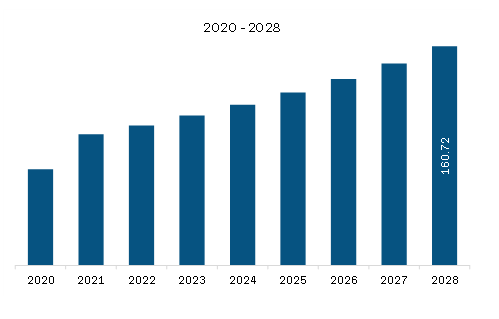
The South & Central America robotics lubricants market is expected to grow from US$ 102.62 million in 2022 to US$ 160.72 million by 2028. It is estimated to grow at a CAGR of 7.8% from 2022 to 2028.
Adoption of Synthetic Oil-Based Robotics Lubricants Drive South & Central America Robotics Lubricants Market
Synthetic oil-based robotics lubricants are widely used in industrial operations and the automotive sector, owing to their advantages. Polyalphaolefin lubricant is the most common synthetic oil utilized in robots in automotive and industrial sectors. It possesses optimum physical and chemical properties, such as high viscosity index, low volatility, low pour point, and thermal stability. The American Petroleum Institute (API) has categorized base oil into 5 groups. Group I, II and III are mineral oils, whereas group IV base oil is fully synthetic. Group IV base oils are high-quality oils used for high-performance applications and low-viscosity motor oils in technically advanced engines. Blending flexibility due to advancements in additive technology and growing fuel efficiency standards are some of the key factors that have the potential to boost sales of high-quality group III base synthetic lubricants. Synthetic lubricants are chemically modified and preferred over mineral oil. Robotics lubricant manufacturers prefer synthetic base oil to reduce dependency on nonrenewable resources such as petroleum and crude oil. Several robotics lubricant manufacturers are focused on research and development of synthetic lubricant formulations to provide improved oxidation stability. Further, advanced lubricants have a major role in reducing carbon emissions during the manufacturing process. In the past few years, end-use industries such as automotive and electrical & electronics have launched various initiatives and policies to reduce carbon footprint and carbon emissions, which is leading to the adoption of synthetic lubricants for robotics applications. Therefore, the adoption of synthetic oil-based robotic lubricants is expected to be a major trend in the South & Central America robotics lubricants market during the forecast period.
South & Central America Robotics Lubricants Market Overview
In the past few years, South & Central America has witnessed business potential for warehouse and manufacturing automation. For instance, in 2021, ABB Ltd announced its plan to develop SafeMove collaborative robot technology at the manufacturing facility of Nestle SA, Brazil. The company, in collaboration with Nestle SA’s engineering team, developed an ABB IRB 660 robot with SafeMove technology, aimed at improving productivity by 53%. According to the statistical yearbook released by the International Federation of Robotics 2022, robot installations in Brazil were registered at 1,702 units in 2021, with an average annual growth rate of 7% compared to 2016. Further, end-use industries prefer suitable lubrication systems to decrease the wear and tear of robotic components and reduce downtime. Thus, the key factors pertaining to the robotic industry in South & Central America are anticipated to boost the South & Central America robotics lubricants market during the forecast period.
South & Central America Robotics Lubricants Market Revenue and Forecast to 2028 (US$ Million)
South & Central America Robotics Lubricants Market Segmentation
The South & Central America robotics lubricants market is segmented into base oil, product type, end use industry, and country.
Based on base oil, the South & Central America robotics lubricants market is segmented into mineral oil, synthetic oil, and others. In 2022, the mineral oil segment registered a largest share in the South & Central America robotics lubricants market.
Based on product type, the South & Central America robotics lubricants market is segmented into hydraulic oil, gear oil, and grease. In 2022, the grease segment registered a largest share in the South & Central America robotics lubricants market.
Based on end use industry, the South & Central America robotics lubricants market is segmented into automotive, food and beverage, medical and healthcare, electrical and electronics, metals, and other manufacturing industries. In 2022, the automotive segment registered a largest share in the South & Central America robotics lubricants market.
Based on country, the South & Central America robotics lubricants market is segmented into Brazil, Argentina, and the Rest of South & Central America. In 2022, Brazil segment registered a largest share in the South & Central America robotics lubricants market.
BP Plc, Fuchs Petrolub SE, Idemitsu Kosan Co Ltd, Kluber Lubrication GmbH & Co KG, Schaeffler Austria GmbH, and Shell Plc are the leading companies operating in the South & Central America robotics lubricants market.
South & Central America Robotics Lubricants Market Strategic Insights
Get more information on this report
South & Central America Robotics Lubricants Market Segmentation Analysis
South & Central America Robotics Lubricants Market Report Highlights
South & Central America Robotics Lubricants Report Scope
Report Attribute
Details
Market size in 2022
US$ 102.62 Million
Market Size by 2028
US$ 160.72 Million
CAGR (2022 - 2028)
7.8%
Historical Data
2020-2021
Forecast period
2023-2028
Segments Covered
By Base Oil
Mineral Oil
Synthetic Oil
By Product Type
Hydraulic Oil
Gear Oil
Grease
By End Use Industry
Automotive
Food and Beverage
Medical and Healthcare
Electrical and Electronics
Metals
Other Manufacturing Industries
Regions and Countries Covered
South and Central America
Brazil, Argentina, Rest of South and Central America
Market leaders and key company profiles
BP Plc
Fuchs Petrolub SE
Idemitsu Kosan Co Ltd
Kluber Lubrication GmbH & Co KG
Schaeffler Austria GmbH
Shell Plc
Get more information on this report
South & Central America Robotics Lubricants Market Country and Regional Insights
Get more information on this report
Identical Market Reports with other Region/Countries
The List of Companies - South & Central America Robotics Lubricants Market
BP Plc Fuchs Petrolub SE Idemitsu Kosan Co Ltd Kluber Lubrication GmbH & Co KG Schaeffler Austria GmbH Shell Plc
Frequently Asked Questions
How big is the South & Central America Robotics Lubricants Market?
The South & Central America Robotics Lubricants Market is valued at US$ 102.62 Million in 2022, it is projected to reach US$ 160.72 Million by 2028.
What is the CAGR for South & Central America Robotics Lubricants Market by (2022 - 2028)?
As per our report South & Central America Robotics Lubricants Market, the market size is valued at US$ 102.62 Million in 2022, projecting it to reach US$ 160.72 Million by 2028. This translates to a CAGR of approximately 7.8% during the forecast period.
What segments are covered in this report?
The South & Central America Robotics Lubricants Market report typically cover these key segments-
Base Oil (Mineral Oil, Synthetic Oil)
Product Type (Hydraulic Oil, Gear Oil, Grease)
End Use Industry (Automotive, Food and Beverage, Medical and Healthcare, Electrical and Electronics, Metals, Other Manufacturing Industries)
What is the historic period, base year, and forecast period taken for South & Central America Robotics Lubricants Market?
The historic period, base year, and forecast period can vary slightly depending on the specific market research report. However, for the South & Central America Robotics Lubricants Market report:
Historic Period : 2020-2021
Base Year : 2022
Forecast Period : 2023-2028
Who are the major players in South & Central America Robotics Lubricants Market?
The South & Central America Robotics Lubricants Market is populated by several key players, each contributing to its growth and innovation. Some of the major players include:
BP Plc
Fuchs Petrolub SE
Idemitsu Kosan Co Ltd
Kluber Lubrication GmbH & Co KG
Schaeffler Austria GmbH
Shell Plc
Who should buy this report?
The South & Central America Robotics Lubricants Market report is valuable for diverse stakeholders, including:
Investors: Provides insights for investment decisions pertaining to market growth, companies, or industry insights. Helps assess market attractiveness and potential returns.
Industry Players: Offers competitive intelligence, market sizing, and trend analysis to inform strategic planning, product development, and sales strategies.
Suppliers and Manufacturers: Helps understand market demand for components, materials, and services related to concerned industry.
Researchers and Consultants: Provides data and analysis for academic research, consulting projects, and market studies.
Financial Institutions: Helps assess risks and opportunities associated with financing or investing in the concerned market.
Essentially, anyone involved in or considering involvement in the South & Central America Robotics Lubricants Market value chain can benefit from the information contained in a comprehensive market report.





 Get Free Sample For South & Central America Robotics Lubricants Market