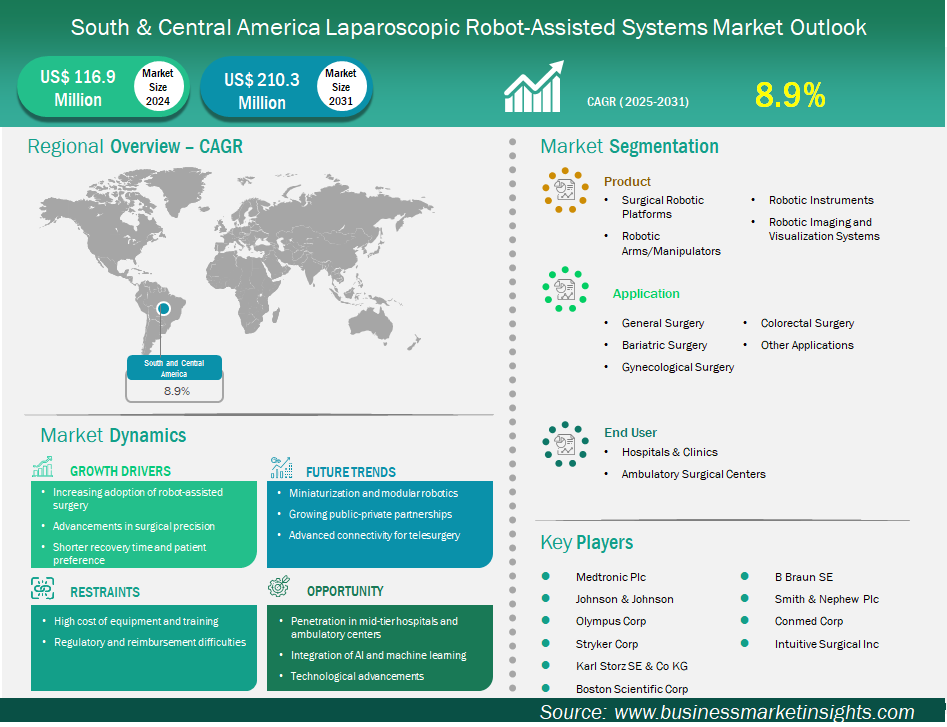
The South and Central America laparoscopic robot-assisted systems market size is expected to reach US$ 210.3 million by 2031 from US$ 116.9 million in 2024. The market is estimated to record a CAGR of 8.9% from 2025 to 2031.
Executive Summary and South and Central America Laparoscopic Robot-Assisted Systems Market Analysis:
The laparoscopic robot-assisted systems market in South and Central America is experiencing significant growth driven by increasing adoption of robot-assisted surgery, advancements in surgical precision, and shorter recovery times and patient preference. South & Central America is moving into the stage of rapid adoption for laparoscopic robot-assisted platforms, driven by increasing demand for minimally invasive surgery (MIS), increased private healthcare investment, and regulatory upgradation. Private hospital chains in major markets, such as Brazil, Argentina, Mexico, and Colombia, are increasingly investing in robotic systems to differentiate themselves on quality, attract medical tourists, and meet patient expectations. There's also an increasing training gap: although the number of individuals trained in robotic systems has grown, most still lack high case-volume exposure, particularly in subspecialties such as colorectal or bariatric robotic laparoscopy. OEM–academic center partnership for proctorship and simulation programs is becoming a corrective.
South and Central America Laparoscopic Robot Assisted Systems Market Segmentation Analysis:
Key segments that contributed to the derivation of the laparoscopic robot-assisted systems market analysis are product, application, and end user.
- By product, the laparoscopic robot-assisted systems market is segmented into surgical robotic platforms, robotic arms/manipulators, robotic instruments, and robotic imaging and visualization systems. The surgical robotic platforms segment dominated the market in 2024. Surgical robotic platforms are the largest segment by product, as they serve as the key enabling technology, enabling hospitals to offer minimally invasive robot-assisted procedures across multiple surgical disciplines, driving demand for the actual platforms themselves.
- In terms of application, the market is segmented into general surgery, bariatric surgery, gynecological surgery, colorectal surgery, and other applications. The general surgery segment held the largest market share in 2024. General surgery is the largest segment by application, as it constitutes a high volume of procedures (such as hernia, gallbladder, and appendectomies) in South & Central America, where hospitals are expanding minimally invasive techniques and robotics to reduce complications and hospital stays.
- By end user, the market is segmented into hospitals and clinics, and ambulatory surgical centers. The hospitals and clinics segment held the largest market share in 2024. Hospitals and clinics are the largest segment by end user, as these centers possess the necessary infrastructure, skilled staff, and budget capacity to absorb the high capital and operational costs associated with robotic systems and to service a sufficient case volume to justify the investment.
South and Central America Laparoscopic Robot-Assisted Systems Market Outlook
The South & Central America market for laparoscopic robot-assisted systems will expand steadily, with several key inflection points. Initially, there will be increased shift from premier urban cities to secondary cities as hospital chains and governments invest in regional health capability; this will necessitate system adaptation to lower‑resource environments and spending on maintenance and support infrastructure outside capitals. Ownership and financing patterns will change, with leasing, shared-use agreements, pay-per-procedure, or subscription-type arrangements becoming more prevalent to eliminate capital risk for hospitals. Robotic MIS specialization will move beyond urology and gynecology into more advanced general and oncologic laparoscopic procedures, driven by local surgeons developing expertise and demand from aging populations and increasing cancer incidence. Moreover, regulatory convergence can be enhanced, especially through regional pressure from Brazil's regulations, which can act as a benchmark; other nations can follow training-certification mandates, device approval procedures, and safety regulations. Software enhancements and AI augmentation (visualization, operative planning, and augmented reality guidance) will amplify the value proposition, particularly with patient outcomes and rates of complications being more strictly monitored. There are risks, including strained public healthcare budgets, economic uncertainty (such as currency fluctuations and inflation), import-tariff or logistics disruptions, and disparate access to training. Additionally, supply chain disruptions and fluctuations in global semiconductor/component prices may affect pricing and delivery. Overall, the outlook is optimistic, driven by growth in the private sector and specialty robotic MIS, as well as expansion into additional geographies, fuelled by changing financing, regulations, and technological advancements.
South and Central America Laparoscopic Robot-Assisted Systems Market Country Insights
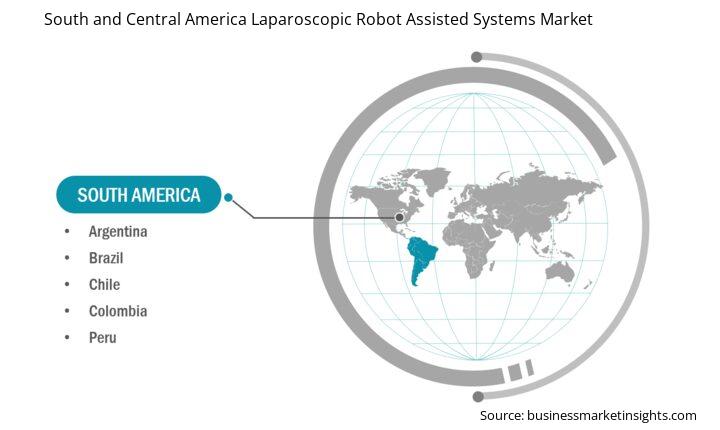
Based on country, the South and Central America laparoscopic robot-assisted systems market is segmented into Brazil, Argentina, Peru, Chile, and Colombia. Brazil held the largest share in 2024.
Country‑level dynamics within South & Central America vary significantly and will determine where robotic laparoscopy accelerates more rapidly. Brazil is the regional leader: it possesses the largest installed base, more advanced regulations, pre-established training/certification initiatives, and a significant surgical volume. Brazil also recently approved new platforms that enhance supply options. Argentina is also an early adopter, particularly in its private and academic hospitals, frequently adopting patterns set in Brazil for regulation and surgical specialty concentration. However, its economic instability occasionally delays capital acquisitions. Colombia, Chile, and Peru are growth frontier markets: urban areas within these nations are increasingly automating robotic systems and investing in resident training, yet rural or remote areas are underserved. In a few smaller Central American nations, adoption is extremely limited due to capital expenses, regulatory uncertainty, and limited technical/surgical training capacity. Import tariffs and foreign exchange risk are larger problems in countries with weaker regulatory protection or those that are more import-incentivized. Public-private partnerships could have a vital role in filling infrastructure and financing gaps in these mid- and lower-income nations. Cultural issues are also relevant—patient and surgeon perception of advantages of robotic laparoscopy, confidence in newer systems, and evidence of clinical outcomes published in the local population are key to broader adoption. Vendors need to customize their country strategies by prioritizing regulatory interaction, surgeon training, flexible pricing/financing, and local support to capitalize on the diverse opportunities within the region.
South and Central America Laparoscopic Robot Assisted Systems Market Company Profiles
Medtronic Plc; Johnson & Johnson; Olympus Corp; Stryker Corp; Karl Storz SE & Co KG, Boston Scientific Corp, B Braun SE, Smith & Nephew Plc, Conmed Corp, and Intuitive Surgical Inc., are among the key players operating in the market. These players adopt strategies such as expansion, product innovation, and mergers and acquisitions to stay competitive in the market and offer innovative products to their consumers.
South and Central America Laparoscopic Robot-Assisted Systems Market Research Methodology:
The following methodology has been followed for the collection and analysis of data presented in this report:
Secondary Research
The research process begins with comprehensive secondary research, utilizing both internal and external sources to gather qualitative and quantitative data for each market. Commonly referenced secondary research sources include, but are not limited to:
- Company websites, annual reports, financial statements, broker analyses, and investor presentations
- Industry trade journals and other relevant publications
- Government documents, statistical databases, and market reports
- News articles, press releases, and webcasts specific to companies operating in the market
Note: All financial data included in the Company Profiles section has been standardized to US$. For companies reporting in other currencies, figures have been converted to US$ using the relevant exchange rates for the corresponding year.
Primary Research
Business Market Insights conducts a significant number of primary interviews each year with industry stakeholders and experts to validate and analyze the data and gain valuable insights. These research interviews are designed to:
- Refine findings from secondary research
- Enhance the expertise and market understanding of the analysis team
- Gain insights into market size, trends, growth patterns, competitive dynamics, and future prospects
Primary research is conducted via email interactions and telephone interviews with industry experts across various markets, categories, segments, and sub-segments in different regions. Participants typically include:
- Industry stakeholders: Vice Presidents, business development managers, market intelligence managers, and national sales managers
- External experts: Valuation specialists, research analysts, and key opinion leaders with industry-specific expertise
Key Sources Referred:
- World Health Organization (WHO)
- The World Bank Group
- Worldometer
- The Lancet
- BMC Medical Education
- Eurostat
South and Central America Laparoscopic Robot Assisted Systems Market Strategic Insights
South and Central America Laparoscopic Robot Assisted SystemsMarket Report Highlights
| Report Attribute | Details |
| Market size in 2024 | US$ 116.9 Million |
| Market Size by 2031 | US$ 210.3 Million |
| CAGR (2025 - 2031) | 8.9% |
| Historical Data | 2021-2023 |
| Forecast period | 2025-2031 |
| Segments Covered |
By Product
|
|
Regions and Countries Covered
|
|
| South and Central America | Brazil, Argentina, Chile, Colombia, Peru |
| Market leaders and key company profiles |
|
South and Central America Laparoscopic Robot Assisted Systems Market Country and Regional Insights