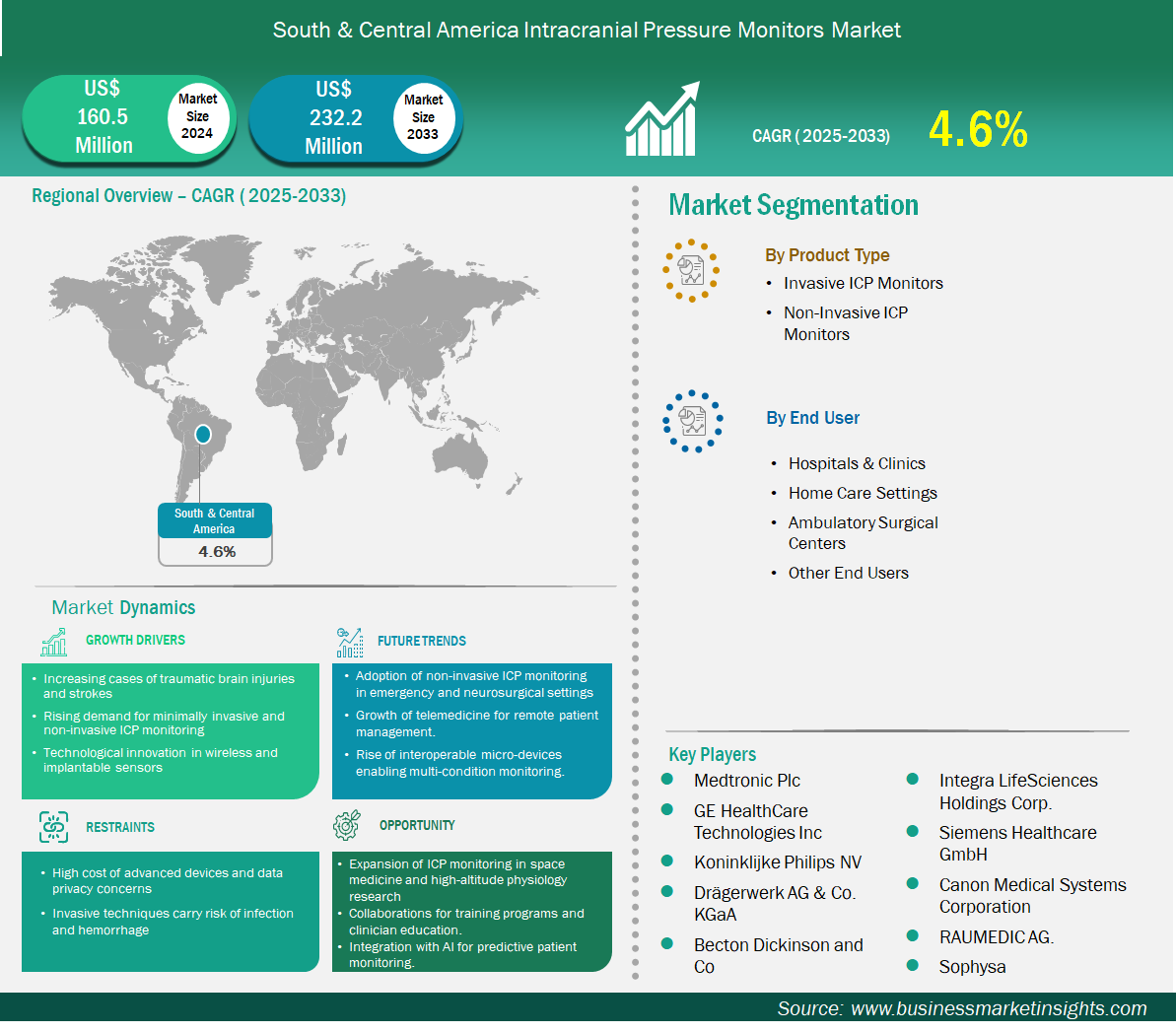
The South and Central America intracranial pressure monitors market size is expected to reach US$ 232.2 million by 2033 from US$ 160.5 million in 2024. The market is estimated to record a CAGR of 4.6% from 2025 to 2033.
Executive Summary and South and Central America Intracranial Pressure Monitors Market Analysis:
The intracranial pressure monitors market in South and Central America is experiencing significant growth driven by increasing cases of traumatic brain injuries and strokes, rising demand for minimally invasive and non-invasive ICP monitoring, and technological innovation in wireless and implantable sensors. The intracranial pressure (ICP) monitors market in South and Central America is the result of clinical demand, infrastructural deficiencies, and changes in healthcare priorities. Invasive ICP monitors basically dominate the product landscape as they are the major tools in the management of neurotrauma and critical neurological conditions, which are mainly referred to tertiary hospitals and trauma centers. The market is decided by procurement in the public sector, which is usually coordinated through national health ministries and regional hospital networks, and the purchasing decisions are based on clinical reliability and cost-efficiency. Multinational MedTech companies have a vibrant existence in the market, and they are the ones who supply the devices that have CE and FDA approval to the local distributors who are in charge of regulatory compliance and logistics. Although high adoption rates characterize urban centers of Brazil, Argentina, and Colombia, the rural and deprived areas still face problems with access, training, and device maintenance. The region is a fragmented but growing market for ICP monitors, and the demand is grounded in trauma care modernization and strategic healthcare investment.
South and Central America Intracranial Pressure Monitors Market Segmentation Analysis:
Key segments that contributed to the derivation of the intracranial pressure monitors market analysis are product and end user.
- By product, the intracranial pressure monitors market is segmented into invasive ICP monitors, non-invasive ICP monitors. The invasive ICP monitors segment dominated the market in 2024. Invasive ICP monitors are the largest segment by product in South and Central America due to their established clinical effectiveness and routine use in managing neurotrauma within tertiary care settings.
- By end user, the market is segmented into hospitals and clinics, home-care Settings, ambulatory surgical centers, and other end users. The hospitals and clinics segment held the largest market share in 2024. Hospitals and clinics are the largest segment by end user in South and Central America due to centralized healthcare delivery and the concentration of neurosurgical services in institutional care environments.
South and Central America Intracranial Pressure Monitors Market Outlook
The South and Central America ICP monitors market perspective is influenced by healthcare reform, regional innovation, and the rising burden of neurological disorders. Across the region, governments are upgrading the infrastructure of emergency care and investing in specialized diagnostics, hence creating demand for ICP monitoring systems that facilitate early intervention and improved outcomes. The prevalence of road traffic accidents, stroke, and paediatric hydrocephalus has increased the clinical scope of ICP monitoring. Besides the same, Digital health initiatives are becoming popular in such countries as Chile, where they are looking into telemedicine platforms and mobile diagnostics as ways to extend neurocritical care in the most inaccessible areas. The private healthcare providers are, therefore, also enlarging their footprint, providing top-notch services in the field of neurology, which includes ICP monitoring as a part of comprehensive care packages. Due to regional collaborations and donor-funded programs, technology transfer and clinical standards harmonization became easier. With the transformation of healthcare systems to value-based care and outcome-driven protocols, the use of ICP monitoring is anticipated to be essential in neurological recovery improvement as well as ICU burden reduction in the whole region.
South and Central America Intracranial Pressure Monitors Market Country Insights
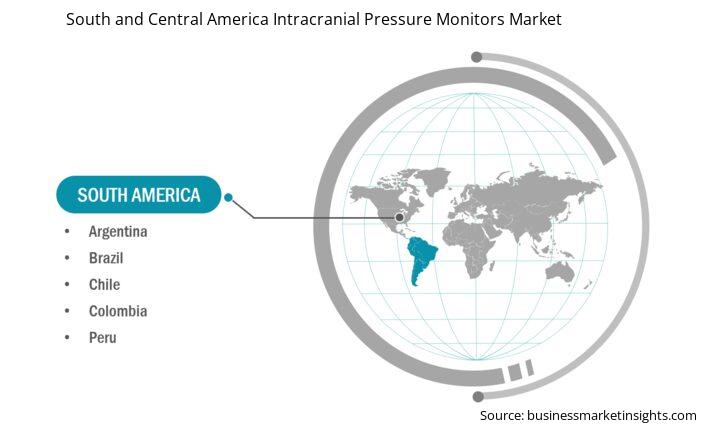
Based on country, the South and Central America intracranial pressure monitors market is segmented into Brazil, Argentina, Peru, Chile, and Colombia. Brazil held the largest share in 2024.
Analysing the country-level scenarios in South and Central America, there are diverse patterns of adoption and strategic priorities in the ICP monitors market. Brazil accounts for the highest number of clinical procedures and has advanced medical infrastructure, including large-scale public hospitals and clinics. The public sector takes the lead in Argentina, where the emphasis is put on its engagement and clinical integration. National health programs and university hospital networks augment this. Columbia positions itself as a regional hub for medical device distribution with the help of its strategic location and a friendly regulatory environment. Chile faces no financial constraints in digital health and specialized care, which leads to the opening up of the telemetric and non-invasive ICP markets. Peru is actively involved in enlarging the neurocritical care capacity through international aid and public-private partnerships. At the same time, Central American countries are extremely dependent on donor support and initiatives led by NGOs for access to ICP technologies. The regulatory frameworks are not the same in different parts of the region, thereby affecting product approval timelines and market entry strategies. These country-specific insights reiterate the necessity of neighbourhood engagement, clinician training, and coordination with national health priorities to be able to access the market potential in the whole of South and Central America.
South and Central America Intracranial Pressure Monitors Market Company Profiles
Medtronic Plc, GE HealthCare Technologies Inc, Koninklijke Philips NV, Becton Dickinson and Co, Integra LifeSciences Holdings Corp, Dragerwerk AG & Co KGaA, Siemens Healthcare GmbH, Canon Medical Systems Corporation, RAUMEDIC AG, Sophysa, are among the key players operating in the market. These players adopt strategies such as expansion, product innovation, and mergers and acquisitions to stay competitive in the market and offer innovative products to their consumers.
South and Central America Intracranial Pressure Monitors Market Research Methodology:
The following methodology has been followed for the collection and analysis of data presented in this report:
-
Secondary Research
The research process begins with comprehensive secondary research, utilizing both internal and external sources to gather qualitative and quantitative data for each market. Commonly referenced secondary research sources include, but are not limited to:
- Company websites, annual reports, financial statements, broker analyses, and investor presentations
- Industry trade journals and other relevant publications
- Government documents, statistical databases, and market reports
- News articles, press releases, and webcasts specific to companies operating in the market
Note: All financial data included in the Company Profiles section has been standardized to US$. For companies reporting in other currencies, figures have been converted to US$ using the relevant exchange rates for the corresponding year.
-
Primary Research
Business Market Insights conducts a significant number of primary interviews each year with industry stakeholders and experts to validate and analyze the data and gain valuable insights. These research interviews are designed to:
- Refine findings from secondary research
- Enhance the expertise and market understanding of the analysis team
- Gain insights into market size, trends, growth patterns, competitive dynamics, and future prospects
Primary research is conducted via email interactions and telephone interviews with industry experts across various markets, categories, segments, and sub-segments in different regions. Participants typically include:
- Industry stakeholders: Vice Presidents, business development managers, market intelligence managers, and national sales managers
- External experts: Valuation specialists, research analysts, and key opinion leaders with industry-specific expertise
Key Sources Referred:
- World Health Organization (WHO)
- Organisation for Economic Co-operation and Development (OECD)
- The World Bank Group
- Worldometer
- The Lancet
- BMC Medical Education
- Eurostat
South and Central America Intracranial Pressure Monitors Market Strategic Insights
South and Central America Intracranial Pressure MonitorsMarket Report Highlights
| Report Attribute | Details |
| Market size in 2024 | US$ 160.5 Million |
| Market Size by 2033 | US$ 232.2 Million |
| CAGR (2025 - 2033) | 4.6% |
| Historical Data | 2022-2023 |
| Forecast period | 2025-2033 |
| Segments Covered |
By Product
|
|
Regions and Countries Covered
|
|
| South and Central America | Brazil, Argentina, Chile, Colombia, Peru |
| Market leaders and key company profiles |
|
South and Central America Intracranial Pressure Monitors Market Country and Regional Insights