Analysis By Type (Air-cured and Autoclaved), Application (Roofing, Outside Siding or Façade, and Others), and End-Use (Residential and Non-Residential)
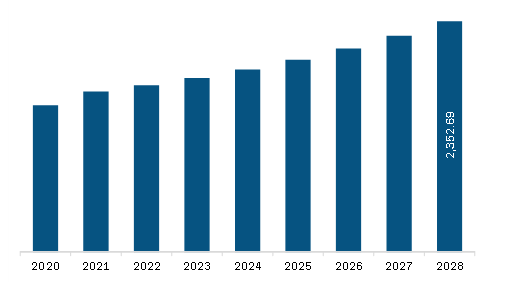
The South & Central America fiber cement market is expected to grow from US$ 1,698.59 million in 2022 to US$ 2,352.69 million by 2028. It is estimated to grow at a CAGR of 5.6% from 2022 to 2028.
Growing Awareness Regarding Benefits of Fiber Cement Drives South & Central America Fiber Cement Market
Durability is one of the most desirable qualities of fiber cement. Fiber cement siding, boards, and panels typically outlast vinyl siding and other alternative products in lifespan. Within 10 to 15 years, vinyl siding can show signs of aging, whereas fiber cement siding can last up to 30 to 50 years or more. Further, in cement production, carbon dioxide is a by-product. However, manufacturing vinyl siding containing polyvinyl chloride (PVC) produces more carbon dioxide than cement production. Moreover, vinyl siding off-gases throughout its lifetime as it occupies a space landfill. Hence, fiber cement siding is a greener alternative to vinyl siding.
Fiber cement products do not require frequent repainting as it holds paint well. Also, they do not dent unlike steel siding. Fiber cement products stand stronger in moisture and leaks than gypsum boards. These products possess excellent moisture-absorbing and drying properties, making them resistant to weather changes.
Fiber cement products are fireproof, insect resistant, and perform well in natural disasters. The products have good sound insulation properties suitable for building good quality and long-lasting homes. Further, fiber cement products are available in various styles such as panels and shingles. They are also available in baked-on, prefinished colors that do not require painting. Owing to the growing awareness about these benefits of fiber cement products compared to other substitute products, they are increasingly used in flooring, furniture making, and wall cladding, which drives the South & Central America fiber cement market growth.
South & Central America Fiber Cement Market Overview
The fiber cement market in South and Central America is sub-segmented into Brazil, Argentina, and the Rest of South and Central America. The rising household income levels and the increasing number of people migrating from rural to urban areas are expected to drive the demand for the residential buildings in the country. The augmented focus on affordable housing by both the public and the private sector may propel development in the residential construction sector, thereby boosting the usage of fiber cement boards in construction applications. Furthermore, the region's key players can increase their market share by focusing on product development and innovations. It is considered that with the increasing presence of global and local market players, coupled with growing research and development activities, the fiber cement market is expected to find immense opportunities during the forecast period. The rise in investment in research & development activities and technological innovation related to the fiber cement board is also expected to bolster the growth of the market.
South & Central America Fiber Cement Market Revenue and Forecast to 2028 (US$ Million)
South & Central America Fiber Cement Market Segmentation
The South & Central America fiber cement market is segmented into type, application, end-use, and country.
Based on type, the South & Central America fiber cement market is segmented into air-cured and autoclaved. The autoclaved segment held a larger share of the South & Central America fiber cement market in 2022.
Based on application, the South & Central America fiber cement market is segmented into roofing, outside siding or façade, and others. The roofing segment held the largest share of the South & Central America fiber cement market in 2022.
Based on end-use, the South & Central America fiber cement market is segmented into residential and non-residential. The non-residential segment held a larger share of the South & Central America fiber cement market in 2022.
Based on country, the South & Central America fiber cement market is segmented into Brazil, Argentina, and the Rest of South & Central America. Brazil dominated the share of the South & Central America fiber cement market in 2022.
Compagnie de Saint Gobain SA; Etex NV; Plycem Construsistemas Costa Rica SA; and Swisspearl Group AG are the leading companies operating in the South & Central America fiber cement market.
South & Central America Fiber Cement Market Strategic Insights
Get more information on this report
South & Central America Fiber Cement Market Segmentation Analysis
South & Central America Fiber Cement Market Report Highlights
South & Central America Fiber Cement Report Scope
Report Attribute
Details
Market size in 2022
US$ 1,698.59 Million
Market Size by 2028
US$ 2,352.69 Million
CAGR (2022 - 2028)
5.6%
Historical Data
2020-2021
Forecast period
2023-2028
Segments Covered
By Type
Air-cured
Autoclaved
By Application
Roofing
Outside Siding or Fa?ade
By End-Use
Residential and Non-Residential
Regions and Countries Covered
South and Central America
Brazil, Argentina, Rest of South and Central America
Market leaders and key company profiles
Compagnie de Saint Gobain SA
Etex NV
Plycem Construsistemas Costa Rica SA
Swisspearl Group AG
Get more information on this report
South & Central America Fiber Cement Market Country and Regional Insights
Get more information on this report
Identical Market Reports with other Region/Countries
The List of Companies - South & Central America Fiber Cement Market
Compagnie de Saint Gobain SAEtex NVPlycem Construsistemas Costa Rica SASwisspearl Group AG
Frequently Asked Questions
How big is the South & Central America Fiber Cement Market?
The South & Central America Fiber Cement Market is valued at US$ 1,698.59 Million in 2022, it is projected to reach US$ 2,352.69 Million by 2028.
What is the CAGR for South & Central America Fiber Cement Market by (2022 - 2028)?
As per our report South & Central America Fiber Cement Market, the market size is valued at US$ 1,698.59 Million in 2022, projecting it to reach US$ 2,352.69 Million by 2028. This translates to a CAGR of approximately 5.6% during the forecast period.
What segments are covered in this report?
The South & Central America Fiber Cement Market report typically cover these key segments-
Type (Air-cured, Autoclaved)
Application (Roofing, Outside Siding or Fa?ade)
End-Use (Residential and Non-Residential)
What is the historic period, base year, and forecast period taken for South & Central America Fiber Cement Market?
The historic period, base year, and forecast period can vary slightly depending on the specific market research report. However, for the South & Central America Fiber Cement Market report:
Historic Period : 2020-2021
Base Year : 2022
Forecast Period : 2023-2028
Who are the major players in South & Central America Fiber Cement Market?
The South & Central America Fiber Cement Market is populated by several key players, each contributing to its growth and innovation. Some of the major players include:
Compagnie de Saint Gobain SA
Etex NV
Plycem Construsistemas Costa Rica SA
Swisspearl Group AG
Who should buy this report?
The South & Central America Fiber Cement Market report is valuable for diverse stakeholders, including:
Investors: Provides insights for investment decisions pertaining to market growth, companies, or industry insights. Helps assess market attractiveness and potential returns.
Industry Players: Offers competitive intelligence, market sizing, and trend analysis to inform strategic planning, product development, and sales strategies.
Suppliers and Manufacturers: Helps understand market demand for components, materials, and services related to concerned industry.
Researchers and Consultants: Provides data and analysis for academic research, consulting projects, and market studies.
Financial Institutions: Helps assess risks and opportunities associated with financing or investing in the concerned market.
Essentially, anyone involved in or considering involvement in the South & Central America Fiber Cement Market value chain can benefit from the information contained in a comprehensive market report.





 Get Free Sample For South & Central America Fiber Cement Market