Analysis - by Product (Blood Collection Tubes, Blood Collection Needles/Holders, Blood Collection Set, and Others), Methods (Manual Blood Collection and Automated Blood Collection), and End User (Hospitals and Pathology Laboratories, Blood Bank, and Others)
No. of Pages:81
Report Code:
TIPRE00016323
Category:
Life Sciences
South & Central America Blood Collection Devices Market
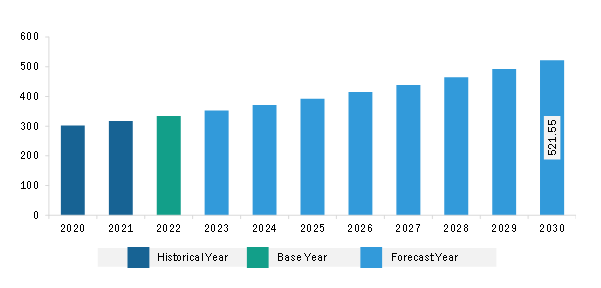
The South & Central America blood collection devices market is expected to grow from US$ 333.95 million in 2022 to US$ 521.55 million by 2030. It is estimated to grow at a CAGR of 5.7% from 2022 to 2030.
Rising Incidences of Chronic Diseases Drive South & Central America Blood Collection Devices Market
Blood collection devices are used for drawing blood from the veins. According to the World Health Organization, the most noncommunicable disease-related deaths are cardiovascular diseases, accounting for ∼17 million people each year, followed by cancers, chronic respiratory diseases, and diabetes (including deaths associated with the kidney). Furthermore, the needles are used for drawing blood for cholesterol testing as high cholesterol can cause heart stroke and heart attack. According to the World Heart Federation, high cholesterol causes 4.4 million deaths yearly, and ∼24% of cardiovascular-related deaths are attributable to high low-density lipoprotein (LDL) cholesterol. Further, diabetes is a life-threatening chronic disease with no practical cure. Diabetes can lead to several complications in different body parts and increase the probability of premature death. Heart attack, kidney failure, stroke, vision loss, leg amputation, and nerve damage are the major complications associated with diabetes. As per the International Diabetes Federation (IDF), in 2021, ∼537 million adults suffered from diabetes worldwide. The number is anticipated to reach 643 million and 783 million by 2030 and 2045, respectively. The treatment of chronic diseases requires blood tests and long-term medications; hence, the growing incidence of chronic diseases is anticipated to create numerous growth opportunities for the market players in the coming years.
South & Central America Blood Collection Devices Market Overview
Brazil has a significant medical device industry, and it is the largest of all Latin American countries. According to the International Trade Administration (US Department of Commerce), the medical device industry in Brazil relies mainly on the US, China, and Germany. In 2021, the country reported an increase of 7.3% in the imports of medical devices, reaching the value of US$ 6.2 billion. As per estimates by the Brazilian Ministry of Health, ~3 million units of blood are collected each year in Brazil; out of the total blood collected, ~70% of donations in these regions are collected through the public system. According to the Global Burden of Disease data published in 2020, Brazil has a high prevalence of chronic obstructive pulmonary disease (COPD), diabetes, and ischemic heart disease. Additionally, ischemic heart disease, stroke, COPD, and diabetes were the leading cause of death among the Brazilian population between 2009 and 2019. Thus, the country provides lucrative opportunities for companies providing blood collection devices for blood donation and disease diagnostics.
South & Central America Blood Collection Devices Market Revenue and Forecast to 2030 (US$ Million)
South & Central America Blood Collection Devices Market Segmentation
The South & Central America blood collection devices market is segmented into product type, methods, end user, and country.
Based on product type, the South & Central America blood collection devices Market is segmented into blood collection tubes, blood collection needles/holders, blood collection set, and others. The blood collection tubes segment held the largest share of the South & Central America blood collection devices market in 2022.
In terms of methods, the South & Central America blood collection devices Market is bifurcated into manual blood collection and automated blood collection. The manual blood collection segment held a larger share of the South & Central America blood collection devices market in 2022.
By end user, the South & Central America blood collection devices market is segmented into hospitals and pathology laboratories, blood bank, and others. The hospitals and pathology laboratories segment held the largest share of the South & Central America blood collection devices market in 2022.
Based on country, the South & Central America blood collection devices market is segmented into Brazil, Argentina, and the Rest of South & Central America. Brazil dominated South & Central America blood collection devices market in 2022.
Becton Dickenson and Co, Terumo Corp, Cardinal Health, SARSTEDT AG & Co. KG, NIPRO, Thermo Fisher Scientific Inc, Sekisui Chemical Co Ltd, and Greiner Bio One International GmBH are some of the leading companies operating in the South & Central America blood collection devices market.
South & Central America Blood Collection Devices Market Strategic Insights
Get more information on this report
South & Central America Blood Collection Devices Market Segmentation Analysis
South & Central America Blood Collection Devices Market Report Highlights
South & Central America Blood Collection Devices Report Scope
Report Attribute
Details
Market size in 2022
US$ 333.95 Million
Market Size by 2030
US$ 521.55 Million
CAGR (2022 - 2030)
5.7%
Historical Data
2020-2021
Forecast period
2023-2030
Segments Covered
By Product
Blood Collection Tubes
Blood Collection Needles/Holders
Blood Collection Set
By Methods
Manual Blood Collection and Automated Blood Collection
By End User
Hospitals and Pathology Laboratories
Blood Bank
Regions and Countries Covered
South and Central America
Brazil, Argentina, Rest of South and Central America
Market leaders and key company profiles
Becton Dickenson and Co
Terumo Corp
Cardinal Health
SARSTEDT AG & Co. KG
NIPRO
Thermo Fisher Scientific Inc
Sekisui Chemical Co Ltd
Greiner Bio One International GmBH
Get more information on this report
South & Central America Blood Collection Devices Market Country and Regional Insights
Get more information on this report
Identical Market Reports with other Region/Countries
The List of Companies - South & Central America Blood Collection Devices Market
Becton Dickenson and CoTerumo CorpCardinal HealthSARSTEDT AG & Co. KGNIPROThermo Fisher Scientific IncSekisui Chemical Co LtdGreiner Bio One International GmBH
Frequently Asked Questions
How big is the South & Central America Blood Collection Devices Market?
The South & Central America Blood Collection Devices Market is valued at US$ 333.95 Million in 2022, it is projected to reach US$ 521.55 Million by 2030.
What is the CAGR for South & Central America Blood Collection Devices Market by (2022 - 2030)?
As per our report South & Central America Blood Collection Devices Market, the market size is valued at US$ 333.95 Million in 2022, projecting it to reach US$ 521.55 Million by 2030. This translates to a CAGR of approximately 5.7% during the forecast period.
What segments are covered in this report?
The South & Central America Blood Collection Devices Market report typically cover these key segments-
Methods (Manual Blood Collection and Automated Blood Collection)
End User (Hospitals and Pathology Laboratories, Blood Bank)
What is the historic period, base year, and forecast period taken for South & Central America Blood Collection Devices Market?
The historic period, base year, and forecast period can vary slightly depending on the specific market research report. However, for the South & Central America Blood Collection Devices Market report:
Historic Period : 2020-2021
Base Year : 2022
Forecast Period : 2023-2030
Who are the major players in South & Central America Blood Collection Devices Market?
The South & Central America Blood Collection Devices Market is populated by several key players, each contributing to its growth and innovation. Some of the major players include:
Becton Dickenson and Co
Terumo Corp
Cardinal Health
SARSTEDT AG & Co. KG
NIPRO
Thermo Fisher Scientific Inc
Sekisui Chemical Co Ltd
Greiner Bio One International GmBH
Who should buy this report?
The South & Central America Blood Collection Devices Market report is valuable for diverse stakeholders, including:
Investors: Provides insights for investment decisions pertaining to market growth, companies, or industry insights. Helps assess market attractiveness and potential returns.
Industry Players: Offers competitive intelligence, market sizing, and trend analysis to inform strategic planning, product development, and sales strategies.
Suppliers and Manufacturers: Helps understand market demand for components, materials, and services related to concerned industry.
Researchers and Consultants: Provides data and analysis for academic research, consulting projects, and market studies.
Financial Institutions: Helps assess risks and opportunities associated with financing or investing in the concerned market.
Essentially, anyone involved in or considering involvement in the South & Central America Blood Collection Devices Market value chain can benefit from the information contained in a comprehensive market report.





 Get Free Sample For South & Central America Blood Collection Devices Market