Analysis – by Type (Instruments, Media & Reagents, and Consumables), Application (Plant Research, Agriculture, Forestry & Technical Grade, and Others), and End Users (Greenhouse, Field, and Laboratory)
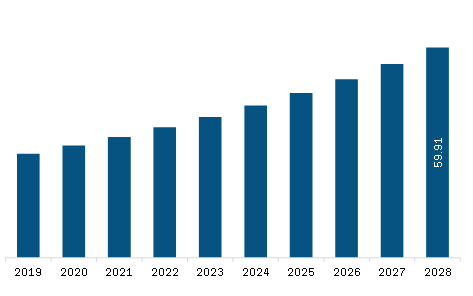
The South America plant tissue culture market is expected to grow from US$ 37.17 million in 2022 to US$ 59.91 million by 2028; it is estimated to register a CAGR of 8.3% from 2022 to 2028.
Automation in Tissue Culture Laboratories Bolsters Market Growth
Research studies on automation technology and equipment of test-tube plantlets have been carried out in various developing countries. In manual propagation, the plantlet is grasped and cut at the node point between the cotyledon and stem, which is hardly located and can be easily damaged by the gripper. Using an agricultural intelligent robot to replace manual operation will significantly improve the efficiency and quality of the propagation of plantlets. With the use of robots, the chances of contamination are less as compared to manual propagation. The cost of labor is increasing annually. The cost of a robotic machine will decrease in near future due to the rapid development of electronic and mechanical technology. Therefore, the laboratories are introducing robots so that the procedures are carried out properly and are cost-effective. The high-throughput screening of recombinant protein expression is advantageous during early process development because it identifies optimal expression constructs and process conditions. Simple screening platforms based on microtiter plates are available for microbes and animal cells, but this was not possible for plants until the development of plant cell packs (PCPs), also known as “cookies,” which provide a versatile and scalable screening tool for recombinant protein production. This will help in developing the plantlets according to the need of the researchers. Due to the use of robotics in plant tissue culture laboratories the market for plant tissue culture is expected to grow.
South America Plant Tissue Culture Market Overview
The South America plant tissue culture market is segmented into Brazil, Argentina, and South America. The demand for fruits and vegetable ingredients is rising in the food & beverages industry in South America, which contributes to the market growth in this region. The expansion of the tourism industry has led to the development of the hotel and restaurant sector in South America, creating new avenues and demand for fruit and vegetables. In addition, consumers in the region prefer to include vegetables and fruits as key ingredients in their daily diet due to the rising awareness of health. Thus, consumer preference for healthier and premium food products such as smoothies, juices, and salads made with natural ingredients amplifying the demand for plant tissue culture in South America.
South America Plant Tissue Culture Market Revenue and Forecast to 2028 (US$ Million)
South America Plant Tissue Culture Market Segmentation
The South America plant tissue culture market is segmented on the basis of type, application, end users, and country. Based on type, the South America plant tissue culture market is segmented into instrument, media & reagents, and consumables. The instrument segment held the largest market share in 2022. Further, the instrument segment is categorized into incubators, centrifuges, microscopes, sterilizers, and others. Similarly, media & reagents are categorized into murashige and skoog media, linsmaier and skoog media, and others.
Based on application, the South America plant tissue culture market is segmented into plant research, agriculture, forestry & technical grade, and others. The agriculture segment held the largest market share in 2022.
Based on end users, the South America plant tissue culture market is segmented into greenhouse, field, and laboratory. The field segment held the largest market share in 2022.
Based on country, the South America plant tissue culture market is segmented into Brazil, Argentina, and the Rest of South America. Brazil dominated the market in 2022.
Thomas Scientific LLC; Sigma-Aldrich Co LLC; HiMedia Laboratories Pvt Ltd; Caisson Labs Inc.; Alpha Laboratories Ltd.; and Becton, Dickinson and Co. are the leading companies operating in the South America plant tissue culture market.
South America Plant Tissue Culture Market Strategic Insights
Get more information on this report
South America Plant Tissue Culture Market Segmentation Analysis
South America Plant Tissue Culture Market Report Highlights
South America Plant Tissue Culture Report Scope
Report Attribute
Details
Market size in 2022
US$ 37.17 Million
Market Size by 2028
US$ 59.91 Million
CAGR (2022 - 2028)
8.3%
Historical Data
2020-2021
Forecast period
2023-2028
Segments Covered
By Type
Instruments
Media & Reagents
Consumables
By Application
Plant Research
Agriculture
Forestry & Technical Grade
By End Users
Greenhouse
Field
Laboratory
Regions and Countries Covered
South and Central America
Brazil, Argentina, Rest of South and Central America
Market leaders and key company profiles
Thomas Scientific LLC
Sigma-Aldrich Co LLC
HiMedia Laboratories Pvt Ltd
Caisson Labs Inc.
Alpha Laboratories Ltd.
Becton, Dickinson and Co.
Get more information on this report
South America Plant Tissue Culture Market Country and Regional Insights
Get more information on this report
Identical Market Reports with other Region/Countries
The List of Companies - South America Plant Tissue Culture Market
Thomas Scientific LLCSigma-Aldrich Co LLCHiMedia Laboratories Pvt LtdCaisson Labs Inc.Alpha Laboratories Ltd.Becton, Dickinson and Co.
Frequently Asked Questions
How big is the South America Plant Tissue Culture Market?
The South America Plant Tissue Culture Market is valued at US$ 37.17 Million in 2022, it is projected to reach US$ 59.91 Million by 2028.
What is the CAGR for South America Plant Tissue Culture Market by (2022 - 2028)?
As per our report South America Plant Tissue Culture Market, the market size is valued at US$ 37.17 Million in 2022, projecting it to reach US$ 59.91 Million by 2028. This translates to a CAGR of approximately 8.3% during the forecast period.
What segments are covered in this report?
The South America Plant Tissue Culture Market report typically cover these key segments-
What is the historic period, base year, and forecast period taken for South America Plant Tissue Culture Market?
The historic period, base year, and forecast period can vary slightly depending on the specific market research report. However, for the South America Plant Tissue Culture Market report:
Historic Period : 2020-2021
Base Year : 2022
Forecast Period : 2023-2028
Who are the major players in South America Plant Tissue Culture Market?
The South America Plant Tissue Culture Market is populated by several key players, each contributing to its growth and innovation. Some of the major players include:
Thomas Scientific LLC
Sigma-Aldrich Co LLC
HiMedia Laboratories Pvt Ltd
Caisson Labs Inc.
Alpha Laboratories Ltd.
Becton, Dickinson and Co.
Who should buy this report?
The South America Plant Tissue Culture Market report is valuable for diverse stakeholders, including:
Investors: Provides insights for investment decisions pertaining to market growth, companies, or industry insights. Helps assess market attractiveness and potential returns.
Industry Players: Offers competitive intelligence, market sizing, and trend analysis to inform strategic planning, product development, and sales strategies.
Suppliers and Manufacturers: Helps understand market demand for components, materials, and services related to concerned industry.
Researchers and Consultants: Provides data and analysis for academic research, consulting projects, and market studies.
Financial Institutions: Helps assess risks and opportunities associated with financing or investing in the concerned market.
Essentially, anyone involved in or considering involvement in the South America Plant Tissue Culture Market value chain can benefit from the information contained in a comprehensive market report.





 Get Free Sample For South America Plant Tissue Culture Market