Analysis By Component (Software and Services), Application (Security & Surveillance, Access Control, and Others), and Vertical (BFSI, Retail and E-commerce, Government, Healthcare, Education, Automotive and Transportation, and Others)
No. of Pages:116
Report Code:
TIPRE00029036
Category:
Technology, Media and Telecommunications
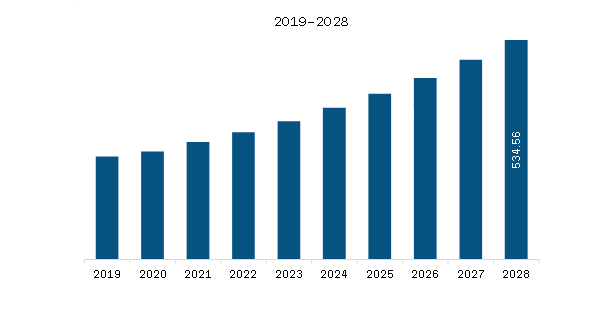
The facial recognition market in South America is expected to grow from US$ 286.03 million in 2021 to US$ 534.56 million by 2028; it is estimated to grow at a CAGR of 9.3% from 2021 to 2028.
3D face recognition systems deliver more accurate results than their 2D counterparts by measuring the geometry of rigid facial features. 3D face recognition systems could accurately recognize human faces even under dim lights. With varying facial positions and expressions, 2D face recognition systems face difficulties while operating in such conditions. The 3D face recognition technique uses sensors that help capture 3D face images and track persons’ faces in real time with improved precision; moreover, these systems identify an individual irrespective of variations in their poses and expressions, and lighting conditions. Owing to the higher accuracy of 3D facial recognition systems, their deployment is on the rise in public safety systems at airports, and border protection and surveillance check posts. Thus, with the growing research and development efforts, 3D recognition systems are leading to significant future trends in the facial recognition market.
South America Facial Recognition Market Revenue and Forecast to 2028 (US$ Million)
South America Facial Recognition Market Segmentation
The South America facial recognition market is segmented on the basis of component, application, vertical, and country. Based on component, the market is segmented into software and services. In 2020, the software segment held a larger market share. The market for the software segment is further segmented into 2D facial recognition, 3D facial recognition, and facial analytics. In 2020, the 3D facial recognition segment held the largest market share. The market for the services segment is subsegmented into training & consulting, integration and implementation, and support & maintenance. In 2020, the integration and implementation segment held the largest share of the market. Based on application, the South America facial recognition market is segmented into security & surveillance, access control, and others. In 2020, the security & surveillance segment held the largest market share. Based on vertical, the market is segmented into BFSI, retail and e-commerce, government, healthcare, education, automotive and transportation, and others. In 2020, the government segment held the largest market share. Aware Inc., Fujitsu Limited, IDEMIA, NEC Corporation, and Thales Group are among the leading companies in the South America facial recognition market.
South America Facial Recognition Market Strategic Insights
Get more information on this report
South America Facial Recognition Market Segmentation Analysis
South America Facial Recognition Market Report Highlights
South America Facial Recognition Report Scope
Report Attribute
Details
Market size in 2021
US$ 286.03 Million
Market Size by 2028
US$ 534.56 Million
CAGR (2021 - 2028)
9.3%
Historical Data
2019-2020
Forecast period
2022-2028
Segments Covered
By Component
Software
Services
By Application
Security & Surveillance
Access Control
By Vertical
BFSI
Retail and E-commerce
Government
Healthcare
Education
Automotive and Transportation
Regions and Countries Covered
South and Central America
Brazil, Argentina, Rest of South and Central America
Market leaders and key company profiles
Aware Inc.
Fujitsu Limited
IDEMIA
NEC Corporation
Thales Group
Get more information on this report
South America Facial Recognition Market Country and Regional Insights
Get more information on this report
Identical Market Reports with other Region/Countries
Siddhika is an experienced market research professional with over five years of expertise in delivering actionable market intelligence and strategic insights to support business growth and decision-making. She has strong experience in designing and managing end-to-end research engagements, including research planning, data collection, and insight generation.
Proficient in research methodologies, Siddhika synthesizes diverse information sources to deliver accurate, high-quality insights and strategic recommendations. She excels at translating complex market information into strategic narratives that support executive decision-making..
Show More
Frequently Asked Questions
How big is the South America Facial Recognition Market?
The South America Facial Recognition Market is valued at US$ 286.03 Million in 2021, it is projected to reach US$ 534.56 Million by 2028.
What is the CAGR for South America Facial Recognition Market by (2021 - 2028)?
As per our report South America Facial Recognition Market, the market size is valued at US$ 286.03 Million in 2021, projecting it to reach US$ 534.56 Million by 2028. This translates to a CAGR of approximately 9.3% during the forecast period.
What segments are covered in this report?
The South America Facial Recognition Market report typically cover these key segments-
Vertical (BFSI, Retail and E-commerce, Government, Healthcare, Education, Automotive and Transportation)
What is the historic period, base year, and forecast period taken for South America Facial Recognition Market?
The historic period, base year, and forecast period can vary slightly depending on the specific market research report. However, for the South America Facial Recognition Market report:
Historic Period : 2019-2020
Base Year : 2021
Forecast Period : 2022-2028
Who are the major players in South America Facial Recognition Market?
The South America Facial Recognition Market is populated by several key players, each contributing to its growth and innovation. Some of the major players include:
Aware Inc.
Fujitsu Limited
IDEMIA
NEC Corporation
Thales Group
Who should buy this report?
The South America Facial Recognition Market report is valuable for diverse stakeholders, including:
Investors: Provides insights for investment decisions pertaining to market growth, companies, or industry insights. Helps assess market attractiveness and potential returns.
Industry Players: Offers competitive intelligence, market sizing, and trend analysis to inform strategic planning, product development, and sales strategies.
Suppliers and Manufacturers: Helps understand market demand for components, materials, and services related to concerned industry.
Researchers and Consultants: Provides data and analysis for academic research, consulting projects, and market studies.
Financial Institutions: Helps assess risks and opportunities associated with financing or investing in the concerned market.
Essentially, anyone involved in or considering involvement in the South America Facial Recognition Market value chain can benefit from the information contained in a comprehensive market report.







 Get Free Sample For South America Facial Recognition Market