Analysis – by Component (Hardware and Software), Protocol (Arinc 429/629, Mil-Std 1553, and Others), and Application (Marine, Automotive, Commercial Aviation, and Military Aviation)
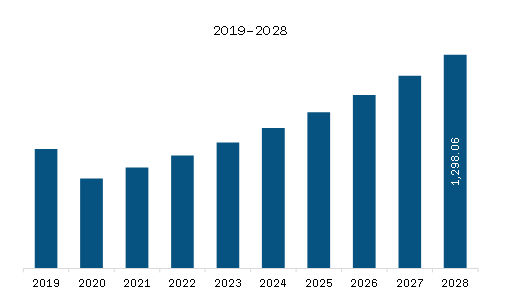
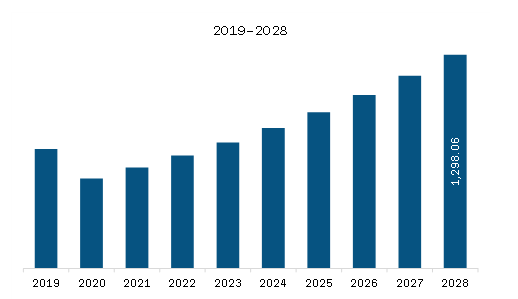
The SAM data bus market is expected to grow from US$ 1,114.23 million in 2021 to US$ 1,298.06 million by 2028; it is estimated to grow at a CAGR of 2.2% from 2021 to 2028.
On the onboard bus, there is an upsurge in traffic. Remote terminals expect improved services from the onboard bus as they become more "intelligent." They expect to access the bus on demand to transfer data packets. Many current software architectures are built around messaging capabilities, in which programs communicate via variable-length messages generated asynchronously. Because of the growing "intelligence" of remote terminals, their expectations for more complete communication services, and the necessity to support increasingly sophisticated, multi-bus designs, higher-level protocols are being used more frequently on the onboard bus. This, in turn, may increase traffic volume, particularly asynchronous traffic, but it also emphasizes the necessity for the onboard bus to provide asymmetric medium access service. While asynchronous packet traffic on spacecraft buses has been steadily increasing, the number of basic sensors and actuators that must be serviced through the bus has remained constant. In reality, there is strong evidence that such low-cost gadgets are increasing. The MIL-STD-1553B command and control bus is the most frequent aboard a spacecraft, and the additions in ECSS-E-ST-50-13C cover it for future space use. However, as processing power grows and sub-systems become more complex, there is a growing demand for data networks that meet MIL-STD-1553B requirements while also being compatible with the miniaturized low-power devices they connect. Pin counts, connector sizes, and harness bulk can all be reduced in this way. The awareness that the building block method demands standardization above the basic bus protocols goes hand in hand with the requirement to improve connectivity. Future data system innovations include, among other things, the adoption of the CAN bus as a complement to MIL-STD-1553B, the creation and usage of higher-layer protocols, and the standardization of digital sensor buses as the most efficient means to decrease harness and integration costs. Therefore, growing high performance data buses is expected to fuel the SAM market growth.
With the new features and technologies, vendors can attract new customers and expand their footprints in emerging markets. This factor is likely to drive the SAM data bus market in the coming years. The market is expected to grow at a good CAGR during the forecast period.
SAM Data Bus Market Revenue and Forecast to 2028 (US$ Million)
SAM Data Bus Market Segmentation
The SAM data bus market has been segmented and analyzed on the basis of component, protocol, application, and country. Based on component, the SAM data bus market is further segmented into hardware and software. The hardware segment dominated the SAM data bus market in 2020 and software segment is expected to be fastest growing during forecast period. On the basis of protocol, the SAM data bus market is segmented into ARINC 429/629, MIL–STD-1553, and others. The MIL–STD-1553 segment dominated the SAM data bus market in 2020 and ARINC 429/629 segment is expected to be fastest growing during forecast period. On the basis of application, the SAM data bus market is further segmented into automotive, marine, commercial aviation, and military aviation. The military aviation segment dominated the SAM data bus market in 2020 and same segment is expected to be fastest growing during forecast period. Based on country, the SAM data bus market is segmented into Brazil, Argentina, and the rest of SAM.
Collins Aerospace, Data Device Corporation, Fujikura Ltd., HUBER+SUHNER, Nexans, and TE Connectivity Corporation are among the leading companies in the SAM data bus market.
South America Data Bus Market Strategic Insights
Get more information on this report
South America Data Bus Market Segmentation Analysis
South America Data Bus Market Report Highlights
South America Data Bus Report Scope
Report Attribute
Details
Market size in 2021
US$ 1,114.23 Million
Market Size by 2028
US$ 1,298.06 Million
CAGR (2021 - 2028)
2.2%
Historical Data
2019-2020
Forecast period
2022-2028
Segments Covered
By Component
Hardware
Software
By Protocol
Arinc 429/629
Mil-Std 1553
By Application
Marine
Automotive
Commercial Aviation
Military Aviation
Regions and Countries Covered
South and Central America
Brazil, Argentina, Rest of South and Central America
Market leaders and key company profiles
Collins Aerospace
Data Device Corporation
Fujikura Ltd.
HUBER+SUHNER
Nexans
TE Connectivity Corporation
Get more information on this report
South America Data Bus Market Country and Regional Insights
Get more information on this report
Identical Market Reports with other Region/Countries
The List of Companies - South America Data Bus Market
Collins Aerospace Data Device CorporationFujikura Ltd.HUBER+SUHNERNexans TE Connectivity Corporation
Frequently Asked Questions
How big is the South America Data Bus Market?
The South America Data Bus Market is valued at US$ 1,114.23 Million in 2021, it is projected to reach US$ 1,298.06 Million by 2028.
What is the CAGR for South America Data Bus Market by (2021 - 2028)?
As per our report South America Data Bus Market, the market size is valued at US$ 1,114.23 Million in 2021, projecting it to reach US$ 1,298.06 Million by 2028. This translates to a CAGR of approximately 2.2% during the forecast period.
What segments are covered in this report?
The South America Data Bus Market report typically cover these key segments-
Component (Hardware, Software)
Protocol (Arinc 429/629, Mil-Std 1553)
Application (Marine, Automotive, Commercial Aviation, Military Aviation)
What is the historic period, base year, and forecast period taken for South America Data Bus Market?
The historic period, base year, and forecast period can vary slightly depending on the specific market research report. However, for the South America Data Bus Market report:
Historic Period : 2019-2020
Base Year : 2021
Forecast Period : 2022-2028
Who are the major players in South America Data Bus Market?
The South America Data Bus Market is populated by several key players, each contributing to its growth and innovation. Some of the major players include:
Collins Aerospace
Data Device Corporation
Fujikura Ltd.
HUBER+SUHNER
Nexans
TE Connectivity Corporation
Who should buy this report?
The South America Data Bus Market report is valuable for diverse stakeholders, including:
Investors: Provides insights for investment decisions pertaining to market growth, companies, or industry insights. Helps assess market attractiveness and potential returns.
Industry Players: Offers competitive intelligence, market sizing, and trend analysis to inform strategic planning, product development, and sales strategies.
Suppliers and Manufacturers: Helps understand market demand for components, materials, and services related to concerned industry.
Researchers and Consultants: Provides data and analysis for academic research, consulting projects, and market studies.
Financial Institutions: Helps assess risks and opportunities associated with financing or investing in the concerned market.
Essentially, anyone involved in or considering involvement in the South America Data Bus Market value chain can benefit from the information contained in a comprehensive market report.




 Get Free Sample For South America Data Bus Market