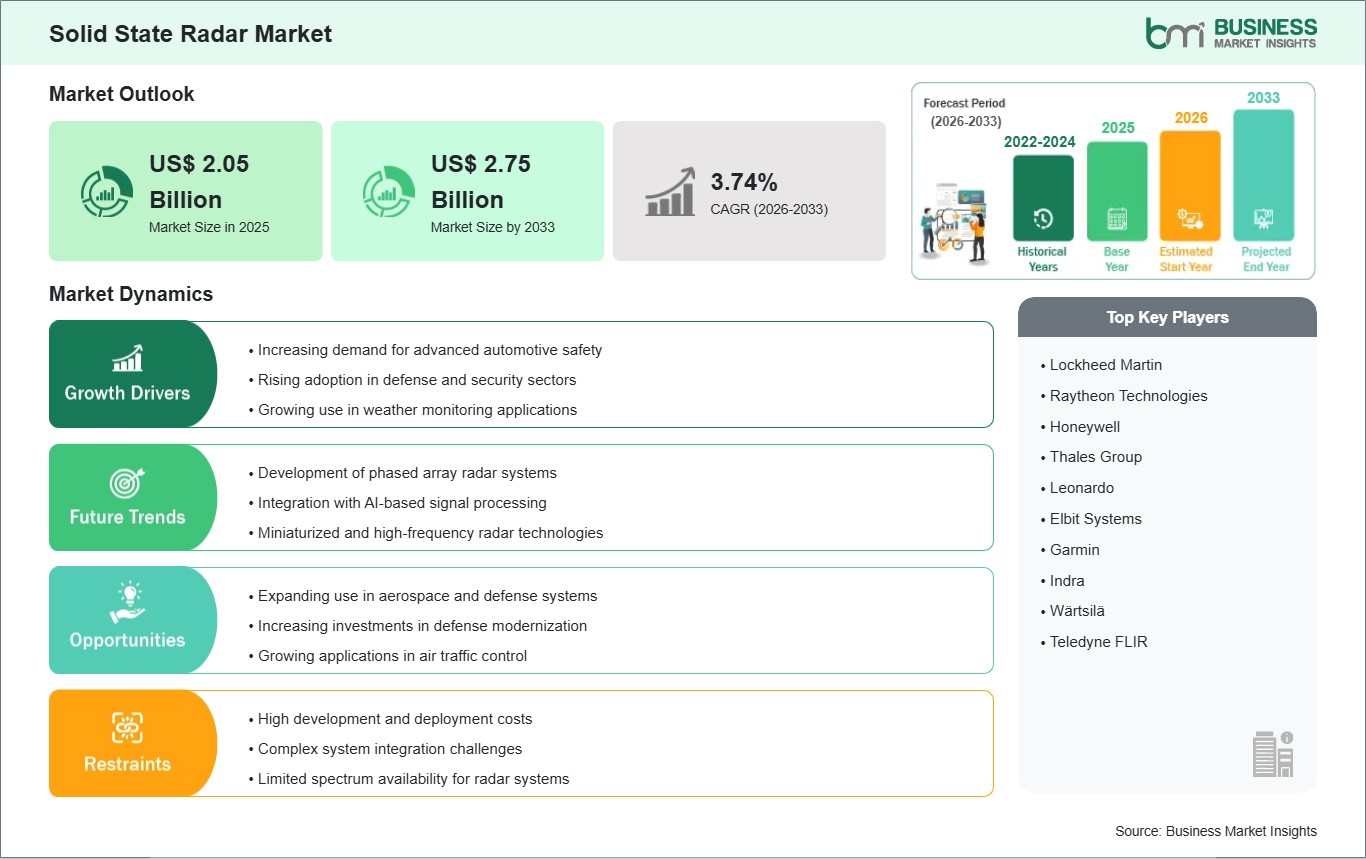
The Solid State Radar Market size is expected to reach US$ 2.75 billion by 2033 from US$ 2.05 billion in 2025. The market is estimated to record a CAGR of 3.74% from 2026 to 2033.
The solid state radar market is growing steadily. Defense, aerospace, automotive, and industrial sectors are adopting radar solutions that offer better reliability, improved detection capabilities, and lower maintenance compared to traditional mechanical radars. Solid state radars use semiconductor-based transmitters, like gallium nitride (GaN) and gallium arsenide (GaAs). These radars provide faster scanning, better resolution, and a longer operational life. The market is fueled by rising demand for surveillance systems, air traffic monitoring, weather detection, and autonomous vehicle navigation. Advances in technology play a big role in this growth. The integration of phased-array antennas, digital beamforming, and real-time signal processing has significantly increased radar sensitivity and target tracking accuracy.
Additionally, compact and energy-efficient radar systems can be deployed in space-constrained environments like drones, smart vehicles, and portable defense units. Increasing government spending on military upgrades, border security, and air defense systems is boosting demand for solid state radar solutions. Industries are also investing in radar-based collision avoidance, maritime navigation, and industrial monitoring applications. The trend toward multifunctional radars, which can handle surveillance, tracking, and imaging at the same time, is expected to drive more innovation. This makes solid state radar systems a key part of the next generation of detection and monitoring infrastructure around the world.

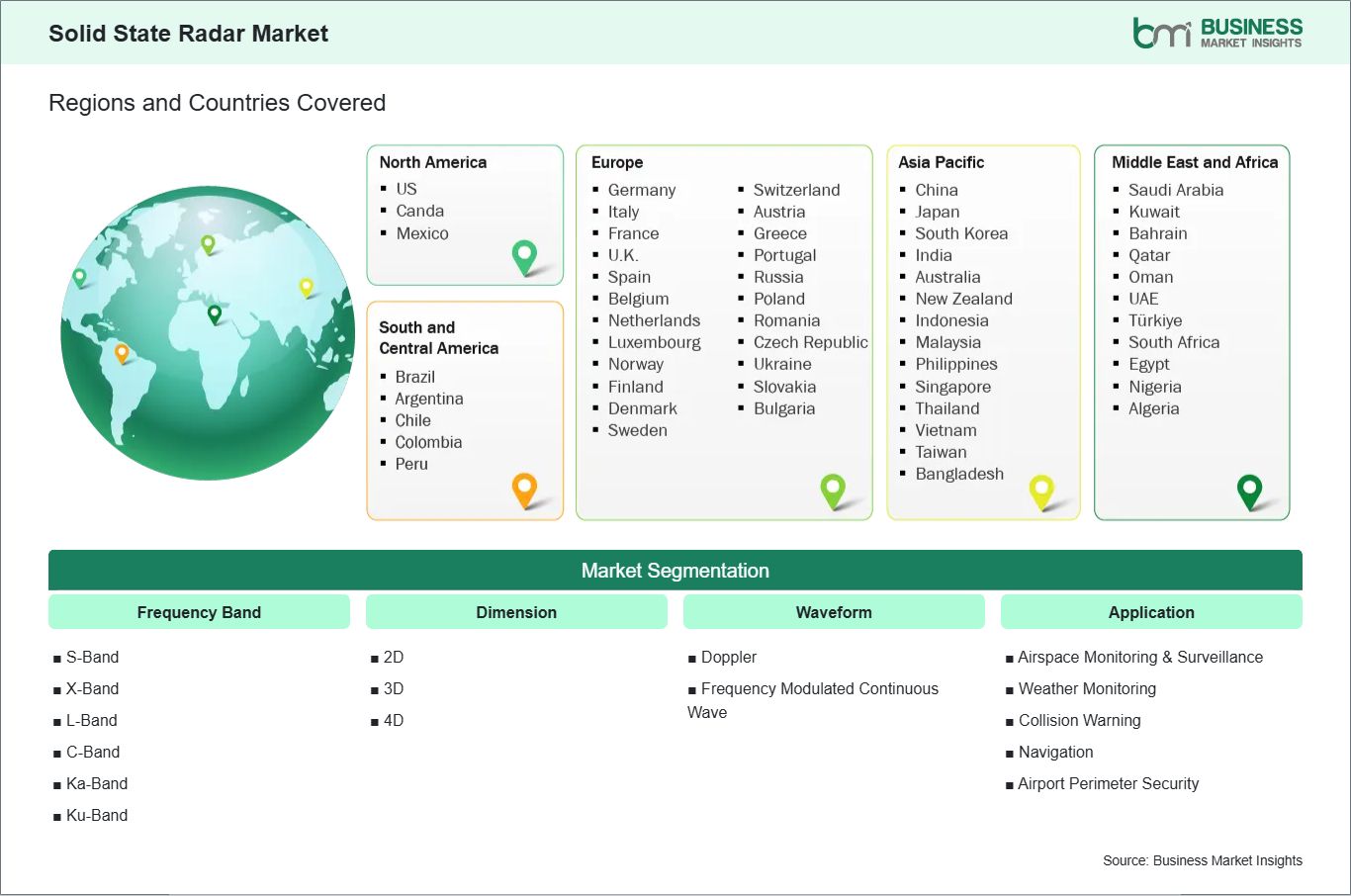
Key segments that contributed to the derivation of the solid state radar market analysis are frequency band, dimension, waveform, application, and industry.
The global solid state radar market is experiencing strong growth due to rising demand for advanced automotive safety systems. As vehicles increasingly incorporate automated driver-assistance technologies, radar sensors have become critical for collision avoidance, adaptive cruise control, and lane-keeping assistance. The need for precise and reliable detection of surrounding vehicles and obstacles is driving widespread adoption of solid state radar in modern vehicles. Growing consumer awareness of vehicle safety, along with regulatory standards for accident prevention, is further fueling market expansion. Manufacturers are investing in high-performance radar systems to ensure compliance with safety requirements while maintaining competitive advantages in the automotive industry. These developments are creating consistent demand for advanced radar solutions.
Additionally, the shift toward autonomous and semi-autonomous vehicles is intensifying the need for robust sensing technologies. Solid state radar provides accurate real-time monitoring of dynamic driving environments, enabling enhanced vehicle control, improved safety, and reduced accident risks, which positions it as a key technology for the automotive market.
Solid state radar is becoming increasingly important in aerospace and defense applications due to its reliability, high resolution, and low maintenance requirements. It is widely used in surveillance, threat detection, and airspace monitoring systems where precise tracking of fast-moving objects is essential. The technology’s ability to operate continuously and provide accurate detection makes it an ideal solution for both civil and defense applications. The demand for integrated air traffic management, secure borders, and advanced situational awareness is further driving adoption. Solid state radar enables real-time monitoring and rapid response to potential threats, enhancing operational efficiency and safety across critical systems. Its scalability and adaptability make it suitable for a range of platforms, including airborne, maritime, and ground-based installations. In addition, investments in next-generation aerospace and defense technologies are encouraging the deployment of solid state radar across multiple applications. The trend toward miniaturization, higher precision, and multifunctional radar platforms is creating new opportunities, positioning solid state radar as a vital component for modern aerospace and defense operations.
The Solid State Radar Market demonstrates steady growth, with size and share analysis highlighting evolving trends and competitive dynamics among key players. The report examines subsegments categorized within frequency band, dimension, waveform, application, and industry, offering insights into their contribution to overall market performance.
Frequency Band, the X‑Band subsegment dominated the market in 2025, driven by high-resolution imaging and extensive use in defense and air traffic monitoring.
Based on Dimension, the 3D subsegment dominated the market in 2025, driven by advanced target detection, tracking, and situational awareness capabilities.
Based on Waveform, the FMCW subsegment dominated the market in 2025, driven by superior range resolution and velocity measurement performance.
Based on Application, the airspace monitoring & surveillance subsegment dominated the market in 2025, driven by increased air traffic management and defense requirements.
In terms of Industry, the commercial subsegment dominated the market in 2025, driven by demand from civil aviation, airport security, and commercial shipping sectors.
| Report Attribute | Details |
|---|---|
| Market size in 2025 | US$ 2.05 Billion |
| Market Size by 2033 | US$ 2.75 Billion |
| Global CAGR (2026 - 2033) | 3.74% |
| Historical Data | 2022-2024 |
| Forecast period | 2026-2033 |
| Segments Covered | By Frequency Band
|
|
Regions and Countries Covered
| |
| North America | US, Canada, Mexico |
| Europe | Belgium, Austria, Finland, Denmark, Greece, Poland, Romania, Russia, Ukraine, Czech Republic, Slovakia, Bulgaria, Italy, Luxembourg, Germany, Switzerland, France, Netherlands, Norway, Portugal, Spain, Sweden, United Kingdom |
| Asia-Pacific | Australia, China, India, Japan, South Korea, Indonesia, Malaysia, Philippines, Singapore, Thailand, Vietnam, Bangladesh, New Zealand, Taiwan |
| South and Central America | Brazil, Argentina, Peru, Chile, Colombia |
| Middle East and Africa | Bahrain, Kuwait, Oman, Qatar, Saudi Arabia, United Arab Emirates, Turkiye, South Africa, Egypt, Algeria, Nigeria |
| Market leaders and key company profiles |
|
The "Solid State Radar Market Size and Forecast (2022 - 2033)" report provides a detailed analysis of the market covering below areas:
The geographical scope of the Solid State Radar Market report is divided into North America, Asia Pacific, Europe, Middle East & Africa, and South & Central America. North America held the largest share in 2025.
Regional adoption of solid state radar systems is influenced by defense spending, technological infrastructure, and industrial applications. North America dominates the market, supported by high defense budgets, advanced R&D facilities, and extensive adoption of radar systems in military, aerospace, and autonomous vehicle applications. The United States leads in deploying GaN-based radars, phased-array systems, and multifunctional radar technologies for air, naval, and terrestrial surveillance.
Asia Pacific is a rapidly growing market due to increased defense modernization programs, expanding commercial aviation, and automotive radar adoption. Countries such as China, Japan, and South Korea are investing in high-performance radar solutions for air defense, naval security, and intelligent transportation systems. India is gradually enhancing its radar infrastructure for border security and air traffic management.
Europe focuses on advanced military radars, weather monitoring, and industrial applications. Germany, France, and the United Kingdom are actively integrating solid state radar technologies in naval vessels, airport surveillance, and autonomous systems.
Middle East & Africa is expanding radar adoption for border security, maritime surveillance, and infrastructure protection, with Saudi Arabia, UAE, and South Africa investing in modern radar systems. South & Central America is gradually implementing radar technologies for aviation safety, maritime monitoring, and industrial applications, reflecting a growing emphasis on modernization and technological development across emerging markets.

The Solid State Radar Market is evaluated by gathering qualitative and quantitative data post primary and secondary research, which includes important corporate publications, association data, and databases. A few of the key developments in the solid state radar market are:
The Solid State Radar Market is valued at US$ 2.05 Billion in 2025, it is projected to reach US$ 2.75 Billion by 2033.
As per our report Solid State Radar Market, the market size is valued at US$ 2.05 Billion in 2025, projecting it to reach US$ 2.75 Billion by 2033. This translates to a CAGR of approximately 3.74% during the forecast period.
The Solid State Radar Market report typically cover these key segments-
The historic period, base year, and forecast period can vary slightly depending on the specific market research report. However, for the Solid State Radar Market report:
The Solid State Radar Market is populated by several key players, each contributing to its growth and innovation. Some of the major players include:
The Solid State Radar Market report is valuable for diverse stakeholders, including:
Essentially, anyone involved in or considering involvement in the Solid State Radar Market value chain can benefit from the information contained in a comprehensive market report.
Please tell us your area of interest
(Market Segments/ Regions and Countries/ Companies)