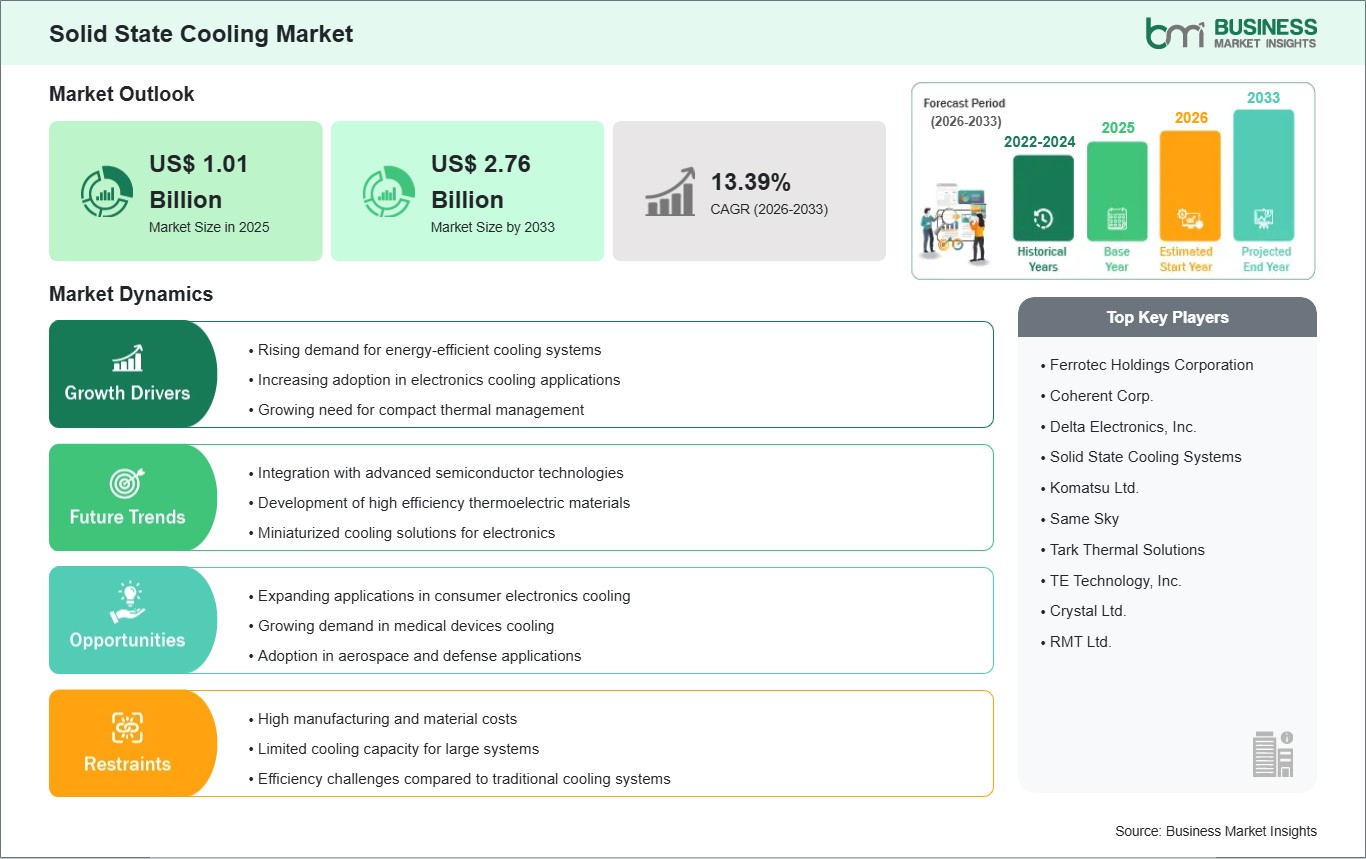
The Solid State Cooling Market size is expected to reach US$ 2.76 billion by 2033 from US$ 1.01 billion in 2025. The market is estimated to record a CAGR of 13.39% from 2026 to 2033.
The solid state cooling market is becoming an important sector of the larger thermal management industry. This change is driven by the rising demand for energy-efficient and eco-friendly cooling options. Solid state cooling technologies, including thermoelectric, magnetocaloric, and electrocaloric systems, provide a compact and sustainable choice compared to traditional vapor-compression refrigeration. They do this while cutting greenhouse gas emissions and lowering energy use. The increasing emphasis on low-carbon technologies and stricter environmental laws is speeding up the adoption of these systems in consumer electronics, automotive, medical, and industrial fields. Improvements in material science, like high-performance thermoelectric alloys and magnetocaloric compounds, are boosting cooling efficiency, stability, and the lifespan of devices.
Companies are putting money into product development to create modular and scalable cooling solutions that work for both small electronics and large industrial operations. Combining these systems with smart controls and IoT monitoring tools allows for real-time performance updates, predictive maintenance, and energy-efficient operations. Market trends also reflect a growing need for portable and quiet cooling systems, especially in electronics and medical devices. Collaborations between material developers, component makers, and system integrators are helping bring advanced solid state cooling technologies to market. Overall, the market is moving towards solutions that blend high performance with sustainability and flexibility for various applications, supporting its long-term growth.

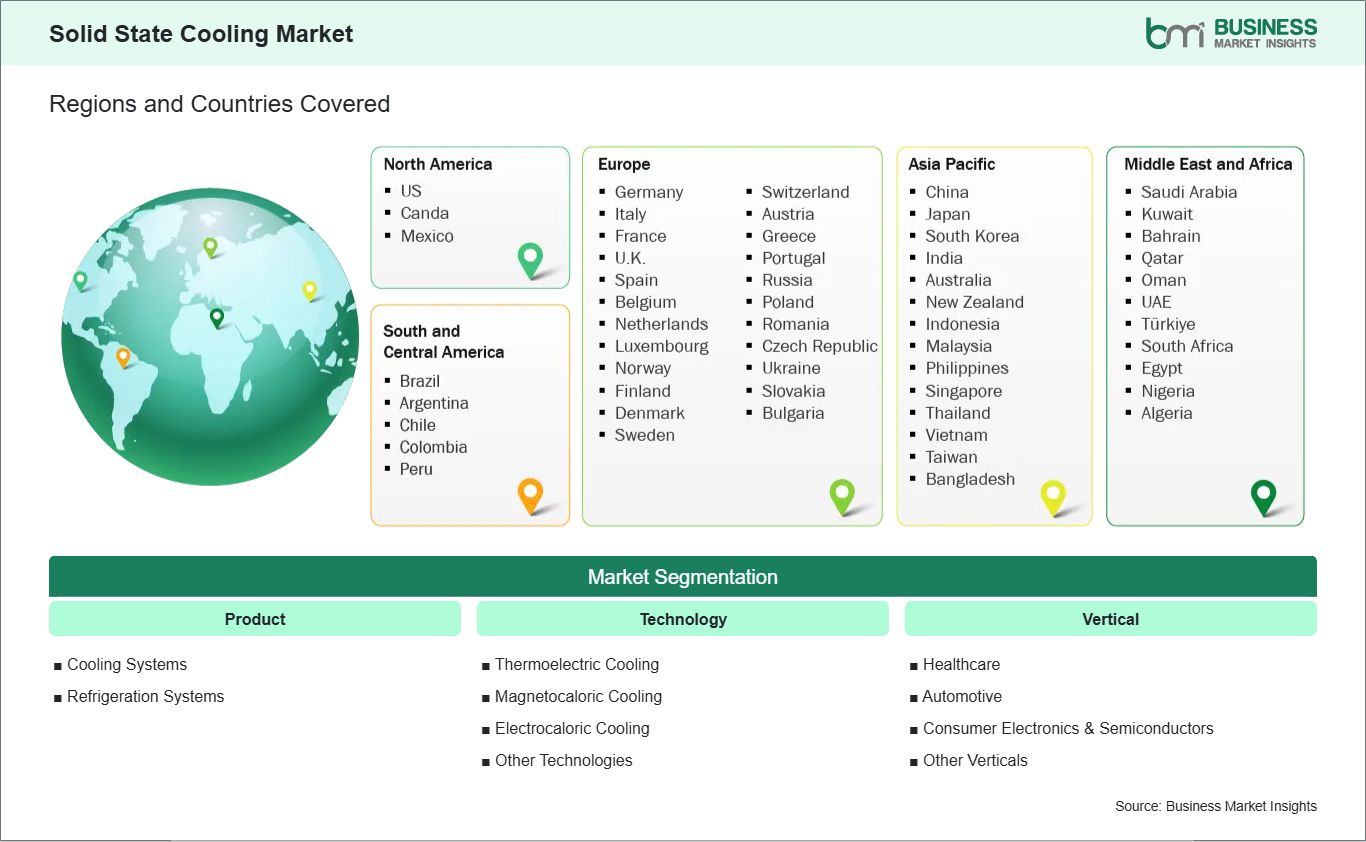
Key segments that contributed to the derivation of the solid state cooling market analysis are product, technology, and vertical.
The global solid state cooling market is experiencing significant growth due to the increasing emphasis on energy efficiency and sustainable thermal management. As industries and consumers seek alternatives to traditional cooling methods, solid state technologies offer advantages such as reduced power consumption, compact design, and lower environmental impact. These benefits are driving adoption across industrial, commercial, and residential applications. Rising energy costs and stringent efficiency regulations are further encouraging the shift toward solid state cooling. Manufacturers are investing in research and development to improve device performance, enhance reliability, and reduce operational expenses. This focus on efficiency helps end users achieve both cost savings and compliance with evolving energy standards, reinforcing market growth. Additionally, the need for precise temperature control in high-performance electronics and sensitive equipment is creating a steady demand for solid state cooling systems. These systems provide consistent and rapid cooling without the use of traditional refrigerants, making them a preferred choice for applications where stability, safety, and energy savings are critical.
The rise of high-performance consumer electronics is fueling demand for solid state cooling solutions capable of handling increased heat loads in compact devices. Smartphones, laptops, gaming systems, and wearable devices require effective thermal management to maintain performance and prolong device lifespan. Solid state cooling meets these needs by offering silent operation, reduced size, and high efficiency. Innovations in solid state cooling are enabling integration into increasingly miniaturized electronics. Advanced designs allow precise temperature control, which prevents overheating in densely packed components and improves overall device reliability. As consumer expectations for faster, more powerful devices grow, manufacturers are exploring solid state technologies to maintain optimal thermal conditions. Furthermore, the market is benefiting from the expansion of new electronics segments, such as portable and smart devices, where conventional cooling methods are impractical. Solid state cooling solutions are increasingly seen as essential for maintaining device performance, enhancing user experience, and supporting the next generation of energy-efficient, high-tech electronics.
The Solid State Cooling Market demonstrates steady growth, with size and share analysis highlighting evolving trends and competitive dynamics among key players. The report examines subsegments categorized within product, technology, and vertical, offering insights into their contribution to overall market performance.
Product, the cooling systems subsegment dominated the market in 2025, driven by increasing demand for efficient thermal management solutions.
Based on Technology, the thermoelectric cooling subsegment dominated the market in 2025, driven by its compact size, reliability, and energy efficiency in electronics and medical applications.
In terms of Vertical, the healthcare subsegment dominated the market in 2025, driven by adoption in medical devices, lab refrigeration, and temperature-sensitive storage solutions.
| Report Attribute | Details |
|---|---|
| Market size in 2025 | US$ 1.01 Billion |
| Market Size by 2033 | US$ 2.76 Billion |
| Global CAGR (2026 - 2033) | 13.39% |
| Historical Data | 2022-2024 |
| Forecast period | 2026-2033 |
| Segments Covered | By Product
|
|
Regions and Countries Covered
| |
| North America | US, Canada, Mexico |
| Europe | Belgium, Austria, Finland, Denmark, Greece, Poland, Romania, Russia, Ukraine, Czech Republic, Slovakia, Bulgaria, Italy, Luxembourg, Germany, Switzerland, France, Netherlands, Norway, Portugal, Spain, Sweden, United Kingdom |
| Asia-Pacific | Australia, China, India, Japan, South Korea, Indonesia, Malaysia, Philippines, Singapore, Thailand, Vietnam, Bangladesh, New Zealand, Taiwan |
| South and Central America | Brazil, Argentina, Peru, Chile, Colombia |
| Middle East and Africa | Bahrain, Kuwait, Oman, Qatar, Saudi Arabia, United Arab Emirates, Turkiye, South Africa, Egypt, Algeria, Nigeria |
| Market leaders and key company profiles |
|
The "Solid State Cooling Market Size and Forecast (2022 - 2033)" report provides a detailed analysis of the market covering below areas:
The geographical scope of the Solid State Cooling Market report is divided into North America, Asia Pacific, Europe, Middle East & Africa, and South & Central America. North America held the largest share in 2025.
The global solid state cooling market exhibits diverse regional dynamics driven by industrial development, environmental regulations, and technology adoption. North America is the dominant market, supported by advanced research infrastructure, high demand for energy-efficient solutions, and strong adoption of solid state cooling in consumer electronics, automotive HVAC systems, and medical refrigeration. The United States and Canada lead in R&D initiatives, with universities, national laboratories, and private companies collaborating to develop high-performance thermoelectric and magnetocaloric cooling solutions. Strong regulatory support for sustainable technologies further reinforces the region’s leadership.
Asia Pacific is emerging as a high-growth region due to rapid industrialization, urbanization, and expansion of electronics and automotive manufacturing. China, Japan, and South Korea are investing heavily in advanced materials and solid state cooling systems, while India is gradually implementing these technologies in industrial and healthcare sectors.
Europe focuses on eco-friendly industrial refrigeration and consumer electronics applications, driven by stringent environmental policies and sustainability targets in Germany, France, and the Netherlands.
Middle East & Africa is adopting solid state cooling primarily for industrial, specialty, and climate-resilient applications, especially in regions with extreme temperatures and limited energy infrastructure.
South & Central America is gradually expanding its adoption of solid state cooling in healthcare, cold chain logistics, and electronics, reflecting increasing technological modernization and environmental awareness in emerging markets.

The Solid State Cooling Market is evaluated by gathering qualitative and quantitative data post primary and secondary research, which includes important corporate publications, association data, and databases. A few of the key developments in the solid state cooling market are:
The Solid State Cooling Market is valued at US$ 1.01 Billion in 2025, it is projected to reach US$ 2.76 Billion by 2033.
As per our report Solid State Cooling Market, the market size is valued at US$ 1.01 Billion in 2025, projecting it to reach US$ 2.76 Billion by 2033. This translates to a CAGR of approximately 13.39% during the forecast period.
The Solid State Cooling Market report typically cover these key segments-
The historic period, base year, and forecast period can vary slightly depending on the specific market research report. However, for the Solid State Cooling Market report:
The Solid State Cooling Market is populated by several key players, each contributing to its growth and innovation. Some of the major players include:
The Solid State Cooling Market report is valuable for diverse stakeholders, including:
Essentially, anyone involved in or considering involvement in the Solid State Cooling Market value chain can benefit from the information contained in a comprehensive market report.
Please tell us your area of interest
(Market Segments/ Regions and Countries/ Companies)