Market Summary
Executive Summary and Global Market Analysis
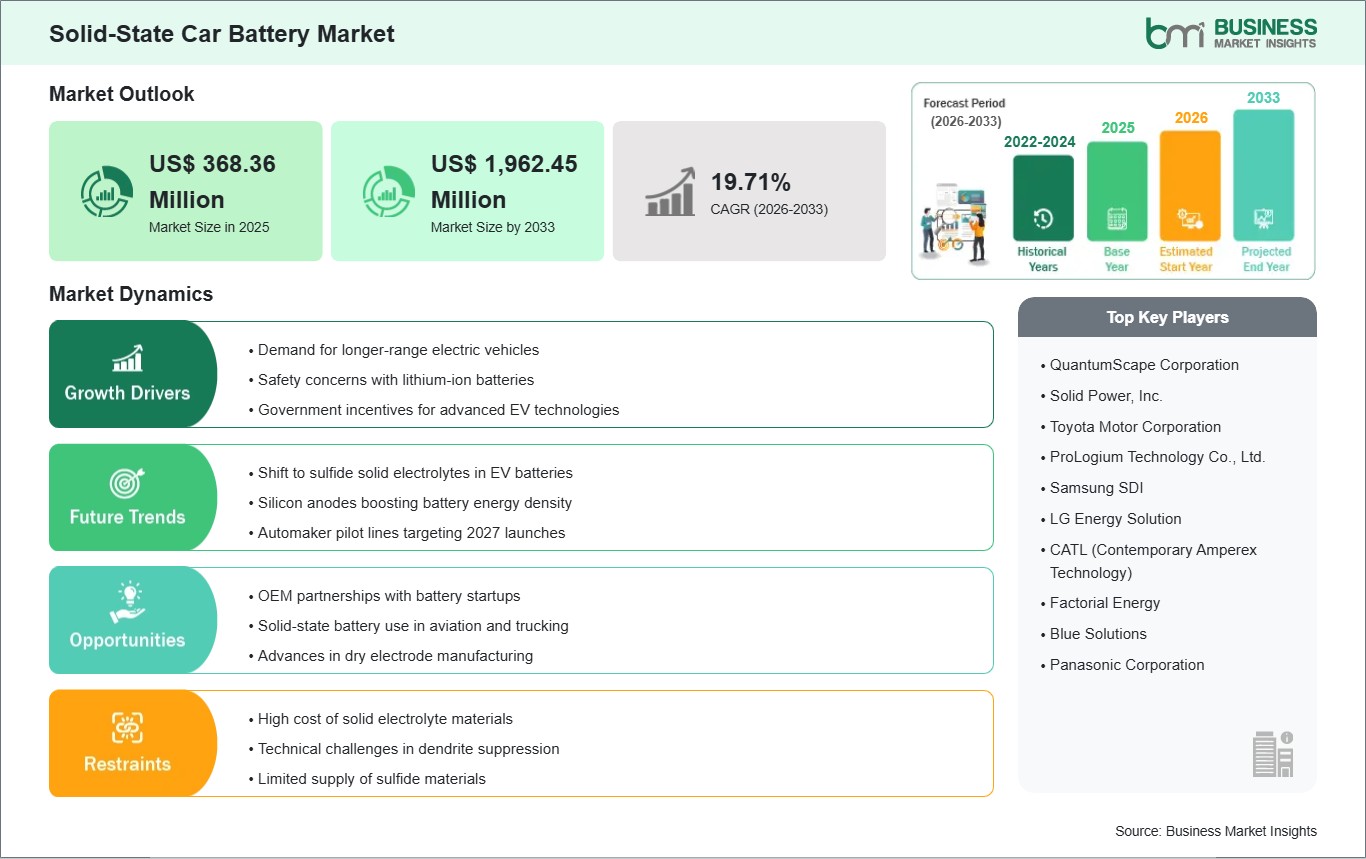
Solid-state car batteries represent a major advancement in electric vehicle technology, replacing liquid-based lithium-ion systems with solid electrodes and electrolytes. The market includes a range of technologies, such as semi-solid state, sulfide-based, oxide, and polymer electrolytes, all essential for next-generation high-performance transportation. These batteries offer significant strategic benefits by removing flammable liquid components, reducing thermal runaway risks, and nearly doubling energy density. This technology supports the future of long-range passenger EVs, electric aviation, and heavy-duty transport. Market growth is fueled by the demand for extended driving ranges over 1,000 km, ultra-fast charging, and substantial government-backed R&D investment targeting energy independence. Additionally, the shift to lithium-metal and silicon-composite anodes is increasing cell-specific energy, paving the way for lighter, safer, and more efficient EVs.
However, several challenges can restrain market growth: high manufacturing complexity and cost remain significant barriers, with current solid-state prototypes costing several times more than established lithium-ion cells due to specialized "dry-room" requirements and exotic materials. Technical interface issues, specifically the difficulty of maintaining consistent contact between solid materials during expansion and contraction, can lead to rapid capacity loss. Additionally, the industry faces constraints due to lithium dendrite formation, where microscopic metallic whiskers can still pierce solid separators, potentially causing short circuits and limiting the overall cycle life of early-generation models.
Despite these hurdles, the market holds immense opportunities in the universal push for zero-emission luxury mobility and the deployment of modular, solid-state energy storage. The expansion of pilot-scale production lines and the development of proprietary, scalable manufacturing processes (such as high-speed roll-to-roll coating) are expected to create significant opportunities for commercial-scale breakthroughs in the coming years.
Segment Analysis
Solid-State Car Battery Market Segmentation
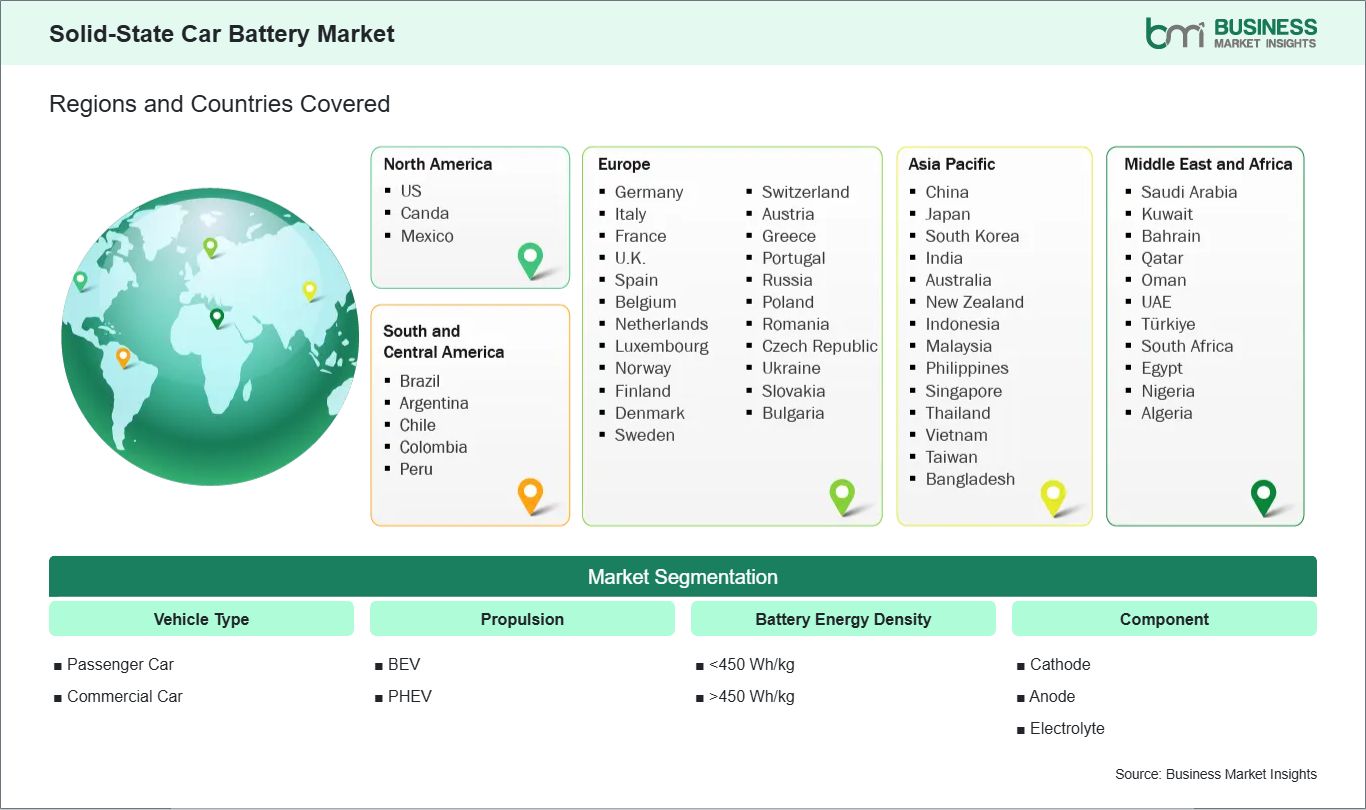
Key segments that contributed to the derivation of the Solid-State Car Battery market analysis are vehicle type, propulsion, battery energy density and component.
- By vehicle type, the market is segmented into passenger car and commercial car.
- By propulsion, the market is divided into BEV and PHEV.
- By battery energy density, the market is categorized into <450 Wh/kg and >450 Wh/kg.
- By component, the market is segmented into cathode, anode, and electrolyte.
Market Forces
Solid-State Car Battery Market Drivers and Opportunities
Advancing Safety Standards and High-Energy Performance Mandates
The primary driver for the Solid-State Car Battery Market is the urgent global requirement for safer, longer-range energy storage solutions that can accelerate the mass adoption of electric vehicles. As of 2026, the industry has reached a tipping point where traditional lithium-ion technology is approaching its theoretical energy density limits, making solid-state architectures non-discretionary for the next generation of high-performance and long-haul EVs. The intrinsic safety of solid electrolytes is a massive catalyst; by eliminating flammable liquid components, these batteries significantly reduce the risk of thermal runaway and fire during high-speed charging or structural impacts. This momentum is further amplified by the intensifying demand for "range anxiety" solutions, as solid-state cells can theoretically double the energy density of current batteries, enabling EVs to achieve ranges exceeding 1,000 kilometers on a single charge.
Furthermore, tightening environmental regulations and government-led decarbonization targets, such as the Paris Agreement goals, are forcing automakers to invest heavily in solid-state R&D to deliver vehicles that charge as quickly as filling a gas tank. With major players such as Toyota, Samsung SDI, and Factorial Energy now moving into commercial-scale pilot production, the drive toward a "solid-state standard" has become a central pillar of the global automotive strategy.
Ultra-Fast Charging and Cross-Sector Power Integration
A significant high-value opportunity lies in the potential for Ultra-Fast Charging Capabilities that can revolutionize the consumer experience. Next-generation solid-state ICs and cell designs allow for extremely high current densities without the degradation common in liquid cells, potentially enabling a full charge in under 15 minutes. There is also a major growth frontier in the development of Lithium-Metal and Anode-Free Architectures, which present a lucrative opportunity for manufacturers to drastically reduce battery weight and volume, allowing for more aerodynamic and efficient vehicle designs. Beyond passenger cars, the Heavy-Duty and Aerospace Electrification sectors offer a substantial opportunity; the high power-to-weight ratio of solid-state batteries is ideal for electric trucks, buses, and emerging eVTOL (electric vertical takeoff and landing) aircraft that require immense energy for lift and long-duration flight.
Furthermore, the rise of Circular Economy and Battery Recycling initiatives presents an opportunity for companies to pioneer specific recovery processes for expensive solid-state materials like silver or specialized ceramics. Manufacturers who focus on solving the current "interface resistance" challenges and those pioneering hybrid "semi-solid" designs to bridge the gap to full-scale mass production are positioned to lead the most innovative and high-margin segments of the energy landscape.
Size and Share Analysis
Solid-State Car Battery Market Size and Share Analysis
The Solid-State Car Battery market demonstrates steady growth, with size and share analysis revealing evolving trends and competitive positioning among key players. The report further examines subsegments categorized within vehicle type, propulsion, battery energy density and component, offering insights into their contribution to overall market performance.
Based on vehicle type, Passenger Cars subsegment holds a significant market presence, serving as the industry benchmark for the early deployment of premium, long-range electric vehicles (EVs). Passenger Cars are indispensable for the Luxury Automotive sector, where consumers prioritize rapid charging and extended range, justifying the higher initial cost of solid-state technology. A notable trend is the surge in the Commercial Car subsegment, which is registering a higher CAGR as logistics fleets and public transit authorities seek batteries with higher cycle life and improved safety profiles. These commercial units are becoming essential for heavy-duty trucks and buses, providing a data-driven path to reducing the total cost of ownership through lower maintenance and reduced fire risk in high-utilization environments.
Report Coverage
Solid-State Car Battery Market Report Coverage and Deliverables
The "Solid-State Car Battery Market Size and Forecast (2022 - 2033)" report provides a detailed analysis of the market covering below areas:
- Solid-State Car Battery market size and forecast at global, regional, and country levels for all the key market segments covered under the scope
- Solid-State Car Battery market trends, as well as market dynamics such as drivers, restraints, and key opportunities
- Solid-State Car Battery market analysis covering key market trends, global and regional framework, major players, regulations, and recent market developments
- Industry landscape and competition analysis covering market concentration, heat map analysis, prominent players, and recent developments for the Solid-State Car Battery market
- Detailed company profiles, including SWOT analysis
Geographic Insights
Solid-State Car Battery Market Geographic Insights
The geographical scope of the Solid-State Car Battery market report is divided into five regions: North America, Asia Pacific, Europe, Middle East & Africa, and South & Central America.
The Asia-Pacific Solid-State Car Battery Market is segmented into China, Japan, South Korea, India, Australia, and the Rest of Asia. In the current landscape, Japan and South Korea lead in technical research and development, with major automotive and electronics firms pushing for commercialization. China acts as the volume engine, leveraging its massive domestic EV market and established lithium-ion infrastructure to pivot toward next-generation solid-state cells. India is emerging as a critical growth hub, supported by aggressive government incentives for electric mobility and a rising number of strategic partnerships between domestic vehicle manufacturers and global battery technology providers.
Growth is further bolstered by a significant shift toward sulfide-based and oxide-based electrolyte systems among manufacturers looking to achieve superior ionic conductivity and thermal stability. The integration of high-potential cathodes and lithium-metal anodes, alongside the rising demand for ultra-fast charging capabilities in the premium passenger vehicle segment, solidifies Asia-Pacific as a critical hub for innovation and the future scaling of the Solid-State Car Battery industry.
Industry Activity
Recent Developments
The Solid-State Car Battery market is evaluated by gathering qualitative and quantitative data post primary and secondary research, which includes important corporate publications, association data, and databases. A few of the key developments in the Solid-State Car Battery market are:
- In October 2025, Solid Power announced a strategic collaboration with Samsung SDI and BMW to pursue development and validation of a demonstration vehicle powered by all-solid-state battery (ASSB) technology. This collaboration marks a key step towards commercialization of ASSB technology, bringing together the complementary expertise of three industry leaders. Under this arrangement, Solid Power will provide sulfide-based solid electrolyte to Samsung SDI, which Samsung SDI will integrate into separator and/or catholyte and use to build cells, in each case subject to achievement of technical requirements.
- In July 2025, QuantumScape Corporation announced the strategic collaboration and licensing arrangement with PowerCo SE, the battery company of the Volkswagen Group, originally entered into in July 2024. The updated collaboration agreement is designed to accelerate the QSE-5 battery development pilot line in San Jose, marking a major step forward in the industrialization of solid-state battery technology. This expansion enables higher-volume prototype cell production and advances commercialization efforts, reinforcing growth in the solid-state car battery market.
Trust & Transparency
Research Methodology
The market analysis combines proprietary research with secondary data from government agencies, company disclosures, regulatory filings, industry databases and expert interviews. Market estimates are validated through data triangulation, cross-market benchmarking and analyst
review.
View Full Research Methodology
Key Sources Referred:
World Bank - Global Trade IndicatorsWorld Trade Organization (WTO)International Monetary Fund (IMF)International Trade Administration (ITA)Company WebsitesCompany Annual ReportsCompany Investor Presentations