Market Summary
Executive Summary and Global Market Analysis
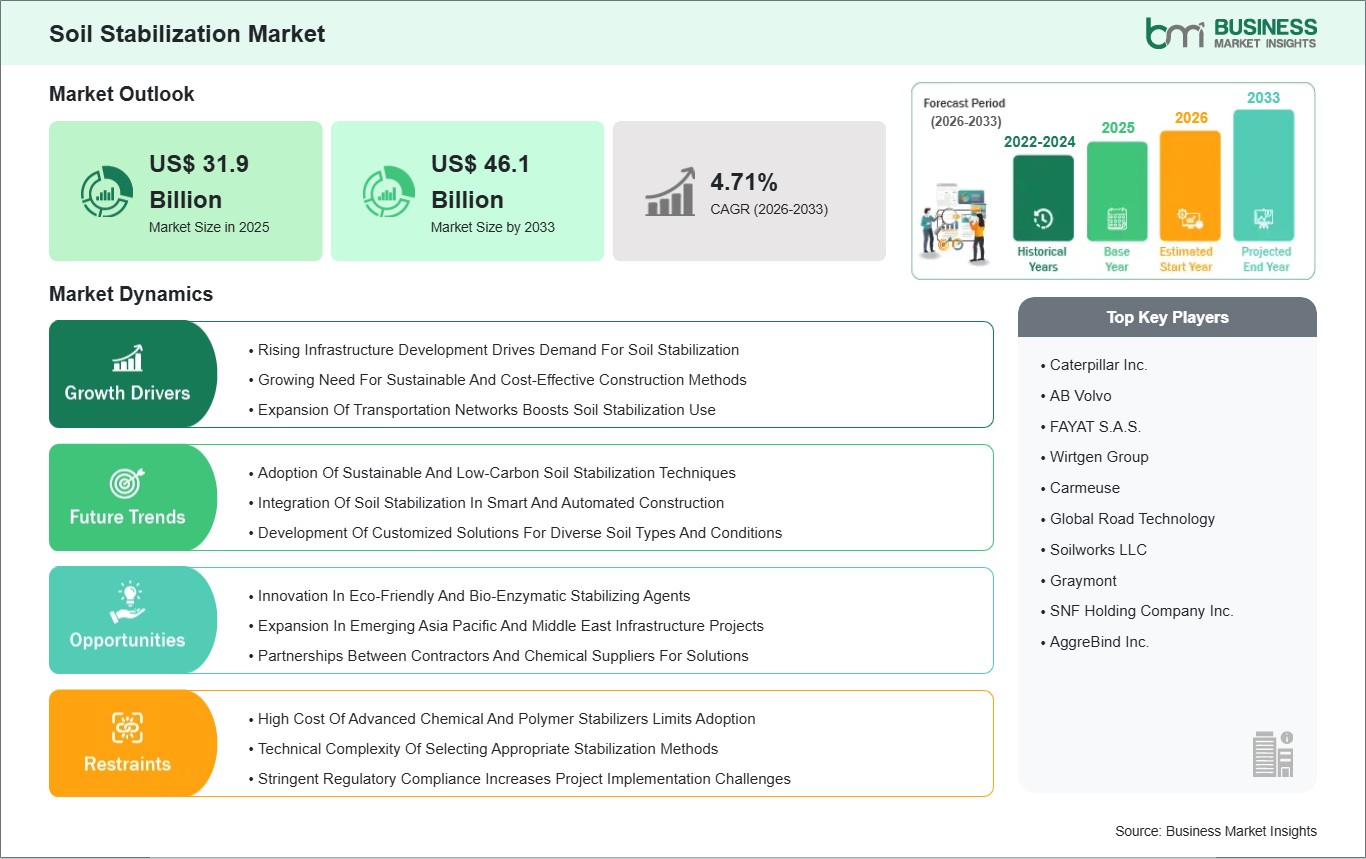
The global soil stabilization market has become a vital part of civil infrastructure development and geotechnical engineering results because of rising expenditures on transportation systems and city expansion work and environmental restoration initiatives. The term soil stabilization describes the process of soil strength improvement through mechanical and chemical and joint method technologies. The market now holds greater value because roads and runways and railway embankments and industrial projects require stable ground conditions to maintain safety and durability. The stabilization methods of lime cement fly ash and polymers and newly developed bio-enzymatic products work for different soil types which include expansive clay and loose sand and peat and silt. The global soil stabilization market experiences its primary growth driver through increased dedication to building resilient infrastructure and environmentally friendly construction methods. The foundation systems which are used in areas with strong weather patterns and earthquake threats and soil movement dangers now receive higher importance from both governmental bodies and private construction firms. The use of soil stabilization techniques improves geotechnical capabilities while decreasing excavation expenses and the requirement for large quantities of fill material and the need for ongoing maintenance. The chemical stabilizers and eco-friendly additives which reduce carbon emissions and stop contaminants from leaking into the environment drive market expansion in regions with strict environmental protection rules. The market encounters obstacles despite having beneficial market drivers.
The cost of advanced polymers and proprietary chemical blends which serve as high-performance stabilizing agents functions as a price barrier for developing regions that have budget constraints. The technical requirements needed for choosing proper stabilization methods to treat different soil types restrict their use in regions which do not have competent geotechnical professionals. Multinational contractors and engineering firms face implementation difficulties because of the different environmental compliance requirements and regulatory systems which exist in various regions. The global soil stabilization market develops through two main factors which include urgent infrastructure development needs and the growing adoption of sustainable high-performance ground improvement methods.
Segment Analysis
Soil Stabilization Market Segmentation
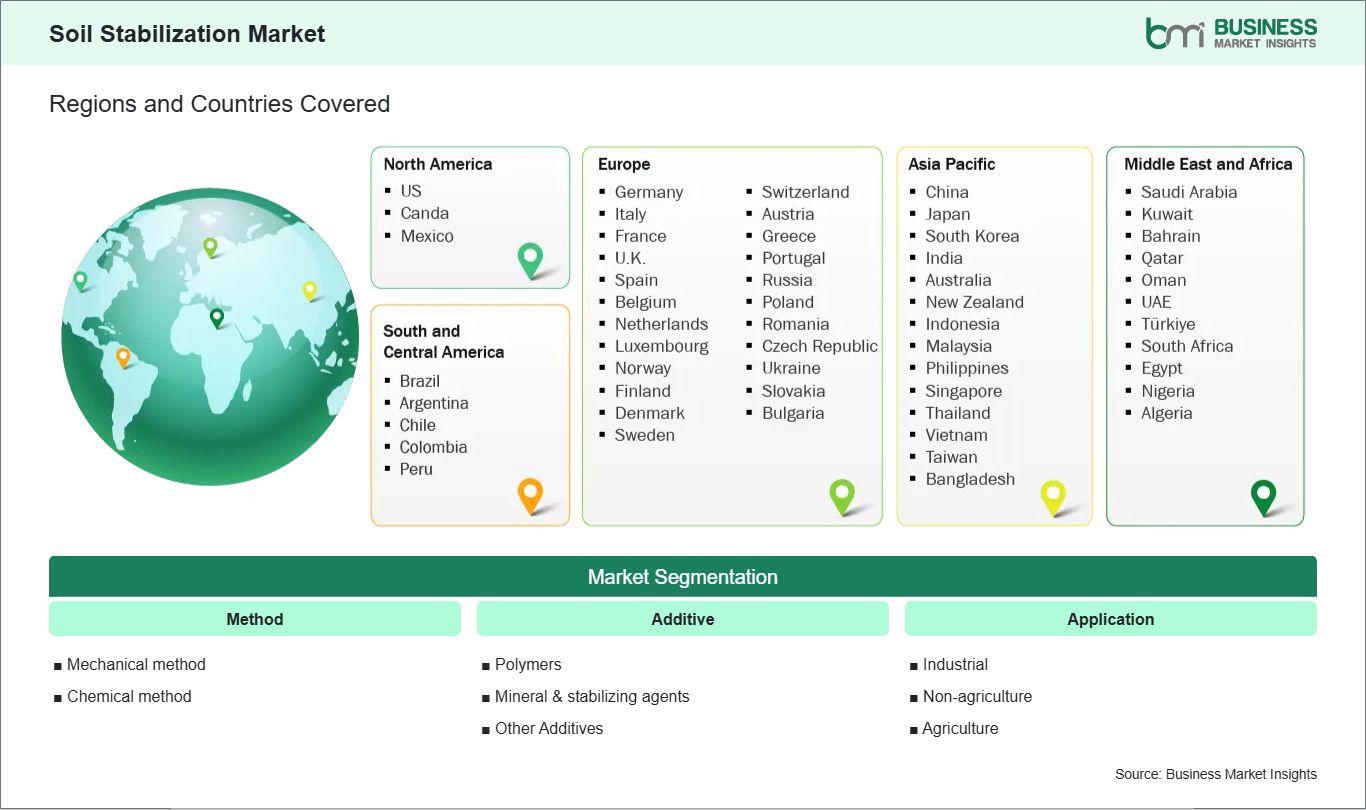
Key segments that contributed to the derivation of the soil stabilization market analysis are method, additive and application.
- By method, the soil stabilization market is segmented into mechanical method, chemical method. The mechanical method segment dominated the market in 2025.
- Based on additive, the soil stabilization market is categorized into polymers, mineral & stabilizing agents, other additives. The mineral & stabilizing agents segment dominated the market in 2025.
- In terms of application, the soil stabilization market is categorized into industrial, non‑agriculture, agriculture. The industrial segment dominated the market in 2025.
Market Forces
Soil Stabilization Market Drivers and Opportunities
Rising Infrastructure Development Drives Demand For Soil Stabilization
The worldwide market for soil stabilization solutions grows because of extensive infrastructure projects which include highway and railway and airport and urban development work. North American countries depend on soil stabilization products to maintain subgrades for their major road rehabilitation and urban transit expansion projects. The Asia Pacific region witnesses major infrastructure development projects in China and India and Indonesia which drive the need for affordable and long-lasting soil stabilization solutions. The project progress and structural stability of construction work depends on the use of cement and lime and polymer-based stabilizing materials. Soil stabilization solutions gain acceptance in emerging markets because of their urbanization and industrialization processes. Stabilized soils enable construction work to proceed on weak and expansive and loose soils because the material meets safety standards and extends the lifespan of high-density development projects and essential transportation infrastructure.
Construction companies use mechanical compaction together with chemical stabilization techniques to achieve better soil support capacity while decreasing their environmental impact, which results in improved performance for major infrastructure development projects. The market expands because of government programs which create sustainable infrastructure that remains usable for extended periods. Public works receive strategic funding which includes financial support for climate-resilient road and railway infrastructure, thus establishing soil stabilization as a vital element for project development.
Innovation In Eco‑Friendly And Bio‑Enzymatic Stabilizing Agents
The global market has increased its use of sustainable practices because organizations have started to adopt environmentally friendly solutions which include bio-enzymatic soil stabilizers and their environmentally friendly counterparts. The use of cement and lime as chemical stabilizers creates environmental problems because these materials produce CO₂ emissions and they have the potential to pollute soil. Bio-enzymatic stabilizers use natural enzymes and microbial activity to provide sustainability by improving soil compaction and strength without producing harmful effects on the environment.
The solutions are becoming more popular through North America and Europe because regulations now require construction projects to use methods which produce fewer carbon emissions. The emerging economies of Asia Pacific and South America are currently testing bio-based stabilizers which provide both budget-friendly and sustainable building solutions. Chemical and construction companies have taken the lead through their research initiatives which focus on developing improved enzyme efficiency and dosage optimization for road and railway and industrial site applications. Research institutions are working together with private companies to develop customized solutions which meet performance and cost and sustainability requirements. The global shift towards climate-resilient and environmentally friendly construction practices will make bio-enzymatic and sustainable stabilizing agents the standard choice for soil stabilization products.
Size and Share Analysis
Soil Stabilization Market Size and Share Analysis
The soil stabilization market demonstrates steady growth, with size and share analysis highlighting evolving trends and competitive dynamics among key players. The report examines subsegments categorized within method, additive and application, offering insights into their contribution to overall market performance.
By method, the mechanical method subsegment dominated the market in 2025, driven by its efficiency in improving soil load-bearing capacity for construction and infrastructure projects without heavy chemical usage.
Based on additive, the mineral & stabilizing agents subsegment dominated the market in 2025, driven by their widespread availability, cost-effectiveness, and proven performance in enhancing soil strength and durability.
In terms of application, the industrial subsegment dominated the market in 2025, driven by high demand from large-scale infrastructure and construction projects, which require reliable soil stabilization for roads, highways, and commercial sites.
Report Coverage
Soil Stabilization Market Report Coverage and Deliverables
The "Soil Stabilization Market Size and Forecast (2022 - 2033)" report provides a detailed analysis of the market covering below areas:
- Soil Stabilization Market size and forecast at global, regional, and country levels for all the key market segments covered under the scope
- Soil Stabilization Market trends, as well as drivers, restraints, and opportunities
- Soil Stabilization Market analysis covering key trends, global and regional framework, major players, regulations, and recent developments
- Industry landscape and competition analysis covering market concentration, heat map analysis, prominent players, and recent developments for the Soil Stabilization Market
- Detailed company profiles, including SWOT analysis
Geographic Insights
Soil Stabilization Market Geographic Insights
The geographical scope of the Soil Stabilization Market report is divided into North America, Asia Pacific, Europe, Middle East & Africa, and South & Central America. North America held the largest share in 2025.
The global soil stabilization market exhibits distinct regional dynamics, with North America emerging as the dominant market because of its developed infrastructure system and its extensive public and private investments in highways and urban transit and airport runways and its strong commitment to building sustainable and long-lasting infrastructures. In North America, especially the United States and Canada, contractors use soil stabilization methods to solve their problems with subgrade materials which contain expansive clay soils and experience freeze-thaw cycles and seasonal ground movement, while they increasingly implement advanced chemical stabilizers and lime and cement and polymer-based solutions.
The Asia Pacific region is experiencing rapid market growth because China and India and Japan and Southeast Asian nations are implementing extensive road construction and railway development and urban growth projects. The adoption of soil stabilization here is supported by infrastructure modernization programs, the need for cost-effective construction techniques, and the growing use of eco-friendly stabilizing agents to meet environmental regulations.
The European market operates under established construction regulations which enforce environmental standards and require the creation of high-quality road and rail systems. The countries of Germany and France and the UK employ various stabilization techniques which combine traditional methods with innovative practices to achieve project durability while protecting the environment.
The Middle East and Africa region demonstrates specific yet important requirements for soil stabilization because desert areas and reclaimed lands and urban development projects need to stabilize loose sandy soils and saline grounds in the United Arab Emirates and Saudi Arabia and South Africa.
South and Central America demonstrates moderate technology adoption because Brazilian and Argentine and Chilean road construction projects create demand for it although bus and taxi operators face challenges with cost and their drivers' different levels of technical knowledge. The regional adoption of technologies depends on three factors because soil features and regulatory requirements and the demand for permanent sustainable ground enhancement methods control technology usage while North America maintains its status as the world leader in developing and applying modern soil stabilization methods.
Industry Activity
Recent Developments
The Soil Stabilization Market is evaluated by gathering qualitative and quantitative data post primary and secondary research, which includes important corporate publications, association data, and databases. A few of the key developments in the soil stabilization market are:
- In October 2024, Soilworks, LLC announced that it had been awarded the Maricopa County Dust Control and Soil Stabilization Contract, strengthening its position as a provider of engineered soil stabilization and dust control solutions for infrastructure and environmental projects across North America and supporting global applications. This contract reflects Soilworks’ continued deployment of its soil stabilization technologies, including polymer‑based products that bond soil particles and improve surface stability.
- In March 2026, Volvo Construction Equipment announced the launch of the new SD70 soil compactor, a strategic rollout in the compaction segment that supports soil stabilization efforts on construction and infrastructure sites globally. The SD70 is positioned as a cost‑efficient, reliable solution for contractors and rental fleets, expanding Volvo CE`s compaction portfolio which directly serves soil stabilization and groundwork applications.
Trust & Transparency
Research Methodology
The market analysis combines proprietary research with secondary data from government agencies, company disclosures, regulatory filings, industry databases and expert interviews. Market estimates are validated through data triangulation, cross-market benchmarking and analyst
review.
View Full Research Methodology
Key Sources Referred:
World Health Organization (WHO) Organisation for Economic Cooperation and Development (OECD) The World Bank Group Worldometer The Lancet International Bar Association International Trade Administration