Market Summary
Executive Summary and Global Market Analysis
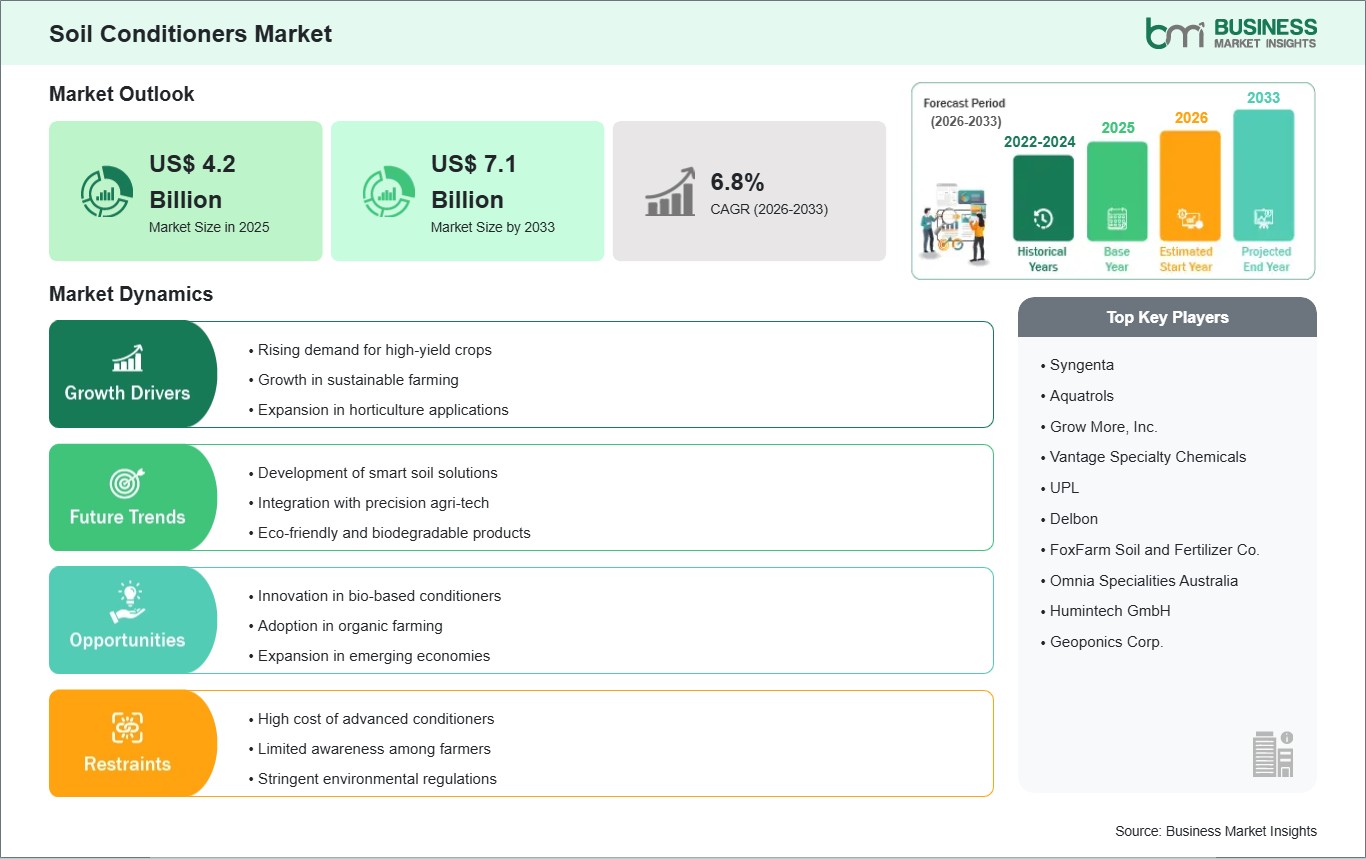
Soil conditioners, also referred to as soil amendments, are natural or synthetic substances added to soil to enhance its physical, chemical, and biological properties. Unlike fertilizers, which primarily provide direct nutrients to plants, these materials focus on improving soil structure, increasing aeration, boosting water retention, and regulating pH levels to create an optimal environment for root development and microbial activity. Market expansion is primarily attributed to the rising global prevalence of soil degradation and erosion, a growing emphasis on organic farming to meet consumer demand for residue-free produce, and government subsidies promoting soil health restoration. Furthermore, the integration of precision agriculture tools, which allow for the variable-rate application of liquid conditioners based on real-time soil sensor data, is substantially improving procedural efficiency.
However, the market faces notable challenges. The high cost of premium organic conditioners, such as biochar and humic substances, limits adoption among small-scale farmers, particularly in developing economies. Technical awareness remains low in these regions, creating a barrier to effective utilization. Additionally, the industry is sensitive to raw material availability; gypsum and humic substances are subject to supply fluctuations, impacting production costs and scalability. These factors collectively restrain market penetration and slow down the pace of innovation in certain segments.
Despite these hurdles, the soil conditioners market presents lucrative opportunities. The global shift toward sustainable agriculture and organic farming is accelerating demand for eco-friendly soil amendments. Regulatory frameworks in regions like the EU and North America are tightening restrictions on synthetic fertilizers, creating a favorable environment for organic alternatives. Furthermore, technological advancements, such as microbial inoculants, nano-scale conditioners, and AI-driven soil monitoring, are transforming soil health management, enabling precision application and improved efficiency. Government subsidies and sustainability initiatives further strengthen the outlook, positioning soil conditioners as a critical solution to combat soil degradation and ensure food security in an era of climate uncertainty.
Segment Analysis
Soil Conditioners Market Segmentation
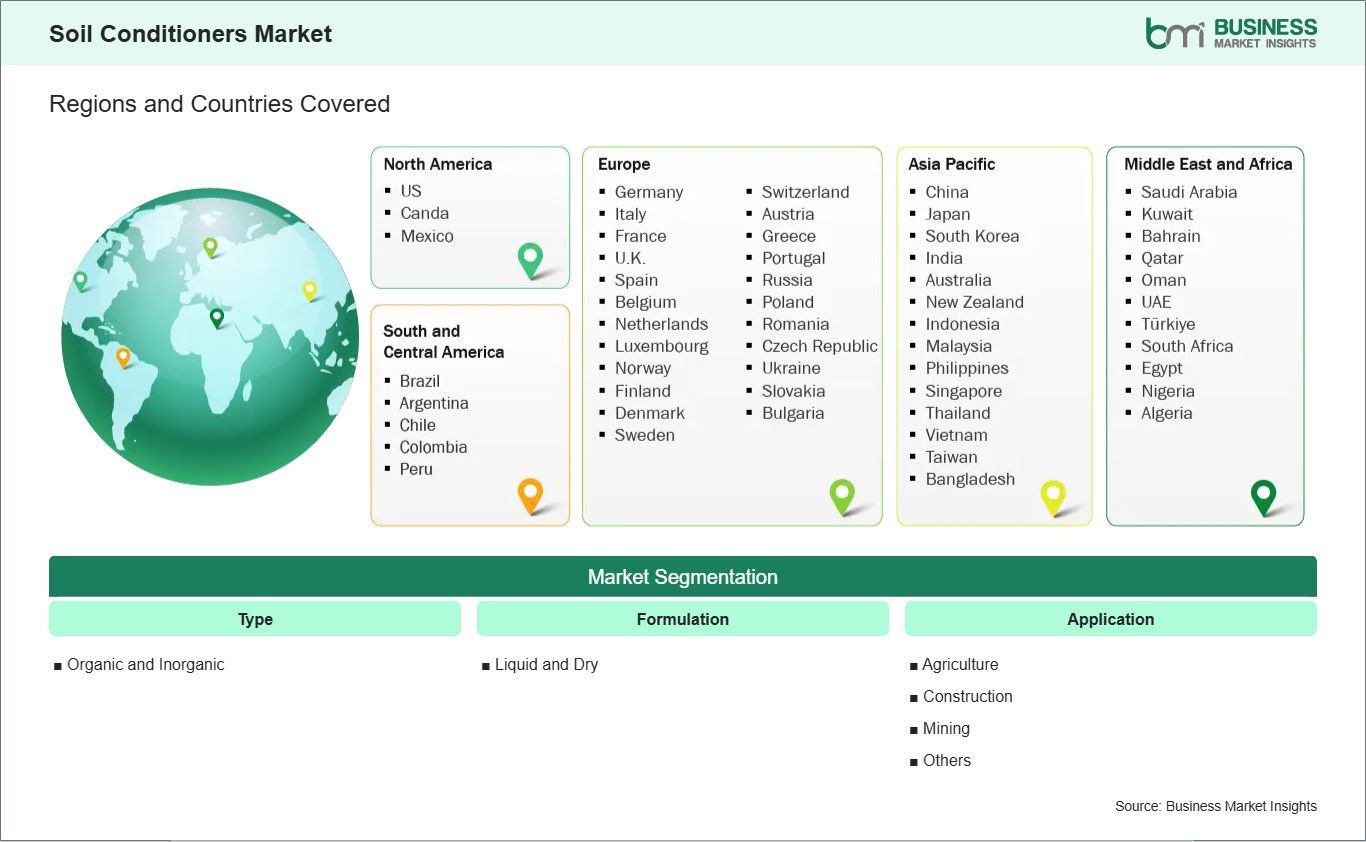
Key segments that contributed to the derivation of the Soil Conditioners market analysis are type, formulation, and application.
- By Type, the market is segmented into Organic and Inorganic.
- By Formulation, the market is segmented into Liquid and Dry.
- By Application, the market is segmented into Agriculture, Construction, Mining, and Others.
Market Forces
Soil Conditioners Market Drivers and Opportunities
Expansion of Organic Farming and Sustainable Agriculture
The global agricultural landscape is witnessing a significant transformation with the rapid expansion of organic farming and sustainable agricultural practices. This shift has become a major driver for the soil conditioners market, as farmers increasingly seek alternatives to synthetic fertilizers and chemicals. Rising consumer awareness about health and environmental impacts has fueled demand for chemical-free produce, compelling growers to adopt organic soil conditioners such as compost, green manure, and animal-based amendments. These products not only improve soil fertility but also enhance microbial activity, ensuring long-term sustainability of farmlands.
This growth trajectory is expected to accelerate further as regulatory authorities in regions like the European Union and North America impose stricter norms on synthetic fertilizer runoff and promote eco-friendly farming methods. Additionally, government incentives, certification programs, and premium pricing for organic products are encouraging farmers to transition toward sustainable practices, creating robust opportunities for soil conditioner manufacturers globally.
Rising Need to Combat Soil Degradation
The escalating issue of soil degradation presents a significant market opportunity for soil conditioner manufacturers. Globalization and intensive farming practices have led to widespread nutrient depletion, erosion, and structural damage to soils, reducing their productivity and resilience. With arable land shrinking due to rapid urbanization and industrialization, farmers and agribusinesses are under pressure to maximize output from existing land resources. This scenario is driving demand for advanced soil conditioners that can restore soil health and ensure sustainable crop yields.
Products such as gypsum and superabsorbent polymers are gaining traction as critical solutions for regions facing water scarcity and high salinity. Gypsum improves soil permeability and mitigates sodicity, while polymers enhance water retention, making them indispensable in drought-prone areas. As governments and agricultural bodies emphasize soil restoration and climate-resilient farming, businesses are increasingly investing in these technologies. The growing need to rejuvenate “tired” soils and maintain long-term productivity positions the soil conditioners market for robust growth, creating lucrative opportunities for innovation and expansion globally.
Size and Share Analysis
Soil Conditioners Market Size and Share Analysis
The Soil Conditioners market demonstrates steady growth, with size and share analysis revealing evolving trends and competitive positioning among key players. The report further examines subsegments categorized within type, formulation, and applications, offering insights into their contribution to overall market performance.
For instance, the Organic subsegment holds a significant market share. Organic conditioners, specifically compost, biochar, and animal manure, are indispensable for enhancing soil structure and microbial activity without the environmental footprint of synthetic alternatives. A notable trend in 2025 is the integration of "smart" biologicals, such as enzyme-activated bio-conditioners that accelerate nutrient cycling and carbon sequestration. These innovations are particularly vital in regenerative farming, where they empower growers to restore degraded land while qualifying for emerging carbon-credit monetization programs.
Report Coverage
Soil Conditioners Market Report Coverage and Deliverables
The "Soil Conditioners Market Size and Forecast (2022–2033)" report provides a detailed analysis of the market covering below areas:
- Soil Conditioners market size and forecast at global, regional, and country levels for all the key market segments covered under the scope
- Soil Conditioners market trends, as well as market dynamics such as drivers, restraints, and key opportunities
- Soil Conditioners market analysis covering key market trends, global and regional framework, major players, regulations, and recent market developments
- Industry landscape and competition analysis covering market concentration, heat map analysis, prominent players, and recent developments for the Soil Conditioners market
- Detailed company profiles, including SWOT analysis
Geographic Insights
Soil Conditioners Market Geographic Insights
The geographical scope of the Soil Conditioners market report is divided into five regions: North America, Asia Pacific, Europe, the Middle East & Africa, and South & Central America.
The Asia-Pacific Soil Conditioners Market is segmented into China, Japan, South Korea, India, Australia, New Zealand, Indonesia, Malaysia, the Philippines, Singapore, Thailand, Vietnam, Taiwan, Bangladesh, and the Rest of Asia. The market is primarily anchored by the region’s status as a global agricultural powerhouse, facing significant challenges from soil degradation and nutrient depletion.
Growth is further bolstered by the rising adoption of regenerative agriculture and the transition away from excessive chemical fertilizer use. The increasing popularity of liquid formulations for precision application and the expansion of the horticulture and floriculture sectors in countries like Japan and Australia solidify Asia-Pacific as a critical hub for innovation and the adoption of sustainable soil management solutions.
Industry Activity
Recent Developments
The Soil Conditioners market is evaluated by gathering qualitative and quantitative data post primary and secondary research, which includes important corporate publications, association data, and databases. A few of the key developments in the Soil Conditioners market are:
- In October 2025, Neova launched its NeoTerra range of peat-based soil conditioners, including NeoTerra Aquafix™ and NeoTerra Organic-C™, designed to improve soil structure, water retention, nutrient efficiency, and beneficial microbial activity. The products were tested across multiple crops in five countries, received strong positive customer feedback, and achieved their first commercial order in September 2025.
- In January 2024, Huma® acquired Gro-Power®, a long-established manufacturer of humic-based fertilizers and soil conditioners, and integrated its manufacturing assets into Huma®’s Arizona facilities. Following the acquisition, Huma® relaunched the Gro-Power® product line, expanding its turf and ornamental soil conditioner portfolio and strengthening its position in the soil health and sustainable agriculture market.
Trust & Transparency
Research Methodology
The market analysis combines proprietary research with secondary data from government agencies, company disclosures, regulatory filings, industry databases and expert interviews. Market estimates are validated through data triangulation, cross-market benchmarking and analyst
review.
View Full Research Methodology
Key Sources Referred:
World Bank – Global Trade Indicators
World Trade Organization (WTO)
International Monetary Fund (IMF)
International Trade Administration (ITA)
Company Websites
Company Annual Reports
Company Investor Presentations