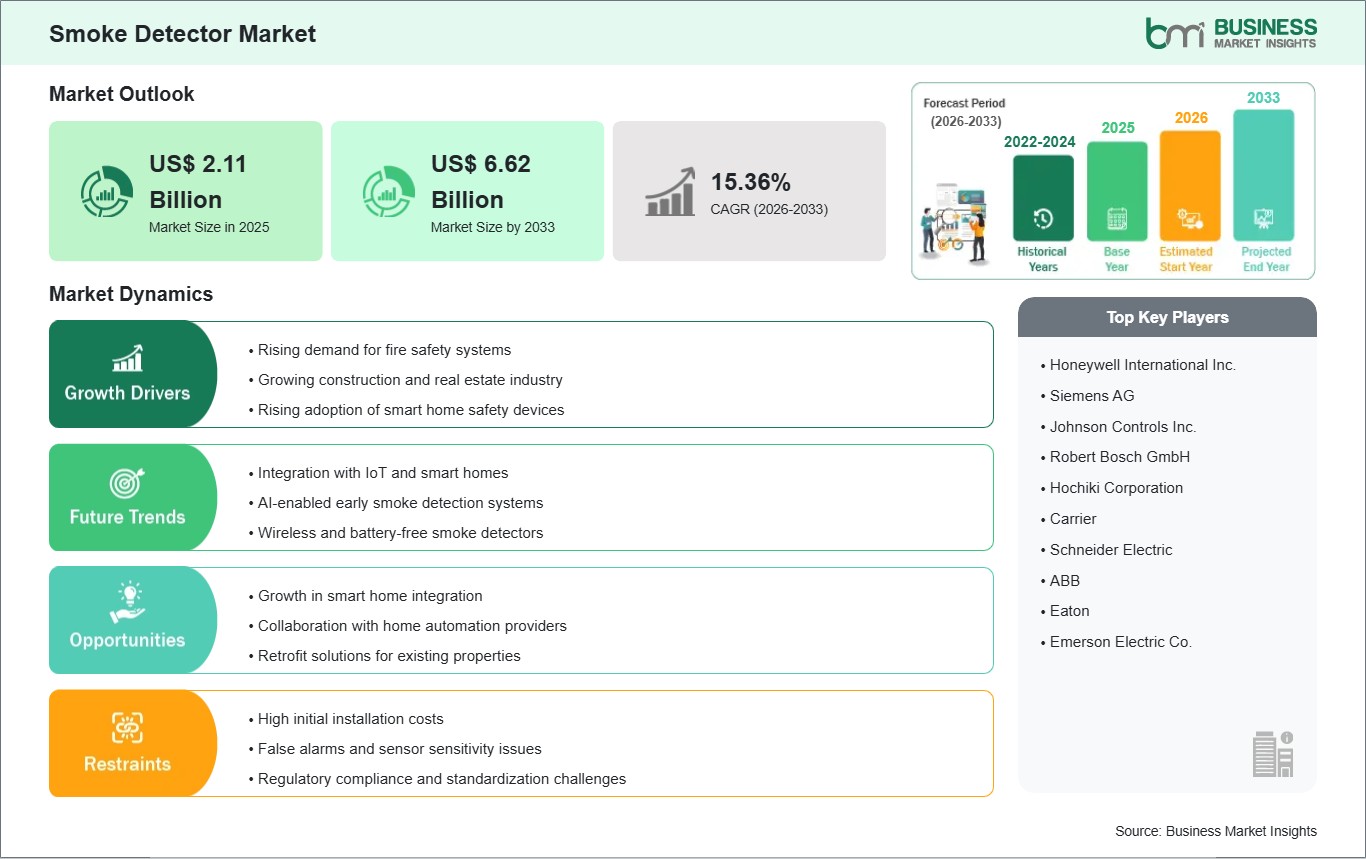
The Smoke Detector Market size is expected to reach US$ 6.62 billion by 2033 from US$ 2.11 billion in 2025. The market is estimated to record a CAGR of 15.36% from 2026 to 2033.
The smoke detector market is growing steadily. Fire safety rules, urban development, and smart building projects are increasing the need for better detection systems. Today's smoke detectors do more than just sound alarms. They combine sensors, connectivity, and automation to detect smoke early and alert people in real time. These devices are common in homes, businesses, and industrial places. They help reduce response times, limit property damage, and improve occupant safety. The rise of smart buildings and devices connected to the Internet has sped up adoption. Detectors now connect to home automation platforms and security systems.
Technological advances are changing the market. Photoelectric, ionization, and dual-sensor systems provide reliable detection for various fire situations. Smart features like remote alerts, voice notifications, and mobile app integration make them easier to use. Manufacturers focus on reducing false alarms, making devices more energy-efficient, and extending their lifespan through better power management and sensor materials. Compliance with rules, fire safety codes, and insurance demands are still key growth factors. In industrial settings, detectors connect to emergency response systems for quick hazard management. In homes, more consumers prefer connected safety devices. Partnerships between fire safety companies, IoT providers, and construction firms are boosting product innovation, making smoke detectors crucial for modern safety systems.

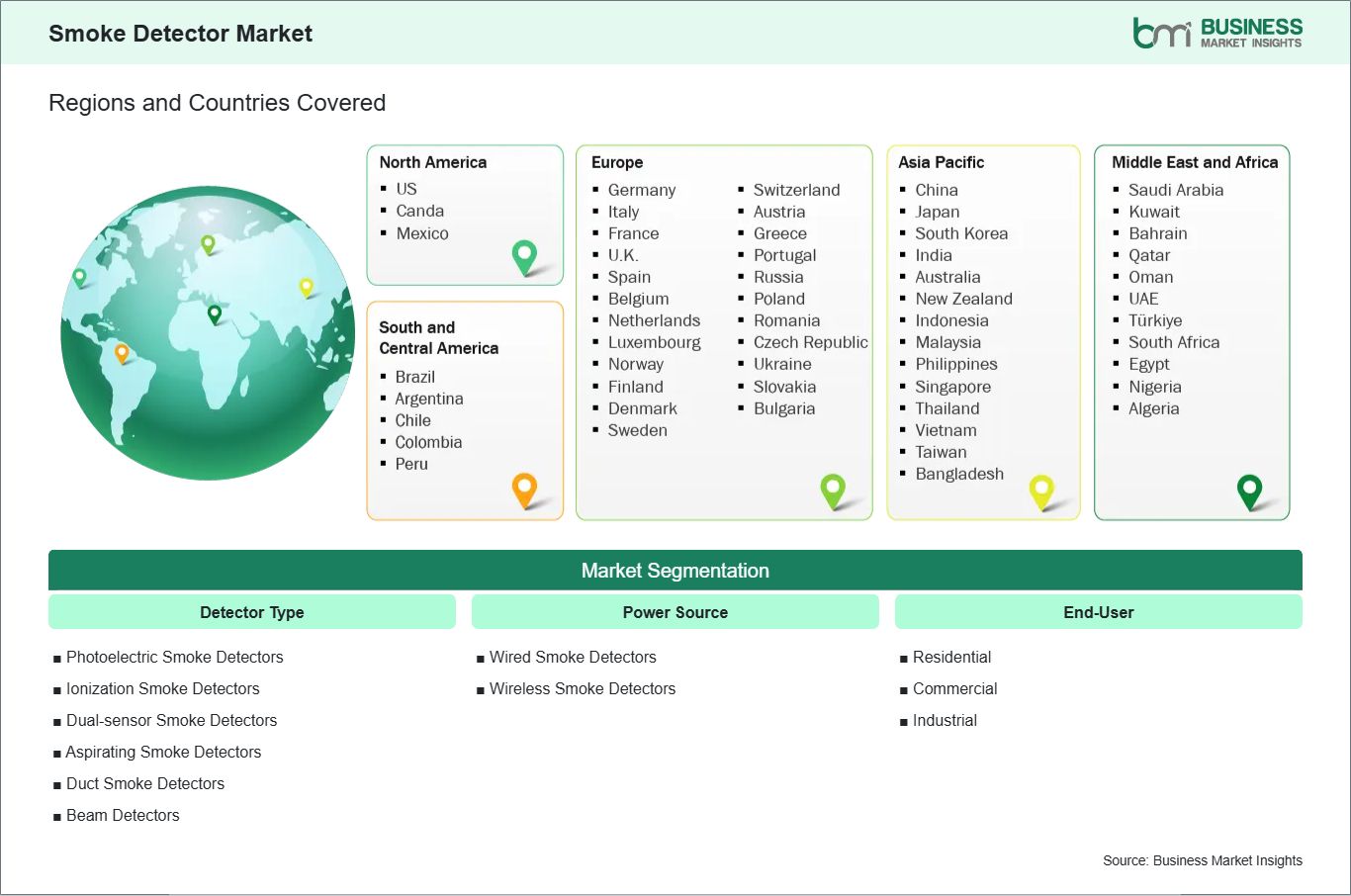
Key segments that contributed to the derivation of the smoke detector market analysis are detector type, power source, end‑user.
The smoke detector market is expanding as fire safety becomes a top priority in residential, commercial, and industrial settings. Increasing awareness of fire hazards, along with stricter building codes and safety regulations, is driving the installation of both standalone and interconnected detection systems. Modern detectors offer multi-sensor technology, rapid alerting, and integration with alarm networks to ensure faster emergency response. Growing adoption is fueled by education campaigns, insurance requirements, and proactive risk management in construction and industrial facilities. Overall, heightened attention to fire prevention and hazard mitigation is a key growth driver for the market.
Smart home adoption is transforming the smoke detector market, with connected devices offering real-time alerts, voice notifications, and seamless integration with other safety systems. Consumers increasingly prefer IoT-enabled detectors that can be monitored and controlled remotely through mobile apps or smart home hubs. Advanced features, such as AI-based hazard detection, battery status monitoring, and interoperability with carbon monoxide detectors or security systems, enhance usability and convenience. As homeowners prioritize safety alongside automation, networked smoke detectors are becoming standard components of modern smart homes, driving innovation, adoption, and overall market growth.
The Smoke Detector Market demonstrates steady growth, with size and share analysis highlighting evolving trends and competitive dynamics among key players. The report examines subsegments categorized within detector type, power source, and end-user, offering insights into their contribution to overall market performance.
Detector type, the photoelectric smoke detectors sub segment dominated the market in 2025, driven by high sensitivity to visible smoke and reliability in early fire detection.
Based on power source, the wired smoke detectors sub segment dominated the market in 2025, driven by stable power supply and integration with building safety systems.
In terms of end-user, the residential sub segment dominated the market in 2025, driven by growing awareness of home fire safety and regulatory mandates.
| Report Attribute | Details |
|---|---|
| Market size in 2025 | US$ 2.11 Billion |
| Market Size by 2033 | US$ 6.62 Billion |
| Global CAGR (2026 - 2033) | 15.36% |
| Historical Data | 2022-2024 |
| Forecast period | 2026-2033 |
| Segments Covered | By Detector Type
|
|
Regions and Countries Covered
| |
| North America | US, Canada, Mexico |
| Europe | Belgium, Austria, Finland, Denmark, Greece, Poland, Romania, Russia, Ukraine, Czech Republic, Slovakia, Bulgaria, Italy, Luxembourg, Germany, Switzerland, France, Netherlands, Norway, Portugal, Spain, Sweden, United Kingdom |
| Asia-Pacific | Australia, China, India, Japan, South Korea, Indonesia, Malaysia, Philippines, Singapore, Thailand, Vietnam, Bangladesh, New Zealand, Taiwan |
| South and Central America | Brazil, Argentina, Peru, Chile, Colombia |
| Middle East and Africa | Bahrain, Kuwait, Oman, Qatar, Saudi Arabia, United Arab Emirates, Turkiye, South Africa, Egypt, Algeria, Nigeria |
| Market leaders and key company profiles |
|
The "Smoke Detector Market Size and Forecast (2022 - 2033)" report provides a detailed analysis of the market covering below areas:
The geographical scope of the Smoke Detector Market report is divided into North America, Asia Pacific, Europe, Middle East & Africa, and South & Central America. North America held the largest share in 2025.
Regional adoption of smoke detectors varies according to regulatory standards, technological infrastructure, and safety awareness. North America leads the market, driven by strict fire safety regulations, high construction standards, and widespread use of connected home systems. In the United States and Canada, smoke detectors are standard in residential, commercial, and industrial buildings, often integrated with IoT-enabled platforms for real-time monitoring. Public safety campaigns and proactive consumer adoption further reinforce market growth.
Europe is a mature market, particularly in Germany, the United Kingdom, and France, where fire safety codes and smart building initiatives drive adoption. Energy-efficient designs and connectivity with building management systems are key differentiators, aligning with environmental and safety regulations.
Asia Pacific is rapidly growing due to urbanization, industrial expansion, and increasing fire safety awareness. Countries like China, India, Japan, and South Korea are incorporating smoke detectors in high-rise residential and commercial complexes, with smart connectivity features gaining traction in dense urban areas.
Middle East and Africa are emerging markets, with adoption concentrated in luxury residences, commercial buildings, and hotels, supported by government safety programs.
South and Central America, led by Brazil and Mexico, are gradually expanding installation in both residential and commercial sectors. Regulatory compliance, infrastructure readiness, and growing safety awareness are shaping adoption patterns across all regions.

The Smoke Detector Market is evaluated by gathering qualitative and quantitative data post primary and secondary research, which includes important corporate publications, association data, and databases. A few of the key developments in the smoke detector market are:
The Smoke Detector Market is valued at US$ 2.11 Billion in 2025, it is projected to reach US$ 6.62 Billion by 2033.
As per our report Smoke Detector Market, the market size is valued at US$ 2.11 Billion in 2025, projecting it to reach US$ 6.62 Billion by 2033. This translates to a CAGR of approximately 15.36% during the forecast period.
The Smoke Detector Market report typically cover these key segments-
The historic period, base year, and forecast period can vary slightly depending on the specific market research report. However, for the Smoke Detector Market report:
The Smoke Detector Market is populated by several key players, each contributing to its growth and innovation. Some of the major players include:
The Smoke Detector Market report is valuable for diverse stakeholders, including:
Essentially, anyone involved in or considering involvement in the Smoke Detector Market value chain can benefit from the information contained in a comprehensive market report.
Please tell us your area of interest
(Market Segments/ Regions and Countries/ Companies)