Market Summary
Executive Summary and Global Market Analysis
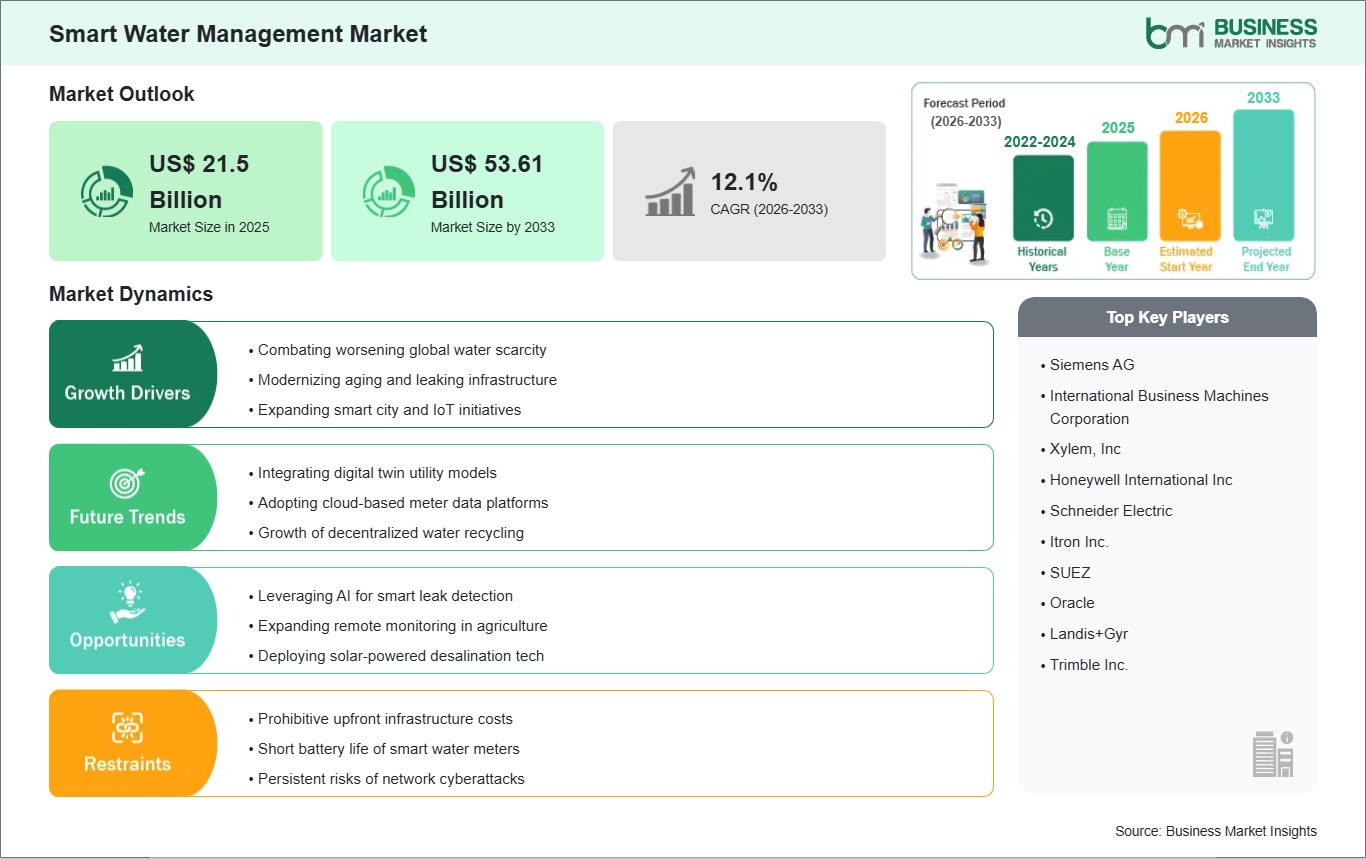
Smart Water Management plays a critical role in providing the digital intelligence and resilient infrastructure essential for addressing the global water crisis and modernizing aging utility networks. It encompasses key equipment and services: Advanced Metering Infrastructure (AMI), leak detection sensors, smart irrigation controllers, and cloud-based water analytics platforms. Smart water management offers advantages, including the drastic reduction of Non-Revenue Water (NRW) losses, the optimization of energy consumption in pumping stations, and the enhancement of public health through real-time water quality monitoring. The market is being fueled by the massive global pressure of urbanization and population growth, the exponential adoption of IoT and Digital Twin technologies for network simulation, and the urgent need to adapt to climate-induced droughts and flooding. Additionally, the shift toward integrated smart city ecosystems, where water data is synchronized with energy and waste management, is fundamentally enhancing urban resource efficiency and sustainability.
However, several challenges can restrain market growth. High initial capital costs and the complexity of replacing extensive legacy underground piping and deploying large-scale AMI networks can strain municipal budgets. Increasing cybersecurity threats, particularly the vulnerability of interconnected water OT networks to remote hacking and ransomware, present ongoing management and security concerns. The industry also faces persistent data silos between regional utilities and a significant talent gap in managing complex, software-defined hydraulic systems. Despite these challenges, the market offers significant opportunities due to the universal need for climate-resilient infrastructure, the rapid adoption of LPWAN and satellite connectivity for remote asset monitoring, and the growing use of AI and machine learning for predictive pipe-burst modeling and automated demand forecasting. The transition to Water-as-a-Service models, which allow utilities to access advanced technology through subscriptions rather than large upfront investments, is expected to create substantial opportunities for market expansion.
Segment Analysis
Smart Water Management Market Segmentation
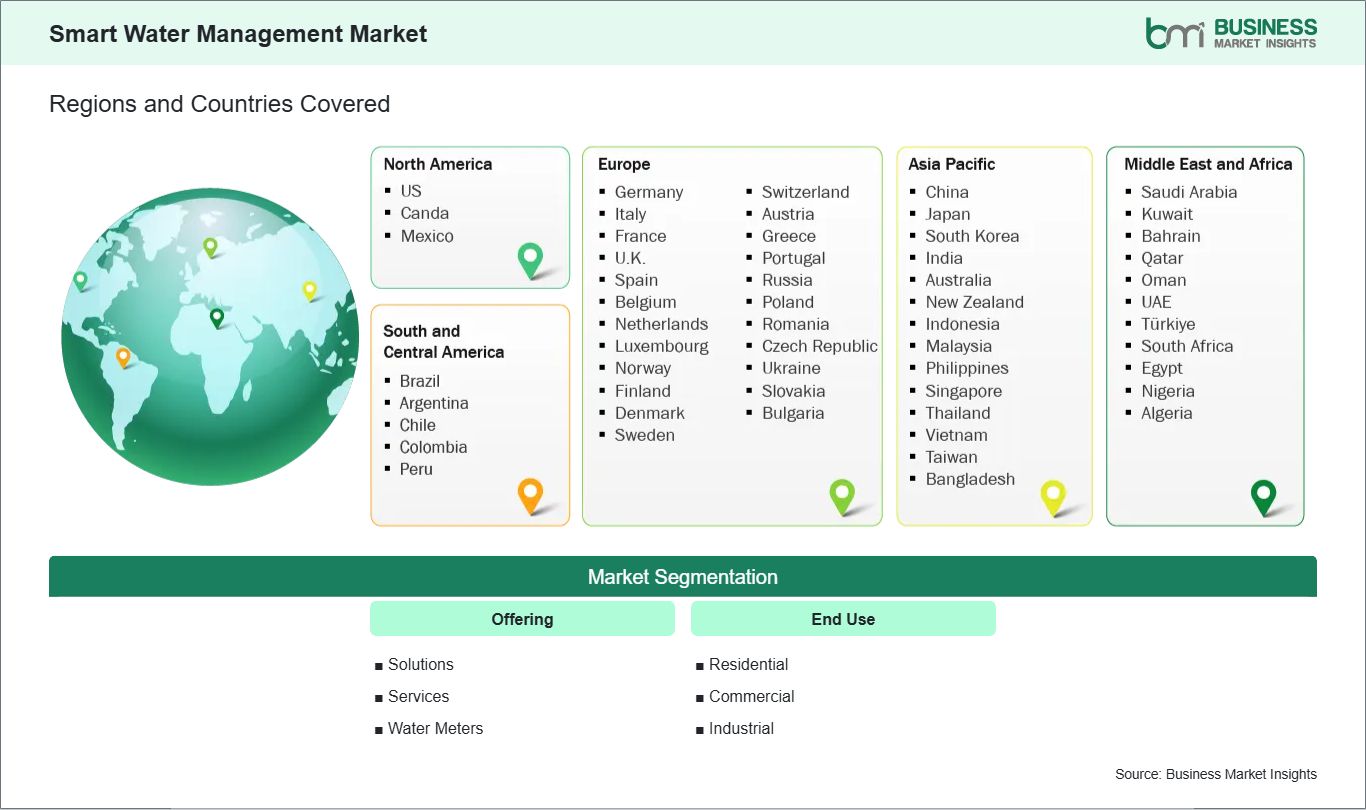
Key segments that contributed to the derivation of the Smart Water Management market analysis are offering and end use.
- By Offering, the market is segmented into Solutions, Services, and Water Meters.
- By End Use, the market is segmented into Residential, Commercial, and Industrial.
Market Forces
Smart Water Management Market Drivers and Opportunities
Escalating Water Crisis Globally
With a significant portion of treated water lost to leaks, often referred to as Non-Revenue Water (NRW), before it even reaches the consumer, municipalities are under immense pressure to adopt digital oversight. Smart management systems utilize a network of IoT sensors and acoustic leak detectors to provide real-time visibility into pipe integrity and flow dynamics. This transition from reactive repairs to proactive maintenance is fueled by the dual necessity of conserving a finite natural resource and reducing the massive financial losses incurred by inefficient distribution networks in rapidly growing urban centers.
Growing Adoption of Digital Twins and AI-Driven Predictive Analytics
Combining Digital Twin technology with Artificial Intelligence helps in developing fully autonomous, self-healing water networks. Virtual models of city water systems allow utilities to simulate scenarios such as water main breaks or sudden demand spikes during droughts. This approach improves energy efficiency in pumping stations and enables automatic pressure adjustments to prevent pipe damage. As ESG (Environmental, Social, and Governance) reporting requirements become more stringent, there is increasing demand for advanced, cloud-based analytics platforms. These tools enable large water users to monitor consumption, quickly identify issues, and maintain compliance with environmental regulations. Consequently, smart water solutions are becoming essential to the global circular economy.
Size and Share Analysis
Smart Water Management Market Size and Share Analysis
The Smart Water Management market demonstrates steady growth, with size and share analysis revealing evolving trends and competitive positioning among key players. The report further examines subsegments categorized within offering and end use, offering insights into their contribution to overall market performance.
For instance, the Solutions subsegment represents a significant portion of the market, driven by the integration of advanced technologies such as IoT and AI for real-time monitoring and leak detection. These solutions are widely adopted in the Industrial sector, where water-intensive industries such as food and beverage and chemical processing utilize them to ensure regulatory compliance and optimize operational efficiency. The shift toward predictive maintenance and automated control systems within this segment helps industrial operators reduce non-revenue water loss and energy consumption.
Report Coverage
Smart Water Management Market Report Coverage and Deliverables
The "Smart Water Management Market Size and Forecast (2022 - 2033)" report provides a detailed analysis of the market covering below areas:
- Smart Water Management market size and forecast at global, regional, and country levels for all the key market segments covered under the scope
- Smart Water Management market trends, as well as market dynamics such as drivers, restraints, and key opportunities
- Smart Water Management market analysis covering key market trends, global and regional framework, major players, regulations, and recent market developments
- Industry landscape and competition analysis covering market concentration, heat map analysis, prominent players, and recent developments for the Smart Water Management market
- Detailed company profiles, including SWOT analysis
Geographic Insights
Smart Water Management Market Geographic Insights
The geographical scope of the Smart Water Management market report is divided into five regions: North America, Asia Pacific, Europe, Middle East & Africa, and South & Central America.
The Asia-Pacific Smart Water Management Market is segmented into China, Japan, South Korea, India, Australia, New Zealand, Indonesia, Malaysia, the Philippines, Singapore, Thailand, Vietnam, Taiwan, Bangladesh, and the Rest of Asia. The market is primarily driven by rapid urbanization and the urgent need to curb Non-Revenue Water (NRW) losses.
Growth is further accelerated by the integration of IoT-enabled sensors and AI-driven analytics for real-time leak detection and water quality monitoring. The rising adoption of Advanced Metering Infrastructure (AMI) and the shift toward sustainable irrigation in agriculture solidify Asia-Pacific as the critical global driver for smart water technology and resource conservation.
Industry Activity
Recent Developments
The Smart Water Management market is evaluated by gathering qualitative and quantitative data post primary and secondary research, which includes important corporate publications, association data, and databases. A few of the key developments in the Smart Water Management market are:
- In November 2025, Commission launches dialogues with Member States to ensure sustainable water management across Europe. As part of the implementation of the EU Water Resilience Strategy, the Commission is launching a series of Structured Water Dialogues with Member States, to jointly accelerate action to achieve the environmental objectives of EU water legislation.
- In May 2025, Xylem announced that Manchester City Football Club is teaming up with Xylem to bring smart water management to City Football Academy. With the help of Xylem Vue, the Club is capturing and reusing rainwater more efficiently through data and analytics. At City Football Academy, Xylem Vue – a digital water platform – uses connected sensors and smart meters to deliver live insights into how water moves across the training facility. Showing exactly when and where water is being used or lost across the 16.5-pitch campus, the system helps the Club make smarter decisions to optimize irrigation and reduce reliance on public water sources.
Trust & Transparency
Research Methodology
The market analysis combines proprietary research with secondary data from government agencies, company disclosures, regulatory filings, industry databases and expert interviews. Market estimates are validated through data triangulation, cross-market benchmarking and analyst
review.
View Full Research Methodology
Key Sources Referred:
World Bank - Global Trade Indicators
World Trade Organization (WTO)
International Monetary Fund (IMF)
International Trade Administration (ITA)
Company Websites
Company Annual Reports
Company Investor Presentations