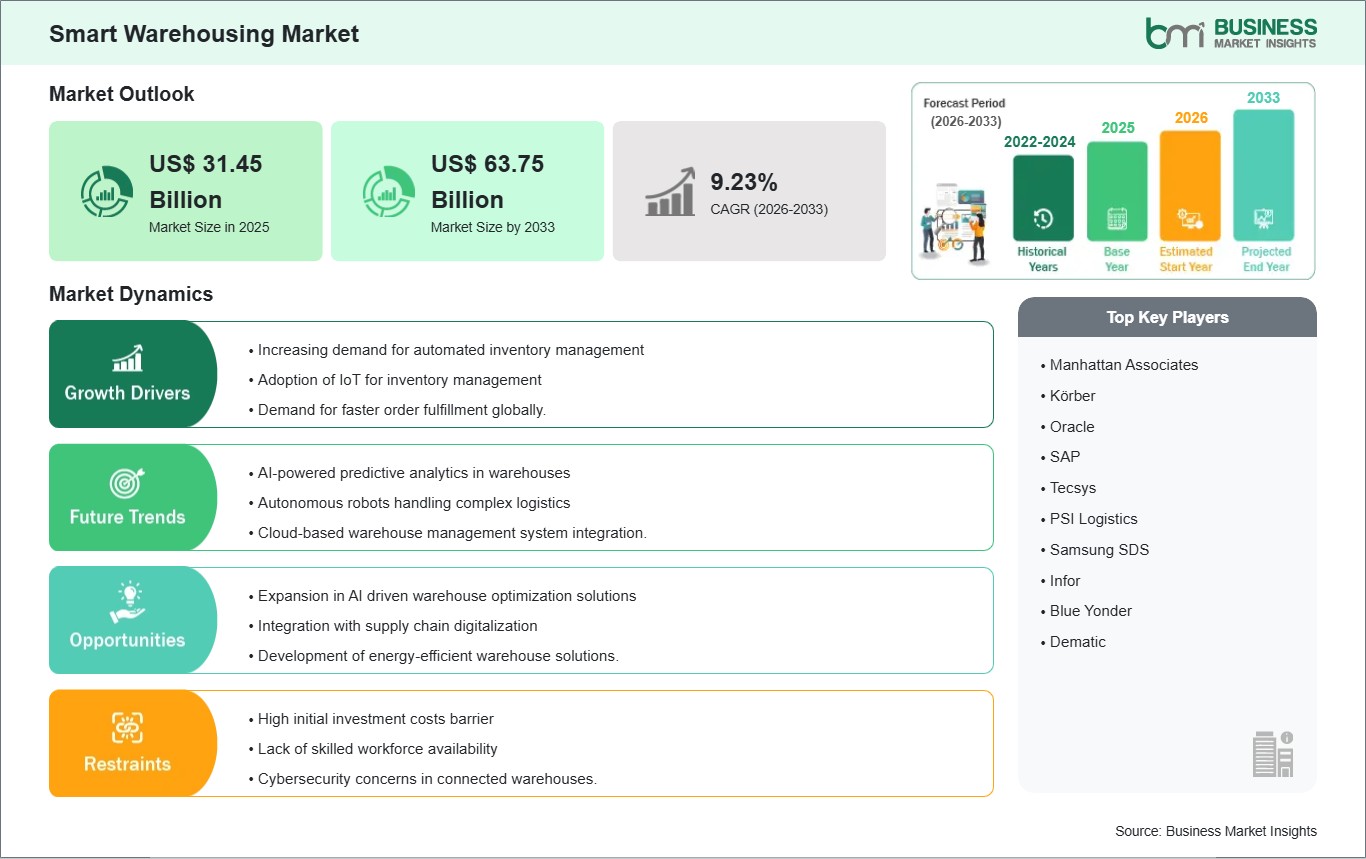
The Smart Warehousing Market size is expected to reach US$ 63.75 billion by 2033 from US$ 31.45 billion in 2025. The market is estimated to record a CAGR of 9.23% from 2026 to 2033.
The smart warehousing market is changing stedily as businesses look to improve efficiency, cut labor costs, and increase visibility in the supply chain using automation and data-based solutions. The combination of robotics, automated guided vehicles (AGVs), and autonomous mobile robots (AMRs) with warehouse management systems (WMS) allows for real-time inventory tracking, better picking routes, and quicker order fulfillment. Companies are using artificial intelligence and machine learning more to predict demand, allocate resources, and reduce operational delays.
The rise of e-commerce and omnichannel retail drives this change, pushing warehouses to handle high-volume, low-latency fulfillment while keeping accuracy. Cloud-based platforms and IoT-enabled sensors support predictive maintenance, energy management, and environmental monitoring. They help maintain operations in temperature-sensitive or high-value storage areas. Cybersecurity and data integration have become vital since smart warehouses produce large amounts of operational and transactional data. Collaboration between logistics providers, technology vendors, and retailers is paving the way for modular, scalable solutions that can fit various sectors. New trends include using drones for inventory management, AI-powered robots for packing, and digital twins to model warehouse workflows. These developments position the market for long-term technological change and operational success.

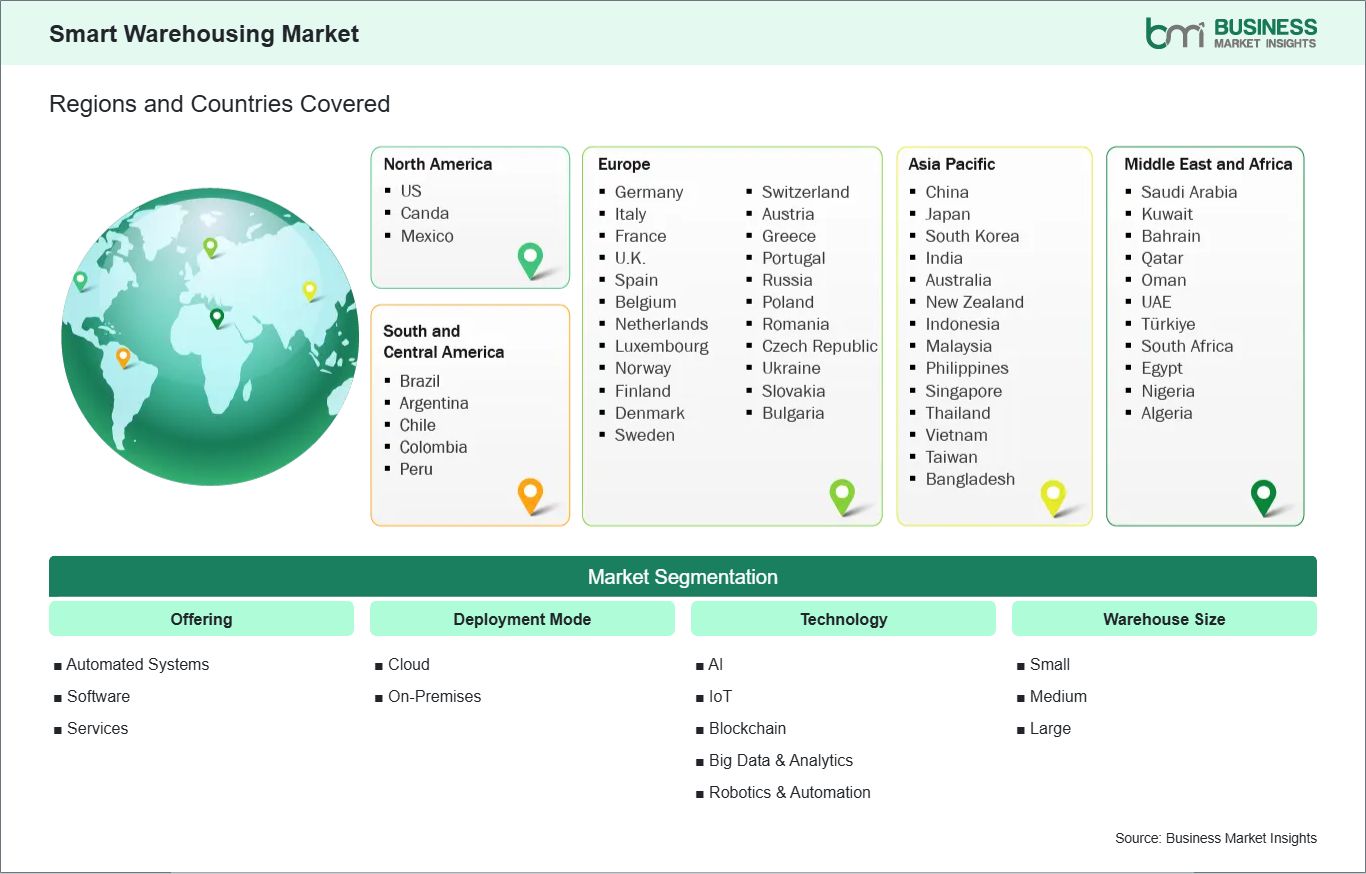
Key segments that contributed to the derivation of the smart warehousing market analysis are offering, deployment mode, technology, warehouse size, and vertical.
The global smart warehousing market is driven by the rising demand for automated inventory management solutions. As businesses strive to reduce stockouts, lower holding costs, and speed up order fulfillment, warehouse operators are turning to automated systems for real-time inventory visibility and control. Technologies like RFID tagging, barcode scanning, and automated storage and retrieval systems (AS/RS) help track goods accurately at every stage of the warehouse lifecycle. This improves accuracy and cuts down on manual checks. Automation also decreases reliance on labor and repetitive tasks. This allows workers to focus on more valuable activities like handling exceptions and strategic planning. This shift is crucial as labor shortages and turnover impact traditional warehousing models.
Automated inventory systems support scalability, helping facilities manage peak demand without sacrificing performance or accuracy. Additionally, integration with warehouse management software (WMS) syncs inventory data across various channels and touchpoints. This visibility enables businesses to make informed decisions, optimize reorder points, and minimize excess stock. Overall, the growing need for automated inventory management strengthens the smart warehousing value and drives significant market growth.
The global smart warehousing market is growing due to the increased use of AI-driven warehouse optimization solutions. Artificial intelligence (AI) technologies like machine learning, predictive analytics, and computer vision are changing how warehouses function. They allow for smarter decision-making and quicker responses. AI systems look at past and current data to predict demand patterns, improve picking routes, and balance workloads across automation assets. This boosts throughput and lowers operational costs. AI-based optimization is more than just automating tasks; it creates workflows that learn and improve over time. Predictive analytics can forecast inventory shortages or bottlenecks before they happen, while machine learning algorithms constantly adjust scheduling and routing plans. These features lead to better service levels, quicker order cycle times, and improved resource use in warehouse operations.
Additionally, AI integration improves collaboration among robots, autonomous guided vehicles (AGVs), and human workers. It organizes activities to reduce delays and safety risks. By centralizing control logic and enabling self-learning optimization, AI solutions support responsive and resilient warehouse systems. As organizations work on digital transformation strategies that focus on agility and performance, AI-driven warehouse optimization is becoming a significant growth driver for the global smart warehousing market.
The smart warehousing market demonstrates steady growth, with size and share analysis highlighting evolving trends and competitive dynamics among key players. The report examines subsegments categorized within offering, deployment mode, technology, warehouse size, and vertical, offering insights into their contribution to overall market performance.
By Offering, the automated systems subsegment dominated the market in 2025, driven by rising adoption of robotics, conveyors, and warehouse automation equipment.
Based on Deployment Mode, the cloud subsegment dominated the market in 2025, owing to scalability, cost-efficiency, and remote monitoring capabilities.
On the Basis of Technology, the AI subsegment dominated the market in 2025, supported by machine learning algorithms optimizing warehouse operations and inventory management.
By Warehouse Size, the large warehouse subsegment dominated the market in 2025, propelled by increasing demand from large-scale eCommerce and logistics companies.
By Vertical, the retail & eCommerce subsegment dominated the market in 2025, due to rapid expansion of online retail and high demand for efficient order fulfillment.
| Report Attribute | Details |
|---|---|
| Market size in 2025 | US$ 31.45 Billion |
| Market Size by 2033 | US$ 63.75 Billion |
| Global CAGR (2026 - 2033) | 9.23% |
| Historical Data | 2022-2024 |
| Forecast period | 2026-2033 |
| Segments Covered | By Offering
|
|
Regions and Countries Covered
| |
| North America | US, Canada, Mexico |
| Europe | Belgium, Austria, Finland, Denmark, Greece, Poland, Romania, Russia, Ukraine, Czech Republic, Slovakia, Bulgaria, Italy, Luxembourg, Germany, Switzerland, France, Netherlands, Norway, Portugal, Spain, Sweden, United Kingdom |
| Asia-Pacific | Australia, China, India, Japan, South Korea, Indonesia, Malaysia, Philippines, Singapore, Thailand, Vietnam, Bangladesh, New Zealand, Taiwan |
| South and Central America | Brazil, Argentina, Peru, Chile, Colombia |
| Middle East and Africa | Bahrain, Kuwait, Oman, Qatar, Saudi Arabia, United Arab Emirates, Turkiye, South Africa, Egypt, Algeria, Nigeria |
| Market leaders and key company profiles |
|
The "Smart Warehousing Market Size and Forecast (2022 - 2033)" report provides a detailed analysis of the market covering below areas:
The geographical scope of the Smart Warehousing Market report is divided into North America, Asia Pacific, Europe, Middle East & Africa, and South & Central America. North America held the largest share in 2025.
North America dominates the smart warehousing market, driven by advanced logistics infrastructure, high e-commerce penetration, and the adoption of automated systems in retail, manufacturing, and third-party logistics. The United States leads in deploying robotics, AI-powered WMS, and IoT-enabled tracking systems to enhance operational efficiency and reduce human error in fulfillment centers.
Asia Pacific is a rapidly expanding market, with China, Japan, South Korea, and India leveraging smart warehousing to support large-scale manufacturing, high-volume e-commerce, and export-oriented supply chains. Investments in automated storage and retrieval systems (ASRS), AGVs, and integrated software solutions are accelerating market adoption.
Europe emphasizes sustainability, energy efficiency, and compliance, with Germany, France, and the UK prioritizing green warehouses equipped with energy-efficient automation, smart lighting, and climate control systems. Adoption is also driven by the need for precision in high-value goods handling, including pharmaceuticals and electronics.
The Middle East and Africa are emerging markets where modern logistics hubs and industrial parks are integrating smart warehousing solutions to optimize inventory management, reduce storage costs, and improve turnaround times.
South and Central America, particularly Brazil, Mexico, and Argentina, are focusing on digitalizing traditional warehouses and introducing automation in retail and industrial sectors. Local supply chain challenges and infrastructure development are shaping the adoption of cost-effective smart solutions.

The Smart Warehousing Market is evaluated by gathering qualitative and quantitative data post primary and secondary research, which includes important corporate publications, association data, and databases. A few of the key developments in the spatial light Modulator market are:
The Smart Warehousing Market is valued at US$ 31.45 Billion in 2025, it is projected to reach US$ 63.75 Billion by 2033.
As per our report Smart Warehousing Market, the market size is valued at US$ 31.45 Billion in 2025, projecting it to reach US$ 63.75 Billion by 2033. This translates to a CAGR of approximately 9.23% during the forecast period.
The Smart Warehousing Market report typically cover these key segments-
The historic period, base year, and forecast period can vary slightly depending on the specific market research report. However, for the Smart Warehousing Market report:
The Smart Warehousing Market is populated by several key players, each contributing to its growth and innovation. Some of the major players include:
The Smart Warehousing Market report is valuable for diverse stakeholders, including:
Essentially, anyone involved in or considering involvement in the Smart Warehousing Market value chain can benefit from the information contained in a comprehensive market report.
Please tell us your area of interest
(Market Segments/ Regions and Countries/ Companies)