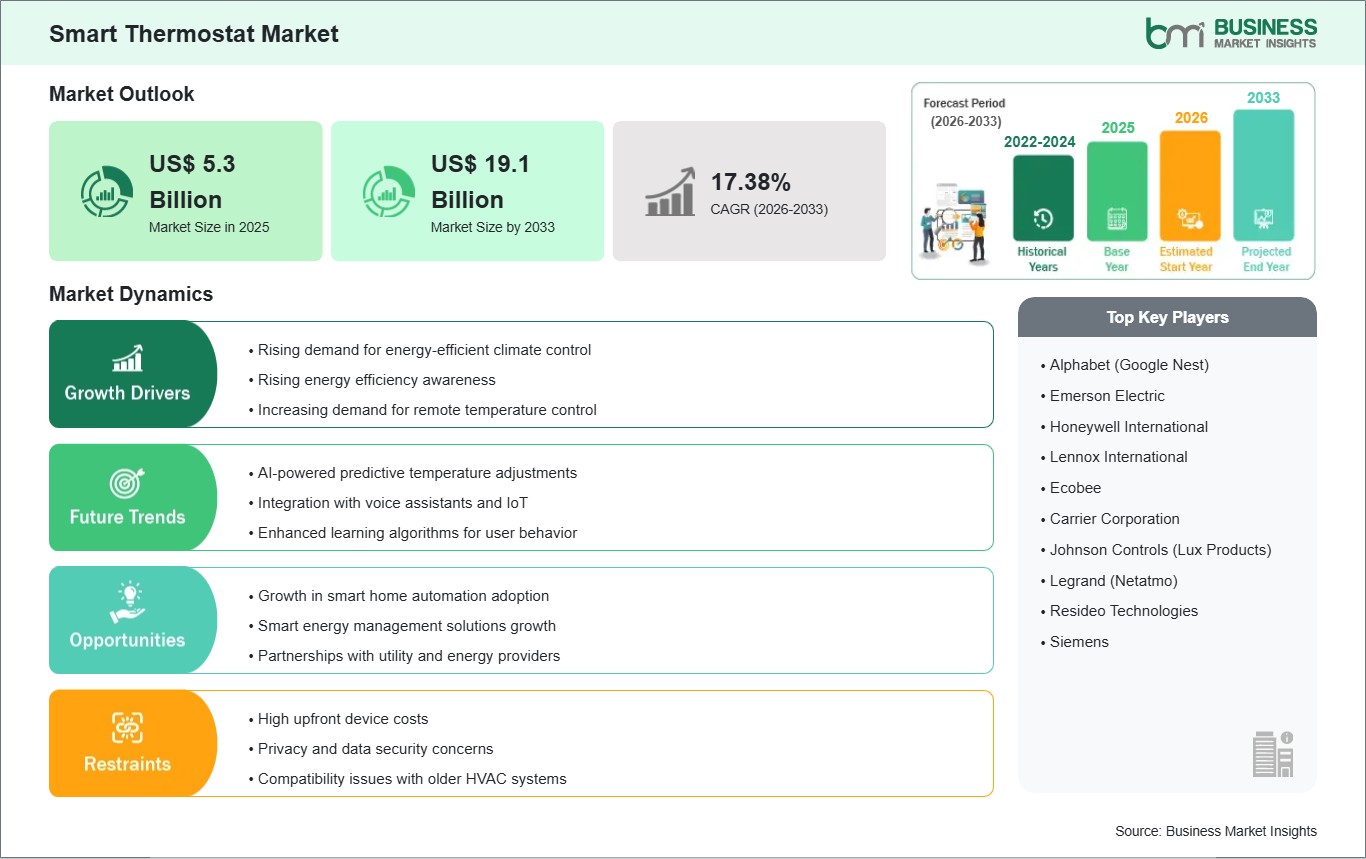
The Smart Thermostat Market size is expected to reach US$ 19.1 billion by 2033 from US$ 5.3 billion in 2025. The market is estimated to record a CAGR of 17.38% from 2026 to 2033.
The smart thermostat market is growing steadily as more consumers and businesses choose connected climate control solutions that mix comfort, efficiency, and sustainability. Smart thermostats use sensors, AI algorithms, and wireless connectivity to improve heating, ventilation, and air conditioning systems. They learn user behavior, track occupancy, and look at weather data. This allows them to automatically adjust temperatures, enhancing comfort while cutting energy use. High electricity costs, rising environmental awareness, and government incentives for energy-efficient building practices drive this trend. Technological improvements are broadening their features. Today’s smart thermostats offer voice control, mobile app integration, and work with larger smart home systems. IoT-enabled systems provide real-time monitoring, predictive maintenance, and communication with other connected devices like lighting, security, and energy meters. Residential use leads the market as homeowners look for convenience and savings.
However, commercial use is rising, especially in offices, hotels, and retail spaces where energy optimization and legal compliance matter. Manufacturers are now concentrating on energy analytics, renewable energy integration, and demand-response capabilities to meet sustainability goals. Collaborations among technology firms, HVAC providers, and utilities are fueling innovation and speeding up market growth. In summary, the smart thermostat market is marked by rapid technological progress, broader industry applications, and a growing need for energy-efficient, connected solutions.

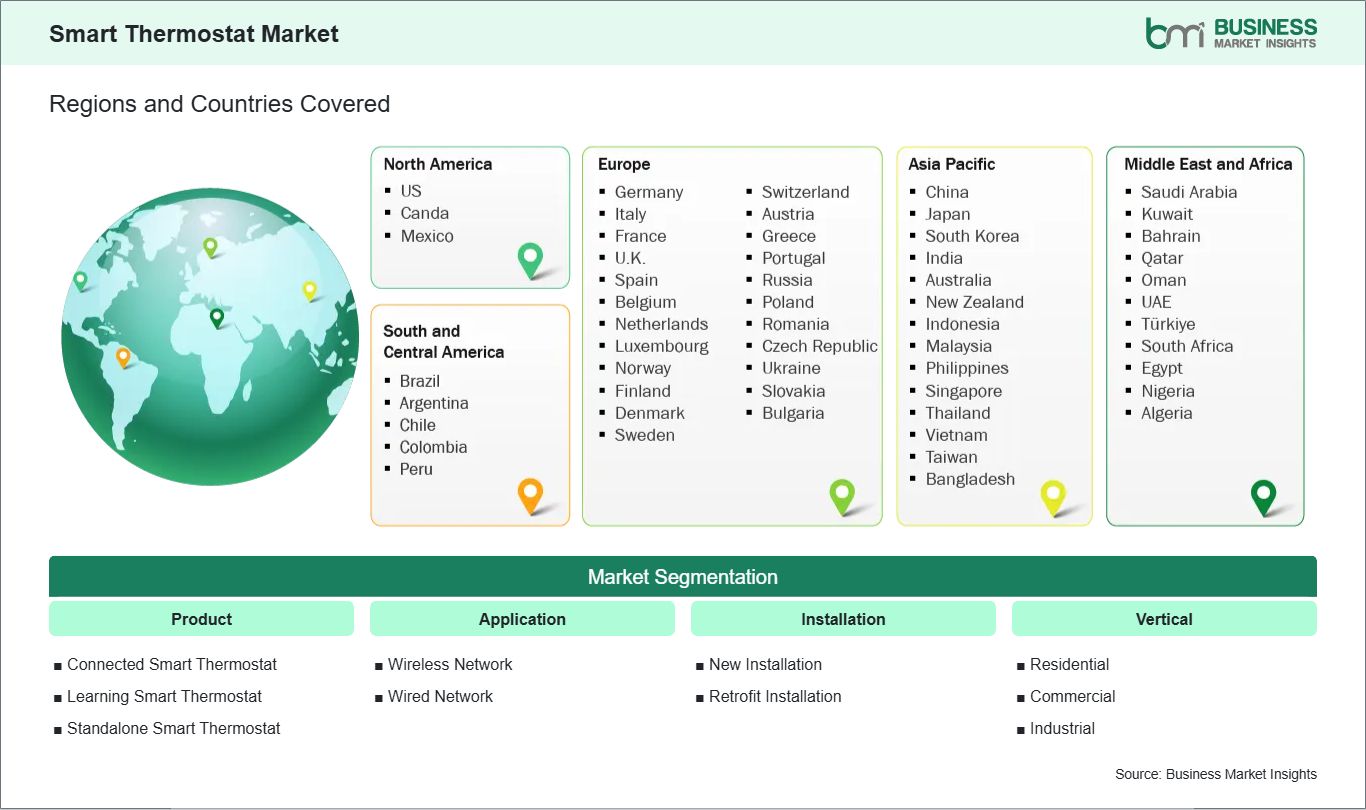
Key segments that contributed to the derivation of the smart thermostat market analysis are product, application, installation, vertical.
The global smart thermostat market is expanding rapidly as IoT and connected technologies become integral to homes and commercial buildings. Intelligent systems allow users to monitor and adjust temperatures remotely, optimizing energy use while improving comfort and convenience. Integration with mobile applications, cloud platforms, and smart home ecosystems enhances automation and predictive control. Advances in AI and sensor technologies improve efficiency and device interoperability, while growing interest in sustainability and cost savings drives adoption. As connected devices become increasingly accessible and reliable, the market continues to see widespread adoption across diverse residential and commercial environments.
Smart sensors are becoming essential in electric and autonomous vehicles, supporting safety, efficiency, and performance. Components such as lidar, radar, ultrasonic, and temperature sensors provide critical data for navigation, collision avoidance, and battery management. The global shift toward electric mobility and autonomous driving is increasing reliance on accurate, reliable sensors to manage energy, monitor conditions, and enable real-time decision-making. Ongoing advancements in miniaturization, durability, and AI-powered processing further enhance their capabilities. As vehicle technology evolves, the demand for sophisticated smart sensors continues to grow, positioning them as foundational elements in next-generation transportation systems.
The Smart Thermostat Market demonstrates steady growth, with size and share analysis highlighting evolving trends and competitive dynamics among key players. The report examines subsegments categorized within product, application, installation, vertical offering insights into their contribution to overall market performance.
Product, the connected smart thermostat sub segment dominated the market in 2025, driven by growing consumer preference for energy-efficient and remotely controllable home heating solutions.
Based on application, the wireless network sub segment dominated the market in 2025, driven by the increasing adoption of IoT-enabled devices and seamless connectivity in smart homes.
Based on installation, the new installation sub segment dominated the market in 2025, driven by the rising construction of smart homes and modernization of HVAC systems.
In terms of vertical, the residential sub segment dominated the market in 2025, driven by the growing demand for home automation and energy management solutions.
| Report Attribute | Details |
|---|---|
| Market size in 2025 | US$ 5.3 Billion |
| Market Size by 2033 | US$ 19.1 Billion |
| Global CAGR (2026 - 2033) | 17.38% |
| Historical Data | 2022-2024 |
| Forecast period | 2026-2033 |
| Segments Covered | By Product
|
|
Regions and Countries Covered
| |
| North America | US, Canada, Mexico |
| Europe | Belgium, Austria, Finland, Denmark, Greece, Poland, Romania, Russia, Ukraine, Czech Republic, Slovakia, Bulgaria, Italy, Luxembourg, Germany, Switzerland, France, Netherlands, Norway, Portugal, Spain, Sweden, United Kingdom |
| Asia-Pacific | Australia, China, India, Japan, South Korea, Indonesia, Malaysia, Philippines, Singapore, Thailand, Vietnam, Bangladesh, New Zealand, Taiwan |
| South and Central America | Brazil, Argentina, Peru, Chile, Colombia |
| Middle East and Africa | Bahrain, Kuwait, Oman, Qatar, Saudi Arabia, United Arab Emirates, Turkiye, South Africa, Egypt, Algeria, Nigeria |
| Market leaders and key company profiles |
|
The "Smart Thermostat Market Size and Forecast (2022 - 2033)" report provides a detailed analysis of the market covering below areas:
The geographical scope of the Smart Thermostat Market report is divided into North America, Asia Pacific, Europe, Middle East & Africa, and South & Central America. North America held the largest share in 2025.
Adoption of smart thermostats varies across regions based on infrastructure, technological maturity, and consumer behavior. North America leads the market, supported by strong smart home adoption, widespread internet connectivity, and major thermostat manufacturers. Residential users prioritize energy savings, convenience, and integration with broader smart home systems, while businesses use smart thermostats for energy efficiency, predictive maintenance, and regulatory compliance. Government programs promoting energy reduction and sustainable buildings further reinforce market growth.
Europe is experiencing steady expansion, driven by Germany, the United Kingdom, and France. Regulatory frameworks encouraging energy-efficient buildings, combined with consumer interest in sustainability and smart home integration, are driving adoption. Both residential and commercial sectors are leveraging smart thermostats to monitor energy use, automate HVAC systems, and integrate with renewable energy sources.
Asia Pacific is growing rapidly, with China, Japan, South Korea, and India leading adoption due to rising urbanization, increasing energy costs, and growing awareness of smart home technologies. Smart thermostats are incorporated in connected apartments, commercial buildings, and industrial facilities for adaptive temperature control and energy management.
Middle East and Africa are emerging markets, with adoption focused on luxury residences and commercial buildings where energy optimization is critical.
South and Central America show gradual uptake, led by Brazil and Mexico, as smart home awareness and electricity costs rise. Regional trends highlight the importance of infrastructure, consumer education, and regulatory incentives in shaping adoption across diverse markets.

The Smart Thermostat Market is evaluated by gathering qualitative and quantitative data post primary and secondary research, which includes important corporate publications, association data, and databases. A few of the key developments in the smart thermostat market are:
The Smart Thermostat Market is valued at US$ 5.3 Billion in 2025, it is projected to reach US$ 19.1 Billion by 2033.
As per our report Smart Thermostat Market, the market size is valued at US$ 5.3 Billion in 2025, projecting it to reach US$ 19.1 Billion by 2033. This translates to a CAGR of approximately 17.38% during the forecast period.
The Smart Thermostat Market report typically cover these key segments-
The historic period, base year, and forecast period can vary slightly depending on the specific market research report. However, for the Smart Thermostat Market report:
The Smart Thermostat Market is populated by several key players, each contributing to its growth and innovation. Some of the major players include:
The Smart Thermostat Market report is valuable for diverse stakeholders, including:
Essentially, anyone involved in or considering involvement in the Smart Thermostat Market value chain can benefit from the information contained in a comprehensive market report.
Please tell us your area of interest
(Market Segments/ Regions and Countries/ Companies)