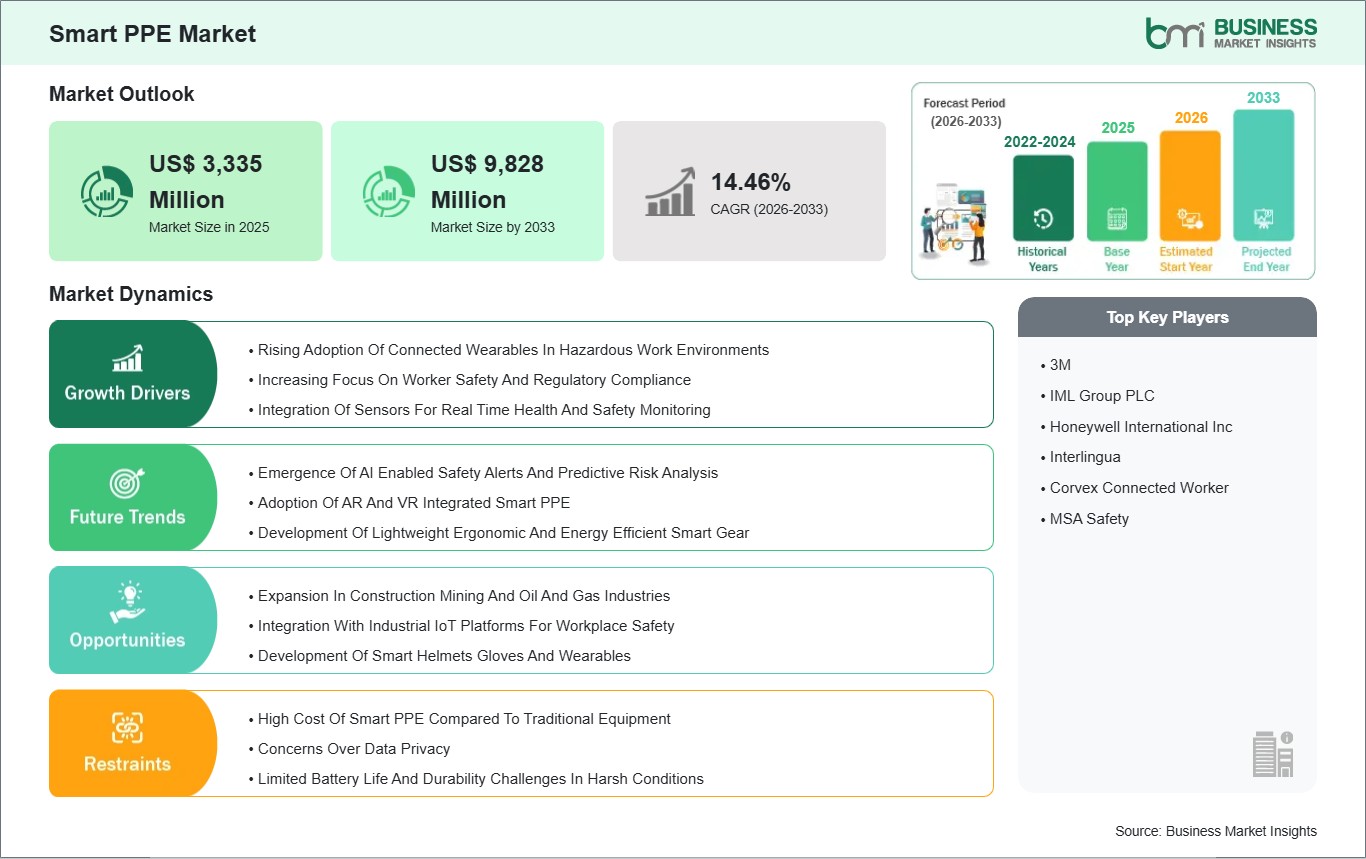
The Smart PPE Market size is expected to reach US$ 9,828. million by 2033 from US$ 3,335. million in 2025. The market is estimated to record a CAGR of 14.46% from 2026 to 2033.
The global smart PPE market is changing how we think about workplace safety by adding smart features to traditional protective gear. Unlike regular equipment that only offers passive protection, smart PPE can monitor workers and their surroundings in real time. For instance, devices such as helmets, vests, and glasses monitor aspects such as fatigue, body temperature, movements, and even exposure to hazards. This is a clear indication that the focus is no longer about following safety rules but is shifting towards a more proactive approach. High-risk industries such as construction, mining, manufacturing, and energy are starting to see the benefits of real-time data for preventing accidents.
Companies now need to handle constant data flow, protect worker privacy, and keep devices working in tough conditions. Workers also need time to get used to using this new technology every day. Despite all these challenges, advancements in wearable technologies, batteries, and designs have made it easier and more discreet to integrate smart PPE. The trend is shifting towards a future where safety equipment will not only be part of the daily business but will actually help organizations build a better and more responsive business.

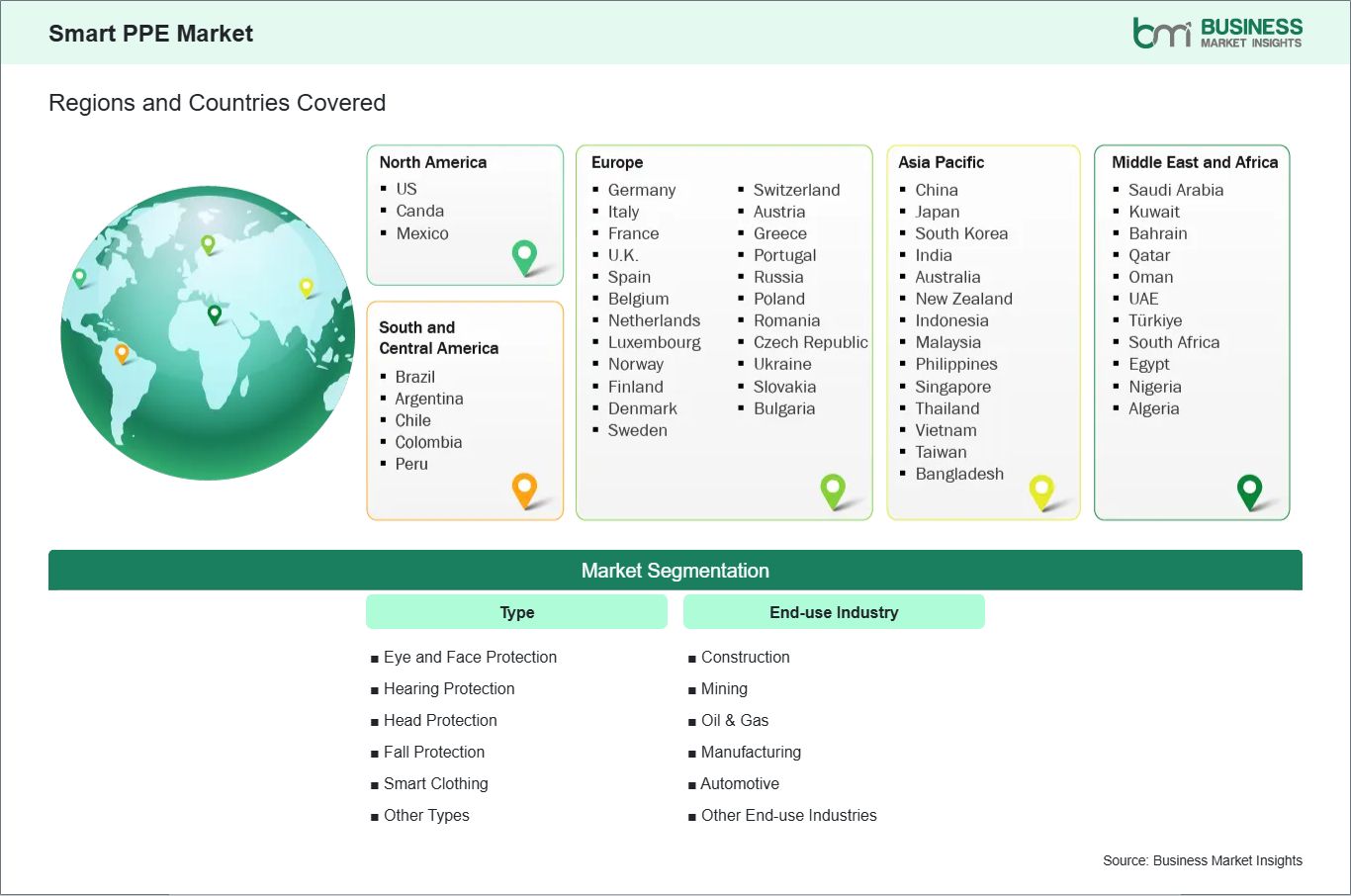
Key segments that contributed to the derivation of the smart PPE market analysis are type and end-use industry.
The increased need for safety and real-time monitoring is resulting in smart PPE adoption in dangerous working environments around the world. Smart wearables such as helmets with sensors, smart vests, and bio-monitoring devices will allow workers and management to monitor and track workers’ vital signs and detect environmental hazards in real-time. This will result in a combination of smart PPE that not only protects workers but also provides them with insights to prevent mishaps.
For example, smart PPE in industrial settings will enable real-time monitoring of environmental conditions such as temperature, gas leaks, and high noise levels. Workers in chemical plants will be able to use smart helmets that will provide alerts for unsafe working conditions, such as air quality and proximity to machinery, thereby reducing potential hazards. Similarly, mining and manufacturing operations will be able to use smart PPE to track workers’ real-time location and provide timely action in case of emergencies.
The interest in connected PPE goes beyond the prevention of immediate hazards. Indeed, the collection of data on long-term working conditions and the health of employees allows companies to improve training programs and optimize working schedules and designs. Worldwide, connected PPE solutions are considered vital for the protection of human capital and the efficient and sustainable management of industrial sites.
The construction, mining, and oil and gas sectors present significant opportunities for smart PPE adoption due to the high-risk nature of these environments. Workers in these industries often face harsh conditions, heavy machinery, and remote locations, making real-time monitoring and automated alerts particularly valuable. Smart PPE allows companies to implement proactive safety measures, reducing the likelihood of injuries and ensuring compliance with strict occupational standards.
In mining and large-scale construction projects, smart gloves, boots, and helmets can track worker movement and detect fatigue or hazardous exposure. For example, in oil and gas operations, wearable sensors can monitor exposure to toxic gases or extreme temperatures, providing alerts before conditions become critical. In regions with intensive infrastructure growth, such as the Middle East and Southeast Asia, integrating smart PPE into safety protocols is helping companies maintain both productivity and workforce protection.
Beyond hazard prevention, smart PPE creates operational insights that enhance efficiency. Data collected from wearables can inform project planning, identify bottlenecks, and optimize labor deployment. By combining safety, analytics, and connectivity, smart PPE is evolving from protective equipment into an intelligent workforce management tool, enabling industries worldwide to achieve safer, more productive, and data-driven operations.

The smart PPE market is experiencing steady growth, with market size and share analysis reflecting evolving treatment preferences and competitive dynamics among key players. The report evaluates important subsegments categorized within type and end-use industry, highlighting their respective contributions to overall market performance.
By type, the eye and face protection subsegment dominated the Smart PPE market in 2025. Smart eye and face protection equipment offers enhanced safety features, real-time monitoring, and improved comfort, making it the most widely adopted solution across industrial and high-risk environments.
Based on end-use industry, the manufacturing subsegment dominated the Smart PPE market in 2025. Manufacturing facilities increasingly implement smart PPE to ensure worker safety, comply with regulations, and integrate advanced monitoring technologies, driving strong demand in this sector.
| Report Attribute | Details |
|---|---|
| Market size in 2025 | US$ 3,335 Million |
| Market Size by 2033 | US$ 9,828 Million |
| Global CAGR (2026 - 2033) | 14.46% |
| Historical Data | 2022-2024 |
| Forecast period | 2026-2033 |
| Segments Covered | By Type
|
|
Regions and Countries Covered
| |
| North America | US, Canada, Mexico |
| Europe | Belgium, Austria, Finland, Denmark, Greece, Poland, Romania, Russia, Ukraine, Czech Republic, Slovakia, Bulgaria, Italy, Luxembourg, Germany, Switzerland, France, Netherlands, Norway, Portugal, Spain, Sweden, United Kingdom |
| Asia-Pacific | Australia, China, India, Japan, South Korea, Indonesia, Malaysia, Philippines, Singapore, Thailand, Vietnam, Bangladesh, New Zealand, Taiwan |
| South and Central America | Brazil, Argentina, Peru, Chile, Colombia |
| Middle East and Africa | Bahrain, Kuwait, Oman, Qatar, Saudi Arabia, United Arab Emirates, Turkiye, South Africa, Egypt, Algeria, Nigeria |
| Market leaders and key company profiles |
|
The "Smart PPE Market Size and Forecast (2022 - 2033)" report provides a detailed analysis of the market covering below areas:
The geographical scope of the Smart PPE market report is divided into five regions: North America, Asia Pacific, Europe, Middle East & Africa, and South & Central America. The Smart PPE market in North America is expected to grow during the forecast period.
North America is leading the smart PPE market thanks to a strong focus on workplace safety and a readiness to use new technologies in different industries. Companies in the United States and Canada are adding smart protective equipment to their daily routines, especially in fields where worker safety is essential for keeping operations running smoothly. Tools like smart helmets that sense impacts, wearables that track fatigue, and devices that warn workers about environmental dangers are now part of modern safety plans. Organizations are going beyond just giving workers protective gear; they are also setting up systems to collect and study safety data, spot trends, predict risks, and improve training. This approach helps create a more flexible safety environment where decisions rely on real-time information instead of only past incidents.
There are still challenges, such as making sure data stays secure and earning workers’ trust in these monitoring tools. It also takes careful planning to fit these new systems into current safety rules. North America is showing how smart PPE can do more than just protect; it can become a key part of a smarter, more connected, and forward-thinking approach to workplace safety.

The smart PPE market is evaluated by gathering qualitative and quantitative data post primary and secondary research, which includes important corporate publications, association data, and databases. A few of the key developments in the smart PPE market are:
The Smart PPE Market is valued at US$ 3,335 Million in 2025, it is projected to reach US$ 9,828 Million by 2033.
As per our report Smart PPE Market, the market size is valued at US$ 3,335 Million in 2025, projecting it to reach US$ 9,828 Million by 2033. This translates to a CAGR of approximately 14.46% during the forecast period.
The Smart PPE Market report typically cover these key segments-
The historic period, base year, and forecast period can vary slightly depending on the specific market research report. However, for the Smart PPE Market report:
The Smart PPE Market is populated by several key players, each contributing to its growth and innovation. Some of the major players include:
The Smart PPE Market report is valuable for diverse stakeholders, including:
Essentially, anyone involved in or considering involvement in the Smart PPE Market value chain can benefit from the information contained in a comprehensive market report.
Please tell us your area of interest
(Market Segments/ Regions and Countries/ Companies)