Smart Ports Market Outlook (2022-2033)

Historic Data: 2022-2024   |   Base Year: 2025   |   Forecast Period: 2026-2033
Report Content: Market Scope, Market Segmentation, Market Dynamics, and Competitive Analysis

Report Coverage:
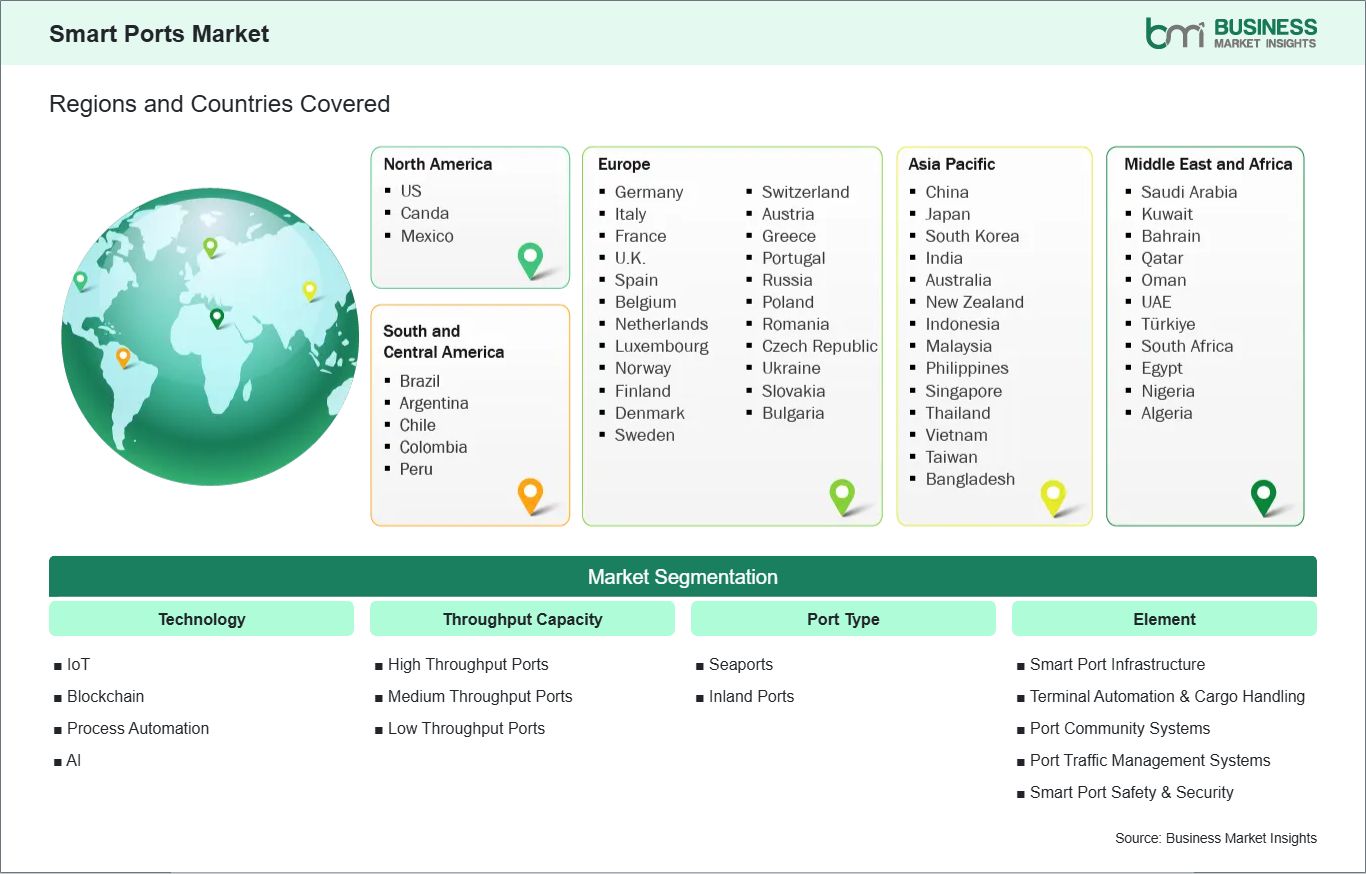
  • Technology (IoT, Blockchain, Process Automation, AI)
  • Throughput Capacity (High Throughput Ports, Medium Throughput Ports, Low Throughput Ports)
  • Port Type (Seaports, Inland Ports)
  • Element (Smart Port Infrastructure, Terminal Automation & Cargo Handling, Port Community Systems, Port Traffic Management Systems, Smart Port Safety & Security)

No. of Pages: 391
Report Code: BMIPUB00034378
Category: Electronics and Semiconductor
Smart Ports Market

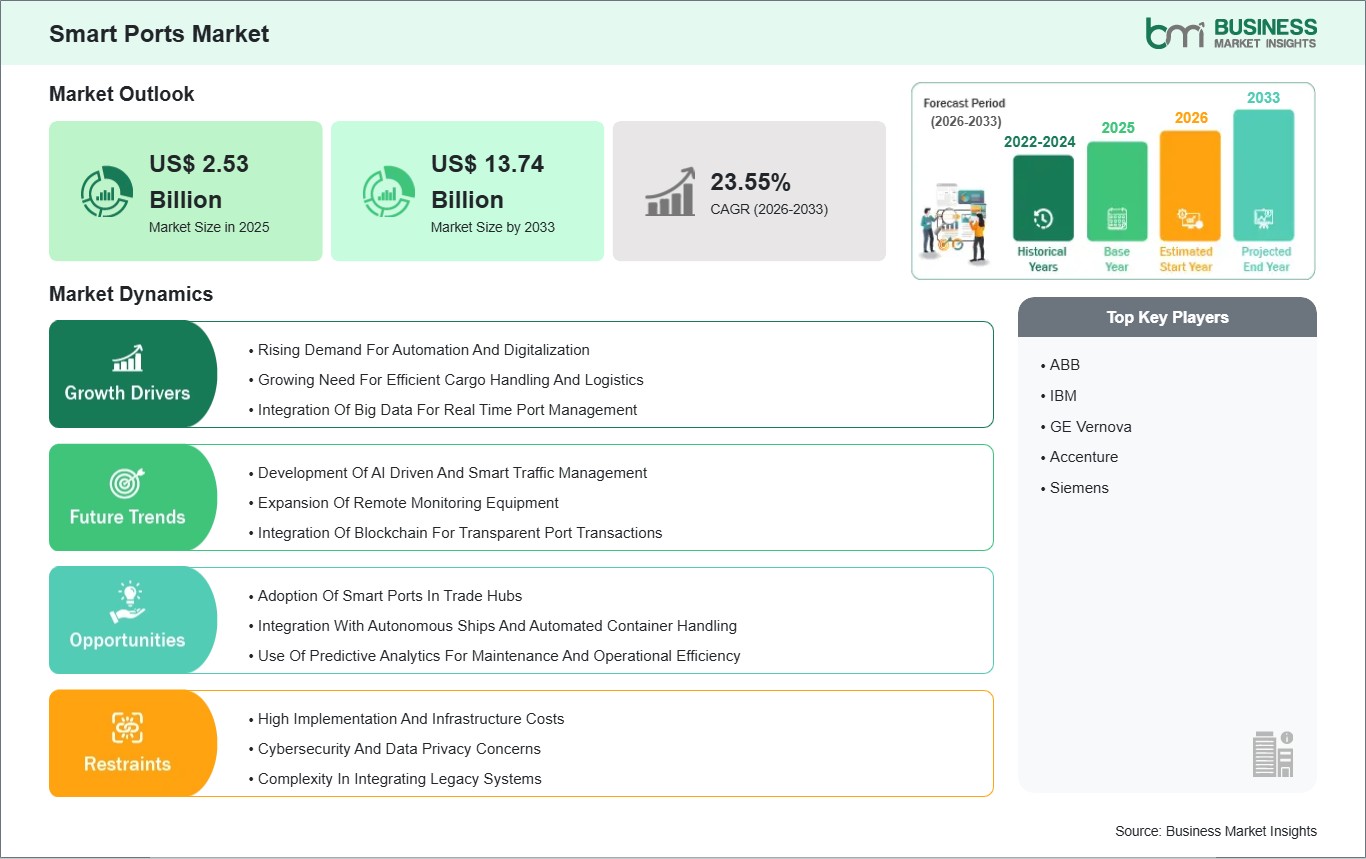
The Smart Ports Market size is expected to reach US$ 13.74 billion by 2033 from US$ 2.53 billion in 2025. The market is estimated to record a CAGR of 23.55% from 2026 to 2033.

Executive Summary and Global Market Analysis:

The global smart ports market is changing how maritime logistics work by adding digital intelligence to port operations. Smart ports use a mix of technologies like IoT sensors, automated guided vehicles, real-time data analytics, AI-based scheduling, drone surveillance, and cloud platforms to make supply chains more efficient, transparent, and responsive. With the increase in global trade and the significance of the reliability of the supply chain, there is an increased need for port authorities and port operators to speed up the transportation of goods, minimize delays, and enhance safety. Smart port technologies enable the real-time monitoring of the movements of vessels, cargo handling, equipment status, and environmental conditions. This leads to better decisions and smoother cooperation between shipping lines, logistics providers, and customs officials.

A major reason for the growth of this market is the need for clear, end-to-end visibility in complex maritime supply chains. In the past, port congestion, bad weather, and changing trade demands have caused delays and inefficiencies. Smart port solutions can help by providing predictive information and automating processes, thus allowing humans to focus their time on more critical decisions. However, smart ports face challenges such as high costs, difficulties in integrating new smart technologies with old ones, and the need for skilled labor, especially in older ports where there is already a system of operation. There are also concerns about cybersecurity and data management as ports become more connected. Still, the push for smarter, more flexible port systems is growing, driven by competition and the need to prepare global trade for the future.

Smart Ports Market - Strategic Insights:

global-market-strategic-framework
Get more information on this report

Smart Ports Market Segmentation Analysis:

Key segments that contributed to the derivation of the smart factory market analysis are technology, throughput capacity, port type, and element.

  • By technology, the smart ports market is segmented into IoT, Blockchain, Process Automation, and AI. The IoT subsegment dominated the market in 2025.
  • Based on throughput capacity, the smart ports market is classified into High Throughput Ports, Medium Throughput Ports, and Low Throughput Ports. The High Throughput Ports subsegment dominated the market in 2025.
  • In terms of port type, the smart ports market is divided into Seaports and Inland Ports. The Seaports subsegment dominated the market in 2025.
  • On the basis element, the smart ports market is categorized into Smart Port Infrastructure, Terminal Automation & Cargo Handling, Port Community Systems, Port Traffic Management Systems, and Smart Port Safety & Security. The Smart Port Infrastructure subsegment dominated the market in 2025.

Smart Ports Market Drivers and Opportunities:

Rising Demand for Automation and Digitalization

The modern shipping industry is experiencing a strong push toward automation and digitalization, driving the development of smart ports worldwide. Traditional port operations, often reliant on manual processes, are being transformed by technologies such as automated cranes, intelligent cargo tracking systems, and AI-enabled logistics platforms. These innovations reduce turnaround times, improve accuracy, and allow port authorities to handle larger volumes of cargo more efficiently.

Ports are increasingly integrating IoT sensors and data analytics to monitor equipment performance, predict maintenance needs, and optimize workflow. For example, automated container handling systems can adjust operations in real time based on ship schedules and cargo priorities, ensuring smooth operations even during peak periods. Across major industrial regions, this combination of automation and digital oversight is enhancing operational reliability and efficiency, while minimizing human error.

Beyond efficiency, smart port automation also improves safety and environmental performance. Automated systems reduce the risk of accidents, enable better tracking of hazardous materials, and help monitor emissions from ships and equipment. As global trade volumes continue to rise, the demand for digitally enabled and automated port infrastructure is becoming a critical factor in maintaining competitive, resilient, and environmentally responsible maritime operations.

Adoption of Smart Ports in Trade Hubs

Smart ports are gaining momentum in major trade hubs around the world, creating opportunities for faster, more connected global supply chains. Ports in Asia, Europe, and the Middle East are adopting digital platforms that link shipping lines, terminal operators, and customs authorities, allowing seamless cargo tracking and real-time communication. This reduces bottlenecks, simplifies documentation processes, and enhances the flow of goods across borders.

The rise of smart ports also presents opportunities for sustainable operations. For example, ports can integrate energy-efficient automated cranes and electric transport vehicles, reducing emissions and energy consumption while maintaining high throughput. In regions with high traffic volumes, such as the Suez Canal or Singapore, these smart solutions are helping ports manage increasing trade volumes without sacrificing environmental and operational standards.

Additionally, smart port adoption enables predictive analytics and data-driven decision-making. By analyzing trends in cargo arrivals, equipment utilization, and shipping schedules, port authorities can optimize resource allocation and plan for peak periods. This intelligence not only reduces delays but also helps in long-term strategic planning, positioning smart ports as a key enabler of efficient, resilient, and globally connected trade networks.

Smart Ports Market Size and Share Analysis:

The smart factory market is experiencing steady growth, with market size and share analysis reflecting evolving treatment preferences and competitive dynamics among key players. The report evaluates important subsegments categorized within technology, throughput capacity, port type, and element, highlighting their respective contributions to overall market performance.

By technology, the IoT subsegment dominated the Smart Ports market in 2025. IoT solutions enable real-time monitoring, asset tracking, and data-driven decision-making, significantly improving operational efficiency and port management, which drives their widespread adoption.

Based on throughput capacity, the High Throughput Ports subsegment dominated the Smart Ports market in 2025. High throughput ports require advanced digital solutions to manage large volumes of cargo efficiently, optimize operations, and reduce congestion, supporting strong demand for smart port technologies.

In terms of port type, the seaports subsegment dominated the Smart Ports market in 2025. Seaports handle the majority of global trade and increasingly adopt smart technologies to enhance logistics efficiency, safety, and connectivity, reinforcing their leading position.

On the basis of element, the Smart Port Infrastructure subsegment dominated the Smart Ports market in 2025. Investments in advanced infrastructure, including connected systems, automation, and digital platforms, are critical for enabling smart port operations, driving the dominance of this segment.

Smart Ports Market Report Highlights:

Report Attribute Details
Market size in 2025 US$ 2.53 Billion
Market Size by 2033 US$ 13.74 Billion
Global CAGR (2026 - 2033)23.55%
Historical Data 2022-2024
Forecast period 2026-2033
Segments Covered By Technology
  • IoT
  • Blockchain
  • Process Automation
  • AI
By Throughput Capacity
  • High Throughput Ports
  • Medium Throughput Ports
  • Low Throughput Ports
By Port Type
  • Seaports
  • Inland Ports
By Element
  • Smart Port Infrastructure
  • Terminal Automation & Cargo Handling
  • Port Community Systems
  • Port Traffic Management Systems
  • Smart Port Safety & Security
Regions and Countries Covered
North America US, Canada, Mexico
Europe Belgium, Austria, Finland, Denmark, Greece, Poland, Romania, Russia, Ukraine, Czech Republic, Slovakia, Bulgaria, Italy, Luxembourg, Germany, Switzerland, France, Netherlands, Norway, Portugal, Spain, Sweden, United Kingdom
Asia-Pacific Australia, China, India, Japan, South Korea, Indonesia, Malaysia, Philippines, Singapore, Thailand, Vietnam, Bangladesh, New Zealand, Taiwan
South and Central America Brazil, Argentina, Peru, Chile, Colombia
Middle East and Africa Bahrain, Kuwait, Oman, Qatar, Saudi Arabia, United Arab Emirates, Turkiye, South Africa, Egypt, Algeria, Nigeria
Market leaders and key company profiles
  • ABB
  • IBM
  • GE Vernova
  • Accenture
  • Siemens
Get more information on this report

Smart Ports Market Report Coverage and Deliverables:

The "Smart Port Market Size and Forecast (2022 - 2033)" report provides a detailed analysis of the market covering below areas:

  • Smart Port market size and forecast at global, regional, and country levels for all the key market segments covered under the scope
  • Smart Port market trends, as well as drivers, restraints, and opportunities
  • Smart Port market analysis covering key trends, regional framework, major players, regulations, and recent developments
  • Industry landscape and competition analysis covering market concentration, heat map analysis, prominent players, and recent developments for the Smart Port market
  • Detailed company profiles, including SWOT analysis

Smart Ports Market Geographic Insights:

The geographical scope of the Smart Port market report is divided into five regions: North America, Asia Pacific, Europe, Middle East & Africa, and South & Central America. The Smart Port market in North America is expected to grow during the forecast period.

North America leads the smart ports market thanks to early adoption of new technology, a strong push for digital transformation, and efforts to modernize maritime infrastructure. In the US and Canada, major ports and transport hubs are using smart systems to move cargo faster, cut down on delays, and help different groups in the logistics chain work together more smoothly. These ports often use real-time tracking, automated equipment, predictive maintenance, and advanced data platforms that link carriers, terminal operators, railways, and trucking companies. Such a level of connectivity makes it easier to transport goods from the ships to the land, hence keeping the supply chain in good condition. The authorities are joining forces with the private sector in the effort to increase the level of connectivity in the supply chain.

For instance, the use of digital twins, which are replicas of physical infrastructures, is helping the authorities in testing the infrastructures, hence planning better without interfering with the operations in the ports. North American smart ports are keen on the sustainability of the operations in the region, hence the importance of green energy, monitoring, and efficient operation in the yards, which are top priorities in the region. In spite of the challenges, the region’s focus on innovation, coupled with the partnership with technology, is moving the region forward. With established trade routes and major investments in digital infrastructure, North America is setting a global example for how ports can balance efficiency, sustainability, and working together in a digital world.

global-market-geography
Get more information on this report

Smart Ports Market Research Report Guidance:

  • The report includes qualitative and quantitative data in the Smart Port market across technology, throughput capacity, port type, element, and geography.
  • The report starts with the key takeaways (chapter 2), highlighting the key trends and outlook of the Smart Port market.
  • Chapter 3 focuses on the research methodology of the study.
  • Chapter 4 includes ecosystem analysis.
  • Chapter 5 highlights the major industry dynamics in the Smart Port market, including factors that are driving the market, prevailing deterrents, potential opportunities, as well as future trends. Impact analysis of these drivers and restraints is also covered in this section.
  • Chapter 6 discusses the Smart Port market scenario, in terms of historical market revenues, and forecast till the year 2033.
  • Chapters 7 to 11 cover the Smart Port market segments by technology, throughput capacity, port type, element, and geography across North America, Europe, Asia Pacific, Middle East and Africa, and South and Central America. They cover the market volume, revenue forecast, and factors driving the market.
  • Chapter 12 describes the competitive analysis with the heat map analysis for the key players operating in the market.
  • Chapter 13 describes the industry landscape analysis. It provides detailed descriptions of business activities such as market initiatives, new developments, mergers, and joint ventures globally, along with a competitive landscape.
  • Chapter 14 provides detailed profiles of the major companies operating in the Smart Port market. Companies have been profiled on the basis of their key facts, business descriptions, products, financial overview, SWOT analysis, and key developments.
  • Chapter 15, i.e., the appendix, is inclusive of a brief overview of the company, list of abbreviations, and disclaimer.

Smart Ports Market News and Key Development:

The smart factory market is evaluated by gathering qualitative and quantitative data post primary and secondary research, which includes important corporate publications, association data, and databases. A few of the key developments in the smart factory market are:

  • In December 2025, MMC Port Holdings Berhad announced that it had signed a Memorandum of Understanding (MoU) with NIZE Intelligent Technology Co., Ltd. to develop a comprehensive digital transformation blueprint for its ports, focusing on smart port technologies such as automation, digital platforms, and intelligent operations to enhance efficiency and sustainability.
  • In June 2025, Maritime and Port Authority of Singapore (MPA), in collaboration with NUS Enterprise, announced the launch of the PIER71 Smart Port Challenge 2025, inviting global startups to develop innovative digital and smart port solutions, including AI, IoT, and automation technologies to address real-world maritime and port challenges.

Key Sources Referred:

  • International Energy Agency (IEA)
  • S. Energy Information Administration (EIA)
  • World Bank
  • International Renewable Energy Agency (IRENA)
  • World Health Organization (WHO)
  • S. Department of Energy (DOE)
  • European Network of Transmission System Operators for Electricity (ENTSO-E)
  • Company Websites
  • Company Annual Reports
  • Company Investor Presentations
The List of Companies - Smart Ports Market
  • ABB
  • IBM
  • GE Vernova
  • Accenture
  • Siemens
Frequently Asked Questions
How big is the Smart Ports Market?

The Smart Ports Market is valued at US$ 2.53 Billion in 2025, it is projected to reach US$ 13.74 Billion by 2033.

What is the CAGR for Smart Ports Market by (2026 - 2033)?

As per our report Smart Ports Market, the market size is valued at US$ 2.53 Billion in 2025, projecting it to reach US$ 13.74 Billion by 2033. This translates to a CAGR of approximately 23.55% during the forecast period.

What segments are covered in this report?

The Smart Ports Market report typically cover these key segments-

  • Technology (IoT, Blockchain, Process Automation, AI)
  • Throughput Capacity (High Throughput Ports, Medium Throughput Ports, Low Throughput Ports)
  • Port Type (Seaports, Inland Ports)
  • Element (Smart Port Infrastructure, Terminal Automation & Cargo Handling, Port Community Systems, Port Traffic Management Systems, Smart Port Safety & Security)

What is the historic period, base year, and forecast period taken for Smart Ports Market?

The historic period, base year, and forecast period can vary slightly depending on the specific market research report. However, for the Smart Ports Market report:

  • Historic Period : 2022-2024
  • Base Year : 2025
  • Forecast Period : 2026-2033
  • Who are the major players in Smart Ports Market?

    The Smart Ports Market is populated by several key players, each contributing to its growth and innovation. Some of the major players include:

  • ABB
  • IBM
  • GE Vernova
  • Accenture
  • Siemens
  • Who should buy this report?

    The Smart Ports Market report is valuable for diverse stakeholders, including:

    • Investors: Provides insights for investment decisions pertaining to market growth, companies, or industry insights. Helps assess market attractiveness and potential returns.
    • Industry Players: Offers competitive intelligence, market sizing, and trend analysis to inform strategic planning, product development, and sales strategies.
    • Suppliers and Manufacturers: Helps understand market demand for components, materials, and services related to concerned industry.
    • Researchers and Consultants: Provides data and analysis for academic research, consulting projects, and market studies.
    • Financial Institutions: Helps assess risks and opportunities associated with financing or investing in the concerned market.

    Essentially, anyone involved in or considering involvement in the Smart Ports Market value chain can benefit from the information contained in a comprehensive market report.

    Available Report Formats

    pdf-format excel-format pptx-format
    Buy Now
    Sales Assistance
    +1 646 791 7070 (US & UK)
    Customization Form

    Please tell us your area of interest
    (Market Segments/ Regions and Countries/ Companies)