Market Summary
Executive Summary and Global Market Analysis
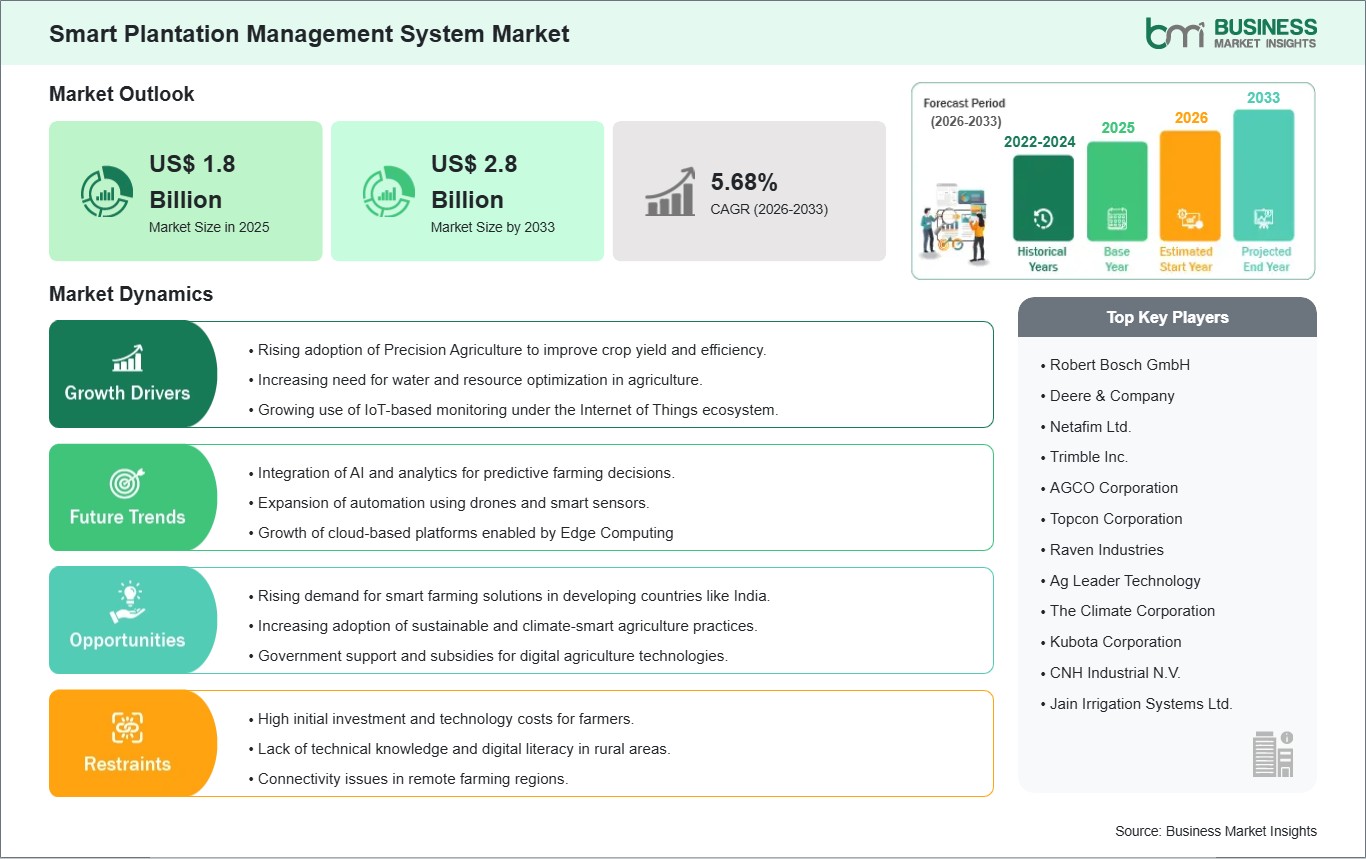
Smart Plantation Management Systems represent a specialized evolution of precision agriculture, tailored to meet the unique challenges of large-scale perennial and industrial crops. These systems leverage a sophisticated interplay between IoT sensors, AI-driven software, and automated machinery to monitor and manage vast estates of high-value crops like coffee, oilseeds, and sugarcane. The integration of such technology is becoming indispensable for plantation owners aiming to balance high productivity with resource conservation. By providing granular, real-time insights into plant physiology and environmental conditions, these systems allow for a "per-plant" management approach, moving away from traditional, inefficient field-level practices.
The market is primarily driven by the urgent need to address rising operational costs and the global scarcity of manual labor in the agricultural sector. Furthermore, the push for sustainable farming and water conservation has made smart irrigation and growth monitoring essential. Despite challenges such as high initial capital expenditure and the lack of high-speed connectivity in remote plantation zones, the market is poised for significant growth. Opportunities are particularly strong in developing regions where government initiatives are actively subsidizing digital agriculture. The future landscape will likely see a surge in autonomous harvesting solutions and cloud-based platforms that offer end-to-end traceability, meeting the growing consumer demand for ethically sourced and environmentally friendly plantation products.
Segment Analysis
Smart Plantation Management System Market Segmentation
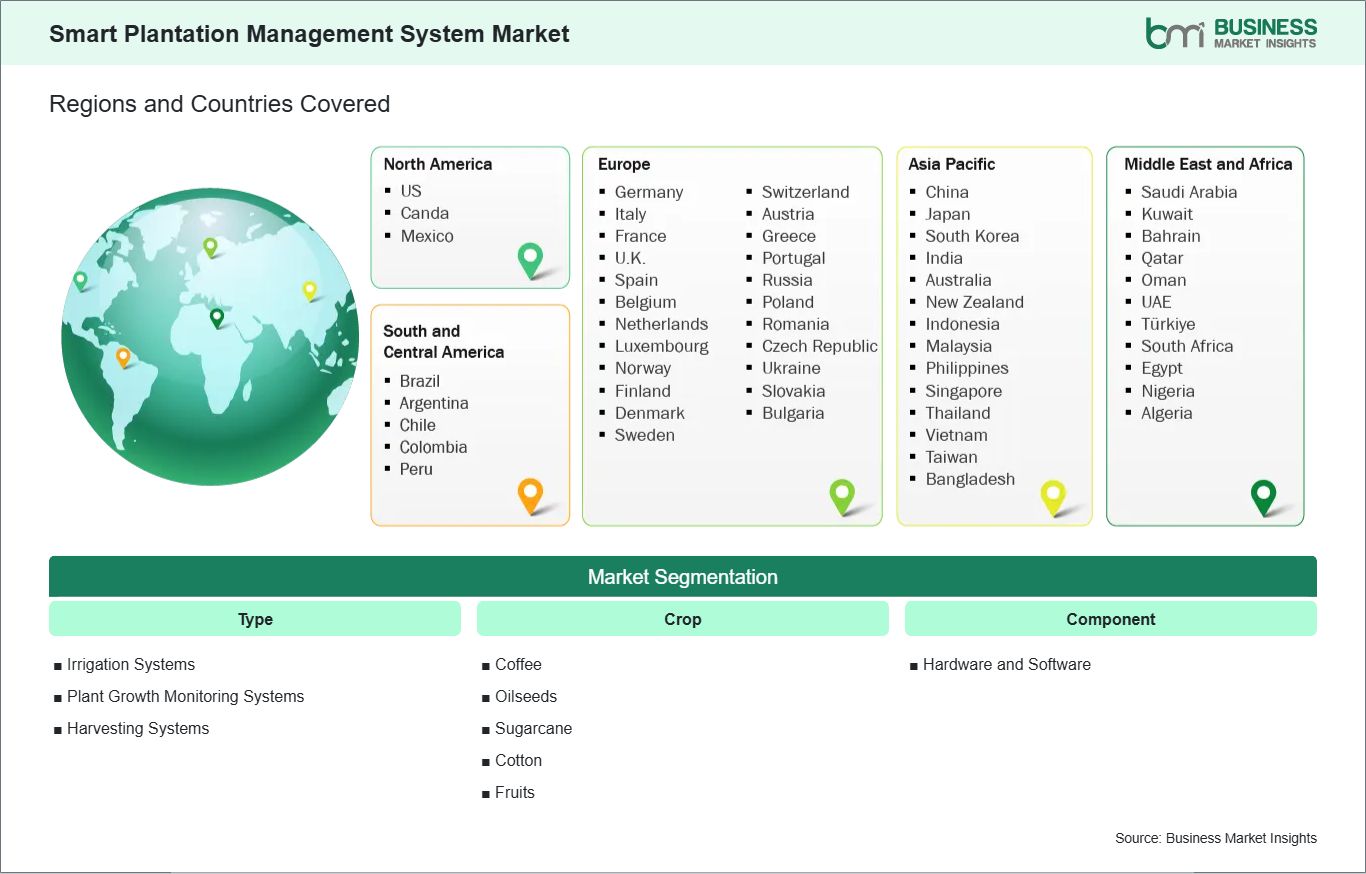
Key segments that contributed to the derivation of the Smart Plantation Management System market analysis are type, crop, and component.
- By Type, the market is segmented into Irrigation Systems, Plant Growth Monitoring Systems, and Harvesting Systems.
- By Crop, the market is divided into Coffee, Oilseeds, Sugarcane, Cotton, and Fruits.
- By Component, the market is categorized into Hardware and Software.
Market Forces
Smart Plantation Management System Market Drivers and Opportunities
Escalating Global Demand for Resource-Efficient Agricultural Automation
The rapid depletion of freshwater resources and the rising cost of manual labor have emerged as the primary catalysts driving the smart plantation management system market. Traditional plantation management, which often relies on flood irrigation and manual scouting, is increasingly viewed as unsustainable both economically and environmentally. In response, plantation owners are adopting automated systems that utilize soil moisture sensors and weather-based controllers to optimize water delivery. This shift is not merely about conservation but about precision; ensuring that high-value crops like sugarcane and oilseeds receive the exact nutrients and hydration required at specific growth stages.
For instance, Water Technology indicates that smart irrigation can reduce water consumption while simultaneously improving yield quality. This efficiency is critical in regions facing frequent droughts or strict environmental regulations. Moreover, as the global population continues to expand, the pressure to produce more on existing land is immense. Smart management systems facilitate this by minimizing resource wastage and maximizing output per hectare. The transition toward these data-driven models is further accelerated by the falling cost of IoT sensors and the increasing availability of user-friendly mobile management platforms, making advanced automation accessible to a broader range of plantation sizes.
Integration of Advanced AI and Remote Sensing for Yield Optimization
The integration of Artificial Intelligence (AI) and remote sensing technologies represents a significant opportunity for the smart plantation management system market to transition from reactive to predictive operations. While traditional systems provide current data, the next generation of smart plantation tools uses machine learning to forecast potential pest outbreaks, disease spread, and the ideal harvesting window. By analyzing years of historical data alongside real-time multispectral imagery from drones and satellites, these systems can alert managers to crop stress long before it is visible to the human eye. This predictive capability is a game-changer for high-risk, high-reward crops like coffee and specialty fruits.
The growing importance of high-resolution satellite imagery in providing daily monitoring of plantation health. These digital tools allow for Variable Rate Technology (VRT), where fertilizers and pesticides are applied only to specific areas that require them, rather than blanket application. This not only reduces chemical costs by up to 15-20% but also helps plantations achieve "Green" certifications and comply with stringent international sustainability standards. As global supply chains demand higher transparency and traceability, the ability of these systems to provide a verified digital "paper trail" from soil to shelf is creating a massive competitive advantage for early adopters in emerging agricultural markets.
Size and Share Analysis
Smart Plantation Management System Market Size and Share Analysis
The smart plantation management system market demonstrates steady growth, with size and share analysis revealing evolving trends and competitive positioning among key players. The report further examines subsegments categorized within type, crop, and component, offering insights into their contribution to overall market performance.
Based on type, Irrigation Systems typically account for a significant share of the market by type. This is due to the critical importance of water management in large-scale estates, where even minor efficiencies can lead to massive cost savings.
In terms of crop segments, Fruits (including citrus, apples, and grapes) represent a share because of their sensitivity to environmental variables and high market value, which justifies the investment in precision monitoring. Coffee and Sugarcane follow closely, particularly in regions like South America and Asia-Pacific.
Hardware remains the largest component segment, as the initial deployment of sensors, GPS-enabled tractors, and automated valves requires significant capital. However, the Software segment is currently the fastest-growing, driven by the increasing need for data analytics platforms that can turn raw sensor data into actionable farm management strategies.
Report Coverage
Smart Plantation Management System Market Report Coverage and Deliverables
The "Smart Plantation Management System Market Size and Forecast (2022–2033)" report provides a detailed analysis of the market covering below areas:
- Smart Plantation Management System market size and forecast at global, regional, and country levels for all the key market segments covered under the scope
- Smart Plantation Management System market trends, as well as market dynamics such as drivers, restraints, and key opportunities
- Smart Plantation Management System market analysis covering key market trends, global and regional framework, major players, regulations, and recent market developments
- Industry landscape and competition analysis covering market concentration, heat map analysis, prominent players, and recent developments for the Smart Plantation Management System market
- Detailed company profiles, including SWOT analysis
Geographic Insights
Smart Plantation Management System Market Geographic Insights
The geographical scope of the Smart Plantation Management System market report is divided into five regions: North America, Asia Pacific, Europe, Middle East & Africa, and South & Central America.
The North America region currently leads the market in terms of revenue share, driven by a high rate of technological adoption and the presence of industry giants like John Deere and Trimble. Large-scale commercial farms in the U.S. and Canada are early adopters of autonomous machinery and satellite-based crop monitoring, supported by government initiatives like the USDA`s climate-smart agriculture programs.
The Asia-Pacific Smart Plantation Management System market is the fastest-growing region globally. It is segmented into China, Japan, India, Australia, Indonesia, and others. The expansion of palm oil and rubber plantations in Southeast Asia, combined with China's massive investment in agricultural IoT, is propelling the region's growth. Governments in India and Indonesia are increasingly providing subsidies to small-to-medium holders to adopt smart irrigation, aiming to boost national food security and export competitiveness.
In Europe, the focus is primarily on sustainability and compliance with environmental regulations. Countries like Germany and France are seeing high demand for software that tracks carbon footprints and chemical usage. Meanwhile, South & Central America (led by Brazil) remains a vital market due to its massive coffee and sugarcane sectors, which are increasingly integrating automated harvesting and growth monitoring to maintain their status as global market leaders.
Industry Activity
Recent Developments
The Smart Plantation Management System market is evaluated by gathering qualitative and quantitative data post primary and secondary research, which includes important corporate publications, association data, and databases. A few of the key developments in the Smart Plantation Management market are:
- In November 2025, Rivulis Pte. Ltd. opened the world`s largest and most advanced manufacturing facility dedicated to producing drippers and sprinklers, the essential components of micro-irrigation systems. By expanding its production capacity, Rivulis reinforces its commitment to advancing global food security and sustainable agriculture amid growing water scarcity.
- In January 2025, John Deere announced several new autonomous machines during a press conference at CES 2025 to support customers in agriculture, construction, and commercial landscaping. The company's second-generation autonomy kit combines advanced computer vision, AI, and cameras to help the machines navigate their environments.
Trust & Transparency
Research Methodology
The market analysis combines proprietary research with secondary data from government agencies, company disclosures, regulatory filings, industry databases and expert interviews. Market estimates are validated through data triangulation, cross-market benchmarking and analyst
review.
View Full Research Methodology
Key Sources Referred:
World Bank – Global Trade Indicators World Trade Organization (WTO) (International Monetary Fund )IMF International Trade Administration (ITA) Company website Company annual reports Company investor presentations