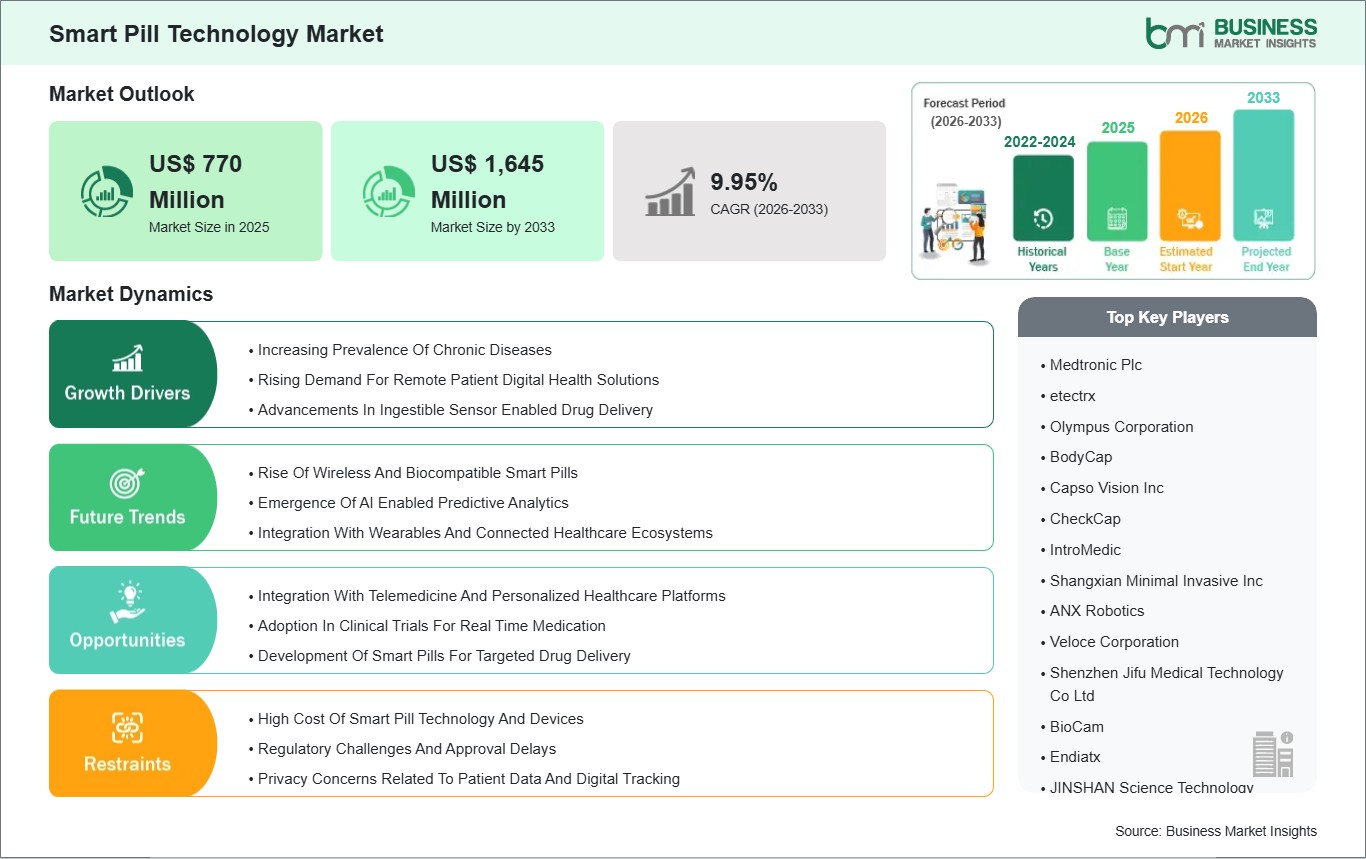
The Smart Pill Technology Market size is expected to reach US$ 1,645. million by 2033 from US$ 770. million in 2025. The market is estimated to record a CAGR of 9.95% from 2026 to 2033.
The global smart pills market is transforming healthcare by enabling real-time monitoring of medication adherence, digestive processes, and internal physiological conditions. Smart pills are ingestible devices equipped with sensors, wireless communication, and advanced imaging technologies that allow physicians and patients to track drug delivery, gastrointestinal health, and other internal metrics with unprecedented precision. This technology solves key problems in the healthcare sector, such as the lack of adherence to medication regimens, the need for early diagnoses, and the need for optimizing individual treatments. The increasing need for digital health technologies and remote monitoring for patients with chronic diseases is a major growth factor for this technology. The high development and manufacturing costs, regulatory issues, and patient concerns regarding safety and data privacy are the other issues.
Finally, the integration of smart pills with the existing healthcare infrastructure requires proper planning and training for doctors and patients. Despite these constraints, innovations in miniaturization, wireless communication, and bio-compatible materials are making smart pills safer, more efficient, and widely applicable. Overall, the market is moving toward a future where healthcare becomes more proactive, personalized, and connected, enabling providers to make data-driven decisions while empowering patients to manage their health more effectively and confidently.

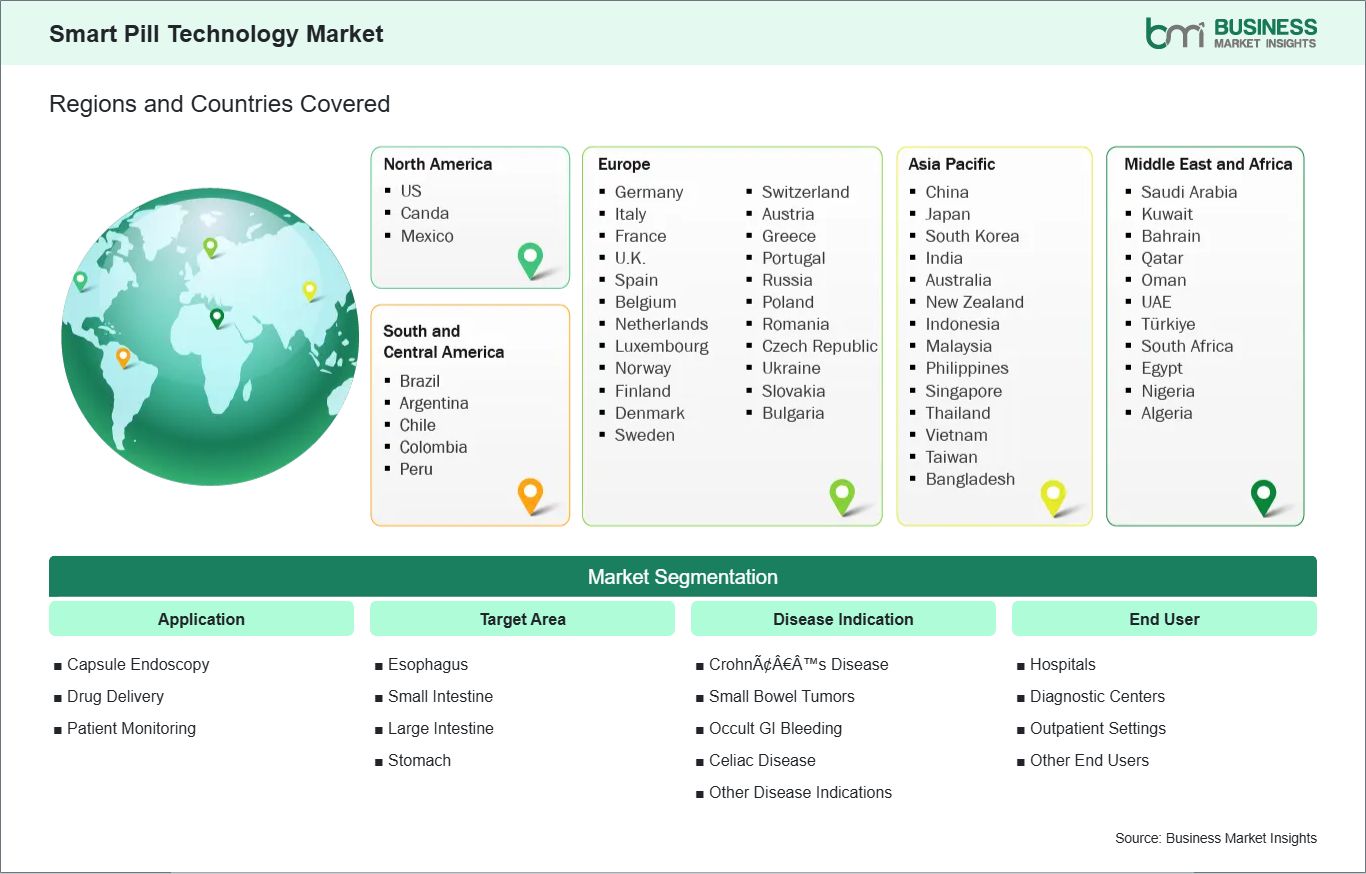
Key segments that contributed to the derivation of the smart pills market analysis are application, target area, disease indication, and end user.
The rising prevalence of chronic diseases such as diabetes, cardiovascular conditions, and gastrointestinal disorders is creating a strong demand for smart pills. Patients and healthcare providers increasingly need ways to monitor treatment adherence, track physiological responses, and ensure that medications are effective. Smart pills, which can transmit real-time data on dosage, absorption, and patient compliance, offer a solution that goes beyond traditional medication, improving outcomes for individuals managing long-term conditions.
In many urban healthcare systems, managing chronic diseases efficiently is a growing concern. For instance, patients in North America and Europe benefit from ingestible sensors that provide doctors with detailed insights into how medications interact with the body over time. This reduces the reliance on guesswork or frequent hospital visits and allows care plans to be adjusted quickly. Globally, these devices are redefining how chronic conditions are monitored, offering both patients and clinicians a clearer picture of health progress.
Beyond individual treatment, smart pills also help healthcare providers improve overall system efficiency. By tracking adherence and physiological data remotely, hospitals and clinics can prioritize patients who need urgent attention while minimizing unnecessary appointments. The combination of convenience, safety, and personalized insights makes smart pills a key driver in the evolving landscape of chronic disease management worldwide.
Smart pills are increasingly being integrated with telemedicine and personalized healthcare platforms, creating new opportunities for connected, patient-centric care. Data from ingestible sensors can be transmitted to mobile apps or cloud-based platforms, allowing physicians to monitor patients remotely and make informed decisions without in-person consultations. This integration is especially valuable in regions with limited access to healthcare facilities or during times when remote monitoring is essential.
The combination of smart pills with digital health platforms also enables highly personalized treatment plans. In Asia and Europe, patients using these technologies can receive tailored feedback, dosage adjustments, or alerts based on real-time physiological data. This level of personalization improves adherence, reduces complications, and empowers patients to take an active role in managing their health. By linking medication with actionable insights, healthcare becomes more interactive, precise, and responsive.
Beyond patient care, integrating smart pills with telemedicine platforms creates opportunities for innovation in preventive healthcare and research. Pharmaceutical companies and medical researchers can analyze anonymized data to identify patterns, optimize drug formulations, or develop predictive models for disease progression. Globally, this convergence of ingestible technology and digital health is positioning smart pills as more than just medication they are a gateway to connected, data-driven, and personalized healthcare experiences.

The smart pills market is experiencing steady growth, with market size and share analysis reflecting evolving treatment preferences and competitive dynamics among key players. The report evaluates important subsegments categorized within application, target area, disease indication, and end user, highlighting their respective contributions to overall market performance.
By application, the capsule endoscopy subsegment dominated the Smart Pills market in 2025. Capsule endoscopy allows non-invasive visualization of the gastrointestinal tract, offering accurate diagnostics and improved patient comfort, which drives its strong adoption.
Based on target area, the small intestine subsegment dominated the Smart Pills market in 2025. The small intestine is difficult to examine with traditional methods, and smart pills provide effective imaging and monitoring solutions, supporting their widespread use.
In terms of disease indication, the occult GI bleeding subsegment dominated the Smart Pills market in 2025. Smart pills are particularly effective in detecting hidden gastrointestinal bleeding, enabling early diagnosis and better clinical outcomes, which fuels adoption in medical settings.
On the basis of end user, the hospitals subsegment dominated the Smart Pills market in 2025. Hospitals are the primary users due to their access to advanced diagnostic tools, specialized equipment, and the capacity to implement smart pill technology for patient care.
| Report Attribute | Details |
|---|---|
| Market size in 2025 | US$ 770 Million |
| Market Size by 2033 | US$ 1,645 Million |
| Global CAGR (2026 - 2033) | 9.95% |
| Historical Data | 2022-2024 |
| Forecast period | 2026-2033 |
| Segments Covered | By Application
|
|
Regions and Countries Covered
| |
| North America | US, Canada, Mexico |
| Europe | Belgium, Austria, Finland, Denmark, Greece, Poland, Romania, Russia, Ukraine, Czech Republic, Slovakia, Bulgaria, Italy, Luxembourg, Germany, Switzerland, France, Netherlands, Norway, Portugal, Spain, Sweden, United Kingdom |
| Asia-Pacific | Australia, China, India, Japan, South Korea, Indonesia, Malaysia, Philippines, Singapore, Thailand, Vietnam, Bangladesh, New Zealand, Taiwan |
| South and Central America | Brazil, Argentina, Peru, Chile, Colombia |
| Middle East and Africa | Bahrain, Kuwait, Oman, Qatar, Saudi Arabia, United Arab Emirates, Turkiye, South Africa, Egypt, Algeria, Nigeria |
| Market leaders and key company profiles |
|
The "Smart Pills Market Size and Forecast (2022 - 2033)" report provides a detailed analysis of the market covering below areas:
The geographical scope of the Smart Pills market report is divided into five regions: North America, Asia Pacific, Europe, Middle East & Africa, and South & Central America. The Smart Pills market in North America is expected to grow during the forecast period.
North America is a leader in smart packaging, with factors such as well-developed infrastructure, high levels of technology adoption, and high consumer demands driving growth. Companies, especially those in the food and beverage, pharmaceutical, and luxury goods industries, are increasingly using smart packaging solutions to enhance their business processes, ensure product authenticity, and monitor environmental factors such as temperature, humidity, and others. Companies use RFID tags, NFC, and sensor-based smart packaging solutions to ensure high levels of inventory tracking, minimize product loss, and ensure compliance with stringent industry requirements related to product safety and quality.
North America is also characterized by high levels of consumer engagement with smart devices, thus providing companies with opportunities to create engaging brand experiences through smart packaging solutions such as QR codes, mobile applications, and others. While smart packaging solutions present challenges such as high costs, complexity, and security, North America is setting a benchmark for smart packaging solutions across the world. North America is showing how smart packaging solutions can not only enhance business processes, increase consumer engagement, and ensure compliance, but can transform conventional packaging solutions into intelligent, interactive, and innovative solutions.

The smart pills market is evaluated by gathering qualitative and quantitative data post primary and secondary research, which includes important corporate publications, association data, and databases. A few of the key developments in the smart pills market are:
The Smart Pill Technology Market is valued at US$ 770 Million in 2025, it is projected to reach US$ 1,645 Million by 2033.
As per our report Smart Pill Technology Market, the market size is valued at US$ 770 Million in 2025, projecting it to reach US$ 1,645 Million by 2033. This translates to a CAGR of approximately 9.95% during the forecast period.
The Smart Pill Technology Market report typically cover these key segments-
The historic period, base year, and forecast period can vary slightly depending on the specific market research report. However, for the Smart Pill Technology Market report:
The Smart Pill Technology Market is populated by several key players, each contributing to its growth and innovation. Some of the major players include:
The Smart Pill Technology Market report is valuable for diverse stakeholders, including:
Essentially, anyone involved in or considering involvement in the Smart Pill Technology Market value chain can benefit from the information contained in a comprehensive market report.
Please tell us your area of interest
(Market Segments/ Regions and Countries/ Companies)