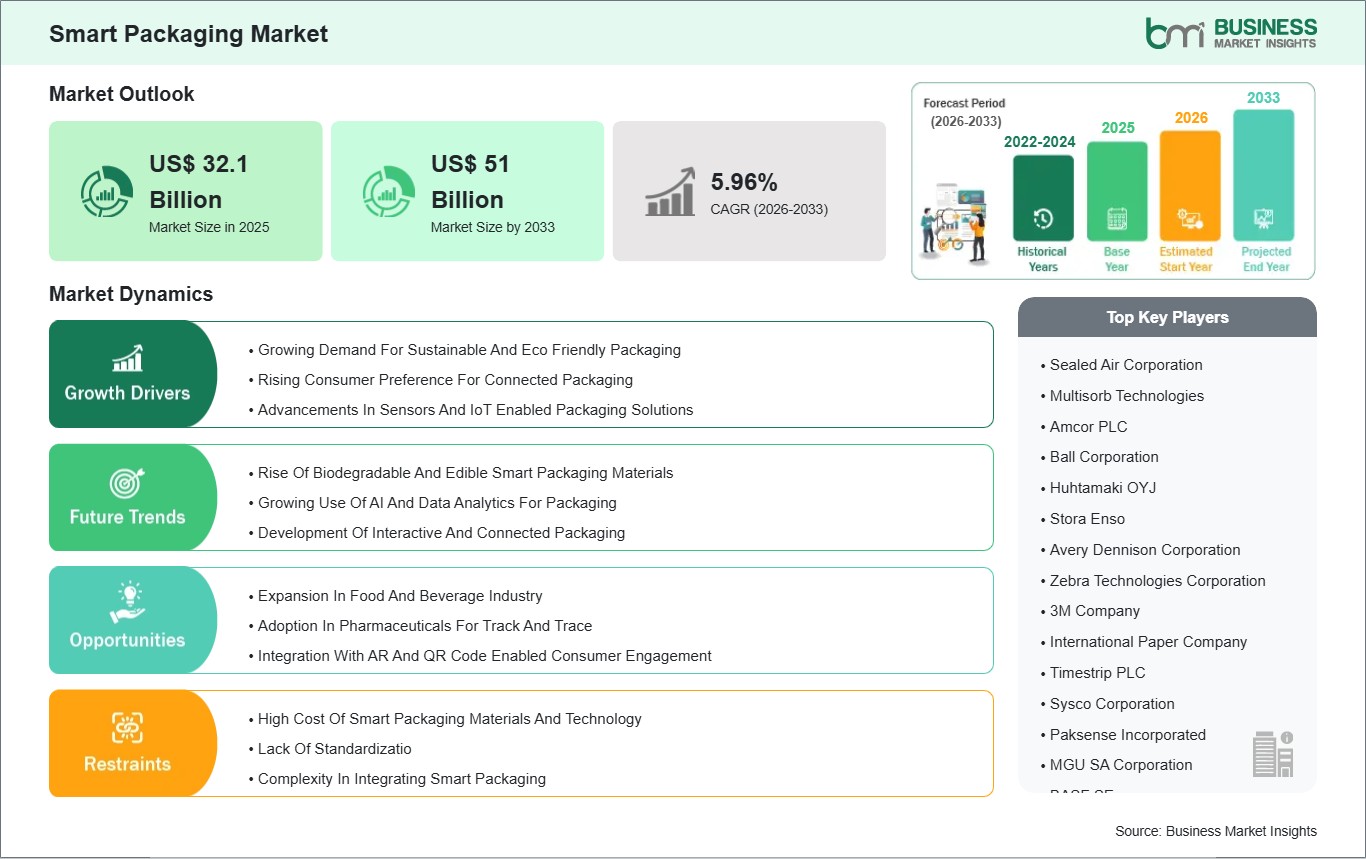
The Smart Packaging Market size is expected to reach US$ 51. billion by 2033 from US$ 32.1 billion in 2025. The market is estimated to record a CAGR of 5.96% from 2026 to 2033.
The global smart packaging market is changing how brands interact with consumers and improving product safety and supply chain efficiency. Smart packaging uses technologies like RFID tags, QR codes, NFC chips, sensors, and smart indicators to give real-time product information, check authenticity, monitor freshness, and engage consumers. For example, the food and beverages, pharmaceuticals, logistics, and luxury goods industries are increasingly using smart packaging as a means of enhancing traceability, preventing counterfeiting, and creating personalization experiences. The need for increased consumer demand for transparency, safety, and sustainability, as well as the requirement for a connected supply chain with real-time status on the condition of the products, is driving the market for smart packaging.
However, high production costs, technical challenges, and difficulties in integrating with current packaging and logistics systems can slow adoption, especially for small and medium businesses. There are also important concerns about data privacy and cybersecurity in connected packaging. However, new advancements in small sensors, affordable printing, and cloud-based data analytics are helping to make smart packaging more viable. The trend is shifting towards a new form of packaging that is not just protective of products but also acts as a smart bridge between a brand and a consumer, providing greater safety, interactivity, and insights throughout a product’s life cycle.

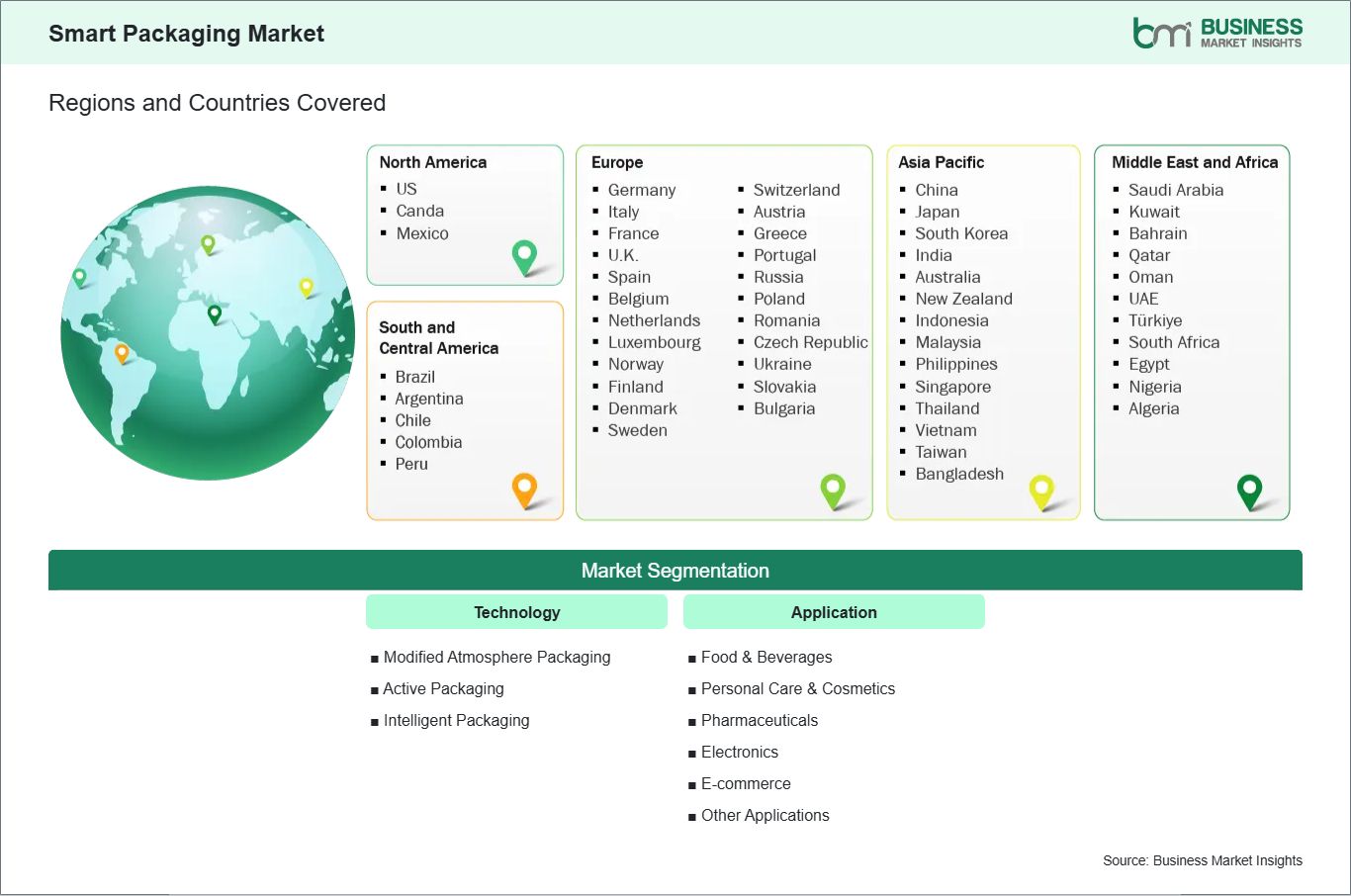
Key segments that contributed to the derivation of the smart packaging market analysis are technology and application.
Consumers as well as enterprises are increasingly focusing on sustainable practices, which has led to a rise in smart packaging solutions to reduce their environmental impact. Sustainable materials, recyclable parts, as well as biodegradable coatings are being paired with technology to create intelligent and sustainable solutions. This allows companies to meet the growing needs of their consumers while reducing their environmental impact.
Sustainability has become a major factor in differentiating companies in many parts of the world. For instance, in Europe, companies are testing sustainable packaging solutions that contain sensors as well as recyclability, which allows consumers to monitor product freshness while also being sustainable. In America, there has been a rise in smart packaging solutions that minimize material use as well as energy consumption during manufacturing, which is a sign of a shift towards more sustainable manufacturing practices.
Beyond meeting regulatory and consumer pressures, sustainable smart packaging also adds value through storytelling and engagement. Brands can communicate their eco-conscious initiatives directly to consumers through QR codes or interactive labels, highlighting recycling instructions or carbon footprint information. This combination of sustainability and intelligence helps build trust, encourages responsible consumption, and positions smart packaging as a forward-thinking solution in a world increasingly focused on environmental stewardship.
The food and beverage industry is a major driver of smart packaging adoption, as companies look to improve freshness, safety, and consumer engagement. Intelligent packaging can monitor temperature, detect spoilage, or track product movement in real time, ensuring that perishable goods reach consumers in optimal condition. In fast-paced urban markets, this technology enhances confidence and convenience, supporting both retailers and end users in maintaining quality and safety standards.
Smart packaging is also contributing to the consumer experience in the food retail market, as well as in the restaurant business. For instance, in the Asian market, interactive labels on beverage containers can offer flavor, taste, and nutrition information, as well as suggestions on the best pairing options for the consumer. In the European retail market, sensor technology in the packaging of fresh produce allows the consumer direct access to the status of the products, hence eliminating food waste while promoting consumer purchase decisions.
Smart packaging technology’s flexibility in the food and beverage market allows for differentiation in the market as a result of the integration of technology with the packaging, as the use of eco-friendly materials with the benefits of smart packaging technology allows companies in the food industry to demonstrate quality and sustainability in the products they offer to the market. In the global market, the integration of food safety, consumer engagement, and sustainability in the use of smart packaging technology in the food and beverage market is a significant development in the industry’s growth trajectory.

The smart packaging market is experiencing steady growth, with market size and share analysis reflecting evolving treatment preferences and competitive dynamics among key players. The report evaluates important subsegments categorized within technology and application, highlighting their respective contributions to overall market performance.
By technology, the active packaging subsegment dominated the Smart Packaging market in 2025. Active packaging enhances product shelf life, preserves quality, and provides protection against microbial contamination, making it the preferred choice across industries.
Based on application, the food & beverages subsegment dominated the Smart Packaging market in 2025. The demand for extended freshness, improved safety, and real-time product monitoring in the food and beverage sector drives strong adoption of smart packaging solutions.
| Report Attribute | Details |
|---|---|
| Market size in 2025 | US$ 32.1 Billion |
| Market Size by 2033 | US$ 51 Billion |
| Global CAGR (2026 - 2033) | 5.96% |
| Historical Data | 2022-2024 |
| Forecast period | 2026-2033 |
| Segments Covered | By Technology
|
|
Regions and Countries Covered
| |
| North America | US, Canada, Mexico |
| Europe | Belgium, Austria, Finland, Denmark, Greece, Poland, Romania, Russia, Ukraine, Czech Republic, Slovakia, Bulgaria, Italy, Luxembourg, Germany, Switzerland, France, Netherlands, Norway, Portugal, Spain, Sweden, United Kingdom |
| Asia-Pacific | Australia, China, India, Japan, South Korea, Indonesia, Malaysia, Philippines, Singapore, Thailand, Vietnam, Bangladesh, New Zealand, Taiwan |
| South and Central America | Brazil, Argentina, Peru, Chile, Colombia |
| Middle East and Africa | Bahrain, Kuwait, Oman, Qatar, Saudi Arabia, United Arab Emirates, Turkiye, South Africa, Egypt, Algeria, Nigeria |
| Market leaders and key company profiles |
|
The "Smart Packaging Market Size and Forecast (2022 - 2033)" report provides a detailed analysis of the market covering below areas:
The geographical scope of the Smart Packaging market report is divided into five regions: North America, Asia Pacific, Europe, Middle East & Africa, and South & Central America. The Smart Packaging market in North America is expected to grow during the forecast period.
North America leads the smart packaging market thanks to its advanced supply chain systems, strong use of technology, and consumers who expect transparency and product safety. In the US and Canada, companies in food, beverages, pharmaceuticals, and luxury goods are using smart packaging more often to track inventory, check authenticity, and monitor conditions like temperature and humidity. Tools like RFID tags, NFC labels, and sensors help improve traceability, reduce losses, and meet strict safety and quality rules. Consumers in this region are also quick to use connected technologies, which lets brands offer interactive experiences through QR codes or mobile apps. These features can share product details, promotions, or personalized suggestions.
Although there are still challenges, such as higher costs, technical hurdles, and data security concerns, North America remains the standard for the industry. The region shows how smart packaging can boost efficiency, engage consumers, and meet regulations, turning regular packaging into a smart and valuable part of supply chains.

The smart packaging market is evaluated by gathering qualitative and quantitative data post primary and secondary research, which includes important corporate publications, association data, and databases. A few of the key developments in the smart packaging market are:
The Smart Packaging Market is valued at US$ 32.1 Billion in 2025, it is projected to reach US$ 51 Billion by 2033.
As per our report Smart Packaging Market, the market size is valued at US$ 32.1 Billion in 2025, projecting it to reach US$ 51 Billion by 2033. This translates to a CAGR of approximately 5.96% during the forecast period.
The Smart Packaging Market report typically cover these key segments-
The historic period, base year, and forecast period can vary slightly depending on the specific market research report. However, for the Smart Packaging Market report:
The Smart Packaging Market is populated by several key players, each contributing to its growth and innovation. Some of the major players include:
The Smart Packaging Market report is valuable for diverse stakeholders, including:
Essentially, anyone involved in or considering involvement in the Smart Packaging Market value chain can benefit from the information contained in a comprehensive market report.
Please tell us your area of interest
(Market Segments/ Regions and Countries/ Companies)