Market Summary
Executive Summary and Global Market Analysis
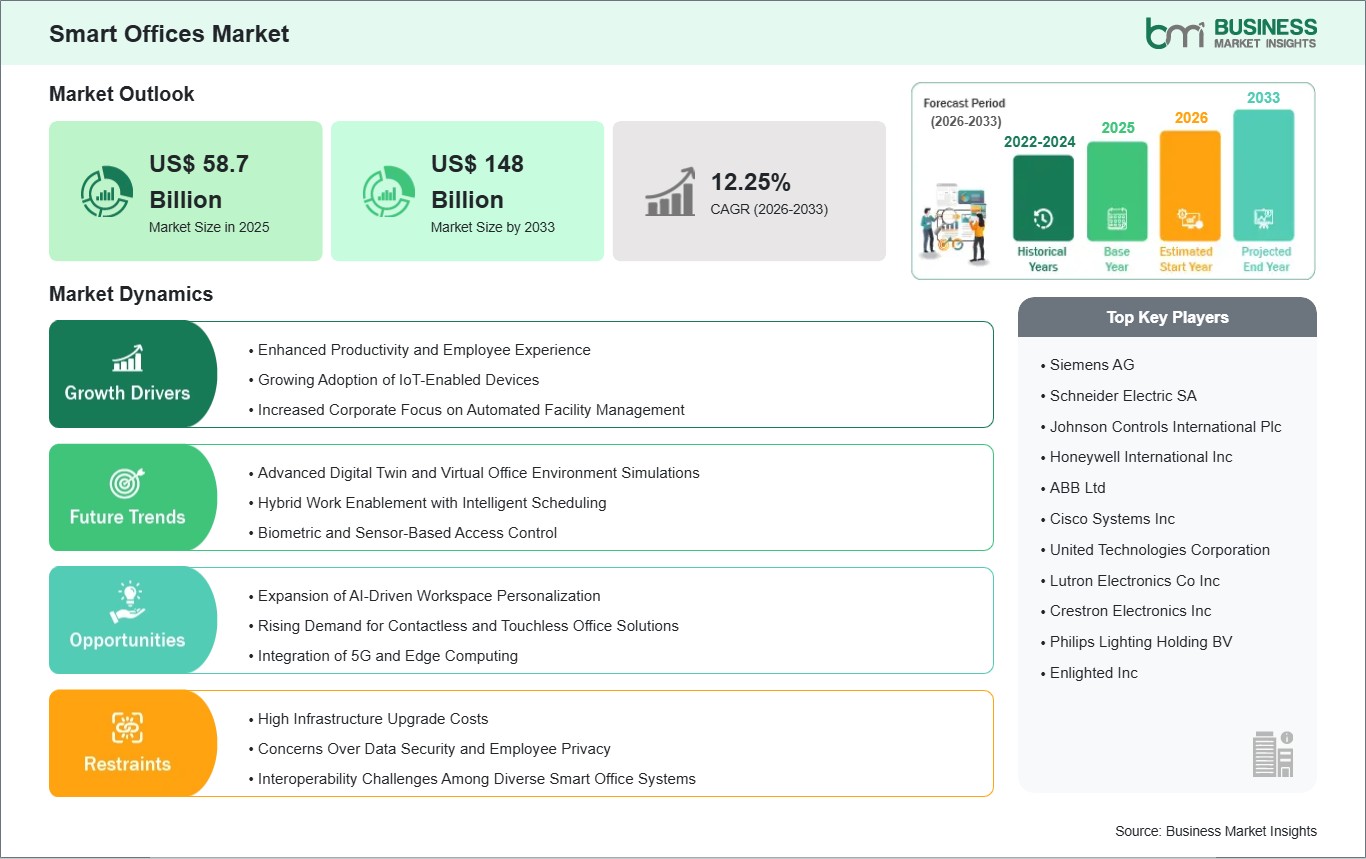
The global market for smart offices centers on the integration of technology, automation, and connectivity in the workplace with the aim of creating efficient, productive, and responsive spaces. Smart offices utilize IoT technology, AI-based analytics, cloud technology, smart lighting, climate management systems, and sensor-based workplace management with the aim of creating efficient, productive, and responsive spaces in the workplace. The need for increased workplace digitization, the focus on employee comfort, and the need for increased energy efficiency are just a few of the driving forces behind the market for smart offices. There is a need for real-time monitoring of space, energy, and employee usage, with the aim of creating efficient, productive, and responsive spaces in the workplace.
However, high costs of investment, data privacy, and cybersecurity challenges may pose challenges to the process, especially for small and medium-sized enterprises. Nevertheless, the developments in AI technology for office management, IoT connectivity, and cloud computing have made smart offices accessible and efficient. There is a gradual shift towards offices that not only serve their purpose well but are also smart, responsive, and adaptive, which is a result of emerging trends related to digital transformation, sustainability, and employee-centric design in contemporary global organizations.
Segment Analysis
Smart Offices Market Segmentation
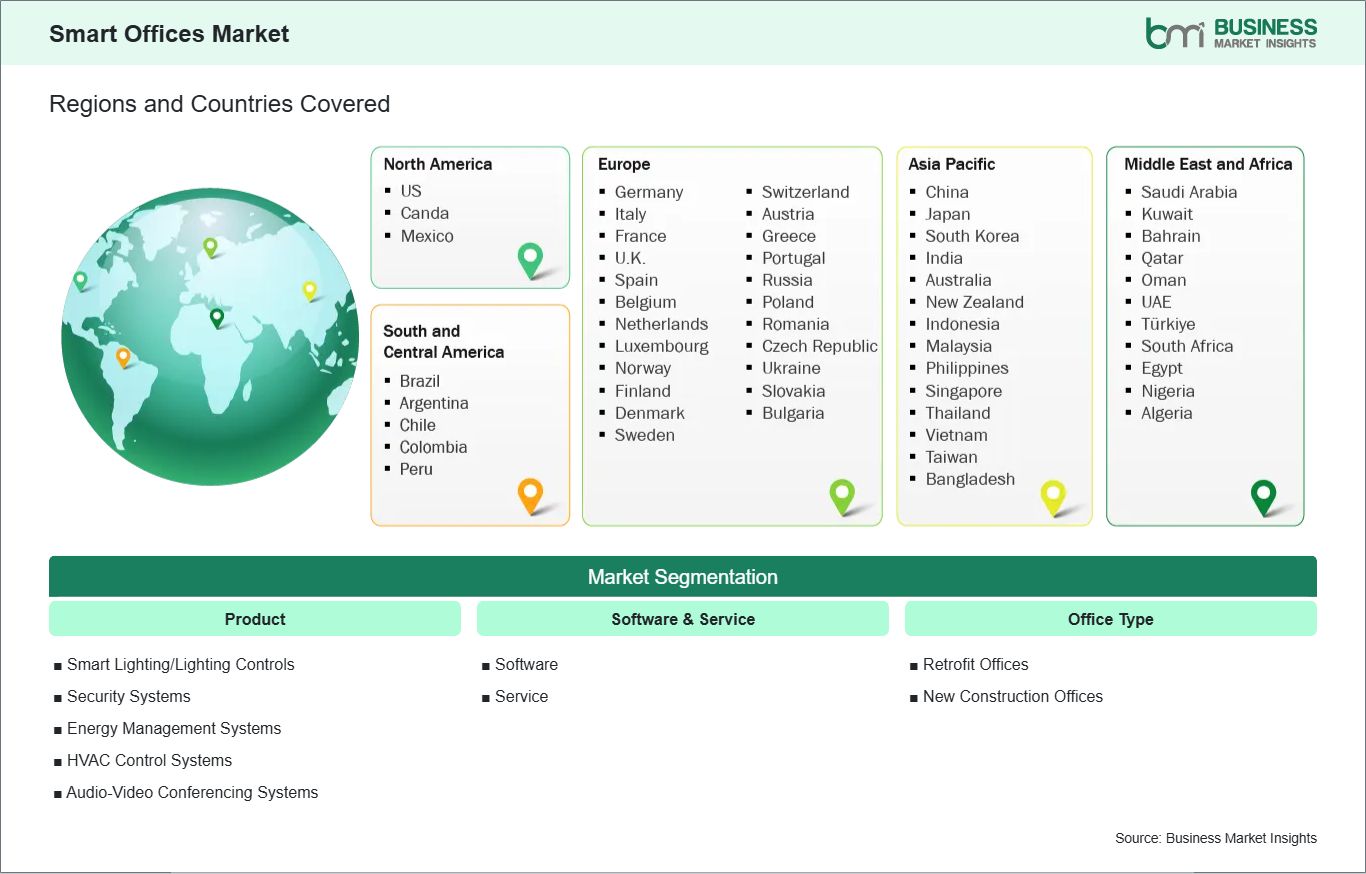
Key segments that contributed to the derivation of the smart offices market analysis are product, software, and office type.
- By product, the smart connected offices market is segmented into Smart Lighting/Lighting Controls, Security Systems, Energy Management Systems, HVAC Control Systems, and Audio - Video Conferencing Systems. The Energy Management Systems subsegment dominated the market in 2025.
- Based on Software & Service, the smart connected offices market is classified into Software and Service. The Software subsegment dominated the market in 2025.
- In terms of office type, the smart connected offices market is categorized into Retrofit Offices and New Construction Offices. The New Construction Offices subsegment dominated the market in 2025.
Market Forces
Smart Offices Market Drivers and Opportunities
Enhanced Productivity and Employee Experience
The smart offices are revolutionizing the way people experience work by making traditional offices smart and responsive to human needs. One can only imagine how it would feel to walk into an office where the lighting is already set to their desired level, the temperature is perfect for their comfort, and their workstation is already ready for them. These small but impactful innovations help people eliminate distractions and focus on what is important by making them feel cared for.
In addition to this, smart offices also help people collaborate and be creative. Meeting rooms have become smart as they can detect people entering them and set up the tools they need for the meeting. This allows people to have fewer distractions and spend more time sharing ideas and sparking creativity in the workplace.
Equally important is the sense of well-being these environments foster. Employees notice when spaces respond to their presence and activity, from quiet zones that minimize noise to smart air quality systems that promote alertness. Over time, these small adjustments create a workplace where people feel supported, appreciated, and motivated, reinforcing a positive work culture that nurtures both productivity and satisfaction.
Expansion of AI‑Driven Workspace Personalization
Artificial intelligence is taking personalization in smart offices to an entirely new level. Instead of a system that caters to a general audience, an AI system can get to know people and groups in an office and make adjustments to suit their needs. This can mean anything from adjusting desk height to suggesting where to sit to get the most quiet time to work.
The beauty of personalization through an AI system is that it strikes a perfect balance between efficiency and empathy. It knows exactly what to do to make life easier without being overly intrusive. For instance, it can automatically adjust lighting and temperature according to how it has seen a person working, or it can prepare a room before a scheduled brainstorming session, making the office feel alive to those inside it.
Perhaps the most meaningful impact is the sense of ownership and comfort employees feel in these spaces. When AI subtly tailors the environment to individual preferences, people feel seen and valued. Over time, these personalized experiences strengthen engagement, encourage creative thinking, and make the office not just a place to work, but a place where people want to thrive and contribute their best.
Size and Share Analysis
Smart Offices Market Size and Share Analysis
The smart offices market is experiencing steady growth, with market size and share analysis reflecting evolving treatment preferences and competitive dynamics among key players. The report evaluates important subsegments categorized within product, software, and office type, highlighting their respective contributions to overall market performance.
By product, the Energy Management Systems subsegment dominated the Smart Connected Offices market in 2025. Energy management systems are widely adopted for their ability to optimize energy consumption, reduce operational costs, and enhance sustainability in modern office environments, driving their strong demand.
Based on Software & Service, the software subsegment dominated the Smart Connected Offices market in 2025. Software solutions enable seamless integration, real-time monitoring, and automation of office systems, making them essential for improving efficiency and occupant comfort.
In terms of office type, the New Construction Offices subsegment dominated the Smart Connected Offices market in 2025. New construction projects increasingly incorporate smart technologies from the design stage to maximize energy efficiency, connectivity, and operational performance, fueling the adoption of connected office solutions.
Report Coverage
Smart Offices Market Report Coverage and Deliverables
The "Smart Offices Market Size and Forecast (2022 - 2033)" report provides a detailed analysis of the market covering below areas:
- Smart Offices market size and forecast at global, regional, and country levels for all the key market segments covered under the scope
- Smart Offices market trends, as well as drivers, restraints, and opportunities
- Smart Offices market analysis covering key trends, regional framework, major players, regulations, and recent developments
- Industry landscape and competition analysis covering market concentration, heat map analysis, prominent players, and recent developments for the Smart Offices market
- Detailed company profiles, including SWOT analysis
Geographic Insights
Smart Offices Market Geographic Insights
The geographical scope of the Smart Offices market report is divided into five regions: North America, Asia Pacific, Europe, Middle East & Africa, and South & Central America. The Smart Offices market in North America is expected to grow during the forecast period.
North America has been identified as a highly developed segment in terms of smart office adoption, owing to factors such as high technology adoption rates, business needs to optimize operational efficiency, and a growing focus on employee experience. Organizations in the US and Canada are increasingly embracing connected devices, AI-driven analytics, and automated intelligent building solutions to optimize space utilization, lighting, temperature, and security. The trend towards flexible work styles, hybrid offices, and collaborative work culture also leads to the adoption of smart office solutions that can dynamically respond to changing needs. North American firms are often at the forefront of experimentation and innovation, with smart technologies such as voice control, predictive climates, and sensor-driven occupancy analytics being incorporated into modern office spaces.
However, in addition to productivity, there is also a major role for sustainability, with many firms using smart technologies to track energy consumption and minimize their impact on the environment. Yet, as with any smart technology, there are also challenges for firms, particularly with regard to data security, integration complexity, and technology compatibility. Overall, the smart office market in North America is a benchmark for the deployment of smart technologies across the world, with regard to balancing operational needs with sustainability.
Industry Activity
Recent Developments
The smart offices market is evaluated by gathering qualitative and quantitative data post primary and secondary research, which includes important corporate publications, association data, and databases. A few of the key developments in the smart offices market are:
- In June 2024, Crestron Electronics announced that it had expanded its Crestron Control platform to support native control interfaces with major unified communications systems such as Microsoft Teams Rooms, Zoom Rooms, and Cisco Webex, enabling more seamless room automation and smart office integration for enterprise customers.
- In February 2024, Huawei Technologies Co., Ltd. announced that it had launched its flagship collaborative smart office product, the IdeaHub ES2 Plus, at MWC Barcelona, featuring advanced AI‑enabled collaboration and connectivity capabilities designed to enhance enterprise office communication and hybrid work environments.
Trust & Transparency
Research Methodology
The market analysis combines proprietary research with secondary data from government agencies, company disclosures, regulatory filings, industry databases and expert interviews. Market estimates are validated through data triangulation, cross-market benchmarking and analyst
review.
View Full Research Methodology
Key Sources Referred:
International Electrotechnical Commission Institute of Electrical and Electronics Engineers International Organization for Standardization Bureau of Indian Standards Central Electricity Authority Ministry of Power Indian Electrical and Electronics Manufacturers' Association European Committee for Electrotechnical Standardization VDE Association for Electrical Electronic & Information Technologies Company Websites Company Annual Reports Company Investor Presentations