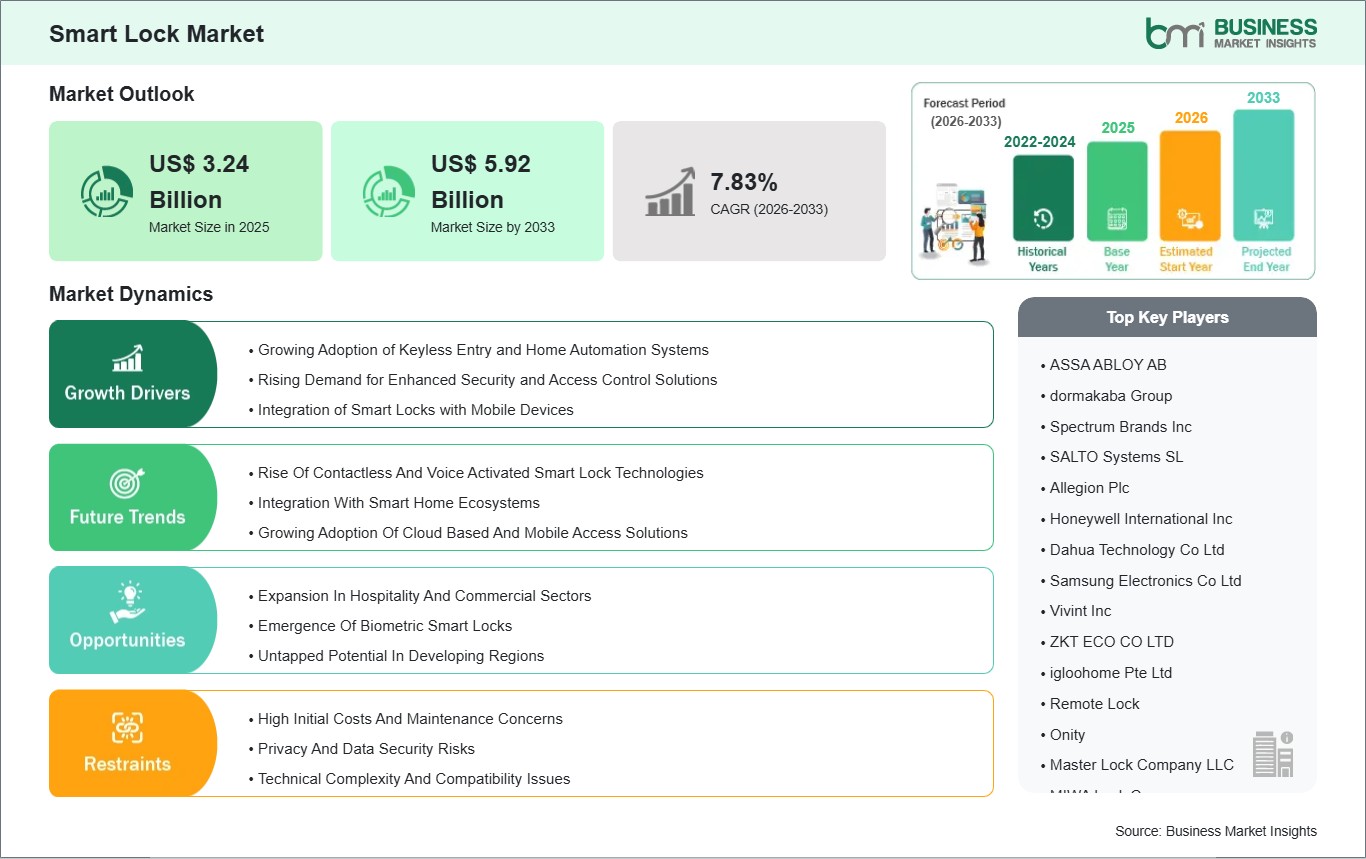
The Smart Lock Market size is expected to reach US$ 5.92 billion by 2033 from US$ 3.24 billion in 2025. The market is estimated to record a CAGR of 7.83% from 2026 to 2033.
The global smart locks market is changing how we think about security by combining traditional locks with new digital and wireless technology. Smart locks now offer features like fingerprint recognition, mobile app controls, keyless entry, and cloud-based access management. These features make them convenient and adaptable for homes, businesses, and industrial sites. More people and companies are choosing smart locks because they can track who enters in real time, allow remote or temporary access, and keep records for accountability. As people become more aware of security at home and work, and as smart buildings and connected homes become more common, smart locks are being adopted around the world.
However, some users worry about digital security, hacking, and whether these systems are reliable, especially if they are not used to connected devices. It can also be hard to add smart locks to older buildings, sometimes needing professional help or extra costs. Improvements in wireless technology, better encryption, and easier-to-use interfaces are making smart locks more dependable and user-friendly. The market is now focused on providing secure and smart ways to manage access, keeping up with new technology and the need for smooth integration between physical and digital security.

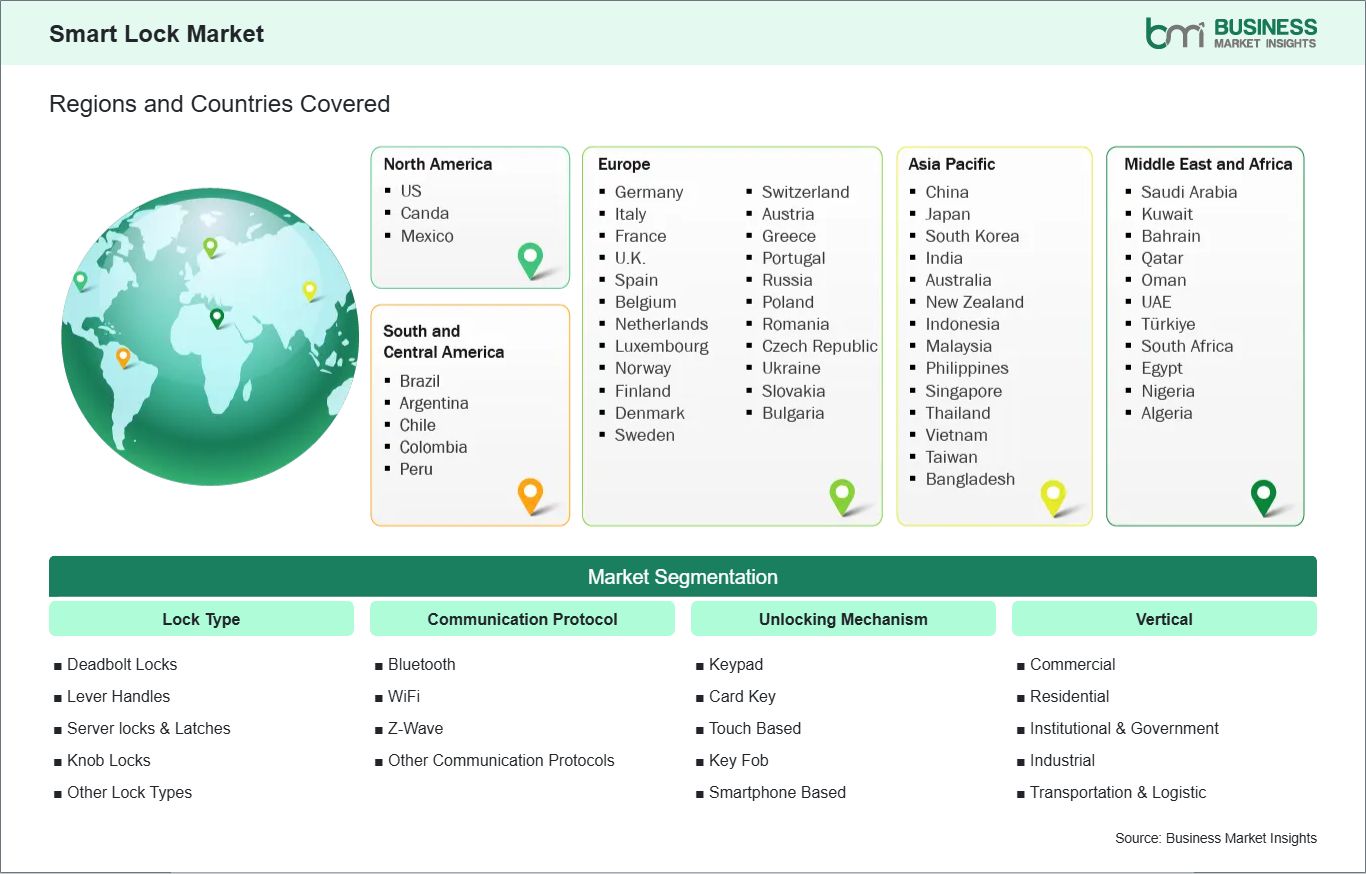
Key segments that contributed to the derivation of the smart lock market analysis are lock type, communication protocol, unlocking mechanism, and vertical.
The rise of keyless entry systems is transforming how people access and secure their homes. Across urban and suburban areas, homeowners increasingly prefer smart locks that can be controlled through smartphones, biometric sensors, or voice assistants. This shift eliminates the need for physical keys while offering convenience, enhanced security, and the ability to monitor entry remotely. For many, the appeal goes beyond technology smart locks provide peace of mind, allowing users to check who enters their home, receive alerts, and grant temporary access to family members or service providers without worrying about lost keys.
Furthermore, integration with other home automation systems is also boosting the need for smart locks. With smart lighting systems, thermostats, and security cameras becoming increasingly ubiquitous in smart homes, smart locks are serving as a central gateway that connects various smart home systems together. In Europe, smart locks are being increasingly connected to home automation systems to control lighting and security systems when doors are opened, thereby providing a seamless and efficient living experience.
Convenience is also a major driver in emerging markets. In Asia Pacific, smart locks are increasingly being used in apartments and buildings due to high-density living and the need to manage multiple residents and guests. With smart locks, users are no longer required to use physical keys and can control access from anywhere in the world, thereby providing a convenient living experience that meets modern living requirements.
Smart locks are also gaining popularity in the hospitality and commercial industries. Hotels and serviced apartments are using smart locks to streamline their check-in process for customers. Customers are able to check in easily using smart locks as they do not have to carry keys. This is also helping the hotels to have better control over the rooms and monitor the customer check-in process in real time. This is also gaining popularity in regions with high tourism activities.
In the commercial sector, smart locks are also gaining popularity in offices, commercial centers, and learning centers. Smart locks are helping organizations to have better control over their premises. Organizations are using smart locks to grant time-sensitive access to their employees or visitors. This is also helping organizations to monitor the entry and exit points for their employees in multiple locations. Smart locks are gaining popularity in the corporate sector in North America. Organizations in this region are using smart locks to have better control over their workplaces. This is also helping them to support the hybrid work culture in the region.
Beyond security, smart locks offer operational insights that create further value. Data from smart lock systems can help facility managers understand usage patterns, optimize access schedules, and even identify potential security vulnerabilities. In commercial buildings and hotels, this information enables proactive management and contributes to improved efficiency, safety, and guest or employee experience. The combination of convenience, analytics, and security positions smart locks as a high‑value solution with opportunities for growth across diverse sectors globally.

The smart lock market is experiencing steady growth, with market size and share analysis reflecting evolving treatment preferences and competitive dynamics among key players. The report evaluates important subsegments categorized within lock type, communication protocol, unlocking mechanism, and vertical, highlighting their respective contributions to overall market performance.
By lock type, the deadbolt locks subsegment dominated the Smart Lock market in 2025. Deadbolt locks are preferred for their enhanced security, durability, and compatibility with smart technologies, making them the most reliable choice for both residential and commercial applications.
Based on communication protocol, the Bluetooth subsegment dominated the Smart Lock market in 2025. Bluetooth-enabled locks offer seamless wireless connectivity, easy integration with smartphones, and convenient access management, which drives their widespread adoption.
In terms of unlocking mechanism, the keypad subsegment dominated the Smart Lock market in 2025. Keypad-based locks provide secure, keyless entry and user-friendly operation, making them highly popular among homeowners and commercial property managers.
On the basis of vertical, the residential subsegment dominated the Smart Lock market in 2025. Growing demand for home security, smart home integration, and remote access features has driven strong adoption of smart locks in the residential sector.
| Report Attribute | Details |
|---|---|
| Market size in 2025 | US$ 3.24 Billion |
| Market Size by 2033 | US$ 5.92 Billion |
| Global CAGR (2026 - 2033) | 7.83% |
| Historical Data | 2022-2024 |
| Forecast period | 2026-2033 |
| Segments Covered | By Lock Type
|
|
Regions and Countries Covered
| |
| North America | US, Canada, Mexico |
| Europe | Belgium, Austria, Finland, Denmark, Greece, Poland, Romania, Russia, Ukraine, Czech Republic, Slovakia, Bulgaria, Italy, Luxembourg, Germany, Switzerland, France, Netherlands, Norway, Portugal, Spain, Sweden, United Kingdom |
| Asia-Pacific | Australia, China, India, Japan, South Korea, Indonesia, Malaysia, Philippines, Singapore, Thailand, Vietnam, Bangladesh, New Zealand, Taiwan |
| South and Central America | Brazil, Argentina, Peru, Chile, Colombia |
| Middle East and Africa | Bahrain, Kuwait, Oman, Qatar, Saudi Arabia, United Arab Emirates, Turkiye, South Africa, Egypt, Algeria, Nigeria |
| Market leaders and key company profiles |
|
The "Smart Lock Market Size and Forecast (2022 - 2033)" report provides a detailed analysis of the market covering below areas:
The geographical scope of the Smart Lock market report is divided into five regions: North America, Asia Pacific, Europe, Middle East & Africa, and South & Central America. The Smart Lock market in North America is expected to grow during the forecast period.
North America leads the smart locks market thanks to widespread technology use, strong consumer awareness, and the popularity of smart home and building automation. In the US and Canada, more homeowners, property managers, and institutions are adding smart locks to improve safety, manage access, and monitor in real time. Features like fingerprint authentication, mobile entry, and automated schedules are now common, making it easy to give guests, service workers, or employees temporary access without physical keys. Businesses are also adopting smart locks in offices, hotels, and co-working spaces to manage busy areas and move away from traditional keys. The region’s advanced wireless networks and smart home compatibility help devices work together smoothly. While there are still challenges like cybersecurity, system compatibility, and the need for consumer education, North America continues to set the pace for the industry. The region shows how smart locks can make security more convenient and flexible for both homes and businesses.

The smart lock market is evaluated by gathering qualitative and quantitative data post primary and secondary research, which includes important corporate publications, association data, and databases. A few of the key developments in the smart lock market are:
The Smart Lock Market is valued at US$ 3.24 Billion in 2025, it is projected to reach US$ 5.92 Billion by 2033.
As per our report Smart Lock Market, the market size is valued at US$ 3.24 Billion in 2025, projecting it to reach US$ 5.92 Billion by 2033. This translates to a CAGR of approximately 7.83% during the forecast period.
The Smart Lock Market report typically cover these key segments-
The historic period, base year, and forecast period can vary slightly depending on the specific market research report. However, for the Smart Lock Market report:
The Smart Lock Market is populated by several key players, each contributing to its growth and innovation. Some of the major players include:
The Smart Lock Market report is valuable for diverse stakeholders, including:
Essentially, anyone involved in or considering involvement in the Smart Lock Market value chain can benefit from the information contained in a comprehensive market report.
Please tell us your area of interest
(Market Segments/ Regions and Countries/ Companies)