Market Summary
Executive Summary and Global Market Analysis
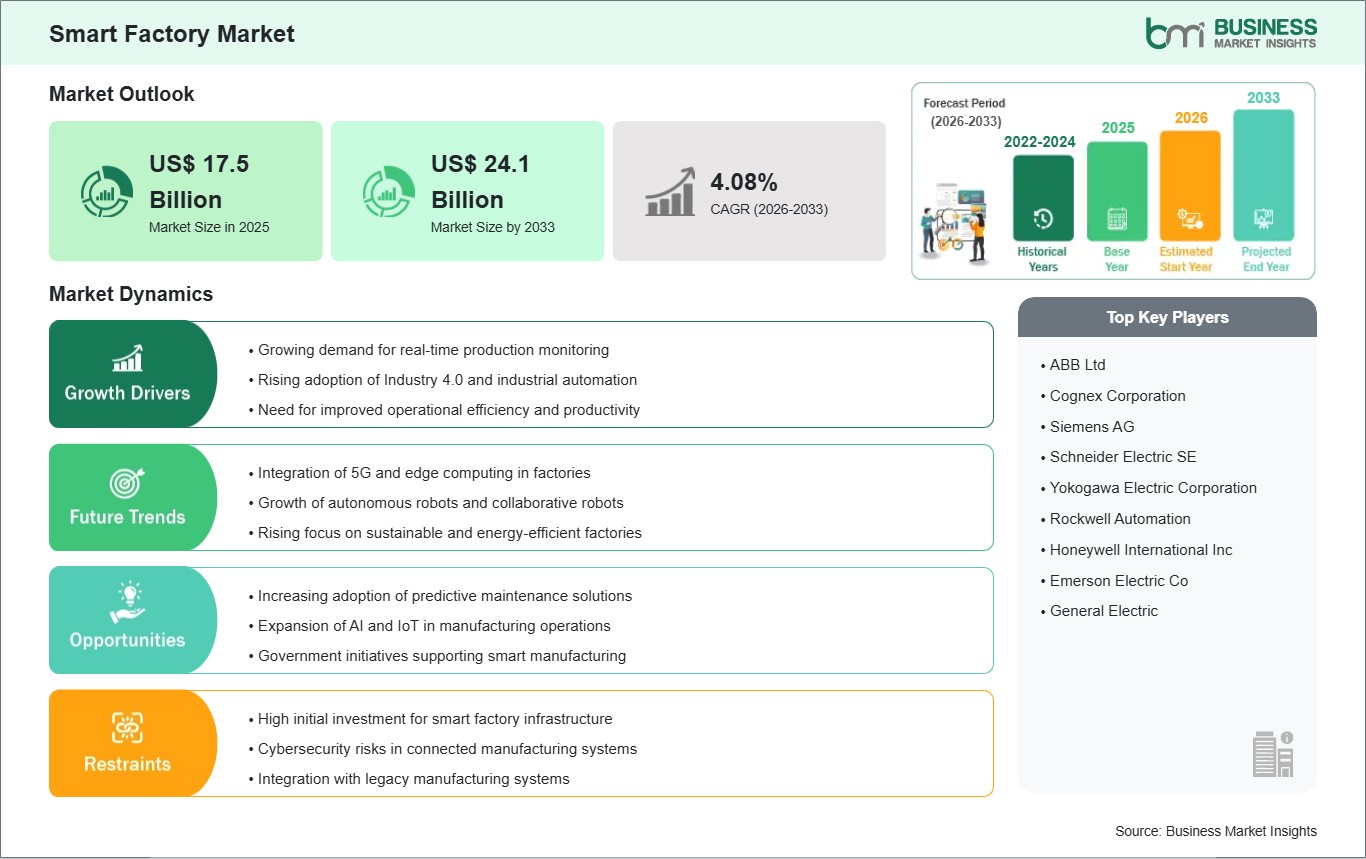
The global smart factory market shows a clear move from traditional manufacturing to more connected and intelligent production systems. In these smart factories, technologies like the industrial Internet of Things (IIoT), artificial intelligence, machine learning, collaborative robots, digital twins, and cloud-based analytics work together to automate and improve manufacturing. With these tools, manufacturers can track equipment in real time, make production more efficient, and improve product quality while cutting down on waste. As industries look for more flexibility and resilience, more companies are investing in smart factory solutions to improve maintenance, streamline their operations, and adapt quickly to changing market needs.
Industry 4.0 is driving this growth, especially in fields like automotive, electronics, pharmaceuticals, and consumer goods. Manufacturers now see that digital production is key to staying competitive and meeting demands for faster delivery and custom products. However, setting up smart factory technology often means big investments in digital upgrades, which can be tough for smaller businesses. There is also a shortage of skilled workers who can manage these advanced systems, which is a major challenge.
Segment Analysis
Smart Factory Market Segmentation
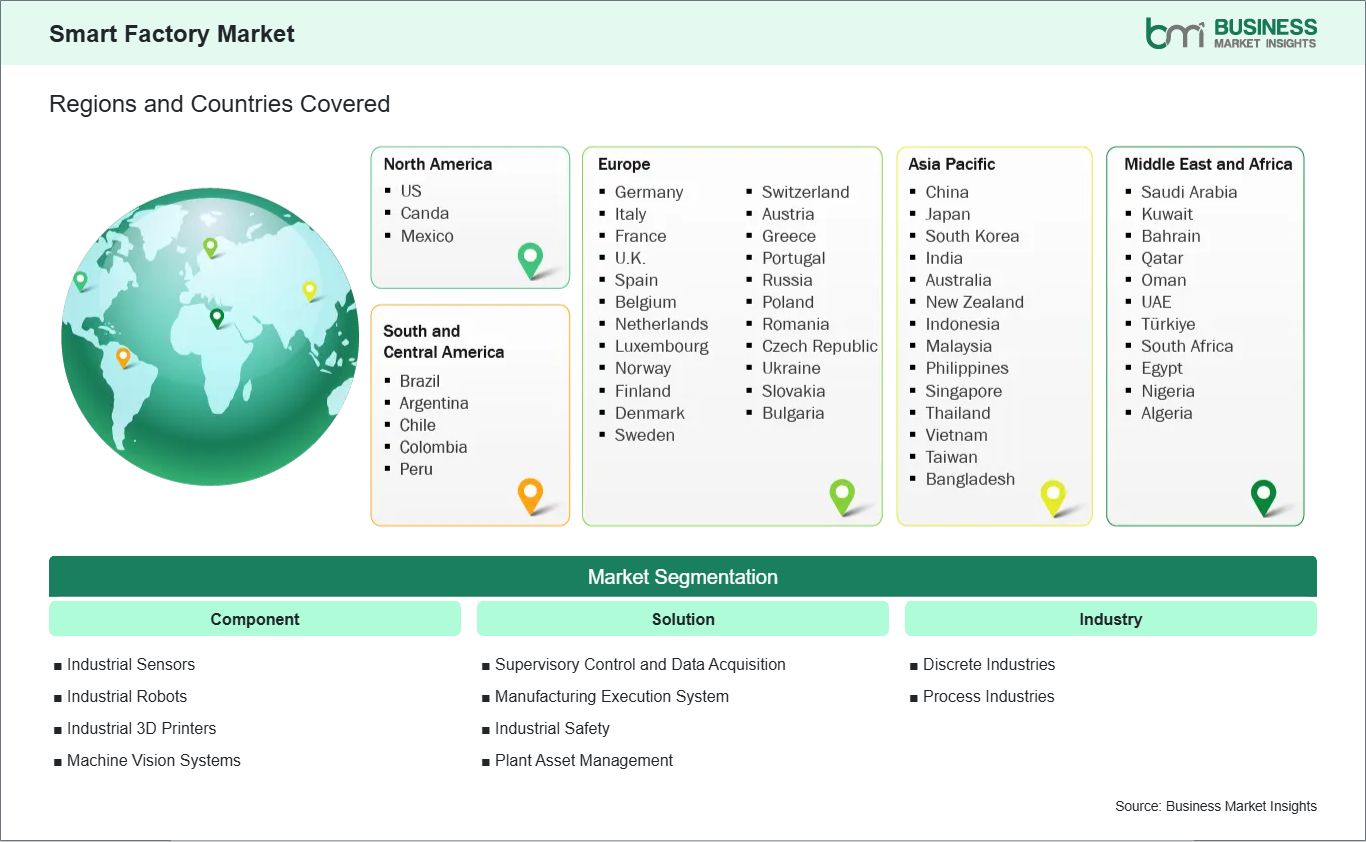
Key segments that contributed to the derivation of the smart factory market analysis are component, solution, and industry.
- By component, the Smart Factory market is segmented into industrial sensors, industrial robots, industrial 3D printers, and machine vision systems. The industrial sensors segment dominated the market in 2025.
- Based on solution, the Smart Factory market is classified into supervisory control and data acquisition (SCADA), manufacturing execution system (MES), plant asset management (PAM), and industrial safety. The manufacturing execution system (MES) segment dominated the market in 2025.
- In terms of industry, the Smart Factory market is categorized into discrete industries and process industries. The discrete industries segment dominated the market in 2025.
Market Forces
Smart Factory Market Drivers and Opportunities
Growing Demand for Real-Time Production Monitoring
The focus of modern manufacturing companies is to enhance the monitoring of their production processes in real time. Smart factories use technology to connect different sensors, digital platforms, and control systems to monitor the activities of their factories. This helps the operators of the factories to constantly monitor their processes, hence ensuring that they can easily identify the inefficiencies in their processes. This, in turn, ensures that the companies can maintain their production levels while ensuring that their products have constant quality.
The advanced monitoring systems also provide production facilities with greater visibility into the performance of individual machines and processes. The operational data can be analyzed in real-time to detect anomalies in parameters such as machine speed, temperature, or production output. This data availability enables production facility operators to make timely adjustments to ensure optimal performance and efficient use of resources. This is especially important in highly automated manufacturing facilities where even a small disturbance can impact overall productivity.
Real-time monitoring also supports the overall trend towards digitally integrated manufacturing systems. When production facility data is integrated with planning, logistics, and inventory management systems, organizations can have a better understanding of their overall operational workflow. This integration enables organizations to make decisions quickly and react to changes in demand or supply conditions. This makes real-time monitoring a key element of overall smart factory solutions
Increasing Adoption of Predictive Maintenance Solutions
Predictive maintenance tools are emerging as an important aspect of smart manufacturing as organizations look to minimize unplanned machine breakdowns. By leveraging sensor information and analytics, predictive maintenance tools are able to assess machine health and identify early indicators of potential issues. This forward-thinking strategy enables organizations to take proactive steps to address potential problems before they result in machine failures, ensuring continuous manufacturing processes.
Another benefit of predictive maintenance is its ability to enhance the planning and execution of maintenance work. Rather than simply performing maintenance work on a scheduled basis, organizations can leverage real-time machine information to identify when maintenance work is actually needed. This data-driven approach ensures that maintenance work is both timely and efficient, eliminating the need for unnecessary maintenance while still protecting key equipment from damage.
Apart from ensuring that downtime is minimized, predictive maintenance is also an important aspect when it comes to the management of assets in the long run. This is because the monitoring of the performance of the equipment helps in the gaining of insights into how the equipment behaves during different production scenarios. This ensures that organizations are able to improve the maintenance of their equipment and ensure that it lasts longer.
Size and Share Analysis
Smart Factory Market Size and Share Analysis
The smart factory market is experiencing steady growth, with market size and share analysis reflecting evolving treatment preferences and competitive dynamics among key players. The report evaluates important subsegments categorized within component, solution, and industry, highlighting their respective contributions to overall market performance.
By component, the industrial sensors subsegment dominated the Smart Factory market in 2025. This dominance is driven by the increasing deployment of sensors for real-time monitoring, predictive maintenance, and process automation across smart manufacturing environments. Industrial sensors enable factories to collect critical operational data from machines and production lines, helping organizations optimize productivity, improve quality control, and reduce operational downtime, making them a fundamental technology in Industry 4.0 implementations.
Based on solution, the manufacturing execution system (MES) subsegment dominated the market in 2025. The leadership of MES is attributed to its capability to bridge enterprise systems and shop-floor operations by providing real-time production tracking, scheduling, and performance monitoring. MES solutions help manufacturers enhance production efficiency, maintain quality standards, and improve decision-making through data-driven insights, supporting widespread adoption in smart factory environments.
In terms of industry, the discrete industries subsegment dominated the market in 2025. This growth is driven by the rapid adoption of automation, robotics, and digital manufacturing technologies in sectors such as automotive, aerospace, semiconductor & electronics, machine manufacturing, and medical devices. These industries increasingly rely on smart factory solutions to streamline complex production processes, increase operational efficiency, and maintain high precision in manufacturing operations.
Report Coverage
Smart Factory Market Report Coverage and Deliverables
The "Smart Factory Market Size and Forecast (2022 - 2033)" report provides a detailed analysis of the market covering below areas:
- Smart Factory market size and forecast at global, regional, and country levels for all the key market segments covered under the scope
- Smart Factory market trends, as well as drivers, restraints, and opportunities
- Smart Factory market analysis covering key trends, regional framework, major players, regulations, and recent developments
- Industry landscape and competition analysis covering market concentration, heat map analysis, prominent players, and recent developments for the Smart Factory market
- Detailed company profiles, including SWOT analysis
Geographic Insights
Smart Factory Market Geographic Insights
The geographical scope of the Smart Factory market report is divided into five regions: North America, Asia Pacific, Europe, Middle East & Africa, and South & Central America. The Smart Factory market in North America is expected to grow during the forecast period.
North America holds a leading position in the Smart Factory market, driven by a well-established manufacturing sector, strong technological innovation capabilities, and early adoption of advanced industrial automation solutions. Manufacturers in the region have been proactive in integrating digital technologies into production environments, leveraging real-time analytics, intelligent robotics, and connected machine networks to improve operational efficiency and production flexibility. Industries such as automotive, aerospace, electronics, and industrial equipment manufacturing have been at the forefront of deploying smart factory frameworks that enable streamlined operations, enhanced asset utilization, and faster product development cycles.
The region’s leadership is further reinforced by the presence of prominent industrial automation providers, advanced software developers, and technology innovators that support the development of integrated smart manufacturing ecosystems. Collaborative initiatives between industry players, technology firms, and research institutions have accelerated innovation in areas such as digital twin modeling, AI-driven production optimization, and cybersecurity for connected industrial systems. Additionally, growing emphasis on supply chain resilience and domestic manufacturing capabilities has encouraged companies to invest in technologies that improve visibility and control across operations. Manufacturers continue to face challenges related to workforce skill gaps and the integration of modern digital solutions with legacy equipment.
Industry Activity
Recent Developments
The smart factory market is evaluated by gathering qualitative and quantitative data post primary and secondary research, which includes important corporate publications, association data, and databases. A few of the key developments in the smart factory market are:
- In January 2024, Siemens announced a partnership with Sony Corporation to develop an immersive engineering solution that combines Siemens’ Xcelerator industrial software with Sony’s spatial content creation technologies to support advanced digital design and smart factory collaboration.
- In December 2022, Schneider Electric announced that it would consolidate six existing factories to establish one of its largest smart factories globally in Bengaluru, India, aiming to expand manufacturing capacity and strengthen Industry 4.0-based production capabilities.
Trust & Transparency
Research Methodology
The market analysis combines proprietary research with secondary data from government agencies, company disclosures, regulatory filings, industry databases and expert interviews. Market estimates are validated through data triangulation, cross-market benchmarking and analyst
review.
View Full Research Methodology
Key Sources Referred:
International Electrotechnical Commission Institute of Electrical and Electronics Engineers International Organization for Standardization Bureau of Indian Standards Central Electricity Authority Ministry of Power Indian Electrical and Electronics Manufacturers' Association European Committee for Electrotechnical Standardization VDE Association for Electrical Electronic & Information Technologies Company Websites Company Annual Reports Company Investor Presentations