Smart Card Market Outlook (2022-2033)

Historic Data: 2022-2024   |   Base Year: 2025   |   Forecast Period: 2026-2033
Report Content: Market Scope, Market Segmentation, Market Dynamics, and Competitive Analysis

Report Coverage:
  • Interface (Contact, Contactless, Dual)
  • Type (Memory, MPU Microprocessor)
  • Functionality (Transaction, Communication, Security & Access Control)
  • Offering (Smart Card, Smart Card Readers)

No. of Pages: 422
Report Code: BMIPUB00034361
Category: Electronics and Semiconductor
Smart Card Market

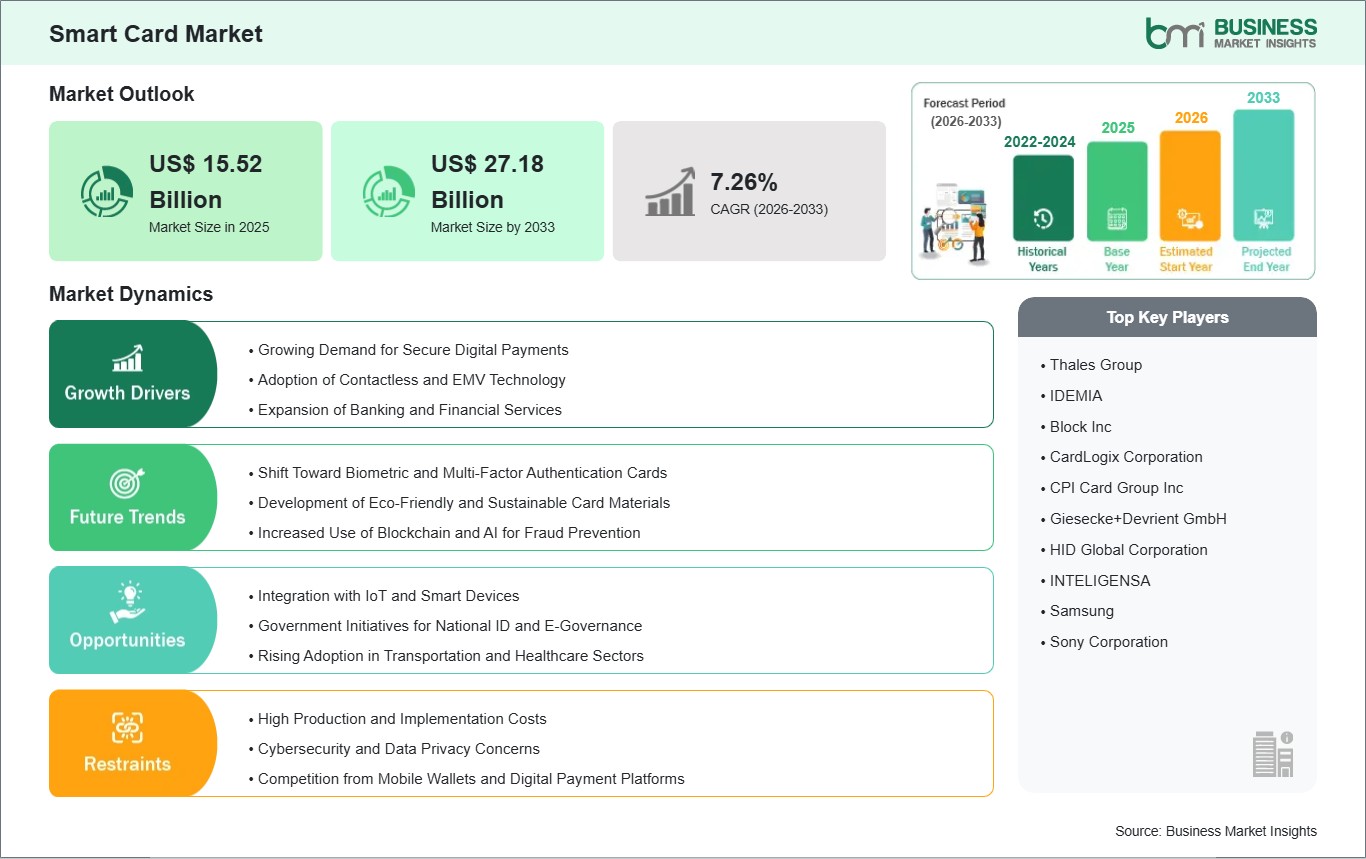
The Smart Card Market size is expected to reach US$ 27.18 billion by 2033 from US$ 15.52 billion in 2025. The market is estimated to record a CAGR of 7.26% from 2026 to 2033.

Executive Summary and Global Market Analysis:

The international smart card market is growing at a rapid pace as organizations and governments are increasingly adopting secure and multifunctional card solutions for identity verification, financial transactions, access control, and authentication. Smart cards combine embedded microchips that support secure data storage and processing, providing a host of benefits over conventional magnetic stripe cards in terms of dependability, security, and functionality. The banking, telecom, healthcare, transportation, and public services sectors are primarily driving the demand for smart cards to improve financial transaction security, simplify identity verification procedures, and optimize business processes. Increasing concerns about cybersecurity threats, digital fraud, and identity theft have significantly fueled the adoption of advanced smart card solutions, especially those that support encryption, biometric authentication, and contactless interfaces.

Moreover, the growing use of digital payment systems and the emergence of cashless economies have further fueled the demand for smart cards as secure payment media. Moreover, regulatory requirements and standards in various geographical areas might pose implementation challenges. Smart cards remain a key facilitator of secure digital financial transactions and identity management solutions, providing flexibility, improved security, and seamless integration for organizations and governments across the world.

Smart Card Market - Strategic Insights:

global-market-strategic-framework
Get more information on this report

Smart Card Market Segmentation Analysis:

Key segments that contributed to the derivation of the smart card market analysis are interface, type, functionality, offering, and vertical.

  • On the basis of interface, the Smart Card market is categorized into contact, contactless, and dual. The contactless segment dominated the market in 2025.
  • By type, the Smart Card market is segmented into memory and MPU microprocessor. The MPU microprocessor segment dominated the market in 2025.
  • Based on functionality, the Smart Card market is classified into transaction, communication, and security & access control. The communication segment dominated the market in 2025.
  • In terms of offering, the Smart Card market is categorized into smart card and smart card readers. The smart card segment dominated the market in 2025.
  • By vertical, the Smart Card market is segmented into BFSI, telecommunications, government & healthcare, education, retail, transportation, and other verticals. The telecommunications segment dominated the market in 2025.

Smart Card Market Drivers and Opportunities:

Growing Demand for Secure Digital Payments

The need for secure digital payment solutions is being driven faster by the growing adoption of cashless transactions. Smart cards, which are equipped with embedded security, are a safe and reliable way of securing sensitive financial data during digital transactions. The cards enable the storage of encrypted data and facilitate secure authentication, which safeguards against fraud and unauthorized access, allowing both parties to conduct transactions with confidence. The need for secure digital payment solutions is driving the adoption of smart cards across various industries, including retail and service sectors.

In addition to providing payment security, smart cards are being applied to simplify complex financial transactions. For example, prepaid cards, virtual wallets, and multi-currency accounts are protected from tampering by the use of chip-based security, which also simplifies user access. Smart cards offer additional security features such as dynamic PINs and one-time transaction codes, which provide additional verification to boost confidence in digital payment systems. Organizations can now provide flexible and secure payment solutions that support both online and offline transactions.

Smart cards are also being increasingly recognized as instruments of financial inclusion and innovation. By integrating payment services with identity, loyalty, or reward programs, smart cards enable consumers to handle multiple services using a single secure platform. This multi-service functionality not only enhances convenience but also promotes the adoption of digital financial services in a context where the infrastructure for cashless transactions is still evolving. With the growing adoption of digital payments, smart cards are becoming the key to a safer, smarter, and more integrated financial environment.

Integration with IoT and Smart Devices

Smart cards are increasingly being used in smart ecosystems, where the need for secure identification and storage of data is critical for device authentication and authorization. Smart cards make it possible for devices to authenticate users and authorize operations without exposing sensitive data. This is becoming increasingly important in settings where multiple devices are connected and share data, such as smart home devices, automated entry systems, and wearable devices.

Apart from ensuring authorization, smart cards make it possible for devices to work independently while still being compliant with privacy regulations. For instance, smart cards can be used to store temporary credentials or encrypted keys that enable users to engage with connected devices without exposing their personal data. The capacity to process and store sensitive data locally eliminates the need for centralized servers, which can be a source of potential security breaches.

The combination of smart card technology and the IoT also provides opportunities for new services and user experiences. Smart cards can be used in conjunction with health monitoring systems, vehicle systems, or workplace access systems to offer secure authentication, logging, and data transfer. The combination of these features makes smart cards a trusted identity token and a secure bridge between physical and digital services. With the expansion of connectivity in various sectors and in daily life, smart cards are becoming a fundamental technology for secure, intelligent, and multifunctional digital interactions.

Smart Card Market Size and Share Analysis:

The smart card market is experiencing steady growth, with market size and share analysis reflecting evolving treatment preferences and competitive dynamics among key players. The report evaluates important subsegments categorized within interface, type, functionality, offering, and vertical, highlighting their respective contributions to overall market performance.

On the basis of interface, the contactless segment dominated the Smart Card market in 2025. This is driven by the growing demand for secure, convenient, and fast transactions in applications such as payments, access control, and identification. Contactless smart cards offer enhanced user experience, reduced transaction times, and improved security, making them a key revenue driver for manufacturers and ensuring steady adoption across banking, transportation, and enterprise sectors.

By type, the MPU microprocessor segment dominated the market in 2025. The leadership of MPU microprocessor cards is attributed to their ability to store and process data securely, support complex applications, and enable multi-functional operations. These cards are highly preferred in sectors requiring advanced security features, such as financial services, government ID programs, and secure communications, driving strong market demand.

Based on functionality, the communication segment dominated the market in 2025. The strong adoption of communication smart cards is driven by the need for reliable and secure data exchange in telecom networks, SIM applications, and digital identity systems. Their ability to facilitate encrypted communication, authentication, and interoperability makes them highly valuable for service providers and enterprises.

In terms of offering, the smart card segment dominated the market in 2025. The leadership of smart cards is attributed to their versatility, ease of integration, and broad applicability across payments, identification, transportation, and loyalty programs. Manufacturers continue to see strong demand for smart cards due to their secure and convenient functionality, making them a core revenue generator in the market.

By vertical, the telecommunications segment dominated the market in 2025. The strong presence of smart cards in telecom is driven by their widespread use in SIM cards, subscriber authentication, and secure network access. The increasing penetration of mobile devices, 5G networks, and digital services has reinforced the demand for smart cards in telecommunications, establishing this vertical as the dominant end-user segment in the market.

Smart Card Market Report Highlights:

Report Attribute Details
Market size in 2025 US$ 15.52 Billion
Market Size by 2033 US$ 27.18 Billion
Global CAGR (2026 - 2033)7.26%
Historical Data 2022-2024
Forecast period 2026-2033
Segments Covered By Interface
  • Contact
  • Contactless
  • Dual
By Type
  • Memory
  • MPU Microprocessor
By Functionality
  • Transaction
  • Communication
  • Security & Access Control
By Offering
  • Smart Card
  • Smart Card Readers
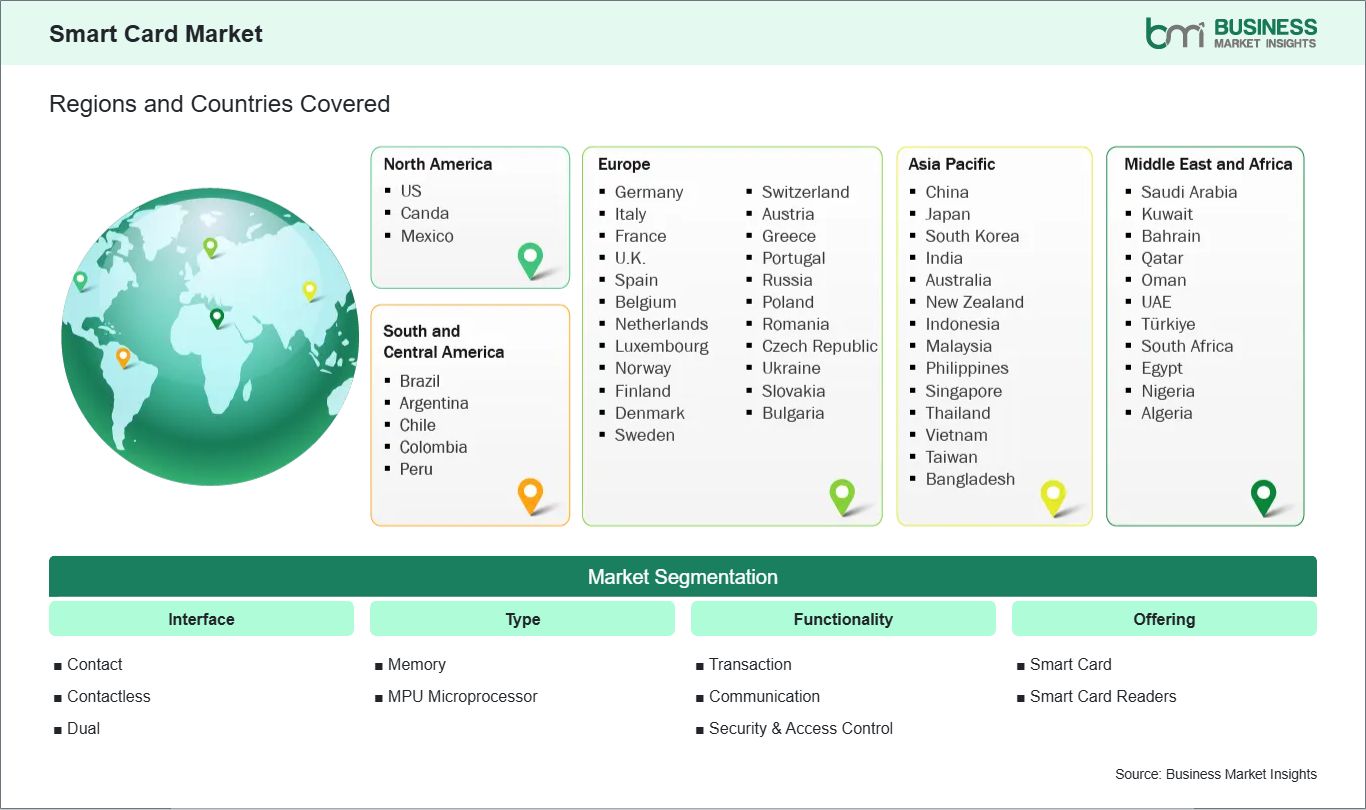
Regions and Countries Covered
North America US, Canada, Mexico
Europe Belgium, Austria, Finland, Denmark, Greece, Poland, Romania, Russia, Ukraine, Czech Republic, Slovakia, Bulgaria, Italy, Luxembourg, Germany, Switzerland, France, Netherlands, Norway, Portugal, Spain, Sweden, United Kingdom
Asia-Pacific Australia, China, India, Japan, South Korea, Indonesia, Malaysia, Philippines, Singapore, Thailand, Vietnam, Bangladesh, New Zealand, Taiwan
South and Central America Brazil, Argentina, Peru, Chile, Colombia
Middle East and Africa Bahrain, Kuwait, Oman, Qatar, Saudi Arabia, United Arab Emirates, Turkiye, South Africa, Egypt, Algeria, Nigeria
Market leaders and key company profiles
  • ThalesGroup
  • IDEMIA
  • BlockInc
  • CardLogixCorporation
  • CPICardGroupInc
  • GieseckeDevrientGmbH
  • HIDGlobalCorporation
  • INTELIGENSA
  • Samsung
  • SonyCorporation
Get more information on this report

Smart Card Market Report Coverage and Deliverables:

The "Smart Card Market Size and Forecast (2022 - 2033)" report provides a detailed analysis of the market covering below areas:

  • Smart Card market size and forecast at global, regional, and country levels for all the key market segments covered under the scope
  • Smart Card market trends, as well as drivers, restraints, and opportunities
  • Smart Card market analysis covering key trends, regional framework, major players, regulations, and recent developments
  • Industry landscape and competition analysis covering market concentration, heat map analysis, prominent players, and recent developments for the Smart Card market
  • Detailed company profiles, including SWOT analysis

Smart Card Market Geographic Insights:

The geographical scope of the Smart Card market report is divided into five regions: North America, Asia Pacific, Europe, Middle East & Africa, and South & Central America. The Smart Card market in North America is expected to grow during the forecast period.

North America has the largest market share in the smart card industry, owing to the highly developed technology environment, early adoption of digital payment systems, and numerous initiatives undertaken by the government and organizations in terms of security and digital identity. There is a highly developed infrastructure in the region that helps in the implementation of smart card technology in various industries, including finance, telecommunication, healthcare, and transportation.

Smart cards are used to ensure the security of financial transactions, provide controlled access to physical and digital spaces, and offer identification and authentication services. The banking and financial services industry in the region has been one of the key areas that has adopted smart card technology, including contactless, EMV, and multi-application smart cards to enhance the security and overall customer experience.

Telecommunication companies in the region have used smart card technology in SIM card applications to offer secure services to their customers. In addition to the commercial sector, smart card technology has been used in various government initiatives to offer secure identification services.

Although the market has seen a highly developed technology adoption environment, various factors, including cost considerations and compatibility with existing technology, have influenced the implementation of smart card.

global-market-geography
Get more information on this report

Smart Card Market Research Report Guidance:

  • The report includes qualitative and quantitative data in the Smart Card market across interface, type, functionality, offering, vertical, and geography.
  • The report starts with the key takeaways (chapter 2), highlighting the key trends and outlook of the Smart Card market.
  • Chapter 3 focuses on the research methodology of the study.
  • Chapter 4 includes ecosystem analysis.
  • Chapter 5 highlights the major industry dynamics in the Smart Card market, including factors that are driving the market, prevailing deterrents, potential opportunities, as well as future trends. Impact analysis of these drivers and restraints is also covered in this section.
  • Chapter 6 discusses the Smart Card market scenario, in terms of historical market revenues, and forecast till the year 2033.
  • Chapters 7 to 12 cover the Smart Card market segments by interface, type, functionality, offering, vertical, and geography across North America, Europe, Asia Pacific, Middle East and Africa, and South and Central America. They cover the market volume, revenue forecast, and factors driving the market.
  • Chapter 13 describes the competitive analysis with the heat map analysis for the key players operating in the market.
  • Chapter 14 describes the industry landscape analysis. It provides detailed descriptions of business activities such as market initiatives, new developments, mergers, and joint ventures globally, along with a competitive landscape.
  • Chapter 15 provides detailed profiles of the major companies operating in the Smart Card market. Companies have been profiled on the basis of their key facts, business descriptions, products, financial overview, SWOT analysis, and key developments.
  • Chapter 16, i.e., the appendix, is inclusive of a brief overview of the company, list of abbreviations, and disclaimer.

Smart Card Market News and Key Development:

The smart card market is evaluated by gathering qualitative and quantitative data post primary and secondary research, which includes important corporate publications, association data, and databases. A few of the key developments in the smart card market are:

  • In June 2024, IDEMIA Secure Transactions announced that it had launched the IDEMIA Starlight payment card, the first network‑certified payment card incorporating OLED technology for an illuminated contactless experience, certified by major payment networks.
  • In November 2024, GlobalFoundries announced that it had partnered with IDEMIA Secure Transactions to develop next‑generation smart card ICs using GF’s 28ESF3 platform, creating a fully European‑manufactured secure element for payment and identity applications, with production slated for 2026 at its Dresden facility.

Key Sources Referred:

  • International Electrotechnical Commission
  • Institute of Electrical and Electronics Engineers
  • International Organization for Standardization
  • Bureau of Indian Standards
  • Central Electricity Authority
  • Ministry of Power
  • Indian Electrical and Electronics Manufacturers' Association
  • European Committee for Electrotechnical Standardization
  • VDE Association for Electrical Electronic & Information Technologies
  • Company Websites
  • Company Annual Reports
  • Company Investor Presentations
The List of Companies - Smart Card Market
  • ThalesGroup
  • IDEMIA
  • BlockInc
  • CardLogixCorporation
  • CPICardGroupInc
  • GieseckeDevrientGmbH
  • HIDGlobalCorporation
  • INTELIGENSA
  • Samsung
  • SonyCorporation
Frequently Asked Questions
How big is the Smart Card Market?

The Smart Card Market is valued at US$ 15.52 Billion in 2025, it is projected to reach US$ 27.18 Billion by 2033.

What is the CAGR for Smart Card Market by (2026 - 2033)?

As per our report Smart Card Market, the market size is valued at US$ 15.52 Billion in 2025, projecting it to reach US$ 27.18 Billion by 2033. This translates to a CAGR of approximately 7.26% during the forecast period.

What segments are covered in this report?

The Smart Card Market report typically cover these key segments-

  • Interface (Contact, Contactless, Dual)
  • Type (Memory, MPU Microprocessor)
  • Functionality (Transaction, Communication, Security & Access Control)
  • Offering (Smart Card, Smart Card Readers)

What is the historic period, base year, and forecast period taken for Smart Card Market?

The historic period, base year, and forecast period can vary slightly depending on the specific market research report. However, for the Smart Card Market report:

  • Historic Period : 2022-2024
  • Base Year : 2025
  • Forecast Period : 2026-2033
  • Who are the major players in Smart Card Market?

    The Smart Card Market is populated by several key players, each contributing to its growth and innovation. Some of the major players include:

  • ThalesGroup
  • IDEMIA
  • BlockInc
  • CardLogixCorporation
  • CPICardGroupInc
  • GieseckeDevrientGmbH
  • HIDGlobalCorporation
  • INTELIGENSA
  • Samsung
  • SonyCorporation
  • Who should buy this report?

    The Smart Card Market report is valuable for diverse stakeholders, including:

    • Investors: Provides insights for investment decisions pertaining to market growth, companies, or industry insights. Helps assess market attractiveness and potential returns.
    • Industry Players: Offers competitive intelligence, market sizing, and trend analysis to inform strategic planning, product development, and sales strategies.
    • Suppliers and Manufacturers: Helps understand market demand for components, materials, and services related to concerned industry.
    • Researchers and Consultants: Provides data and analysis for academic research, consulting projects, and market studies.
    • Financial Institutions: Helps assess risks and opportunities associated with financing or investing in the concerned market.

    Essentially, anyone involved in or considering involvement in the Smart Card Market value chain can benefit from the information contained in a comprehensive market report.

    Available Report Formats

    pdf-format excel-format pptx-format
    Buy Now
    Sales Assistance
    +1 646 791 7070 (US & UK)
    Customization Form

    Please tell us your area of interest
    (Market Segments/ Regions and Countries/ Companies)