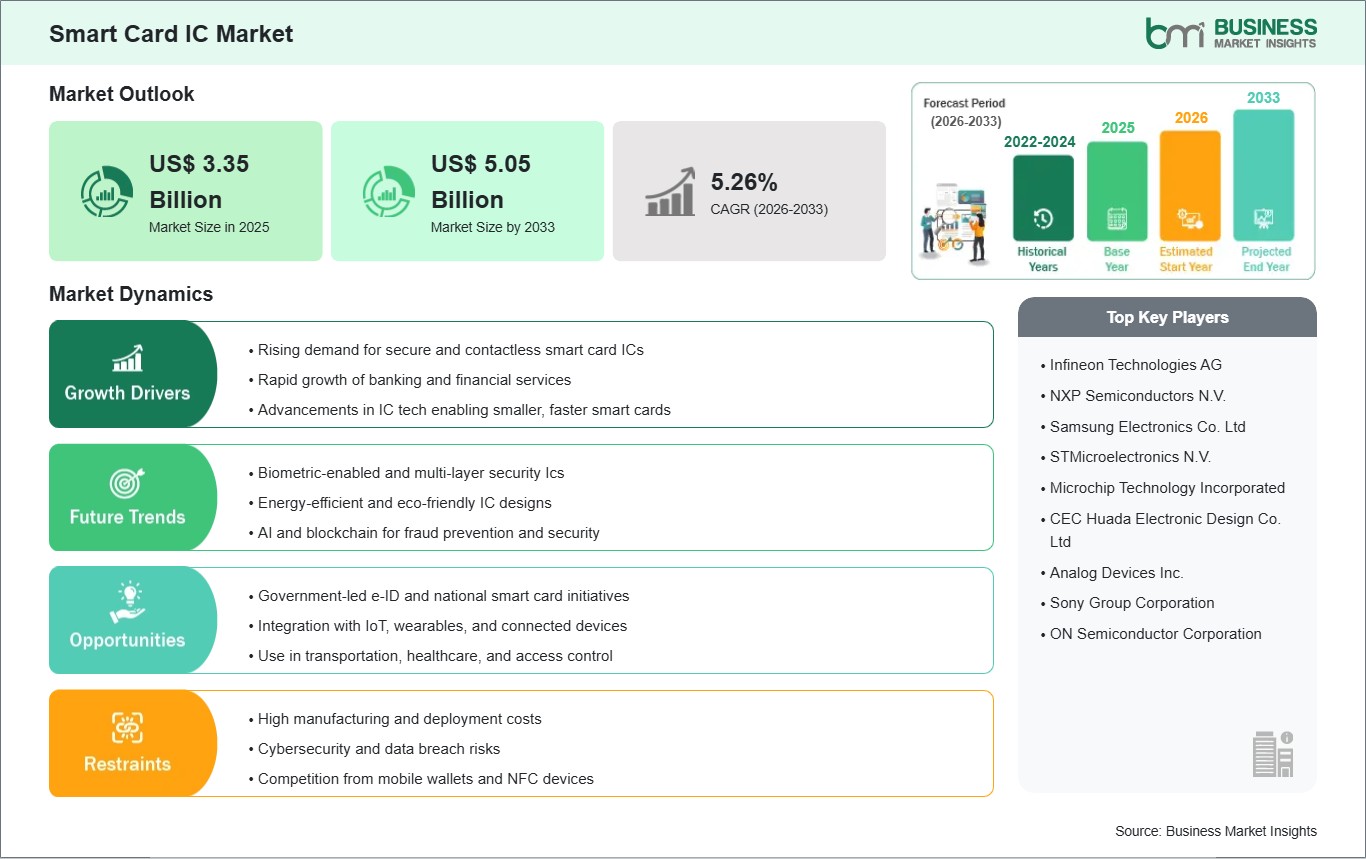
The Smart Card IC Market size is expected to reach US$ 5.05 billion by 2033 from US$ 3.35 billion in 2025. The market is estimated to record a CAGR of 5.26% from 2026 to 2033.
The global smart card IC market continues to grow steadily as more organizations seek secure, flexible, and highly integrated systems in various sectors like finance, telecommunication, government, healthcare, and transport. Smart card ICs, also referred to as embedded microcontroller chips, form the core of smart cards, providing security features like secure data storage, encryption, processing, and authentication. In the face of the digital revolution in the world, where digital payment systems, contactless transactions, and robust identification systems have become the need of the hour, smart card ICs have become the heart of all digital systems. Innovations in encryption technology, biometric technology, and contactless technology have made smart card ICs more sought after in the market.
Moreover, the world moving toward cashless transactions, digital identification systems, and secure IoT connectivity makes smart card ICs all the more important in the world. Smart card ICs have been at the core of all digital systems, providing security features like high-speed transactions, robust authentication, and reliable security systems.

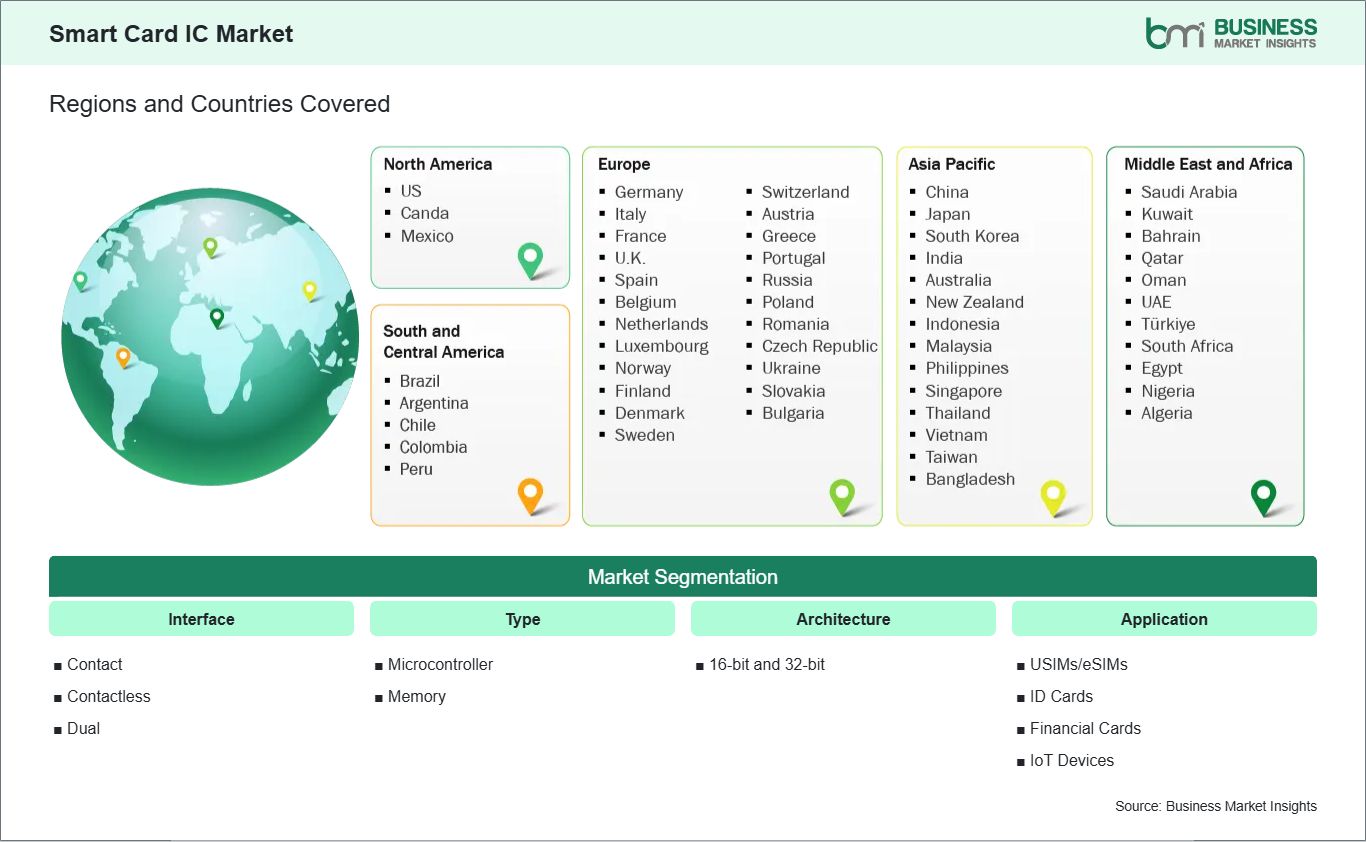
Key segments that contributed to the derivation of the smart card IC market analysis are interface, type, application, offering, and end user.
There is an increased demand for secure and contactless smart card ICs due to the rising demand from organizations and consumers for digital technologies that provide convenience and security in equal measure. Smart card ICs incorporate microprocessors and advanced encryption techniques directly onto smart cards, providing secure transaction, identity verification, and anti-tampering capabilities. The presence of contactless smart card ICs provides increased convenience due to their fast and touch-free interaction capabilities, thus providing an advantage in their usage in different applications and organizations.
New innovations in smart card IC technologies have greatly improved their capabilities and usage in different applications and organizations. The new smart card IC technologies have the capability to execute complex cryptographic algorithms and store information securely, thus providing versatility in their usage in different applications and organizations. The versatility of smart card IC technologies allows their usage in different applications and organizations, such as secure payment systems, loyalty schemes, and multi-purpose identification cards, thus providing organizations with a high level of convenience and security in their operations.
The contactless smart card ICs are also altering the expectations of users with regard to digital transactions. Users are now preferring fast and seamless interactions that do not require any contact or human intervention. This ease, combined with the security features of smart card ICs, is making them suitable for new applications such as campus entry, transportation, and membership cards, where fast and secure authentication is required.
Government initiatives are a smart card IC adoption, particularly through national digital identity programs. By embedding secure microchips into official identity cards, governments can verify authenticity, reduce fraud, and provide citizens with reliable digital credentials to access public services. Many of these programs utilize multi-function cards that combine identification, payment, and access features, creating demand for high-performance smart card ICs that meet rigorous security and reliability standards.
Beyond identification, smart card ICs support public service applications such as social benefits distribution, healthcare access management, and transportation fare collection. Cryptographically secured chips ensure that these cards cannot be easily duplicated or misused, providing both operational efficiency and trust in the systems they support. By enabling secure and streamlined management of sensitive information, smart card ICs enhance the effectiveness of public programs while safeguarding user data.
Government-led smart card initiatives also encourage private sector adoption and innovation. Financial institutions, telecom providers, and utilities often leverage government-issued smart card platforms for secure authentication and transaction services. This collaboration creates an ecosystem in which smart card IC technology underpins both public services and commercial applications, solidifying its role as a foundational tool for secure digital identity and trusted transactions.
The smart card IC market is experiencing steady growth, with market size and share analysis reflecting evolving treatment preferences and competitive dynamics among key players. The report evaluates important subsegments categorized within interface, type, application, offering, and end user, highlighting their respective contributions to overall market performance.
On the basis of interface, the contactless subsegment dominated the Smart Card IC market in 2025. This is driven by the growing demand for secure and convenient transactions in applications such as payments, access control, and identification. Contactless smart card ICs offer faster data transfer, enhanced security, and improved user experience, making them a key revenue driver for manufacturers and ensuring steady adoption across banking, transportation, and enterprise sectors.
By type, the microcontroller subsegment dominated the market in 2025. The leadership of microcontroller ICs is attributed to their ability to store and process data securely, support complex applications, and enable multi-functional operations. These ICs are highly preferred in sectors requiring robust security and flexible functionality, such as financial services, government ID programs, and secure communications, driving strong market demand.
Based on architecture, the 16-bit subsegment dominated the market in 2025. The dominance of 16-bit architectures is driven by their balance of processing power, energy efficiency, and cost-effectiveness, making them suitable for a wide range of smart card applications. Their capability to support secure computation and multitasking enables reliable performance in both contactless and contact smart card systems.
In terms of application, the USIMs/eSIMs subsegment dominated the market in 2025. The strong adoption of USIM and eSIM applications is driven by the widespread use of mobile devices, growing demand for secure subscriber identity management, and increasing adoption of embedded SIM technology in IoT and connected devices. These applications require secure, high-performance smart card ICs, reinforcing their dominance in the market.
By end user, the telecommunications subsegment dominated the market in 2025. The leadership of this segment is attributed to the extensive use of smart card ICs in mobile subscriber identification, secure network access, and SIM/eSIM deployment. Telecommunications providers rely on these ICs to ensure secure connectivity, data privacy, and operational reliability.

| Report Attribute | Details |
|---|---|
| Market size in 2025 | US$ 3.35 Billion |
| Market Size by 2033 | US$ 5.05 Billion |
| Global CAGR (2026 - 2033) | 5.26% |
| Historical Data | 2022-2024 |
| Forecast period | 2026-2033 |
| Segments Covered | By Interface
|
|
Regions and Countries Covered
| |
| North America | US, Canada, Mexico |
| Europe | Belgium, Austria, Finland, Denmark, Greece, Poland, Romania, Russia, Ukraine, Czech Republic, Slovakia, Bulgaria, Italy, Luxembourg, Germany, Switzerland, France, Netherlands, Norway, Portugal, Spain, Sweden, United Kingdom |
| Asia-Pacific | Australia, China, India, Japan, South Korea, Indonesia, Malaysia, Philippines, Singapore, Thailand, Vietnam, Bangladesh, New Zealand, Taiwan |
| South and Central America | Brazil, Argentina, Peru, Chile, Colombia |
| Middle East and Africa | Bahrain, Kuwait, Oman, Qatar, Saudi Arabia, United Arab Emirates, Turkiye, South Africa, Egypt, Algeria, Nigeria |
| Market leaders and key company profiles |
|
The "Smart Card IC Market Size and Forecast (2022 - 2033)" report provides a detailed analysis of the market covering below areas:
The geographical scope of the Smart Card IC market report is divided into five regions: North America, Asia Pacific, Europe, Middle East & Africa, and South & Central America. The Smart Card IC market in North America is expected to grow during the forecast period.
North America maintains a leading role in the smart card IC market, backed by advanced technological infrastructure, early adoption of digital payment systems, and strong initiatives focused on cybersecurity and digital identity. The region’s mature semiconductor and electronics ecosystem supports the rapid development, production, and deployment of high-performance smart card ICs across a range of industries. Financial institutions are among the largest adopters, leveraging smart card ICs to offer secure contactless payments, multi-functional cards, and enhanced authentication solutions. Telecommunication providers also utilize these chips for secure SIM applications and network access management. Beyond commercial applications, government programs are increasingly implementing smart card ICs for secure identification, e-governance, and social service access.
While adoption is bolstered by technological readiness, factors such as the cost of high-performance ICs, integration with legacy systems, and compliance with evolving regulatory standards continue to influence deployment strategies. North America’s role as a hub of innovation ensures the region remains at the forefront of smart card IC development, shaping trends that resonate across the global market and promoting the adoption of secure, intelligent card-based solutions.

The smart card IC market is evaluated by gathering qualitative and quantitative data post primary and secondary research, which includes important corporate publications, association data, and databases. A few of the key developments in the smart card IC market are:
The Smart Card IC Market is valued at US$ 3.35 Billion in 2025, it is projected to reach US$ 5.05 Billion by 2033.
As per our report Smart Card IC Market, the market size is valued at US$ 3.35 Billion in 2025, projecting it to reach US$ 5.05 Billion by 2033. This translates to a CAGR of approximately 5.26% during the forecast period.
The Smart Card IC Market report typically cover these key segments-
The historic period, base year, and forecast period can vary slightly depending on the specific market research report. However, for the Smart Card IC Market report:
The Smart Card IC Market is populated by several key players, each contributing to its growth and innovation. Some of the major players include:
The Smart Card IC Market report is valuable for diverse stakeholders, including:
Essentially, anyone involved in or considering involvement in the Smart Card IC Market value chain can benefit from the information contained in a comprehensive market report.
Please tell us your area of interest
(Market Segments/ Regions and Countries/ Companies)