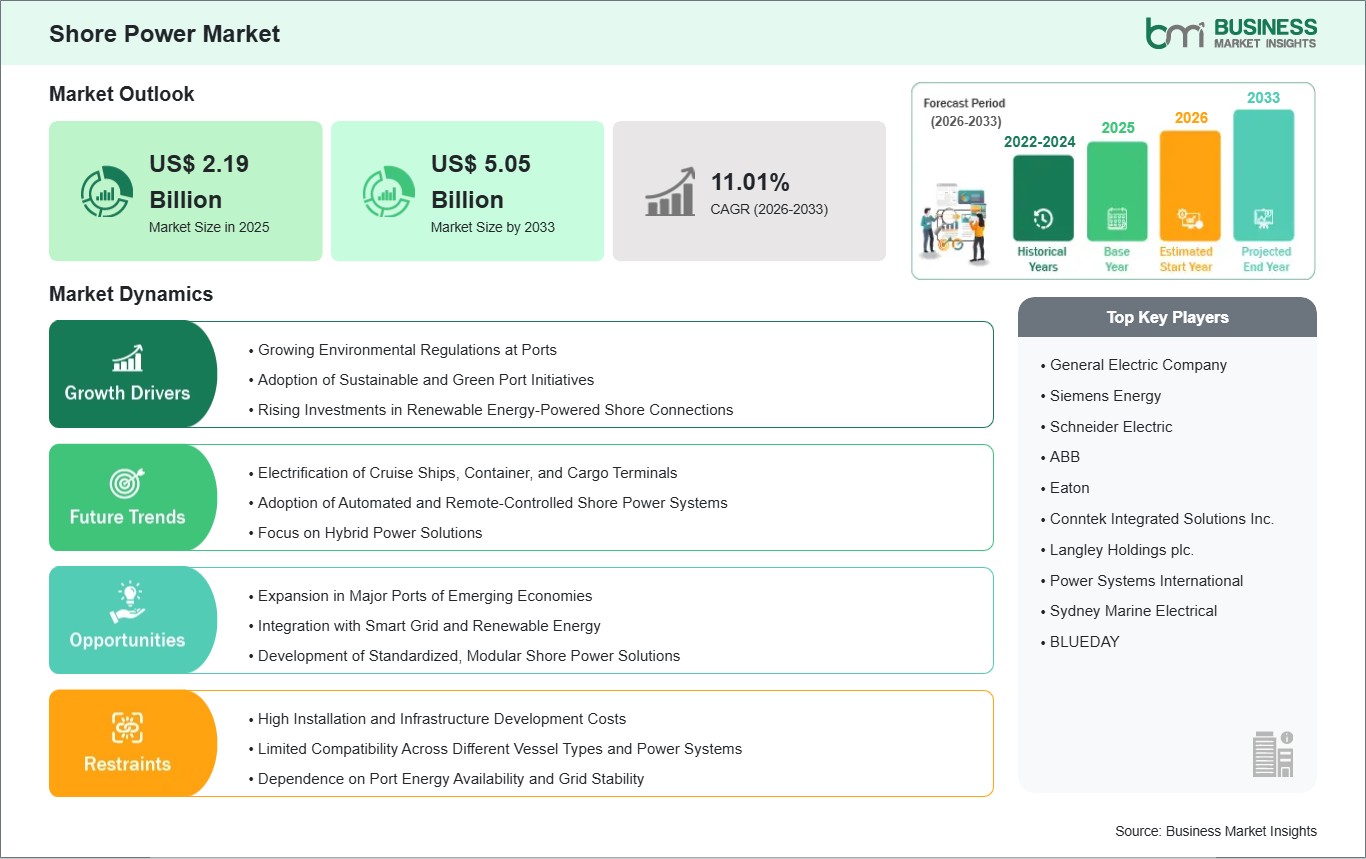
The Shore Power Market size is expected to reach US$ 5.05 billion by 2033 from US$ 2.19 billion in 2025. The market is estimated to record a CAGR of 11.01% from 2026 to 2033.
The global shore power market is becoming an important part of the maritime and energy transition sectors. This growth is mainly due to stricter environmental rules, decarbonization goals, and the need for cleaner port operations. Shore power, also known as “cold ironing” or alternative maritime power, lets ships turn off their engines while docked and use electricity from the shore instead. This change helps cut emissions of nitrogen oxides, sulfur oxides, and particulate matter in ports and coastal areas. It also supports global climate goals and encourages sustainable shipping. More governments, port authorities, and shipping companies are adding shore power systems to their green port projects and climate action plans. New regulations, pressure from environmental groups, and the need for better air quality in port cities are all helping the market grow.
However, the high cost of installing shore power systems and the lack of standard technology for different types of ships are challenges. Some emerging economies also face limits because their power grids are not strong enough. Still, ongoing investments in renewable energy and new technology are setting the stage for big changes in the global shore power market.

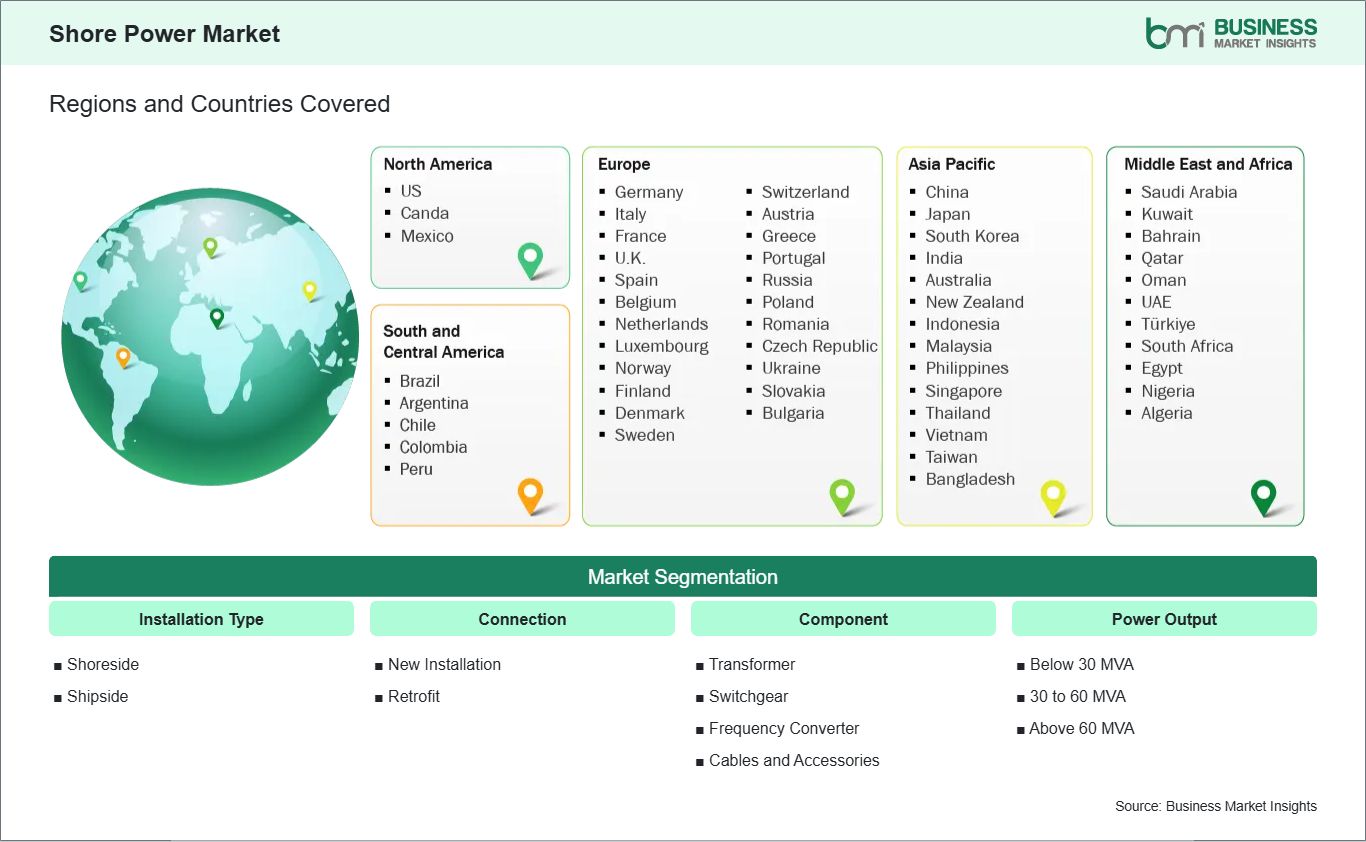
Key segments that contributed to the derivation of the shore power market analysis are installation type, connection, component, and power output.
Stricter environmental regulations are having a major impact on the global shore power market. More ports and authorities are putting rules in place to limit the use of diesel generators on ships while they are docked. With shore power systems, ships can plug into the local electrical grid, turn off their engines, and cut down on air pollution and greenhouse gas emissions during their time in port. As meeting environmental standards becomes more important, more ports and shipping companies are starting to use shore power technology.
Shipping companies and port operators are facing more pressure to show they are operating sustainably and meeting international climate targets. Since the maritime industry is a major source of air pollution in coastal areas, there are now tougher rules and closer monitoring. Shore power technology helps ports meet these standards, improve local air quality, and lower noise from ship engines. As a result, more ports are adding shore power to their plans for modernization and environmental management.
In addition, governments and maritime authorities are providing incentives and frameworks that promote investment in cleaner port technologies. This includes measures that incorporate guidelines for emission reduction, sustainability, and upgrades to support electrification. Therefore, shore power solutions are now considered an essential part of sustainable port development, ensuring that the demand for the equipment, installations, and electrical components remains consistent.
The expansion and modernization of major ports in emerging economies present significant opportunities for the shore power market. As global trade continues to grow, many developing nations are investing heavily in port infrastructure to improve cargo handling capacity and operational efficiency. These infrastructure upgrades create a favorable environment for integrating advanced technologies such as shore power systems during the planning and construction phases of new port facilities.
Port authorities are increasingly recognizing the long-term benefits of incorporating sustainable technologies into infrastructure development. Installing shore power capabilities not only supports environmental objectives but also enhances the competitiveness of ports by attracting shipping lines that prioritize sustainable operations. As global supply chains evolve and environmental expectations increase, ports equipped with modern shore power facilities are likely to gain a strategic advantage in maritime logistics.
Furthermore, the growing focus on green port initiatives is encouraging both public and private sector stakeholders to support investments in electrification technologies. Partnerships between port authorities, energy providers, and technology companies are helping accelerate the deployment of shore power systems in expanding maritime hubs. With rising emphasis on sustainable trade infrastructure and efficient port operations, the integration of shore power solutions represents a strong opportunity for market growth in the coming years.

The shore power market is experiencing steady growth, with market size and share analysis reflecting evolving treatment preferences and competitive dynamics among key players. The report evaluates important subsegments categorized within are type, connection, component, and power output, highlighting their respective contributions to overall market performance.
By installation type, the shoreside subsegment dominated the Shore Power market in 2025. This dominance is driven by the increasing development of port infrastructure and government initiatives aimed at reducing emissions from docked vessels. Shoreside systems enable ships to connect to onshore electrical grids while at berth, reducing reliance on onboard diesel generators and helping ports comply with stricter environmental regulations.
Based on connection, the new installation subsegment dominated the Shore Power market in 2025. The growth of this subsegment is attributed to the increasing number of newly developed ports and terminals integrating shore power infrastructure as part of sustainable maritime operations. Governments and port authorities are investing in new installations to support cleaner energy usage and reduce air pollution in port areas.
In terms of component, the transformer subsegment dominated the Shore Power market in 2025. Transformers play a critical role in adjusting voltage levels between shore-side power supply and shipboard electrical systems, ensuring safe and efficient power transfer. Their importance in maintaining stable power delivery makes them a key component in shore power infrastructure.
By power output, the below 30 MVA subsegment dominated the Shore Power market in 2025. This is primarily due to its widespread use in small to medium-sized ports and terminals where moderate power capacity is sufficient to support various vessel types. These systems offer cost-effective and efficient solutions for ports transitioning toward shore-based electricity.
| Report Attribute | Details |
|---|---|
| Market size in 2025 | US$ 2.19 Billion |
| Market Size by 2033 | US$ 5.05 Billion |
| Global CAGR (2026 - 2033) | 11.01% |
| Historical Data | 2022-2024 |
| Forecast period | 2026-2033 |
| Segments Covered | By Installation Type
|
|
Regions and Countries Covered
| |
| North America | US, Canada, Mexico |
| Europe | Belgium, Austria, Finland, Denmark, Greece, Poland, Romania, Russia, Ukraine, Czech Republic, Slovakia, Bulgaria, Italy, Luxembourg, Germany, Switzerland, France, Netherlands, Norway, Portugal, Spain, Sweden, United Kingdom |
| Asia-Pacific | Australia, China, India, Japan, South Korea, Indonesia, Malaysia, Philippines, Singapore, Thailand, Vietnam, Bangladesh, New Zealand, Taiwan |
| South and Central America | Brazil, Argentina, Peru, Chile, Colombia |
| Middle East and Africa | Bahrain, Kuwait, Oman, Qatar, Saudi Arabia, United Arab Emirates, Turkiye, South Africa, Egypt, Algeria, Nigeria |
| Market leaders and key company profiles |
|
The "Shore Power Market Size and Forecast (2022 - 2033)" report provides a detailed analysis of the market covering below areas:
The geographical scope of the Shore Power market report is divided into five regions: North America, Asia Pacific, Europe, Middle East & Africa, and South & Central America. The Shore Power market in North America is expected to grow during the forecast period.
North America leads the global shore power market thanks to its well-developed ports, supportive regulations, and strong collaboration among stakeholders. Many port authorities on both coasts were quick to adopt shore power technologies, seeing the benefits for the environment and public health by cutting emissions from ships at dock. Because air quality is a big concern in crowded coastal and urban areas, ports in this region have made shore power a priority as part of their efforts to reduce air pollution. Federal and state or provincial climate policies work together to support this trend. Ports and maritime operators in North America also have access to advanced technology and reliable electrical grids, making it easier to install shore power systems. Utility companies, technology providers, and port officials often team up to create scalable and reliable solutions, which helps spread knowledge and drive innovation.
However, the region still faces challenges, like upgrading infrastructure for different types of ships and keeping costs manageable over time. North America's leadership in shore power sets an example for other regions and shapes global standards and investment choices in the maritime industry.

The shore power market is evaluated by gathering qualitative and quantitative data post primary and secondary research, which includes important corporate publications, association data, and databases. A few of the key developments in the shore power market are:
The Shore Power Market is valued at US$ 2.19 Billion in 2025, it is projected to reach US$ 5.05 Billion by 2033.
As per our report Shore Power Market, the market size is valued at US$ 2.19 Billion in 2025, projecting it to reach US$ 5.05 Billion by 2033. This translates to a CAGR of approximately 11.01% during the forecast period.
The Shore Power Market report typically cover these key segments-
The historic period, base year, and forecast period can vary slightly depending on the specific market research report. However, for the Shore Power Market report:
The Shore Power Market is populated by several key players, each contributing to its growth and innovation. Some of the major players include:
The Shore Power Market report is valuable for diverse stakeholders, including:
Essentially, anyone involved in or considering involvement in the Shore Power Market value chain can benefit from the information contained in a comprehensive market report.
Please tell us your area of interest
(Market Segments/ Regions and Countries/ Companies)