Market Summary
Executive Summary and Global Market Analysis
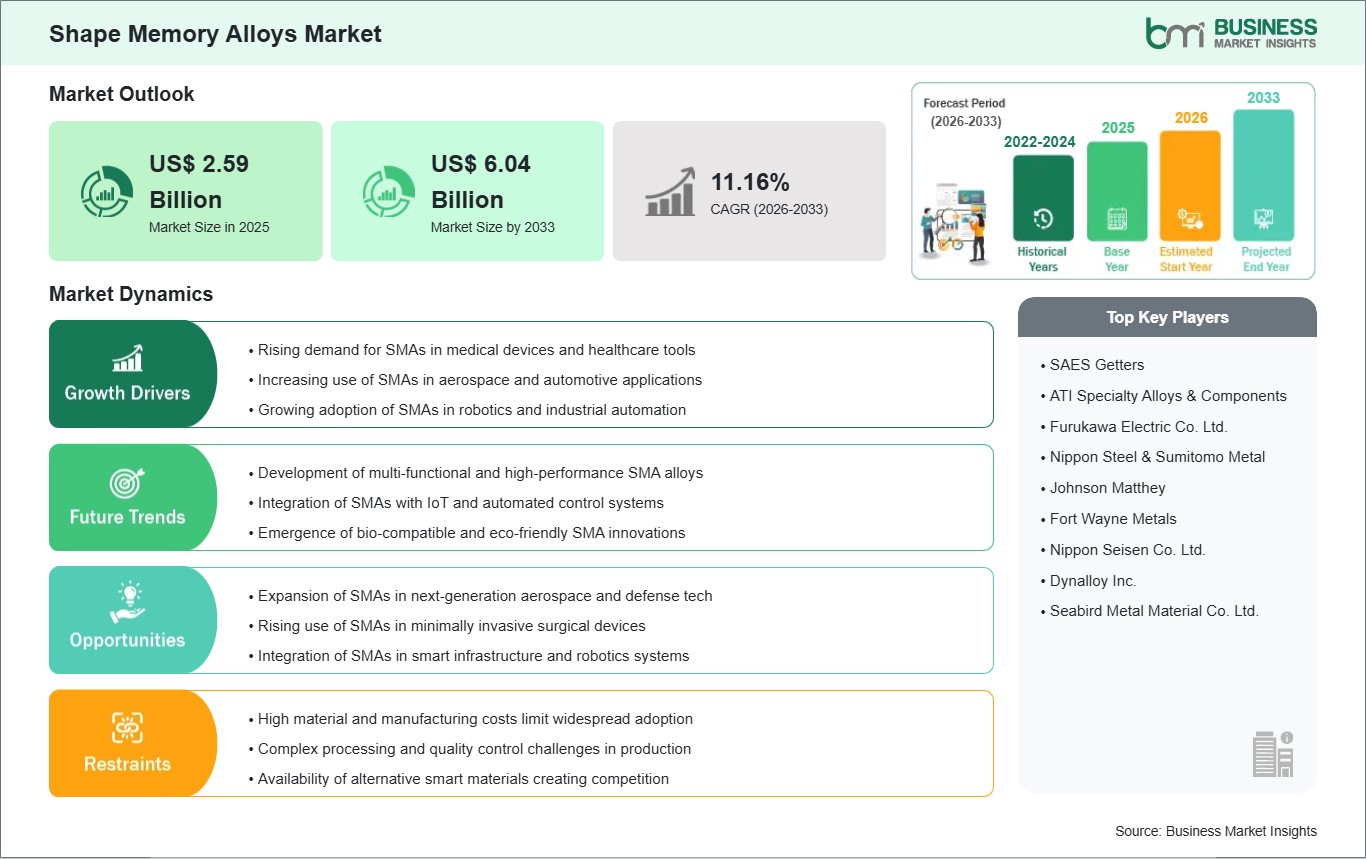
The global shape memory alloys (SMA) market is witnessing considerable momentum because industries around the world now embrace smart materials which possess special functional characteristics that include shape recovery and superelasticity and thermal responsiveness. SMAs are specialized metallic materials which most frequently use nickel‑titanium (Nitinol) and copper‑based alloys to create products that can restore their original form after heating. The various applications of SMAs create demand which extends to multiple industries that include healthcare automotive aerospace robotics consumer electronics and industrial automation.
The global SMA market experiences its main expansion factor through advanced medical devices which use these materials for stents and orthodontic wires and surgical tools and minimally invasive implants which need both high biocompatibility and shape memory functionality. The modern healthcare system requires STLS because it provides precise movement control while maintaining dependable function without using standard mechanical components. SMAs find growing application in aerospace and automotive fields through their use in actuators and vibration dampers and adaptive wing structures and active safety systems because these technologies enable weight reduction and part consolidation which boost system performance and dependability. The increasing importance of automation and robotics and smart systems development helps to increase SMA adoption in the market. SMAs enable industrial automation and consumer electronics applications through their compact and silent actuation capabilities which replace traditional motor and hydraulic systems, thus permitting engineers to create products with reduced component complexity and extended operational durability. The environmental aspects of SMAs show their potential to decrease energy consumption through better mechanical efficiency.
The global SMA market experiences limitations because of high material expenses and complex production requirements. Cost-sensitive markets face limitations because high processing expenses and difficulties in producing consistent alloy quality restrict broader adoption of the technology. The presence of different smart materials including electroactive polymers and piezoelectric actuators provides competitive threats for specific applications which require particular performance traits or financial benefits. The combination of active research and development projects with increasing industrial applications establishes SMAs as essential elements for building advanced smart systems throughout the globe.
Segment Analysis
Shape Memory Alloys Market Segmentation
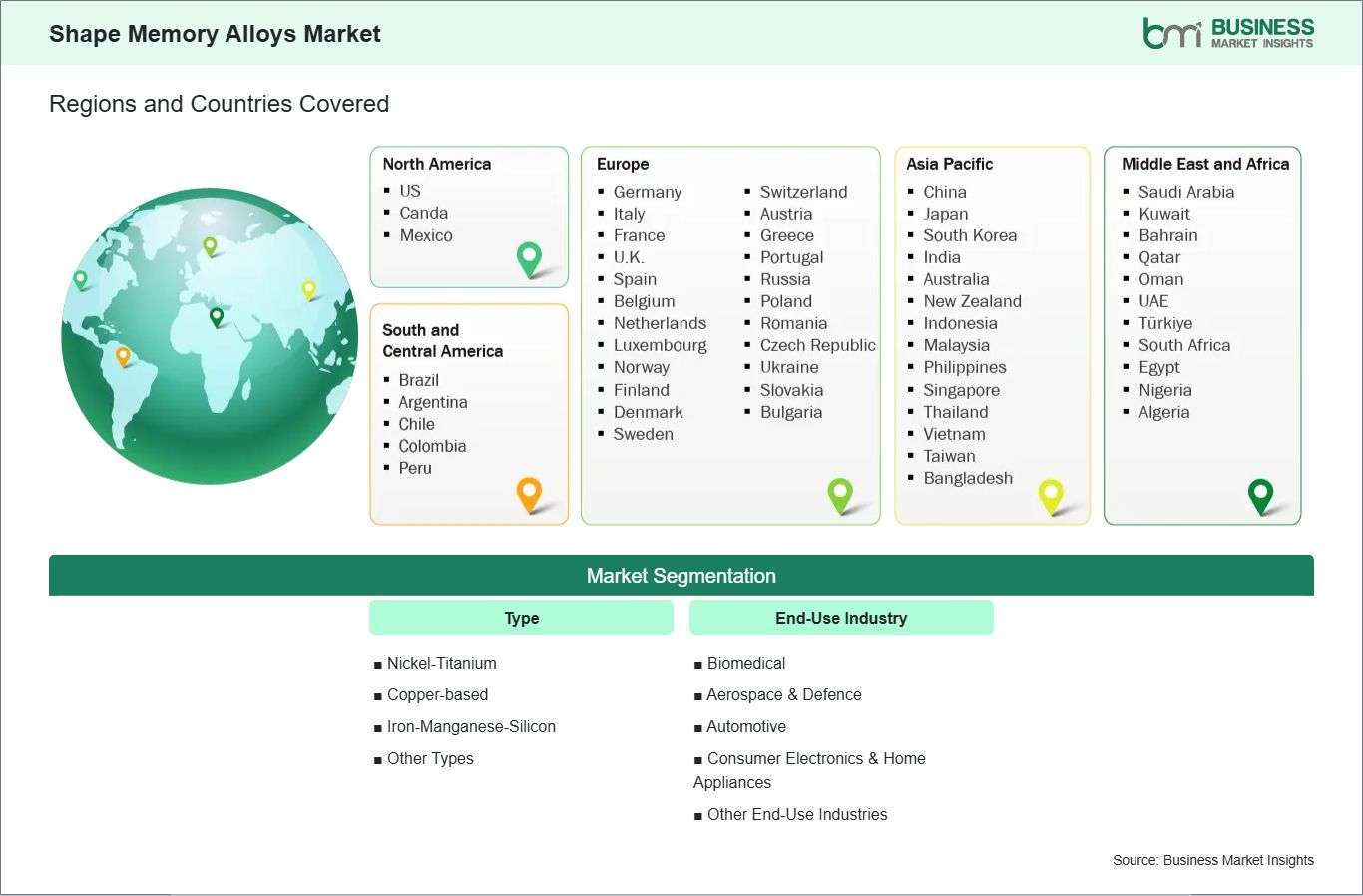
Key segments that contributed to the derivation of the shape memory alloys market analysis are type and end-use industry.
- By type, the shape memory alloys market is segmented into Nickel‑Titanium (Nitinol), Copper‑based, Iron‑Manganese‑Silicon (Fe‑Mn‑Si), and other types. The Nickel‑Titanium (Nitinol) segment dominated the market in 2025.
- Based on end-use industry, the shape memory alloys market is categorized into biomedical, aerospace & defence, automotive, consumer electronics & home appliances, and other end-use industries. The biomedical segment dominated the market in 2025.
Market Forces
Shape Memory Alloys Market Drivers and Opportunities
Rising demand for SMAs in medical devices and healthcare tools
The healthcare sector drives worldwide demand for shape memory alloys because medical devices now use shape memory alloys in cardiovascular stents and guidewires and orthodontic archwires and surgical instruments. The materials enable precise movement which leads to faster recovery times because they possess the ability to recover their original shape and maintain their superelastic characteristics. North America and Europe together with their advanced medical systems and rising demand for less intrusive methods from patients drive the healthcare industry to adopt new technologies.
The adoption of diagnostic and implantable devices receives support from research and development initiatives. Nickel-titanium alloy advancements enable the development of dental and orthopedic and cardiovascular SMA applications because the material delivers both high fatigue resistance and biocompatible properties. To enhance device reliability and protect patient safety hospitals and medical device manufacturers choose to use shape memory alloys. Asian Pacific emerging economies especially China and India experience fast adoption rates because of increasing healthcare infrastructure investments and rising public knowledge about less invasive medical procedures. Global SMA manufacturers establish partnerships with regional healthcare companies to increase their market presence which proves that the medical sector drives global SMA market expansion.
Expansion of SMAs in next-generation aerospace and defense tech
Aerospace and defense sectors increasingly utilize shape memory alloys because these materials possess lightweight and flexible yet dependable properties. SMAs function in aircraft design through their application in deployable structures and vibration dampers and control surface actuators and morphing wings which enable engineers to build lightweight components that still deliver structural integrity and operational control.
The North American market extends this field because aerospace manufacturers and defense contractors use SMAs in their development of advanced aircraft and satellites and unmanned aerial vehicles (UAVs) through strong research partnerships with government bodies. The defense sector drives market expansion because SMAs provide military equipment with compact and sturdy and accurate actuator systems which operate in missile components and adaptive armor systems and deployable devices. These alloys provide performance advantages under extreme environmental conditions, such as high temperature fluctuations and mechanical stress, which are critical for mission success. European and Asian defense manufacturers are also investing in SMA-based solutions for next-generation military platforms and aerospace projects.
The trend toward next-generation aerospace and defense technology including smart aircraft, space systems, and unmanned platforms continues to expand opportunities for SMA adoption. The search for materials that deliver energy efficiency and dependable operation with low upkeep results in SMAs becoming an exclusive material choice that outperforms standard materials. The aerospace and defense fields will benefit from ongoing research about SMA compositions and superior fatigue resistance and their application with sensor and control systems.
Size and Share Analysis
Shape Memory Alloys Market Size and Share Analysis
The shape memory alloys market demonstrates steady growth, with size and share analysis highlighting evolving trends and competitive dynamics among key players. The report examines subsegments categorized within type and end-use industry, offering insights into their contribution to overall market performance.
By type, the Nickel‑Titanium (Nitinol) subsegment dominated the market in 2025, driven by its superior shape memory effect, biocompatibility, and wide adoption in biomedical and industrial applications.
Based on end-use industry, the biomedical subsegment dominated the market in 2025, driven by increasing use of shape memory alloys in stents, guidewires, orthopedic devices, and minimally invasive surgical instruments.
Report Coverage
Shape Memory Alloys Market Report Coverage and Deliverables
The "Shape Memory Alloys Market Size and Forecast (2022 - 2033)" report provides a detailed analysis of the market covering below areas:
- Shape Memory Alloys Market size and forecast at global, regional, and country levels for all the key market segments covered under the scope
- Shape Memory Alloys Market trends, as well as drivers, restraints, and opportunities
- Shape Memory Alloys Market analysis covering key trends, global and regional framework, major players, regulations, and recent developments
- Industry landscape and competition analysis covering market concentration, heat map analysis, prominent players, and recent developments for the Shape Memory Alloys Market
- Detailed company profiles, including SWOT analysis
Geographic Insights
Shape Memory Alloys Market Geographic Insights
The geographical scope of the Shape Memory Alloys Market report is divided into North America, Asia Pacific, Europe, Middle East & Africa, and South & Central America. North America held the largest share in 2025.
The global Shape Memory Alloys (SMA) market displays various patterns across different regions, with North America taking the lead because of its developed industrial base and its strong healthcare and aerospace industries and its pioneering use of smart materials. Medical device manufacturers in the region use nickel-titanium SMAs to produce stents and surgical instruments and orthodontic devices because these materials offer high biocompatibility and dependable performance in their surgical applications. Aerospace and defense industries also use SMAs for adaptive structures and vibration dampers and actuators because they establish strong research partnerships with government agencies and defense contractors. The United States and Canada additionally see SMA adoption in industrial automation and robotics, where compact, energy-efficient actuation replaces bulky electromechanical systems.
The Asian Pacific region has become a fast-expanding market because of rising industrial growth and development of healthcare facilities and the increasing use of technology in automotive and robotics and electronics industries. The governments of China and Japan and India and South Korea are funding research into shape memory alloy applications for medical devices and smart manufacturing and aerospace components development.
Europe maintains stable economic development as Germany France and the UK lead shape memory alloy (SMA) usage throughout medical automotive and precision engineering sectors. The automotive and aerospace industries adopt solutions through research activities and environmentally friendly production methods and lightweight materials development. The aerospace defense and industrial sectors in the Middle East and Africa experience slow growth which derives from rising demand for defense systems and infrastructure projects that countries like UAE Saudi Arabia and South Africa implement.
The South American and Central American regions show moderate solution adoption which Brazil and Mexico lead through their focus on medical devices and automotive actuators and industrial automation that results from urban population growth and improved healthcare access. Energy-efficient solutions which provide high performance and flexible capabilities drive SMA usage in all regions while North America stands as the global standard for innovative commercial practices which North American industrial development and healthcare system development.
Industry Activity
Recent Developments
The Shape Memory Alloys Market is evaluated by gathering qualitative and quantitative data post primary and secondary research, which includes important corporate publications, association data, and databases. A few of the key developments in the shape memory alloys market are:
- In May 2024, Alfa Chemistry announced that it has launched new lines of Shape Memory Alloys (SMAs), including Nitinol SMAs and 3D printing alloys to expand its advanced materials portfolio for medical, aerospace, and electronics applications globally, highlighting its commitment to high‑performance SMA products.
- In January 2023, SAES Getters S.p.A. announced that it had entered into a binding agreement to divest its Nitinol (medical SMA) business — including Memry Corporation and SAES Smart Materials — to Resonetics, a major global contract manufacturer, signaling a strategic shift in how SMA medical production is structured.
Trust & Transparency
Research Methodology
The market analysis combines proprietary research with secondary data from government agencies, company disclosures, regulatory filings, industry databases and expert interviews. Market estimates are validated through data triangulation, cross-market benchmarking and analyst
review.
View Full Research Methodology
Key Sources Referred:
World Health Organization (WHO) Organisation for Economic Cooperation and Development (OECD) The World Bank Group Worldometer The Lancet International Bar Association International Trade Administration