Market Summary
Executive Summary and Global Market Analysis
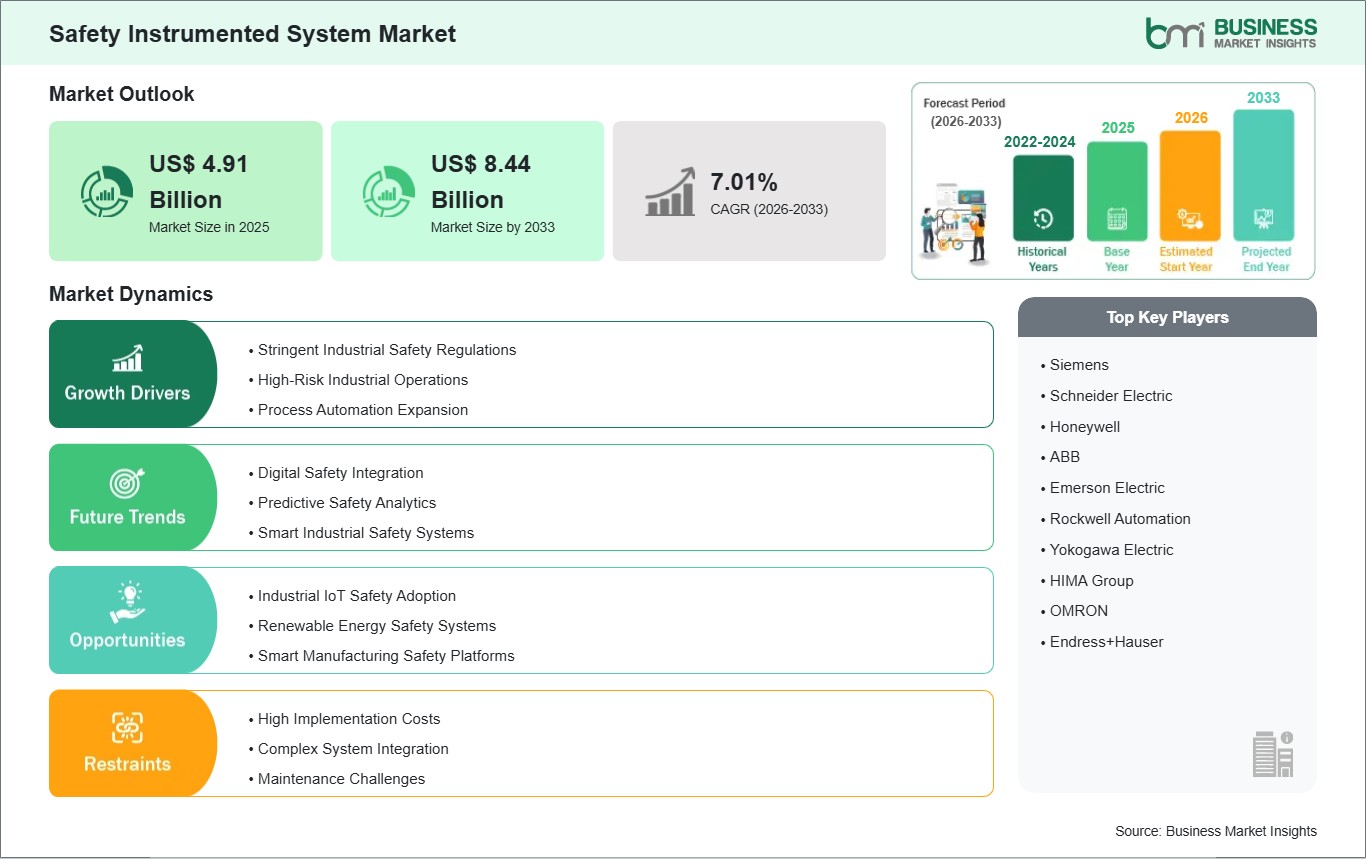
The global safety instrumented system (SIS) market is driven by growing functional safety requirements in high-risk industrial environments. SIS solutions detect hazardous process conditions and initiate protective responses to place operations in a safe state.
These systems combine safety sensors, logic solvers, and final control elements to prevent catastrophic incidents like explosions, chemical leaks, or equipment failures. Increasing automation and complex industrial processes are expanding SIS adoption across oil and gas, petrochemicals, power generation, and pharmaceuticals.
Modern SIS solutions integrate digital technologies such as advanced diagnostics, predictive maintenance, and real-time monitoring to improve system availability, reduce downtime, and enhance operational reliability.
Segment Analysis
Safety Instrumented System Market Segmentation
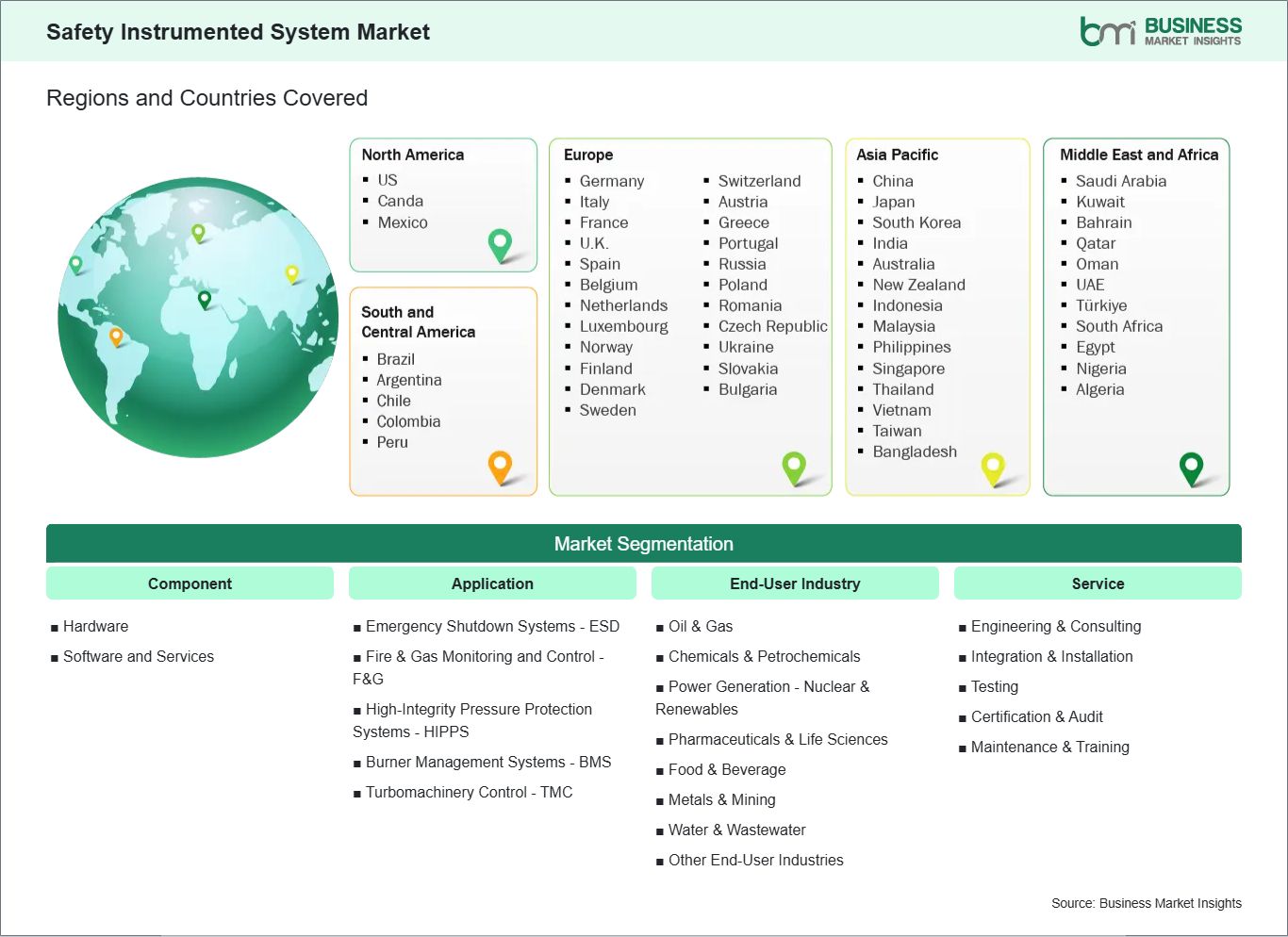
Key segments that contributed to the derivation of the safety instrumented system market analysis are component, application, end-user industry, and service.
- By component, the safety instrumented system market is segmented into safety sensors, logic solvers / safety plcs, final elements (valves, actuators, solenoids), software and services. The logic solvers / safety plcs subsegment dominated the market in 2025.
- In terms of application, the safety instrumented system market is segmented into emergency shutdown systems (esd), fire and gas monitoring and control (fandg), high-integrity pressure protection systems (hipps), burner management systems (bms), turbomachinery control (tmc). The emergency shutdown systems (esd) subsegment dominated the market in 2025.
- By end-user industry, the safety instrumented system market is segmented into oil and gas, chemicals and petrochemicals, power generation (incl. nuclear and renewables), pharmaceuticals and life sciences, food and beverage, metals and mining, water and wastewater, other end-user industries. The oil and gas subsegment dominated the market in 2025.
- By service, the safety instrumented system market is segmented into engineering and consulting, integration and installation, testing, certification and audit, maintenance and training. The integration and installation subsegment dominated the market in 2025.
Market Forces
Safety Instrumented System Market Drivers and Opportunities
Stringent Industrial Safety Regulations
Global enforcement of industrial safety standards drives adoption. Industries face severe operational and environmental risks, prompting investment in SIS to detect abnormal conditions and automatically respond.
Companies increasingly prioritize proactive safety measures, leveraging fault-tolerant architectures, continuous monitoring, and enhanced diagnostics to reduce operational risks.
Integration of Digital Technologies
Industry 4.0 and connected plant ecosystems enable SIS to move beyond basic shutdown mechanisms, incorporating predictive maintenance, analytics, and remote monitoring.
Digital-ready SIS solutions enhance operational decision-making, improve uptime, and support renewable energy, advanced manufacturing, and automated industrial systems. Vendors offering scalable, reliable, and compliant systems are poised for growth.
Size and Share Analysis
Safety Instrumented System Market Size and Share Analysis
The Safety Instrumented System Market demonstrates steady growth, with size and share analysis highlighting evolving trends and competitive dynamics among key players. The report examines subsegments categorized within component, application, end-user industry, and service, offering insights into their contribution to overall market performance.
By component, the logic solvers / safety plcs subsegment dominated the market in 2025, driven by their central role in processing safety signals and executing automated shutdown or protective actions in industrial processes.
Based on application, the emergency shutdown systems (esd) subsegment dominated the market in 2025, driven by their widespread deployment across hazardous industrial environments to ensure immediate system shutdown during abnormal operating conditions.
In terms of end-user industry, the oil and gas subsegment dominated the market in 2025, driven by stringent safety requirements and the need to prevent high-risk incidents across exploration, refining, and distribution operations.
Based on service, the integration and installation subsegment dominated the market in 2025, driven by increasing demand for customized deployment of safety instrumented systems across complex industrial infrastructures.
Report Coverage
Safety Instrumented System Market Report Coverage and Deliverables
The "Safety Instrumented System Market Size and Forecast (2022 - 2033)" report provides a detailed analysis of the market covering below areas:
- Safety Instrumented System Market size and forecast at global, regional, and country levels for all the key market segments covered under the scope
- Safety Instrumented System Market trends, as well as drivers, restraints, and opportunities
- Safety Instrumented System Market analysis covering key trends, global and regional framework, major players, regulations, and recent developments
- Industry landscape and competition analysis covering market concentration, heat map analysis, prominent players, and recent developments for the Safety Instrumented System Market
- Detailed company profiles, including SWOT analysis
Geographic Insights
Safety Instrumented System Market Geographic Insights
The geographical scope of the Safety Instrumented System Market report is divided into North America, Asia Pacific, Europe, Middle East & Africa, and South & Central America. North America held the largest share in 2025.
North America represents a mature and technologically advanced market for safety instrumented systems, supported by strict regulatory frameworks, strong industrial infrastructure, and early adoption of advanced automation technologies. Industries such as oil and gas, chemicals, and power generation across the United States and Canada have implemented robust safety management systems that require reliable safety instrumented architectures. Regulatory bodies enforce strict operational safety standards, encouraging companies to invest in advanced safety automation platforms that ensure continuous monitoring and rapid response to hazardous conditions. Europe also maintains a strong presence in the safety instrumented system market due to the region’s stringent environmental and occupational safety regulations. Countries including Germany, the United Kingdom, and France emphasize industrial safety compliance across manufacturing, energy, and chemical sectors. The region’s well-established industrial automation ecosystem further supports the adoption of integrated safety and control solutions. The Asia Pacific region is experiencing rapid growth in the adoption of safety instrumented systems due to increasing industrialization and infrastructure development. Expanding manufacturing bases in China, India, Japan, and Southeast Asia are driving demand for advanced process safety technologies. Governments in the region are strengthening industrial safety policies and encouraging modernization of industrial facilities, which is accelerating the deployment of safety automation systems. Meanwhile, the Middle East and Africa are witnessing growing adoption of safety instrumented systems within oil and gas operations, particularly in countries such as Saudi Arabia and the UAE. South and Central America are gradually expanding their industrial safety infrastructure, with countries like Brazil and Mexico investing in safety technologies to improve operational reliability and regulatory compliance.
Industry Activity
Recent Developments
The Safety Instrumented System Market is evaluated by gathering qualitative and quantitative data post primary and secondary research, which includes important corporate publications, association data, and databases. A few of the key developments in the safety instrumented system market are:
- In September 2025, Siemens announced enhancements to its SIMATIC Safety Integrated portfolio, introducing improved safety PLC performance and advanced diagnostics for industrial automation environments.
- In February 2025, Schneider Electric expanded its EcoStruxure Triconex Safety Systems portfolio with enhanced safety instrumented architecture designed for energy and chemical industries.
Trust & Transparency
Research Methodology
The market analysis combines proprietary research with secondary data from government agencies, company disclosures, regulatory filings, industry databases and expert interviews. Market estimates are validated through data triangulation, cross-market benchmarking and analyst
review.
View Full Research Methodology
Key Sources Referred:
International Electrotechnical Commission (IEC)International Energy Agency (IEA)U.S. Energy Information Administration (EIA)World BankInternational Labour Organization (ILO)Organisation for Economic Co-operation and Development (OECD)