Market Summary
Executive Summary and Global Market Analysis
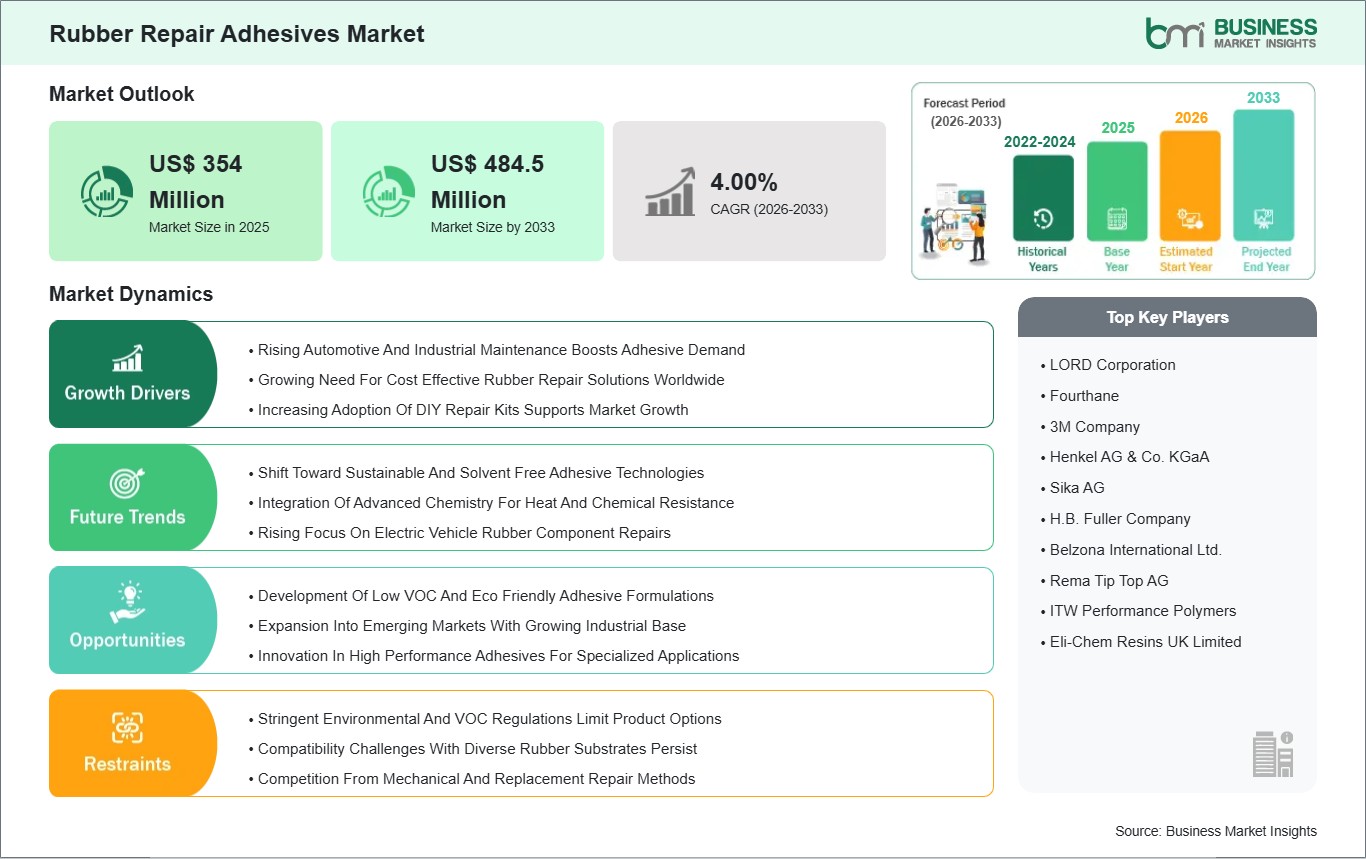
The global rubber repair adhesives market has become an indispensable segment of the broader adhesives and sealants industry, driven by demand from automotive, industrial maintenance, construction, and consumer repair applications. The bonding solutions of rubber repair adhesives function as specialized products which restore rubber materials to their original state. The adhesives create strong bonds which remain flexible while resisting chemical and thermal and operational weight stress, which makes them usable for fixing tires and belts and hoses and gaskets and seals and rubber components in machinery and infrastructure systems.
The industrial maintenance and repair market worldwide represents one of the primary factors which drives this market forward. Maintenance teams use rubber repair adhesives to fix damaged components because companies want to keep valuable equipment operational for as long as possible, which helps them save money on equipment replacements. The automotive industry uses repair adhesives to fix rubber parts which include weather stripping and engine mounts and suspension bushings because these components need to maintain their reliability. DIY repair cultures in regions with developed automotive service networks create demand for this trend, which has become more common.
The organization now prioritizes sustainability initiatives while seeking ways to reduce operational costs. High-performance adhesives which repair rubber components lead to less waste because they extend product life, which helps companies meet their sustainability targets and implement circular economy strategies. The market operates under specific limitations which create obstacles to its operations. The success of rubber adhesives depends on how well their chemical properties match various rubber substrates which differ according to their specific formulations and intended uses.
The presence of mechanical clamps and patches and replacement parts as competing repair methods prevents certain industrial settings from using adhesive products. Manufacturers develop low-VOC and environmentally safe products because environmental regulations require them to limit volatile organic compound emissions and their use of solvents which results in increased research and production expenses.
The global rubber repair adhesives market will experience constant growth because organizations now focus on maintenance efficiency and sustainability and need adaptable repair methods despite the existing difficulties.
Segment Analysis
Rubber Repair Adhesives Market Segmentation
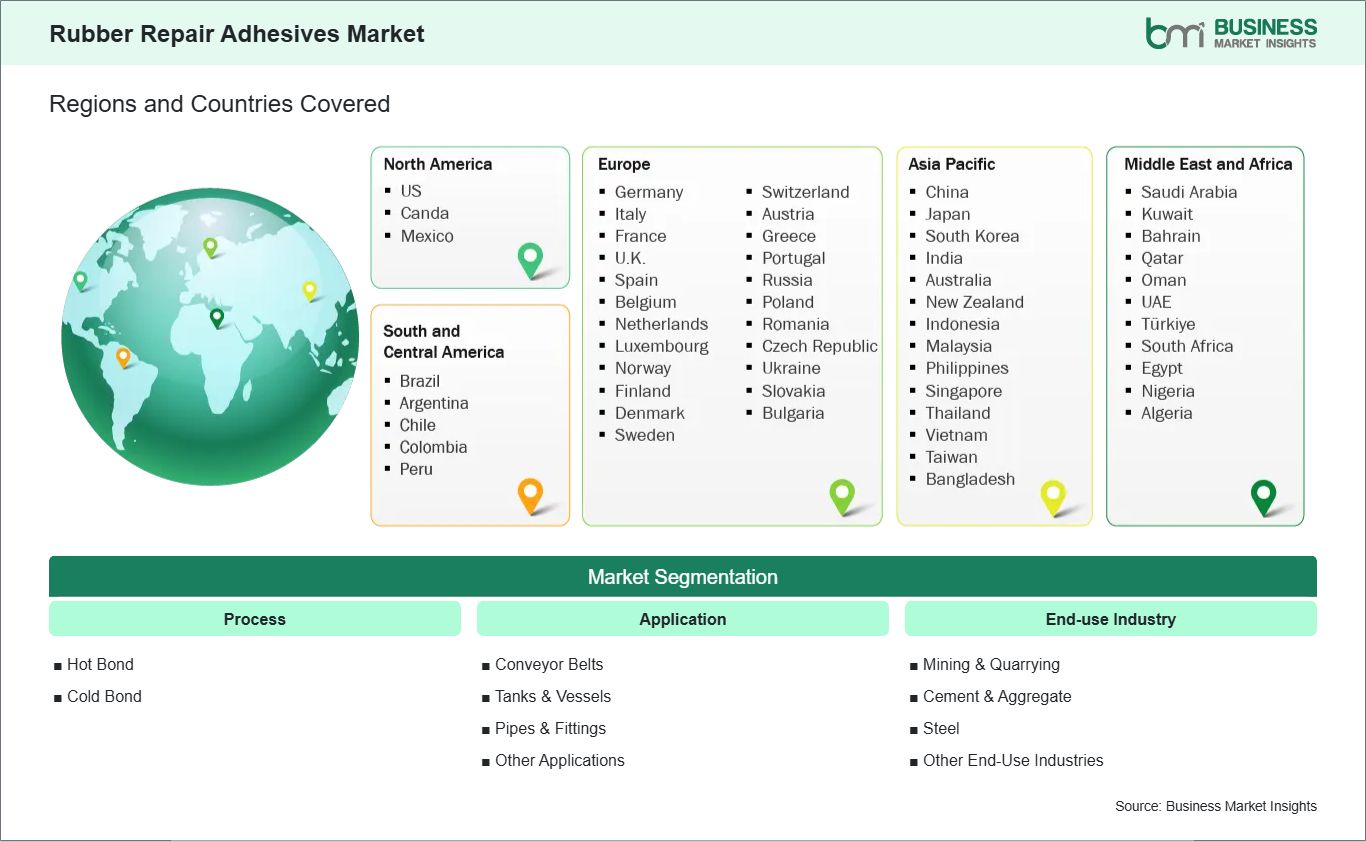
Key segments that contributed to the derivation of the rubber repair adhesives market analysis are process, application, and end‑use industry.
- By process, the rubber repair adhesives market is segmented into hot bond and cold bond. The hot bond segment dominated the market in 2025.
- Based on application, the rubber repair adhesives market is categorized into conveyor belts, tanks & vessels, pipes & fittings, other applications. The conveyor belts segment dominated the market in 2025.
- In terms of end‑use industry, the rubber repair adhesives market is categorized into mining & quarrying, cement & aggregate, steel, other end-use industries. The mining & quarrying segment dominated the market in 2025.
Market Forces
Rubber Repair Adhesives Market Drivers and Opportunities
Rising Automotive And Industrial Maintenance Boosts Adhesive Demand
The global rubber repair adhesives market is strongly supported by ongoing demand in both automotive and industrial maintenance activities, where repairing rubber components often proves more cost‑effective than full replacement. In automotive workshops and service centers across North America and Europe, technicians commonly use specialized adhesives to restore weather stripping, engine mounts, suspension bushings, and brake system seals, as these solutions offer flexibility, resilience, and faster turnaround compared with traditional mechanical fixes. In industrial sectors including manufacturing, energy, and mining rubber adhesives are essential for maintaining conveyor belts, vibration dampeners, flexible couplings, and sealing elements exposed to heat, oil, or friction. Regular upkeep reduces costly downtime and supports operational efficiency.
In Asia Pacific`s expanding manufacturing hubs, maintenance teams increasingly adopt advanced adhesives to prolong equipment life and manage repair costs amid rising production demands. Even in commercial packaging and logistics applications, where rubber gaskets and seals ensure airtight performance, repair adhesives help extend service life and prevent leaks. As industrial complexity grows globally, especially in sectors prioritizing uptime and predictive maintenance, adhesive demand rises accordingly.
Development Of Low VOC And Eco Friendly Adhesive Formulations
The world markets for rubber repair adhesives under eco-friendly regulations and environmental requirements drive manufacturers to create adhesive products which have low volatile organic compound emissions. Chemical companies create water-based and solvent-free adhesive products which maintain bond strength and flexibility because traditional solvent-based adhesives release VOCs which endanger workers and the environment. The European market shows this trend because its strict air quality regulations make safer chemical solutions more popular. North American formulators are increasing their low-VOC product range to meet both building code requirements and environmental certification standards. The automotive repair shops and industrial maintenance facilities and consumer DIY markets show growing acceptance of adhesives which provide performance benefits while decreasing environmental damage.
The global supply chains for Latin American and African and Asian emerging economies now include eco-friendly formulations which support sustainability efforts. The adhesive industry partners with regulatory organizations to conduct research programs which teach end users about environment-friendly products thus promoting the use of advanced adhesive technologies that provide both performance and environmental benefits.
Size and Share Analysis
Rubber Repair Adhesives Market Size and Share Analysis
The rubber repair adhesives market demonstrates steady growth, with size and share analysis highlighting evolving trends and competitive dynamics among key players. The report examines subsegments categorized within process, application, and end‑use industry, offering insights into their contribution to overall market performance.
By process, the hot bond subsegment dominated the market in 2025, driven by its strong adhesion performance and faster curing, making it highly suitable for large-scale rubber repair operations.
Based on application, the conveyor belts subsegment dominated the market in 2025, driven by the high demand in mining, cement, and steel industries where belts require frequent maintenance and repair.
In terms of end‑use industry, the mining & quarrying subsegment dominated the market in 2025, driven by the extensive use of rubber repair adhesives in heavy-duty equipment and conveyor systems within the mining sector.
Report Coverage
Rubber Repair Adhesives Market Report Coverage and Deliverables
The "Rubber Repair Adhesives Market Size and Forecast (2022 - 2033)" report provides a detailed analysis of the market covering below areas:
- Rubber Repair Adhesives Market size and forecast at global, regional, and country levels for all the key market segments covered under the scope
- Rubber Repair Adhesives Market trends, as well as drivers, restraints, and opportunities
- Rubber Repair Adhesives Market analysis covering key trends, global and regional framework, major players, regulations, and recent developments
- Industry landscape and competition analysis covering market concentration, heat map analysis, prominent players, and recent developments for the Rubber Repair Adhesives Market
- Detailed company profiles, including SWOT analysis
Geographic Insights
Rubber Repair Adhesives Market Geographic Insights
The geographical scope of the Rubber Repair Adhesives Market report is divided into North America, Asia Pacific, Europe, Middle East & Africa, and South & Central America. North America held the largest share in 2025.
North America leads the global rubber repair adhesives market because its industrial maintenance system operates at full capacity while its automotive aftermarket functions as a complete system and manufacturing companies together with service industries have adopted modern bonding technologies.
The region uses specialized repair adhesives to restore rubber components in vehicles and industrial machines and infrastructure applications which require both durability and flexibility. The extensive automotive service network creates more demand for adhesive products because both professional technicians and DIY consumers want long‑lasting solutions that are simple to use. Europe functions as a major market because its strict environmental and safety regulations control product development processes which lead manufacturers to create low‑VOC and solvent‑free adhesive systems that fulfill regulatory standards while providing reliable repair capabilities for various rubber materials.
The Asia Pacific region which includes China India and Japan sees increasing rubber repair adhesive use because of its fast industrial growth together with rising automotive production and developing maintenance service markets. The region needs efficient repair materials which minimize downtime and prolong component lifespan to support its expanding infrastructure projects that include transportation systems and manufacturing plants.
The Middle East and Africa market is expanding because maintenance work needs to use adhesives which can resist extreme temperature and dust conditions. In South and Central America, industrial and automotive sectors are developing which leads to higher demand for rubber repair adhesives as companies try to improve efficiency and lower their costs of replacement. The global rubber repair adhesives market development depends on all regions' requirement for repair solutions that deliver effective performance and sustainable results and affordable pricing while North America leads the market due to its superior maintenance methods and existing regulations and extensive usage across different applications.
Industry Activity
Recent Developments
The Rubber Repair Adhesives Market is evaluated by gathering qualitative and quantitative data post primary and secondary research, which includes important corporate publications, association data, and databases. A few of the key developments in the rubber repair adhesives market are:
- In August 2024, H.B. Fuller announced that it had acquired HS Butyl Limited, strengthening its global position in adhesive technologies and expanding its portfolio of butyl‑based sealing tapes and related products used in industrial and automotive rubber repair applications, enabling enhanced solutions and broader reach for repair and bonding markets worldwide.
- In April 2025, Henkel announced that it had expanded its comprehensive solutions portfolio for infrastructure build, maintenance, repair, and protection at the AMPP Annual Conference 2025, highlighting integrated adhesive and repair technologies that support long‑term reliability in industrial rubber and structural applications.
Trust & Transparency
Research Methodology
The market analysis combines proprietary research with secondary data from government agencies, company disclosures, regulatory filings, industry databases and expert interviews. Market estimates are validated through data triangulation, cross-market benchmarking and analyst
review.
View Full Research Methodology
Key Sources Referred:
World Health Organization (WHO) Organisation for Economic Cooperation and Development (OECD) The World Bank Group Worldometer The Lancet International Bar Association International Trade Administration