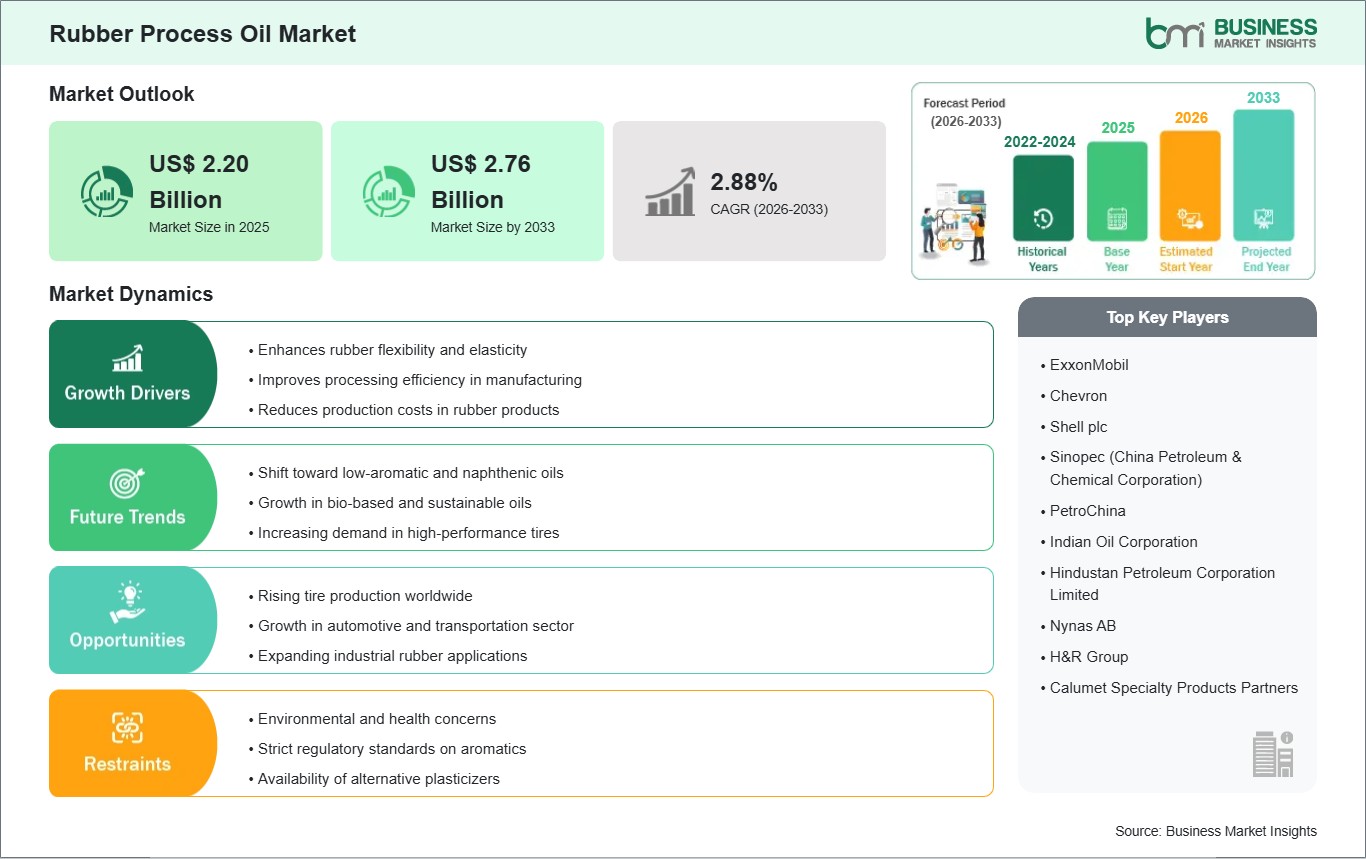
The Rubber Process Oil Market size is expected to reach US$ 2.76 billion by 2033 from US$ 2.2 billion in 2025. The market is estimated to record a CAGR of 2.88% from 2026 to 2033.
The global market for rubber process oil is growing steadily, mainly due to the rising demand for superior-performance rubber products in automotive, tire industry, industrial, and construction sectors. Rubber process oils play an important role as additives in improving the flexibility and workability of rubber compounds. The growing production of vehicles worldwide, along with the trend towards lighter and fuel-efficient tires, has given impetus to the demand for rubber process oils. Moreover, the development of industrial and consumer goods like belts, hoses, and footwear is also creating scope for the applications of rubber process oils.
However, there are certain restraints that affect the market, such as environmental and regulatory issues surrounding the use of aromatic oils, considering the health hazards they may cause. The manufacturers are focusing on producing naphthenic and paraffinic oils, as they are eco-friendly and safe, but this may affect the cost of production. The prices of crude oil, which affect the raw materials, are also a challenge for the market. The rubber process oil market is witnessing new growth opportunities, considering the innovations in eco-friendly oils. The general trend of the rubber process oil market is moving toward safe and efficient oils that are eco-friendly and meet the regulatory requirements. Sustainability is becoming another key driver, with companies investing in bio-based and low-aromatic oils to meet the increasing environmental regulations. However, the market faces the limitation of environmental and health issues linked to conventional aromatic oils and raw materials' volatility due to fluctuations in the availability of crude oil and natural rubber.
The high dependence on petroleum-based oils also poses risks in the supply chain. On the positive side, the emergence of advanced and specialty oils with superior performance and eco-friendly oils is creating new opportunities for differentiation, particularly in countries with stringent regulations. The overall direction of the market is towards advanced and multifunctional sustainable rubber process oils.

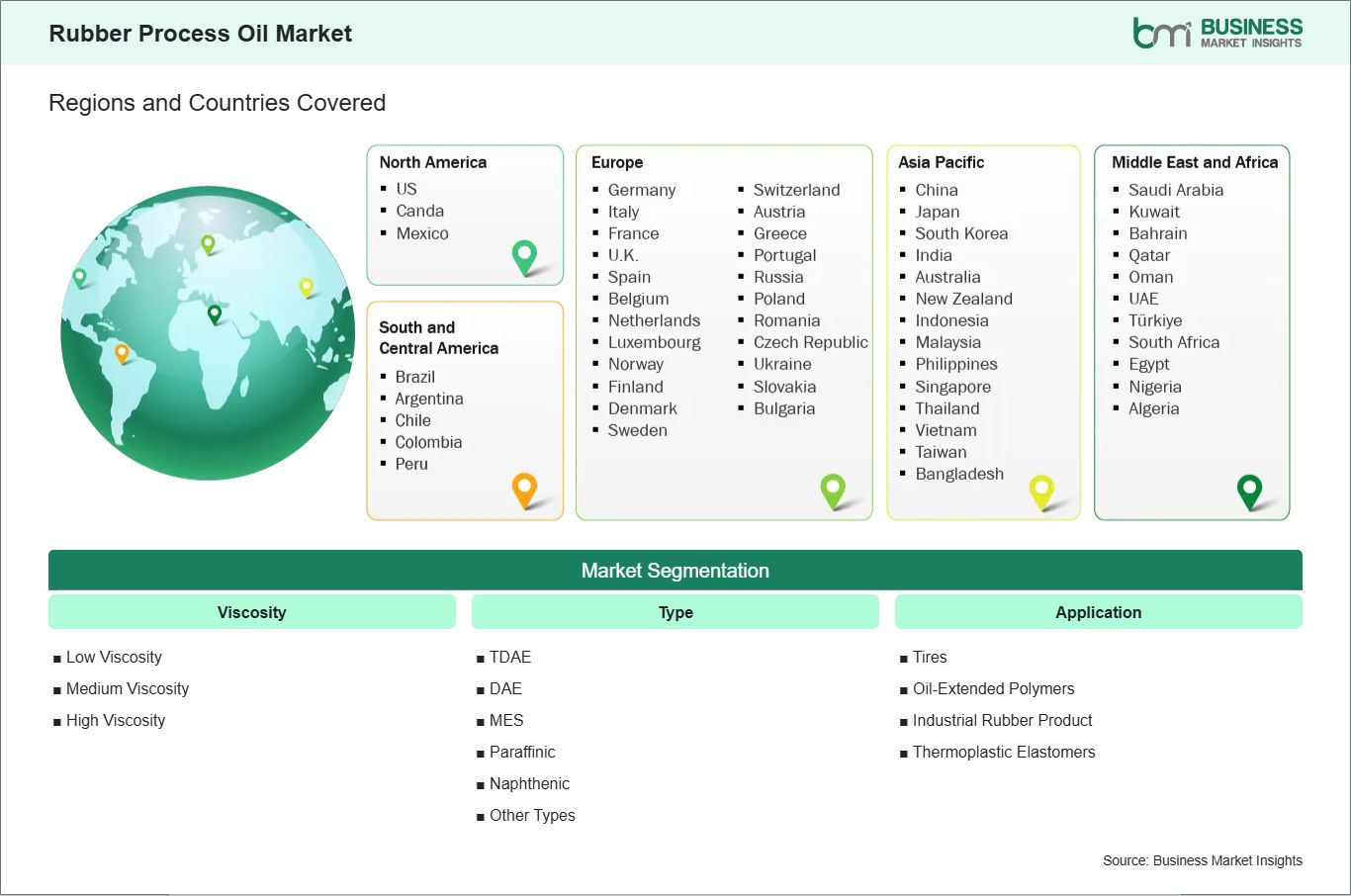
Key segments that contributed to the derivation of the Rubber process oil market analysis are viscosity, type, and application
In the Western European region, the role of the rubber process oils is highly important in the formulation of high-performance rubber materials with better flexibility and elasticity. The end-users in the German automotive industry supply chain, which emphasizes the importance of precise engineering in the production process, highly depend on the process oils to improve the polymer plasticization and the development of the required dynamic properties in the production of various rubber parts. The climate-specific product requirements in the region, ranging from the cold climate of Northern Europe to the moderate climate of the Mediterranean region, make the elasticity of the product an important differentiator in the long-term product performance.
The product requirement for the rubber process oils is quite high in the specialty segments of the rubber industry in the region, such as automotive weatherstrips and industrial belts. The product performance in these segments is usually expressed in terms of flexibility retention at varying temperatures, which is largely affected by the quality and grade of the process oils. The product application in these segments usually requires repeated bending and flexing in the production of various conveyor belts in the logistics hubs around the port city of Rotterdam.
Western Europe’s sustainability agenda is also shaping product development. Buyers increasingly prefer process oils with improved environmental profiles, including reduced volatile components and better biodegradability. Suppliers active in the Netherlands and Scandinavia are responding with tailored oils that balance performance with lower environmental impact, helping rubber compounders meet both technical and regulatory targets. This regional expectation for high flexibility, coupled with eco‑friendly formulations, continues to support stable growth in the Western European rubber process oil market.
The tire manufacturing industry in Western Europe is an important contributor to the global tire market, which in turn directly affects the demand for rubber processing oils. The tire manufacturing companies in Germany, France, and Spain focus on the importance of formulation consistency to meet the performance requirements for passenger cars, commercial vehicles, and racing tires. Rubber process oils are an integral component in tire formulations to enable the process of mixing, dispersion of fillers, and viscosity, which affect the tire performance in various areas.
Even though global demand for tires extends well beyond Europe, Western European producers maintain a foothold in premium and performance segments. This positioning requires precise process control and tailored rubber compounds, which in turn sustains the need for high‑quality process oils. Manufacturers in Italy, known for performance‑oriented tire components, often specify oils that balance processing ease with final product durability, distinguishing their output in competitive export markets.
External factors such as shifts in automotive production and electrification also affect oil demand. As EV adoption grows in countries like Norway and the Netherlands, tire designs are adapting to different load and noise requirements, influencing compound recipes and process oil types. Additionally, European joint ventures with tire makers in Asia and Africa expand Western Europe’s indirect influence on global tire production. These dynamics, grounded in both domestic output and international collaboration, ensure that Western Europe remains a key market for rubber process oils tied to rising tire production worldwide.

The global Rubber process oil market is experiencing steady growth, with market size and share analysis reflecting evolving treatment preferences and competitive dynamics among key players. The report evaluates important subsegments categorized within viscosity, type, and application highlighting their respective contributions to overall market performance.
By viscosity, the medium viscosity subsegment dominated the market in 2025 because they provide the best balance between ease of processing and performance. They allow smooth mixing with rubber compounds while maintaining good mechanical properties, making them suitable for a wide range of applications without compromising durability.
By type, treated distillate aromatic extract (TDAE) segment subsegment dominated the market in 2025 due to their superior safety profile, low aromatic content, and compatibility with modern rubber formulations. They offer stable performance under heat and mechanical stress, making them ideal for tires and industrial rubber products.
By application, the tires subsegment dominated the market in 2025 because the automotive industry is growing rapidly, and tires require high-quality process oils to enhance flexibility, durability, and traction. The demand for energy-efficient and long-lasting tires drives consistent use of rubber process oils in this sector.
| Report Attribute | Details |
|---|---|
| Market size in 2025 | US$ 2.20 Billion |
| Market Size by 2033 | US$ 2.76 Billion |
| Global CAGR (2026 - 2033) | 2.88% |
| Historical Data | 2022-2024 |
| Forecast period | 2026-2033 |
| Segments Covered | By Viscosity
|
|
Regions and Countries Covered
| |
| North America | US, Canada, Mexico |
| Europe | Belgium, Austria, Finland, Denmark, Greece, Poland, Romania, Russia, Ukraine, Czech Republic, Slovakia, Bulgaria, Italy, Luxembourg, Germany, Switzerland, France, Netherlands, Norway, Portugal, Spain, Sweden, United Kingdom |
| Asia-Pacific | Australia, China, India, Japan, South Korea, Indonesia, Malaysia, Philippines, Singapore, Thailand, Vietnam, Bangladesh, New Zealand, Taiwan |
| South and Central America | Brazil, Argentina, Peru, Chile, Colombia |
| Middle East and Africa | Bahrain, Kuwait, Oman, Qatar, Saudi Arabia, United Arab Emirates, Turkiye, South Africa, Egypt, Algeria, Nigeria |
| Market leaders and key company profiles |
|
The "Rubber Process Oil Market Size and Forecast (2022 - 2033)" report provides a detailed analysis of the market covering below areas:
The geographical scope of the Rubber process oil market report is divided into: North America, Asia Pacific, Europe, Middle East & Africa, and South & Central America. North America held the largest share in 2025.
North America is the leading market for rubber process oils, driven by the region’s established automotive, aerospace, and industrial sectors. The U.S. remains a key consumer due to its focus on high-performance tires, advanced automotive components, and strict safety and environmental regulations. Beyond automotive, the industrial and construction sectors create demand for specialized rubber applications, including vibration isolation pads, conveyor belts, and industrial hoses, all of which rely heavily on high-quality process oils.
The region benefits from innovation in low-aromatic and paraffinic oils, which align with regulatory standards while maintaining processing efficiency. Sustainability and green manufacturing initiatives are increasingly influencing product design, with manufacturers exploring bio-based oils to reduce environmental impact without compromising performance. Additionally, North America’s mature supply chain and access to advanced testing and quality control facilities allow for the adoption of high-performance specialty oils that meet demanding mechanical, thermal, and chemical requirements. Challenges such as high raw material costs, environmental compliance, and energy-intensive manufacturing are offset by strong R&D capabilities and a market culture that prioritizes durability, safety, and performance.
In essence, North America not only drives global demand but also sets trends in technological innovation, sustainability, and quality standards in the rubber process oil market.

The rubber process oil market is evaluated by gathering qualitative and quantitative data post primary and secondary research, which includes important corporate publications, association data, and databases. A few of the key developments in the Rubber process oil market are:
The Rubber Process Oil Market is valued at US$ 2.20 Billion in 2025, it is projected to reach US$ 2.76 Billion by 2033.
As per our report Rubber Process Oil Market, the market size is valued at US$ 2.20 Billion in 2025, projecting it to reach US$ 2.76 Billion by 2033. This translates to a CAGR of approximately 2.88% during the forecast period.
The Rubber Process Oil Market report typically cover these key segments-
The historic period, base year, and forecast period can vary slightly depending on the specific market research report. However, for the Rubber Process Oil Market report:
The Rubber Process Oil Market is populated by several key players, each contributing to its growth and innovation. Some of the major players include:
The Rubber Process Oil Market report is valuable for diverse stakeholders, including:
Essentially, anyone involved in or considering involvement in the Rubber Process Oil Market value chain can benefit from the information contained in a comprehensive market report.
Please tell us your area of interest
(Market Segments/ Regions and Countries/ Companies)