Market Summary
Executive Summary and Global Market Analysis
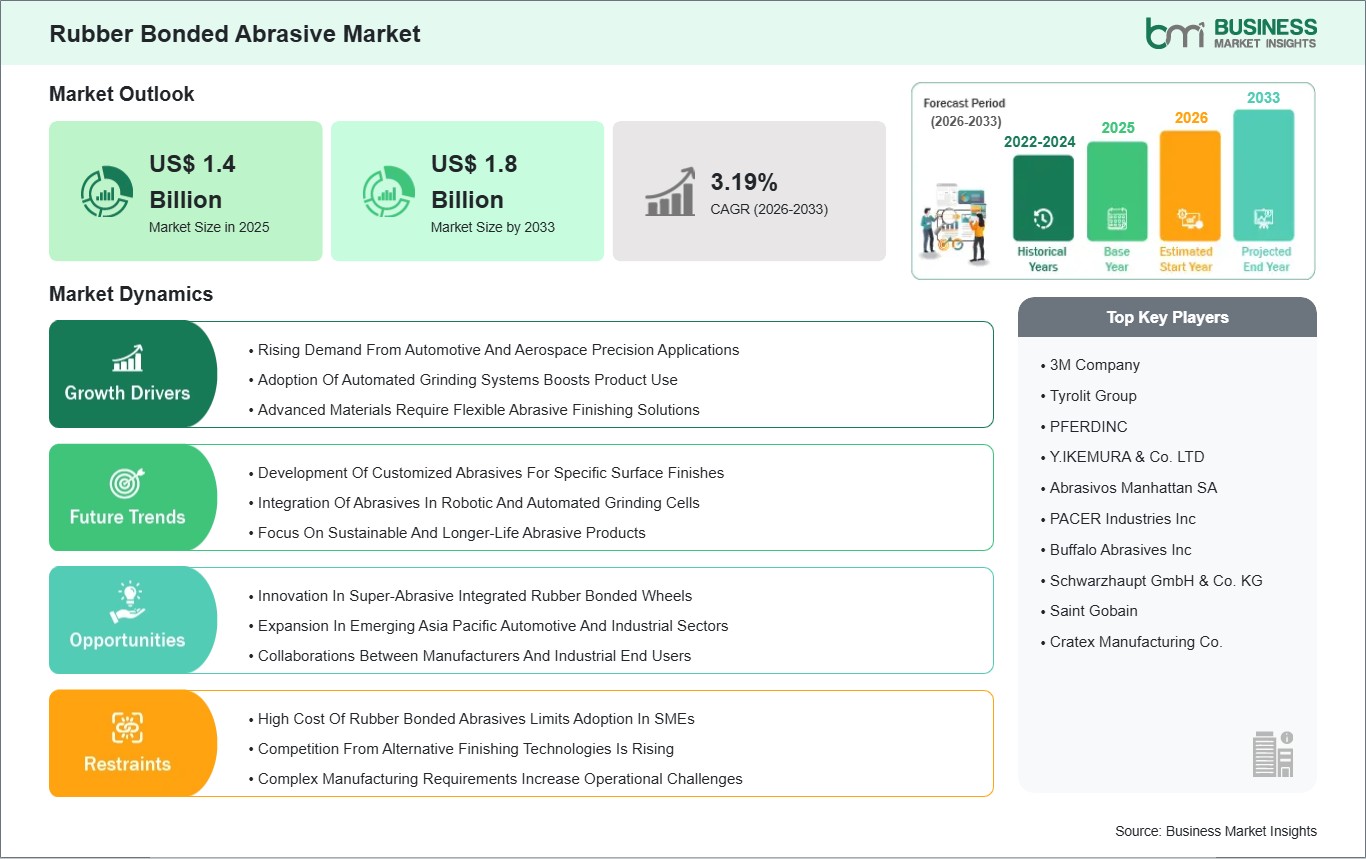
The global rubber bonded abrasive market is shaped by the growing need for precise surface finishing and fine grinding operations across various industrial end‑use sectors. Rubber bonded abrasives serve as specialized tools which enable users to remove materials with controlled rates while achieving smooth surface finishes. The products find applications in automotive component finishing aerospace part manufacturing mold and die polishing precision engineering and metal fabrication workshops that require high surface quality standards.
The global market experiences growth because advanced manufacturing technologies receive more investments and automated grinding and finishing systems become more widespread and industries such as automotive and aerospace increase their efforts to enhance product quality while maintaining strict surface integrity and tolerance specifications. Rubber bonded abrasives serve as the primary market driver because users increasingly adopt these materials to finish advanced materials which include high‑strength steel and aluminum alloy and superalloy components that aerospace and power generation industries use.
The materials require flexible abrasives which can adapt to their intricate shapes without creating excessive harm to their surfaces. Rubber-bonded abrasives enable users to complete their tasks because they deliver better fatigue resistance and minimal vibration compared to standard rigid abrasive systems. The development of abrasive grain technology through advancements in super‑abrasive particles, which use cubic boron nitride and diamond materials that bond with rubber, now enables these products to achieve finer finishes while extending their operational life. The market experiences obstacles because of its strong growth drivers. The cost sensitivity of end users — particularly in emerging markets can limit uptake of premium rubber-bonded products.
The existence of finishing technologies that compete with laser polishing and chemical‑mechanical finishing processes creates market competition. The alternatives provide equivalent quality to the product because they do not require abrasive tools for operation in high‑volume automated lines. Rubber bonded abrasives maintain their importance because they combine flexibility, finish quality, and adaptability to meet the needs of precise surface treatment in manufacturing environments.
Segment Analysis
Rubber Bonded Abrasive Market Segmentation
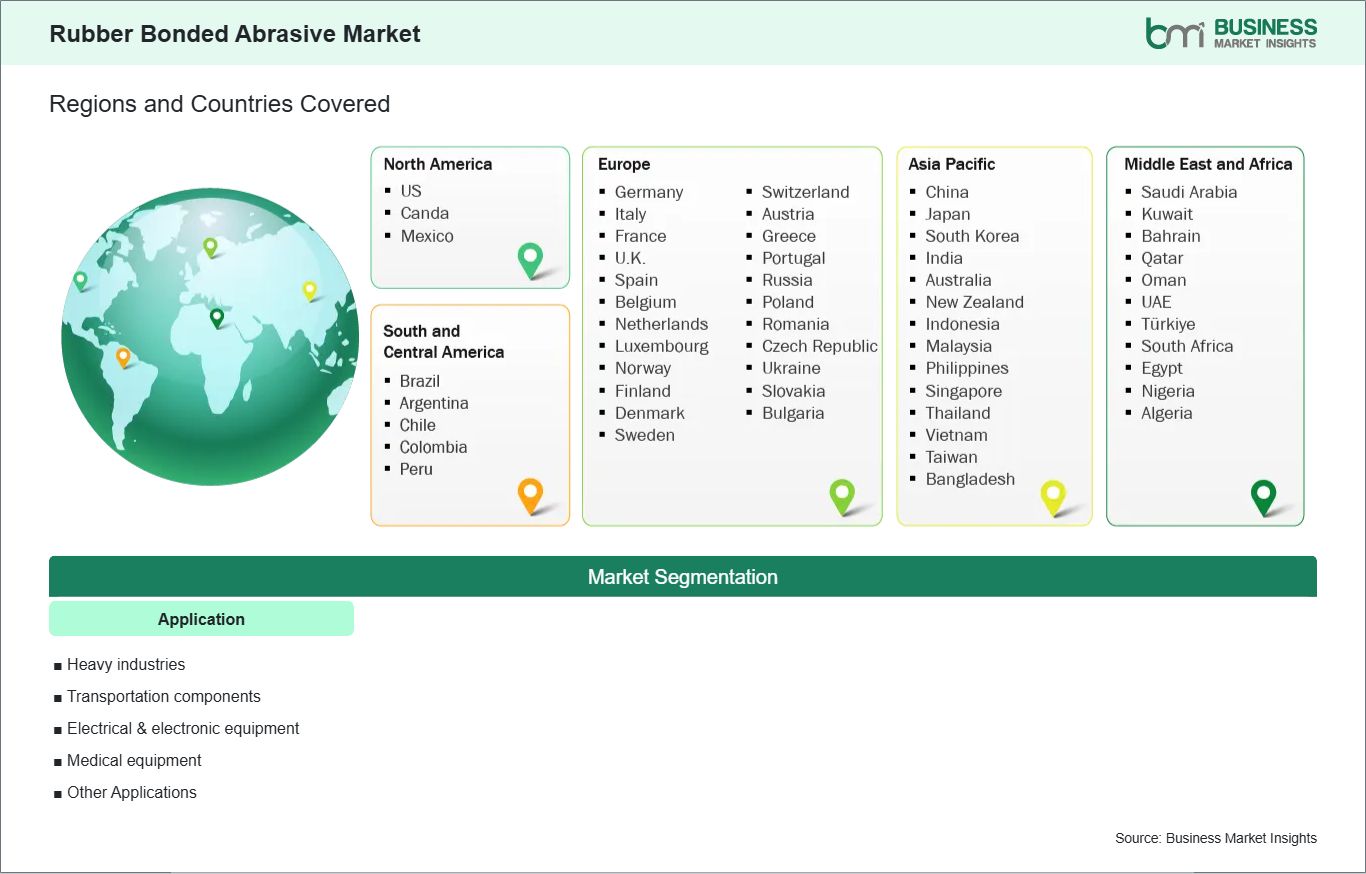
Key segment that contributed to the derivation of the rubber bonded abrasive market analysis is application.
- By application, the rubber bonded abrasive market is segmented into heavy industries, transportation components, electrical & electronic equipment, medical equipment, other applications. The heavy industries segment dominated the market in 2025.
Market Forces
Rubber Bonded Abrasive Market Drivers and Opportunities
Rising Demand From Automotive And Aerospace Precision Applications
The global rubber-bonded abrasive market is significantly affected by increasing demand from the automotive and aerospace industries, which require precise surface finishing. The automotive manufacturing centers of North America, Europe, and Asia Pacific now require engine, transmission, component, and body part production to use fine grinding and surface conditioning methods, which rigid abrasive systems cannot provide. Rubber-bonded abrasives deliver the flexibility and controlled material removal needed to meet exacting tolerances without compromising part integrity. This quality makes them essential equipment for use in these industrial fields.
Aerospace manufacturers need these abrasives to produce finished turbine shafts landing gear components and structural parts which use high-strength alloys. Rubber bonded wheels enable users to grind complex shapes while reducing vibration which results in improved surface quality and extended component durability for aerospace safety and performance. The commercial aircraft production and defense equipment supply chains depend on rubber bonded solutions which fulfill their essential requirements.
European and North American regions support established automotive and aerospace industries which create partnerships between abrasive manufacturers and original equipment makers to develop specialized solutions for diverse materials and specific uses. The rubber-bonded abrasives market maintains global demand because these sectors require high-quality products that deliver exceptional performance and precise results.
Innovation In Super‑Abrasive Integrated Rubber Bonded Wheels
The global rubber-bonded abrasive market is being transformed through the development of super-abrasive integrated rubber-bonded wheels because manufacturers demand products that offer them both flexible operation and better cutting capabilities. The use of CBN (cubic boron nitride) and diamond super-abrasive grains in rubber bonds enables producers to create tools which deliver better surface results and faster material removal and longer operational life than traditional abrasive products. Modern manufacturing requirements receive fulfillment through hybrid products which combine durability with efficient performance. The launch of super-abrasive integrated products occurred at the correct time for industrial regions, which include North America, Western Europe, and Japan. Automotive and aerospace component producers in these markets increasingly handle tougher alloys and complex part geometries that challenge conventional finishing wheels. Enhanced rubber-bonded wheels with super‑abrasive constituents improve process consistency, reduce downtime for tool changes, and support higher throughput in automated grinding systems.
The development creates fresh business possibilities for precision engineering fields including medical device production and high-technology tooling since surface quality determines product performance. Industry players use super-abrasive integration to develop abrasive technology which enables them to meet customer requirements while strengthening the international standing of rubber bonded abrasive products.
Size and Share Analysis
Rubber Bonded Abrasive Market Size and Share Analysis
The rubber bonded abrasive market demonstrates steady growth, with size and share analysis highlighting evolving trends and competitive dynamics among key players. The report examines subsegments categorized within application, offering insights into their contribution to overall market performance.
By application, the heavy industries subsegment dominated the market in 2025, driven by the high demand for durable and precise finishing solutions in steel, automotive, and machinery manufacturing, where rubber bonded abrasives are critical for grinding, polishing, and surface preparation.
Report Coverage
Rubber Bonded Abrasive Market Report Coverage and Deliverables
The "Rubber Bonded Abrasive Market Size and Forecast (2022 - 2033)" report provides a detailed analysis of the market covering below areas:
- Rubber Bonded Abrasive Market size and forecast at global, regional, and country levels for all the key market segments covered under the scope
- Rubber Bonded Abrasive Market trends, as well as drivers, restraints, and opportunities
- Rubber Bonded Abrasive Market analysis covering key trends, global and regional framework, major players, regulations, and recent developments
- Industry landscape and competition analysis covering market concentration, heat map analysis, prominent players, and recent developments for the Rubber Bonded Abrasive Market
- Detailed company profiles, including SWOT analysis
Geographic Insights
Rubber Bonded Abrasive Market Geographic Insights
The geographical scope of the Rubber Bonded Abrasive Market report is divided into North America, Asia Pacific, Europe, Middle East & Africa, and South & Central America. North America held the largest share in 2025.
The global rubber bonded abrasive market shows different regional patterns which emerge from production sector development and industrial progress and usage-based market needs, with North America serving as the primary market area. North America shows strong demand for precise finishing products because advanced sectors in automotive and aerospace and medical device and industrial machinery fields exist there, which makes rubber bonded abrasives necessary to meet strict surface quality requirements. United States and Canada and Mexico manufacturers use these abrasives in their automated grinding and polishing systems because they help their production processes become more efficient while maintaining product quality, which strengthens the region's manufacturing lead.
The Asia Pacific market shows rapid growth because China and India and Japan and South Korea build more automotive production facilities, while Southeast Asia develops its industrial infrastructure. The region's manufacturing ecosystems use rubber bonded abrasives to finish complex components while they produce automotive and electronics products. European automotive OEMs and aerospace manufacturers and precision engineering companies drive continuous demand for rubber bonded abrasives because Western European countries demand ultra-fine surface finishes and environmentally and performance-compliant formulation innovations.
The Middle East and Africa region experiences slow overall expansion because of its limited heavy manufacturing capacity, but specialized fabrication centers and oil and gas equipment finishing develop demand in the UAE and Saudi Arabia and South Africa for high-quality surface treatment of essential components. The regions of South America and Central America display moderate growth because automotive assembly and metal fabrication and maintenance operations drive their business activities in Brazil and Argentina and Chile. The demand for premium finishing technologies is restricted because of economic fluctuations and the slow adoption of these advanced finishing technologies. All regions of the world show a continuing trend toward automation and precision manufacturing and quality-driven finishing solutions which create changes in the application of rubber bonded abrasives. North America leads the market because it has advanced industries and innovation infrastructure and strict surface quality standards to meet.
Industry Activity
Recent Developments
The Rubber Bonded Abrasive Market is evaluated by gathering qualitative and quantitative data post primary and secondary research, which includes important corporate publications, association data, and databases. A few of the key developments in the rubber bonded abrasive market are:
- In December 2024, Saint‑Gobain Specialty Grains & Powders announced that it had introduced Lumeos™ AZ25L, a new alumina‑zirconia abrasive grain designed with lower environmental impact and sustained grinding performance, with plans to expand production globally by 2026. While focused on abrasive grains, this development feeds into bonded and other abrasive tool manufacturing worldwide.
- In September 2024, 3M Abrasives Systems Division announced the launch of new Scotch‑Brite™ Precision Heavy Duty Surface Conditioning Discs featuring 3M Precision‑Shaped Grain technology, replacing older surface conditioning products to deliver improved performance and durability in industrial surface preparation and finishing applications. While these are non‑woven abrasives, they are part of the broader abrasives solutions that complement bonded abrasive products in manufacturing workflows.
Trust & Transparency
Research Methodology
The market analysis combines proprietary research with secondary data from government agencies, company disclosures, regulatory filings, industry databases and expert interviews. Market estimates are validated through data triangulation, cross-market benchmarking and analyst
review.
View Full Research Methodology
Key Sources Referred:
World Health Organization (WHO) Organisation for Economic Cooperation and Development (OECD) The World Bank Group Worldometer The Lancet International Bar Association International Trade Administration