Market Summary
Executive Summary and Global Market Analysis
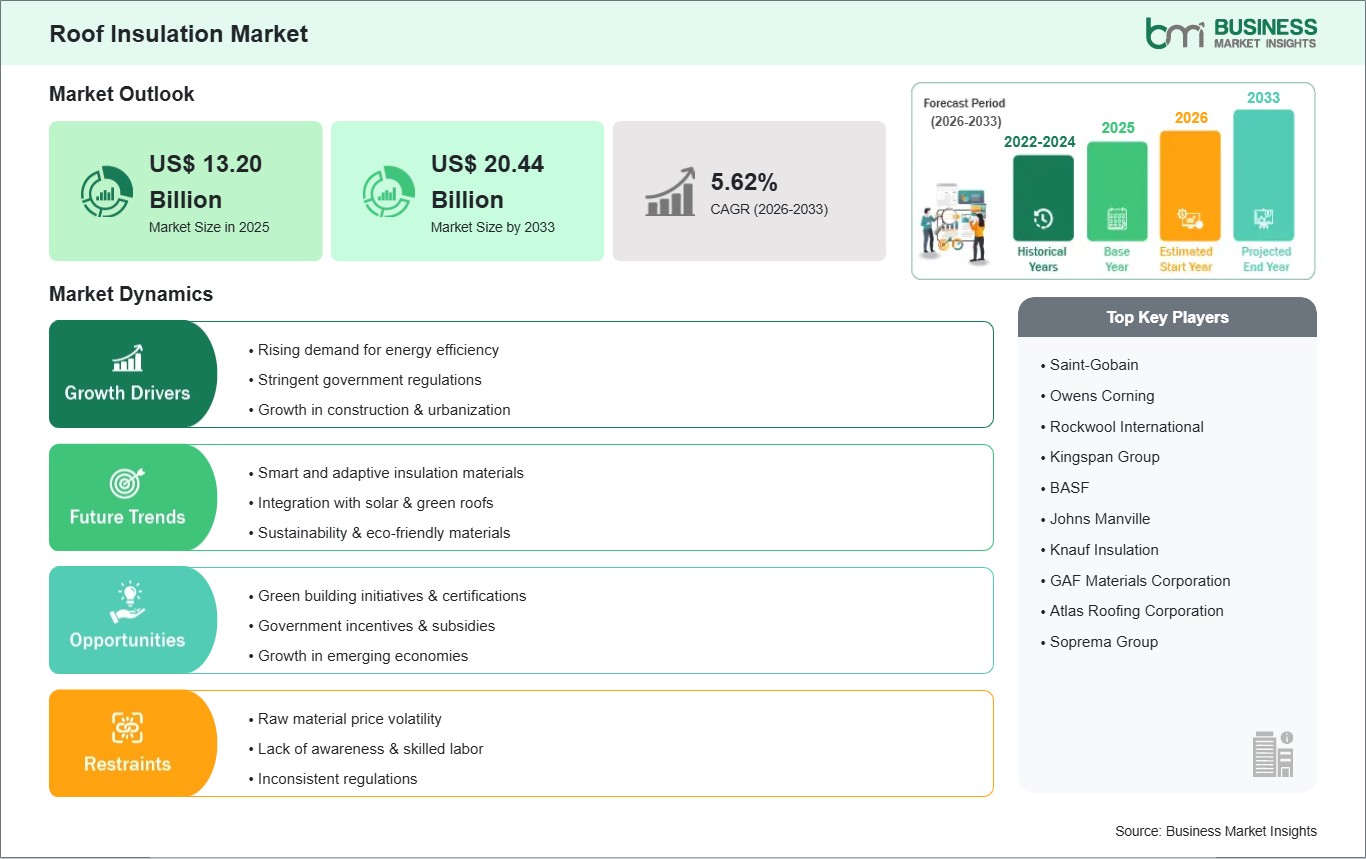
The global roof insulation market is experiencing sustained momentum, driven by the growing emphasis on energy efficiency, climate-responsive construction, and stricter building regulations across both developed and emerging economies. Increasing urbanization, particularly in Asia and parts of Africa, is fuelling new construction activity, while renovation trends in mature markets are reinforcing demand for advanced insulation solutions. Governments worldwide are promoting green building standards and energy conservation practices, which has accelerated the adoption of high-performance insulation materials such as polyurethane foam, mineral wool, and reflective insulation systems.
Additionally, rising awareness among consumers regarding indoor thermal comfort and long-term energy cost savings is shaping purchasing decisions in both residential and commercial sectors. However, the market faces constraints related to fluctuating raw material prices and environmental concerns associated with certain synthetic insulation materials. Supply chain disruptions and the need for skilled installation also pose challenges, particularly in developing regions. Despite these barriers, innovation in eco-friendly and recyclable insulation materials is opening new opportunities, with manufacturers focusing on sustainable product development and improved fire resistance and durability. Overall, the market is evolving toward smarter, energy-efficient roofing solutions aligned with global sustainability goals.
Segment Analysis
Roof Insulation Market Segmentation
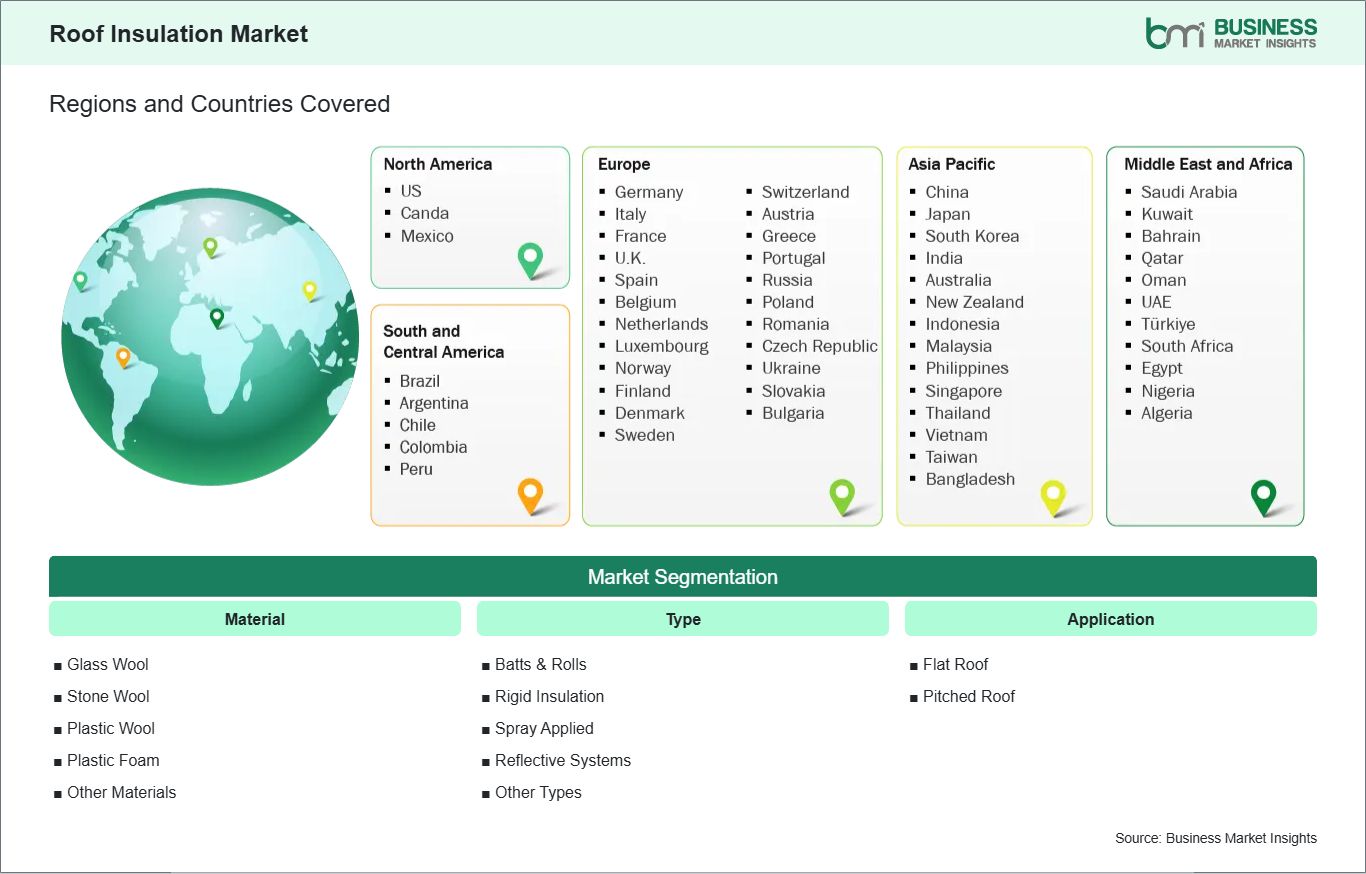
Key segments that contributed to the derivation of the roof insulation market analysis are material, type, and application
- By material, the roof insulation market is segmented into glass wool, stone wool, plastic wool, plastic foam, and other materials. The glass wool segment dominated the market in 2025.
- By type, the roof insulation market is segmented into glass wool, stone wool, plastic wool, plastic foam, and other materials. The rigid insulation segment dominated the market in 2025.
- In terms of application, the roof insulation market is segmented into flat roof and pitched roof. The flat roof segment dominated the market in 2025.
Market Forces
Roof Insulation Market Drivers and Opportunities
Rising Demand for Energy Efficiency
The Western Europe roof insulation market is being driven by the strong focus on energy efficiency in residential as well as commercial buildings. With more and more people becoming aware of energy consumption costs, there is an increasing focus on roof insulation, which is being recognized as an effective solution for maintaining comfortable temperatures in residential homes. Advanced materials are being used in meeting the demand for roof insulation in Western Europe.
Retrofitting of old buildings is also playing an important role in the demand for roof insulation in Western Europe. Most of the buildings in Western Europe have been constructed decades ago, at a time when there were no standards in place for building insulation. Roof insulation is being recognized as an effective solution for reducing energy consumption in old buildings. Urban cities have also been witnessing high demand for roof insulation solutions.
Consumer demand also plays its part in shaping the market. While saving on energy is important, people are increasingly demanding quiet interiors, durability, and eco-friendly materials. This ensures that Western Europe will remain a healthy and stable market for roof insulation products, with growth driven by improving quality rather than sheer volume of new buildings.
Green Building Initiatives & Certifications
Green building initiatives are considered an important factor in influencing the Western Europe roof insulation market. These initiatives include sustainable building and nearly zero-energy building. These initiatives encourage developers to install roof insulations with superior properties. Products with low thermal conductivity and low effects on the environment are becoming common in building construction.
Certifications such as BREEAM, DGNB, and HQE also provide developers with incentives. Roof insulation plays an important role in certification. They are considered an essential factor in enhancing energy efficiency, comfort, and sustainability. More developers are opting for roof insulation with certification properties, such as eco-friendly products.
Government programs also play a significant role in promoting adoption. The incentives for retrofitting and constructing buildings in an energy-efficient manner, along with government projects in schools, hospitals, and buildings, will create a platform for the widespread adoption of innovative roof insulation solutions. Along with sustainability promises in the private sector, it will ensure that innovative roof insulation solutions will always be in demand, maintaining Western Europe’s position as a leader in environmentally friendly construction.
Size and Share Analysis
Roof Insulation Market Size and Share Analysis
The global roof insulation market is experiencing steady growth, with market size and share analysis reflecting evolving treatment preferences and competitive dynamics among key players. The report evaluates important subsegments categorized within material, type, and application highlighting their respective contributions to overall market performance.
By material, the glass wool subsegment dominated the market in 2025 due to it providing an excellent balance of affordability, thermal performance, and fire resistance. It is lightweight, easy to handle, and can be cut or shaped to fit different roof designs. Its versatility and widespread availability make it the preferred choice for both residential and commercial projects.
By type, the rigid insulation segment subsegment dominated the market in 2025 because it delivers long-term durability and consistent thermal performance. It resists moisture, compression, and weathering better than flexible materials, making it ideal for flat and sloped roofs alike. Builders favor it for its ability to maintain insulation efficiency over time, reducing energy costs.
By application, the flat roof subsegment dominated the market in 2025 because they are extensively used in commercial, industrial, and urban residential buildings. Their large, accessible surfaces make installation of insulation easier and more cost-effective. Additionally, flat roofs often integrate other systems like solar panels or HVAC equipment, increasing the demand for durable insulation solutions.
Report Coverage
Roof Insulation Market Report Coverage and Deliverables
The "Roof Insulation Market Size and Forecast (2022 - 2033)" report provides a detailed analysis of the market covering below areas:
- Roof insulation market size and forecast at the regional and country levels for segments covered under the scope
- Roof insulation market trends, as well as drivers, restraints, and opportunities
- Roof insulation market analysis covering key trends, regional framework, major players, regulations, and recent developments
- Industry landscape and competition analysis covering market concentration, heat map analysis, prominent players, and recent developments for the roof insulation market.
- Detailed company profiles, including SWOT analysis
Geographic Insights
Roof Insulation Market Geographic Insights
The geographical scope of the roof insulation market report is divided into: North America, Asia Pacific, Europe, Middle East & Africa, and South & Central America. North America held the largest share in 2025.
North America stands as the dominant region in the global roof insulation market, primarily due to its advanced construction practices, strong regulatory framework, and high awareness of energy efficiency. The region benefits from well-established building codes that mandate insulation standards, especially in the United States and Canada, where climate variations necessitate effective thermal management in buildings. Retrofitting and renovation activities play a crucial role, as a large portion of the existing building stock requires upgrades to meet modern energy efficiency benchmarks. This has led to consistent demand for both traditional and advanced insulation materials.
The commercial sector, including offices, warehouses, and institutional buildings, significantly contributes to market expansion, driven by corporate sustainability commitments and green certification programs. Additionally, extreme weather conditions, ranging from harsh winters to hot summers, increase the reliance on high-performance insulation systems. Technological advancements, such as cool roofing and integrated insulation systems, are gaining traction in the region. However, labor costs and regulatory compliance complexities can act as barriers. Despite these challenges, North America continues to lead due to innovation, early adoption of sustainable materials, and a mature supply chain ecosystem.
Industry Activity
Recent Developments
The roof insulation market is evaluated by gathering qualitative and quantitative data post primary and secondary research, which includes important corporate publications, association data, and databases. A few of the key developments in the Roof insulation market are:
- In July 2023, Kingspan Group plc, announced that it acquired a majority stake in Steico SE, a European insulation manufacturer, strengthening its presence in sustainable insulation solutions across Europe, including Eastern European markets.
- In October 2024, Knauf Insulation, announced that it entered an agreement to acquire Texnopark’s rock mineral wool insulation business in Uzbekistan, including a new low-carbon production plant, expanding its insulation manufacturing footprint in the broader Eastern European and neighboring regional market.
- In 2023, TaperedPlus, achieved B Corp certification and advanced investments in technology and partnerships to improve roof insulation design and energy efficiency, aligning with stricter European building safety and insulation regulations influencing markets across Europe, including Eastern Europe.
Trust & Transparency
Research Methodology
The market analysis combines proprietary research with secondary data from government agencies, company disclosures, regulatory filings, industry databases and expert interviews. Market estimates are validated through data triangulation, cross-market benchmarking and analyst
review.
View Full Research Methodology
Key Sources Referred:
EU REACH Regulation European Chemicals Agency (ECHA) S. Department of Energy Energy Conservation Building Code (ECBC) Energy Performance of Buildings Directive (EPBD) Company Websites Company Annual Reports Company Investor Presentations