Market Summary
Executive Summary and Global Market Analysis
Rolling stock includes rail-based transportation vehicles operating across passenger transit, freight movement, urban mobility, and high-speed railway networks. The category encompasses locomotives, railcars, metro coaches, multiple units, and specialized transit vehicles designed for long-distance, suburban, and intra-city transportation systems. These assets support railway network efficiency through improved mobility capacity, operational reliability, and transportation connectivity.
Urbanization trends and long-term railway infrastructure modernization programs continue reshaping investment priorities throughout the transportation sector. Governments and transit authorities increasingly focus on rail electrification, congestion reduction, and sustainable public mobility initiatives. Freight operators are also upgrading rolling stock fleets to improve cargo handling efficiency, energy optimization, and operational flexibility across expanding logistics corridors.
Metro vehicles and multiple units maintain strong commercial relevance because densely populated metropolitan regions require high-frequency transportation capability. High-speed trains continue receiving infrastructure support across intercity transit projects emphasizing reduced journey durations and passenger comfort standards. Electric propulsion systems remain widely preferred owing to lower operational emissions and compatibility with modern railway electrification programs.
Technology advancement within the sector increasingly emphasizes lightweight materials, predictive maintenance systems, and digitally integrated train control platforms. Manufacturers continue introducing energy-efficient propulsion technologies alongside enhanced passenger safety systems and intelligent monitoring architecture. Automation features, real-time diagnostics, and connected mobility solutions are additionally supporting operational optimization across contemporary rail transportation networks.
Competitive conditions remain influenced by public transportation investment cycles, regional rail expansion strategies, and fleet replacement initiatives. Industry participants prioritize long-term maintenance agreements, localized manufacturing capability, and customized rolling stock configurations for urban and intercity applications. Ongoing railway modernization activity and transition toward low-emission transportation systems continue shaping future procurement patterns across the rolling stock market.
Segment Analysis
Rolling stock Market Segmentation
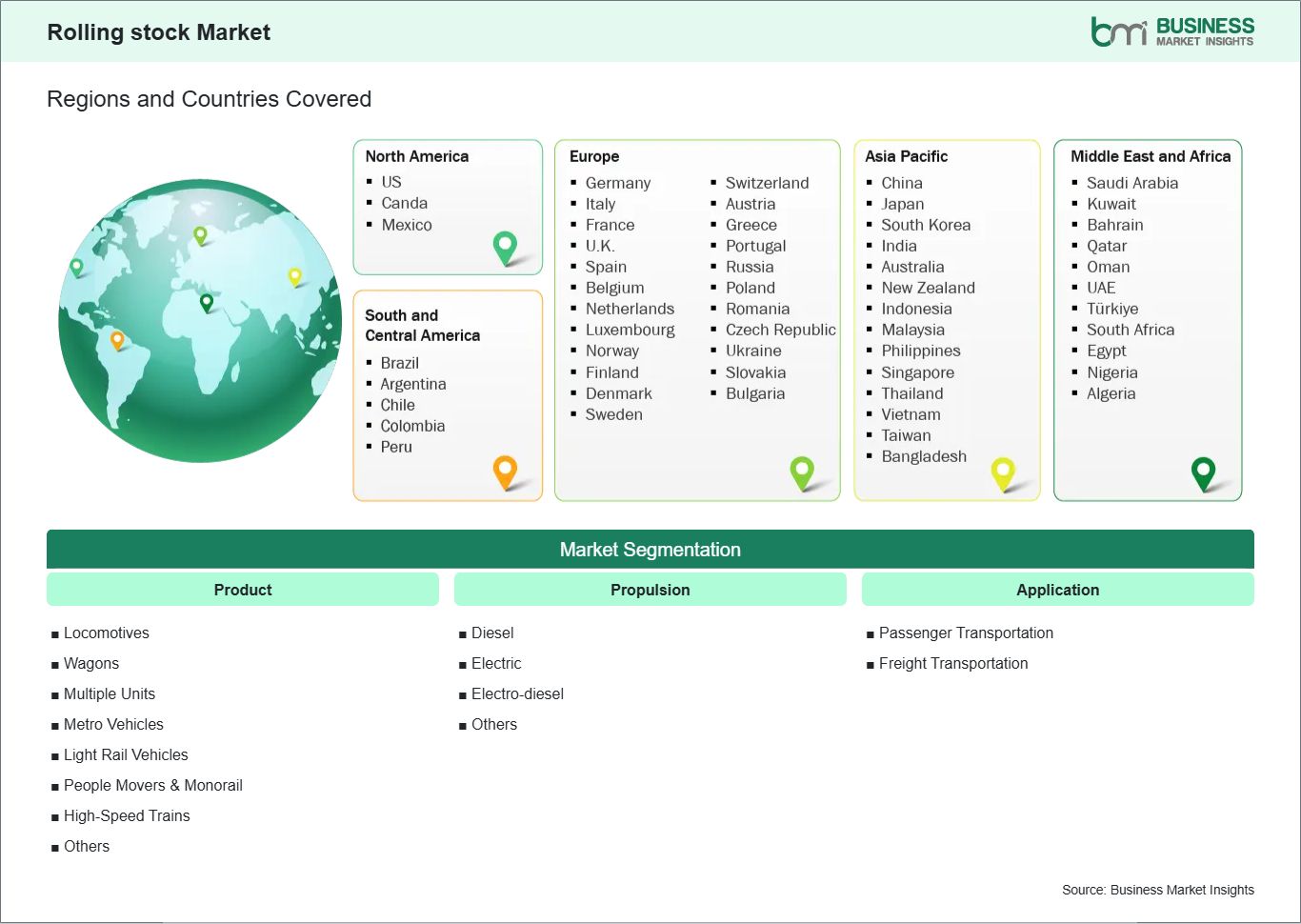
The rolling stock market is segmented based on product, propulsion and application.
By Product
- Locomotives – Supports heavy-haul transportation and long-distance railway operations.
- Wagons – Facilitates efficient bulk cargo movement across freight rail networks.
- Multiple Units (MUs) – Improves passenger transit efficiency through self-propelled train configurations.
- Metro Vehicles – Enables high-frequency urban transportation within densely populated cities.
- Light Rail Vehicles – Serves compact metropolitan transit routes with operational flexibility.
- People Movers & Monorail – Enhances short-distance mobility within airports and commercial districts.
- High-Speed Trains – Strengthens intercity connectivity through accelerated passenger transportation capability.
- Others – Addresses specialized rail mobility applications across diverse transportation environments.
By Propulsion
- Diesel – Maintains operational suitability for non-electrified railway infrastructure networks.
- Electric – Delivers lower-emission railway transportation with higher energy efficiency characteristics.
- Electro-diesel – Combines propulsion adaptability across electrified and conventional rail routes.
- Others – Includes alternative propulsion concepts supporting evolving transportation requirements.
By Application
- Passenger Transportation – Prioritizes commuter mobility, safety, and urban transit accessibility.
- Freight Transportation – Improves cargo efficiency across industrial and logistics supply chains.
Market Forces
Rolling stock Market Drivers and Opportunities
Railway Infrastructure Modernization and Electrification Expansion
Transit authorities and national railway operators continue modernizing aging transportation fleets to improve network efficiency and passenger experience standards. Electrification initiatives, urban transit expansion, and smart mobility programs are increasing procurement activity for technologically advanced rolling stock systems. Rail operators additionally seek energy-efficient vehicles capable of supporting long operational lifecycles with lower maintenance requirements.
The broader impact extends into environmental policy implementation and intermodal transportation planning. Governments increasingly position railway transport as a sustainable mobility solution for managing urban congestion and industrial freight movement. This transition strengthens the relevance of advanced rolling stock deployment within urban transit systems, regional railway corridors, and freight logistics operations.
Development of Smart and High-Speed Railway Systems
The transportation sector increasingly incorporates connected rail technologies, digital diagnostics, and automated train management systems into rolling stock platforms. High-speed rail projects and smart metro networks continue encouraging innovation in lightweight vehicle engineering, onboard analytics, and intelligent passenger information systems. Advanced propulsion technologies are also improving fleet efficiency and operational integration across expanding rail ecosystems.
Future opportunities are associated with sustainable transit investment and next-generation urban mobility initiatives. Emerging economies continue expanding metro connectivity and regional railway infrastructure to support economic development and population mobility requirements. Expanding deployment of smart rail systems and energy-efficient rolling stock is anticipated to reinforce long-term industry progression.
Size and Share Analysis
Rolling stock Market Size and Share Analysis
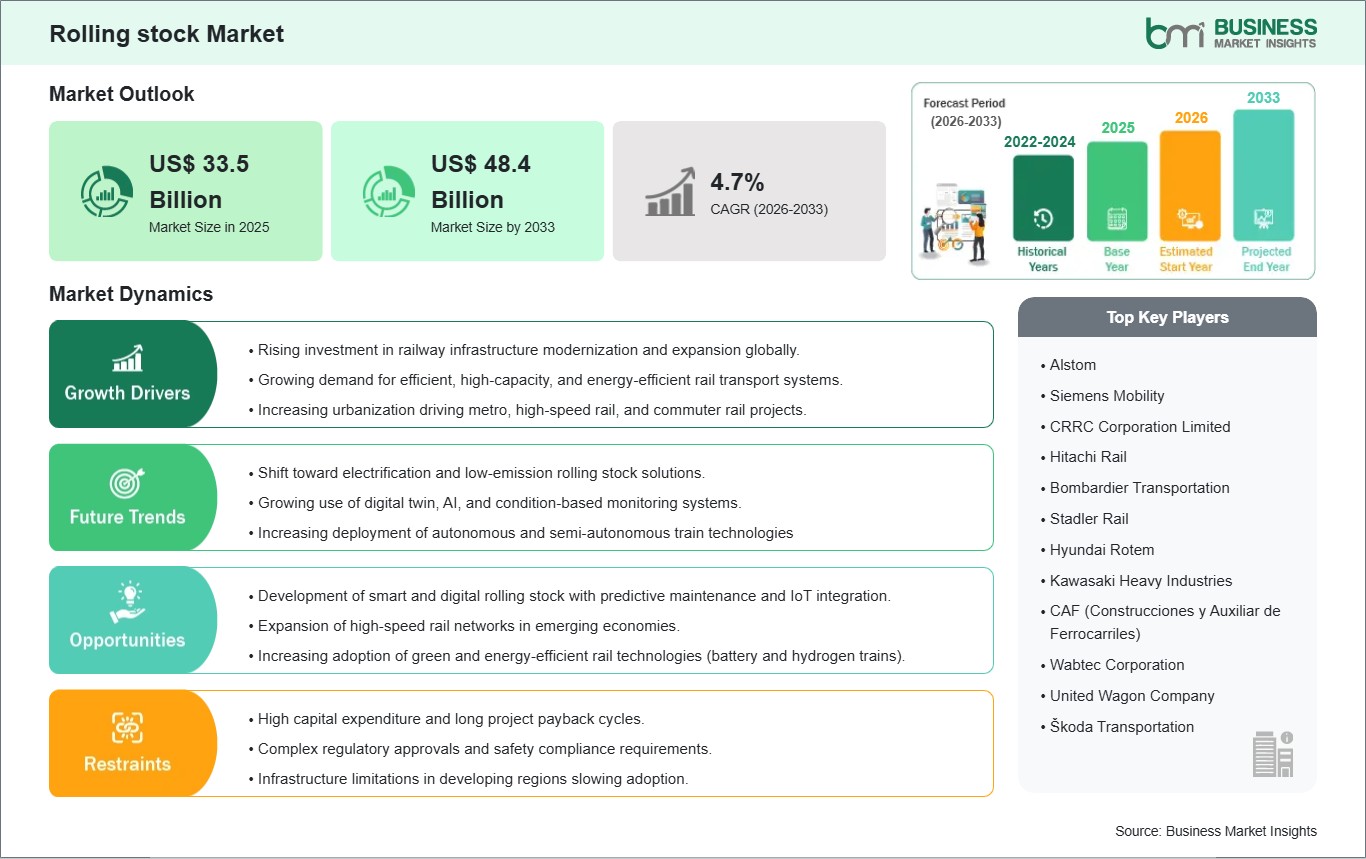
The Rolling Stock Market was valued at USD 33.5 Billion in 2025 and is projected to reach USD 48.4 Billion by 2033, expanding at a CAGR of 4.70% during 2026–2033. Market expansion reflects sustained investment in railway infrastructure modernization, urban mobility systems, and high-capacity freight transportation networks across multiple regions.
Electric propulsion systems maintain significant market positioning due to expanding rail electrification programs and sustainability-focused transportation planning. Metro vehicles and multiple units also account for considerable deployment because urban transit authorities prioritize high-frequency passenger mobility and operational efficiency improvements.
Passenger transportation represents a prominent application segment owing to rising public transit utilization and expanding intercity rail connectivity initiatives. Freight transportation additionally demonstrates notable market participation as logistics operators strengthen rail-based cargo movement capabilities across industrial supply chains.
Report Coverage
Rolling stock Market Report Coverage and Deliverables
The Rolling Stock report provides a detailed analysis of the market covering the below areas:
- Market size and forecast at global, regional, and country levels for all the key market segments covered under the scope
- Market size and forecast at global, regional, and country levels for all the key market segments covered under the scope
- Market trends, as well as market dynamics such as drivers, restraints, and key opportunities
- Market analysis covering key market trends, global and regional framework, major players, regulations, and recent market developments
- Industry landscape and competition analysis covering market concentration, heat map analysis, prominent players, and recent developments for the market
- Detailed company profiles, including SWOT analysis
Geographic Insights
Rolling stock Market Geographic Insights
The Rolling Stock market shows diverse regional adoption patterns influenced by railway electrification agendas, urban mobility expansion, freight transportation requirements, and public infrastructure investment priorities. Transit agencies and railway operators worldwide continue modernizing fleets to improve passenger movement, operational efficiency, and environmental performance across regional and metropolitan rail systems.
North America demonstrates consistent rolling stock investment activity supported by freight rail optimization programs and urban transit modernization initiatives. Passenger rail authorities increasingly prioritize fleet replacement projects integrating digital monitoring technologies and energy-efficient propulsion systems. Freight rail operators throughout the region also continue upgrading wagons and locomotives to strengthen cargo movement efficiency and long-haul operational reliability.
Asia Pacific reflects substantial rail infrastructure expansion associated with urbanization, high-speed corridor development, and metropolitan transit construction programs. Regional governments continue allocating resources toward metro connectivity, electrified rail systems, and domestic rolling stock manufacturing capability. High passenger transit volumes and expanding intercity railway networks further accelerate deployment of technologically advanced rail vehicles throughout the region.
Europe maintains a mature railway ecosystem emphasizing sustainable transportation integration, cross-border rail connectivity, and low-emission mobility solutions. High-speed rail investment and smart transit modernization initiatives continue supporting advanced rolling stock procurement across several countries. Emerging markets within the Middle East, Africa, and South and Central America are additionally strengthening rail infrastructure development to improve urban mobility and regional logistics connectivity.
Industry Activity
Recent Developments
The Rolling Stock market is evaluated by gathering qualitative and quantitative data post primary and secondary research, which includes important corporate publications, association data, and databases. Recent developments and news in the market include:
- In November 2025, Alstom reported stronger-than-expected sales in 2025, driven by high-speed train orders and fleet modernization programs across Europe. The company upgraded its revenue outlook after strong backlog execution and major contracts in Poland and France, including Eurostar fleet expansion.
- In November 2025, Siemens Mobility secured a €2.5 billion contract from Swiss Federal Railways (SBB) to supply 116 commuter trains, with options for additional units.
Trust & Transparency
Research Methodology
The market analysis combines proprietary research with secondary data from government agencies, company disclosures, regulatory filings, industry databases and expert interviews. Market estimates are validated through data triangulation, cross-market benchmarking and analyst
review.
View Full Research Methodology
Key Sources Referred:
Railway transportation industry reports Government railway infrastructure databases Urban mobility and transit development studies Academic journals related to railway engineering Company annual reports and transportation filings Rail electrification and smart transit publications High-speed rail technology research papers Freight transportation and logistics studies