Market Summary
Executive Summary and Global Market Analysis
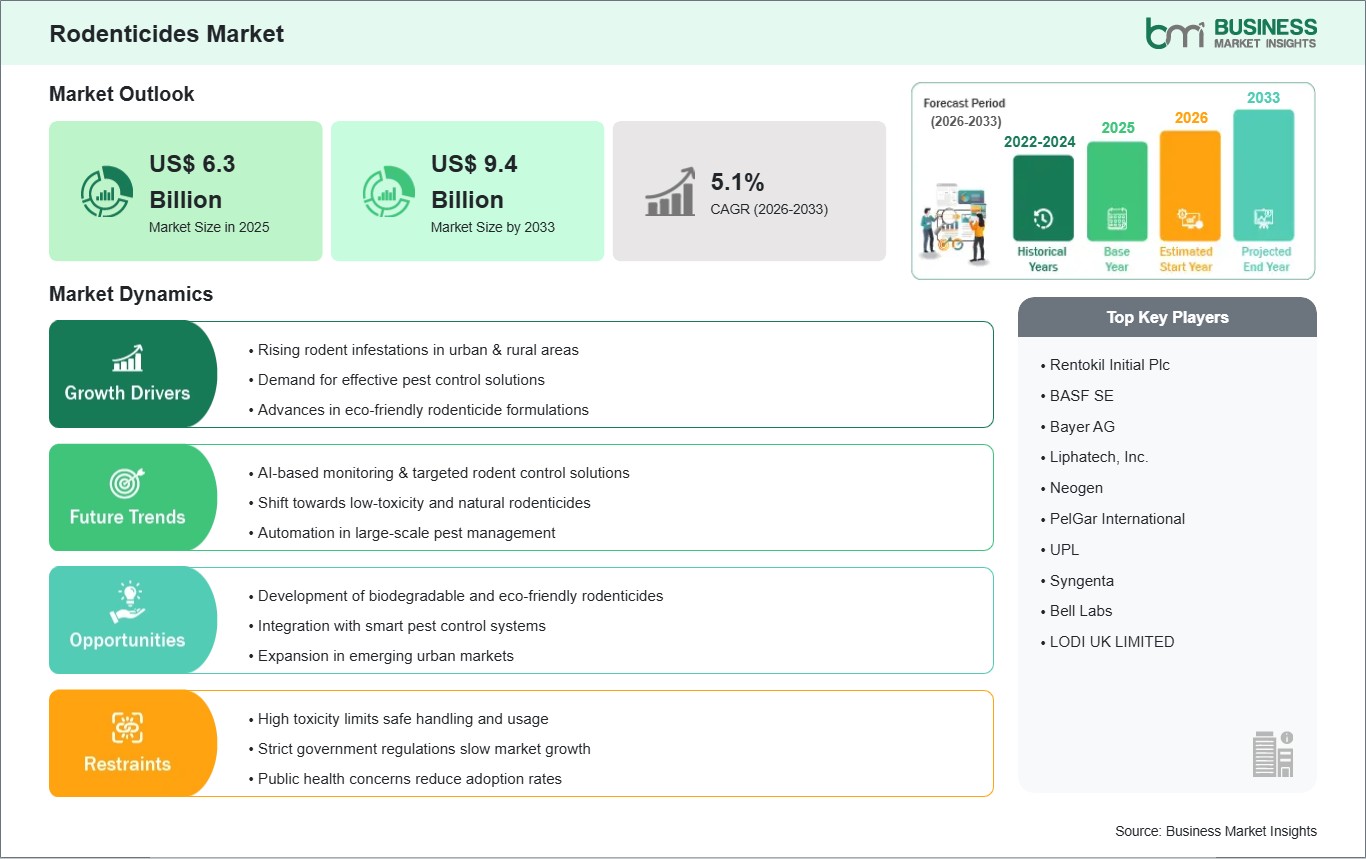
Rodenticides are specialized biocidal chemicals and baits formulated to eliminate pest rodents, including rats, mice, and squirrels. These agents function through various physiological mechanisms, such as anticoagulation, neurotoxicity, or hypercalcemia, to protect public health, agricultural yields, and infrastructure from the damage and disease transmission associated with rodent infestations. Rodenticides market provides the essential pest-control infrastructure for urban hygiene and food security, encompassing anticoagulants (first and second-generation) and non-anticoagulants (zinc phosphide, bromethalin, cholecalciferol). These products offer critical advantages, including high efficacy in high-density infestations, varied delivery formats like pellets and weather-resistant blocks, and the ability to mitigate massive post-harvest losses in agricultural storage. Growth is driven by rapid global urbanization, the rising prevalence of rodent-borne diseases (e.g., leptospirosis and hantavirus), and the expansion of the global warehousing and e-commerce sectors. Additionally, the integration of AI-driven "smart" bait stations is fundamentally enhancing the precision of monitoring and reducing non-target exposure.
However, several challenges can restrain market growth: stringent environmental regulations and bans on specific second-generation anticoagulants (SGARs) due to secondary poisoning risks in wildlife pose a constant compliance hurdle. Rising physiological resistance in rodent populations to traditional active ingredients necessitates continuous, costly R&D for novel formulations. Furthermore, the industry faces constraints due to growing public concern over chemical toxicity and a persistent technical gap in implementing Integrated Pest Management (IPM) strategies that balance chemical use with mechanical exclusion. Despite these hurdles, the market holds immense opportunities in the universal mandate for sustainable food supply chains and the accelerating development of eco-friendly, bio-based rodenticides. The expansion of fertility-control agents (contraceptive baits) and the transition toward IoT-enabled real-time pest analytics are expected to create significant opportunities for market growth.
Segment Analysis
Rodenticides Market Segmentation
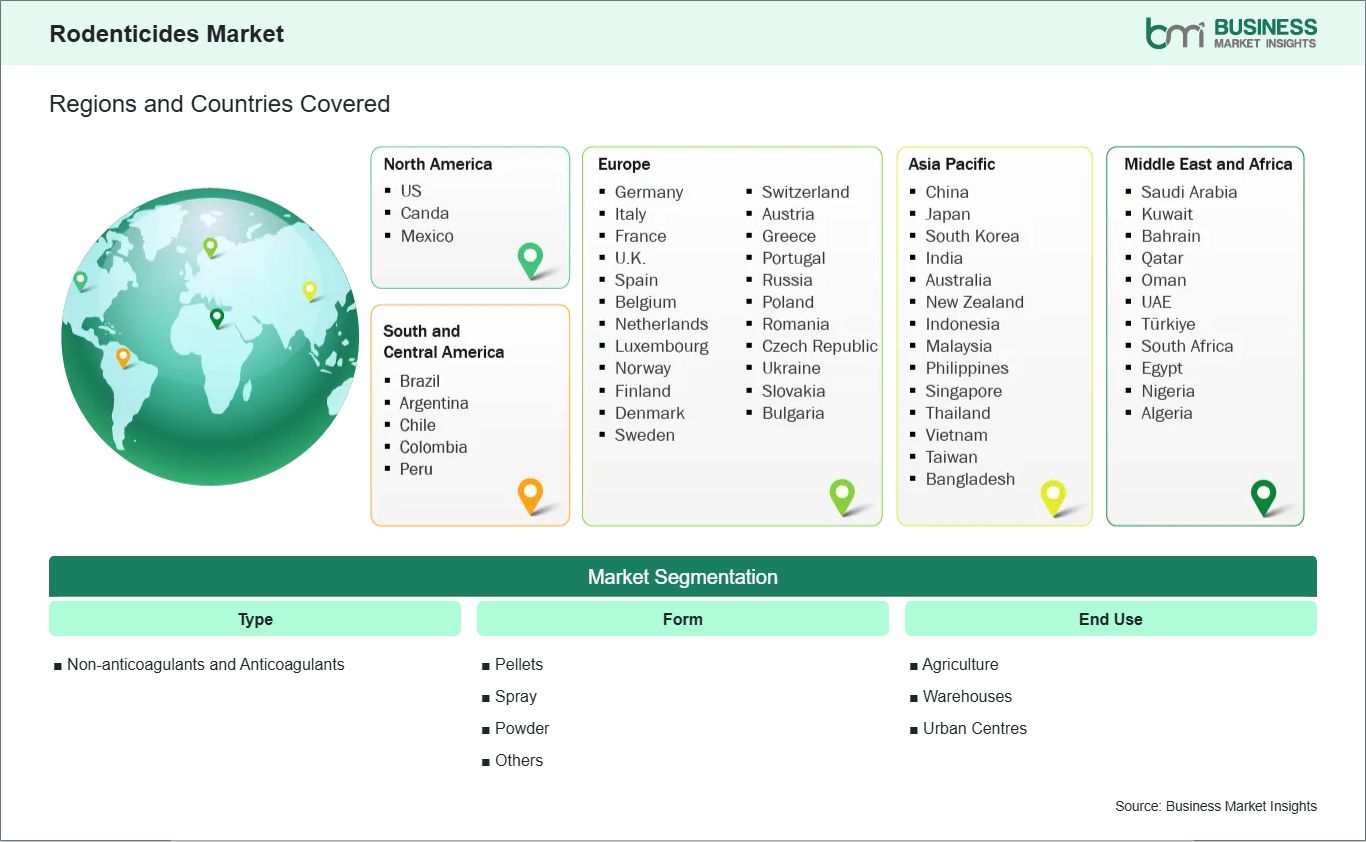
Key segments that contributed to the derivation of the Rodenticides market analysis are type, form, and end use.
- By Type, the market is bifurcated into Non-anticoagulants and Anticoagulants.
- By Form, the market is segmented into Pellets, Spray, Powder, and Others.
- By End Use, the market is segmented into Agriculture, Warehouses, and Urban Centres.
Market Forces
Rodenticides Market Drivers and Opportunities
Surge in Urbanization, Climate Shifts, and Food Security
As cities expand and create more waste, animals like rats and mice are forced out of their natural homes into busy neighborhoods and business districts. This change has led to more infestations. Warmer winters and longer growing seasons have also caused rodents to breed more often and become more active. Rodents are not only a city problem; they also threaten global food supplies by eating and contaminating an estimated 20 to 30 million tons of food grains each year. Growing concern about diseases spread by rodents, such as leptospirosis, hantavirus, and salmonellosis, has led governments to require stricter hygiene and public health rules. This regulatory environment, combined with the need to protect high-value agricultural assets and complex warehousing infrastructure, ensures a steady and growing demand for effective, large-scale rodent control solutions across both developed and emerging economies.
Emergence of Smart Monitoring and Bio-Based Formulations
The shift toward "smart cities" has created a demand for connected traps and sensors that provide real-time data on rodent activity, allowing for targeted, data-driven applications that reduce the unnecessary use of chemicals. This technological leap coincides with a massive market opening for eco-friendly and bio-based rodenticides. As stringent regulations, such as those from the EPA and ECHA, increasingly restrict the use of second-generation anticoagulants due to risks of secondary poisoning in wildlife, there is a burgeoning demand for non-toxic alternatives like cholecalciferol, corn-based baits, and cellulose-based formulations. Manufacturers who innovate in high-palatability, moisture-resistant baits that minimize non-target exposure are positioned to capture the rapidly growing segment of environmentally conscious consumers and commercial food processors. Additionally, the expansion of the hospitality and pharmaceutical sectors in Asia Pacific presents lucrative growth paths for specialized, low-residue rodent control services that align with the rigorous global standards of Integrated Pest Management (IPM).
Size and Share Analysis
Rodenticides Market Size and Share Analysis
The Rodenticides market demonstrates steady growth, with size and share analysis revealing evolving trends and competitive positioning among key players. The report further examines subsegments categorized within type, form, and end use, offering insights into their contribution to overall market performance.
For instance, the Anticoagulants subsegment holds a substantial position in the market due to its proven efficacy and "painless" mode of action. These chemicals, particularly second-generation anticoagulants (SGARs) like brodifacoum, are highly effective as single-dose treatments. However, this segment is facing increasing pressure from new environmental policies, such as California’s Poison-Free Wildlife Act, designed to mitigate the risk of secondary poisoning in non-target animals. As a result, there is a renewed interest in first-generation anticoagulants and "third-generation" innovations that offer shorter half-lives to balance efficacy with ecological safety.
Report Coverage
Rodenticides Market Report Coverage and Deliverables
The Rodenticides Market Size and Forecast (2022–2033) report provides a detailed analysis of the market covering below areas:
- Rodenticides market size and forecast at global, regional, and country levels for all the key market segments covered under the scope
- Rodenticides market trends, as well as market dynamics such as drivers, restraints, and key opportunities
- Rodenticides market analysis covering key market trends, global and regional framework, major players, regulations, and recent market developments
- Industry landscape and competition analysis covering market concentration, heat map analysis, prominent players, and recent developments for the Rodenticides market
- Detailed company profiles, including SWOT analysis
Geographic Insights
Rodenticides Market Geographic Insights
The geographical scope of the Rodenticides market report is divided into five regions: North America, Asia Pacific, Europe, Middle East & Africa, and South & Central America.
The Asia-Pacific Rodenticides Market is segmented into China, Japan, South Korea, India, Australia, New Zealand, Indonesia, Malaysia, the Philippines, Singapore, Thailand, Vietnam, Taiwan, Bangladesh, and the Rest of Asia. The market is primarily driven by the region's massive agricultural output and the severe economic impact of rodents, which are responsible for significant annual crop losses and food contamination across Asia.
Growth is further bolstered by the rising demand for Integrated Pest Management (IPM) solutions and a shift toward non-anticoagulant and eco-friendly formulations (such as cholecalciferol) to reduce secondary poisoning of wildlife. The expansion of the hospitality and tourism sectors in Southeast Asia, alongside increasing public health awareness following the pandemic, solidifies Asia-Pacific as the primary hub for rodenticide innovation and volume growth.
Industry Activity
Recent Developments
The Rodenticides market is evaluated by gathering qualitative and quantitative data post primary and secondary research, which includes important corporate publications, association data, and databases. A few of the key developments in the Rodenticides market are:
- In March 2024, Bell Laboratories launched CAD3ET™ All-Weather BLOX®, a rodenticide that combines proven palatability and weatherability to eliminate rodent infestations wherever they are. Containing the active ingredient cholecalciferol, or vitamin D3, the 20g BLOX are ideal for sensitive accounts and regions. This new D3 formulation is durable, weatherable, and resists mold and moisture, so it can be used indoor and outdoor environments.
- In May 2025, Syngenta and Neogen Corporation entered into a strategic licensing and supply agreement for Talon-G and Talon Weatherblok XT rodenticides, granting Neogen exclusive rights to market and sell these products in the United States and Canada. Under this agreement, Neogen will leverage its commercial and technical expertise to lead the promotion and distribution of these established products. Syngenta will focus more on its long-term vision of bringing new, innovative pest control technologies to market.
Trust & Transparency
Research Methodology
The market analysis combines proprietary research with secondary data from government agencies, company disclosures, regulatory filings, industry databases and expert interviews. Market estimates are validated through data triangulation, cross-market benchmarking and analyst
review.
View Full Research Methodology
Key Sources Referred:
World Bank – Global Trade IndicatorsWorld Trade Organization (WTO)International Monetary Fund (IMF)International Trade Administration (ITA)Company WebsitesCompany Annual ReportsCompany Investor Presentations