Market Summary
Executive Summary and Global Market Analysis
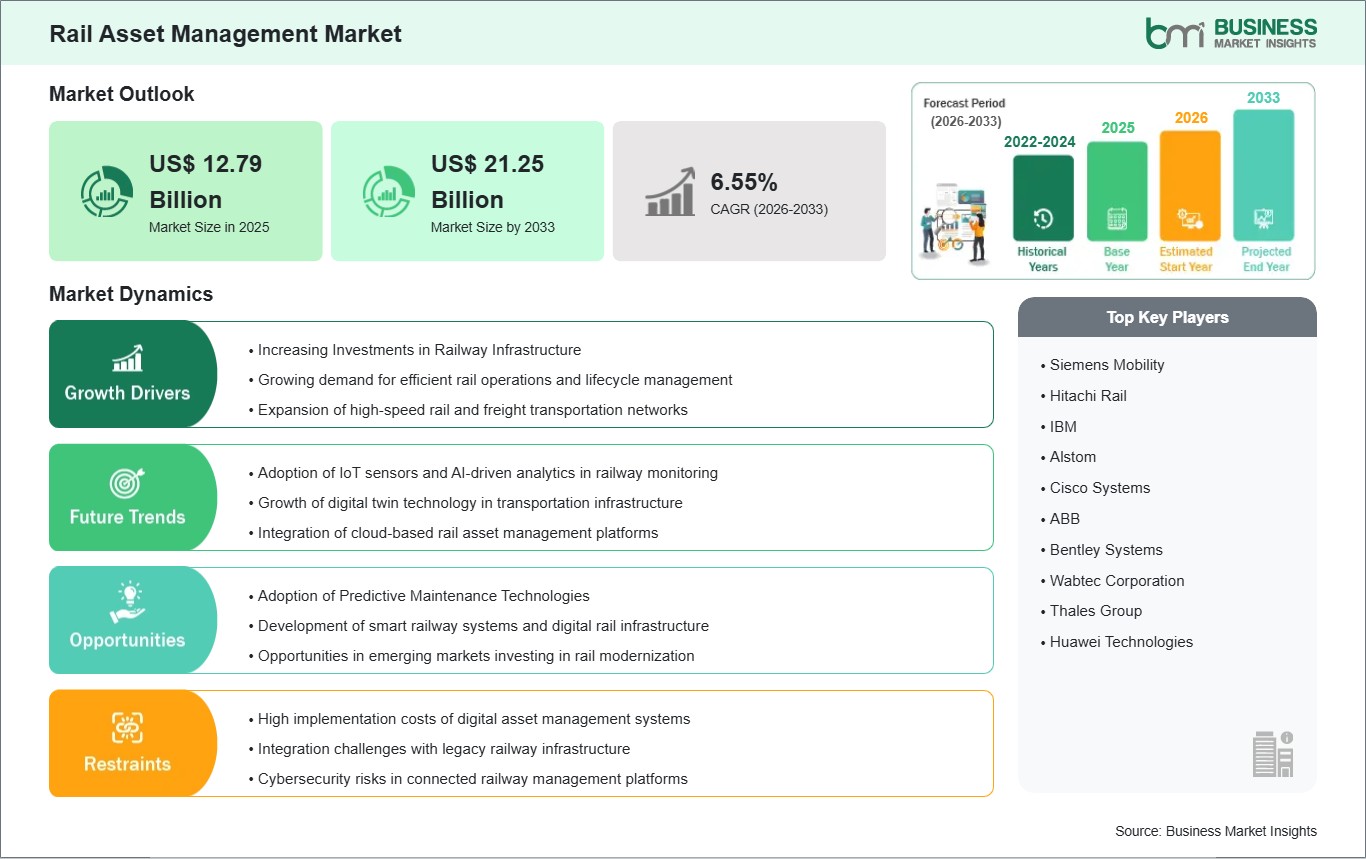
The global rail asset management market is experiencing steady growth as railway operators and infrastructure authorities focus on improving operational efficiency, safety, and cost management. Rail asset management systems monitor, maintain, and optimize the lifecycle of railway assets such as rolling stock, tracks, signaling systems, and supporting infrastructure, enabling enhanced asset reliability, reduced maintenance costs, and uninterrupted rail operations.
Technological advancements including Internet of Things (IoT) sensors, predictive analytics, artificial intelligence, and cloud computing are transforming rail asset management practices by enabling real-time monitoring of asset performance.
The shift toward digital railway systems and smart transportation infrastructure is accelerating the adoption of advanced asset management platforms, supporting centralized monitoring and data-driven strategic decision-making.
Segment Analysis
Rail Asset Management Market Segmentation
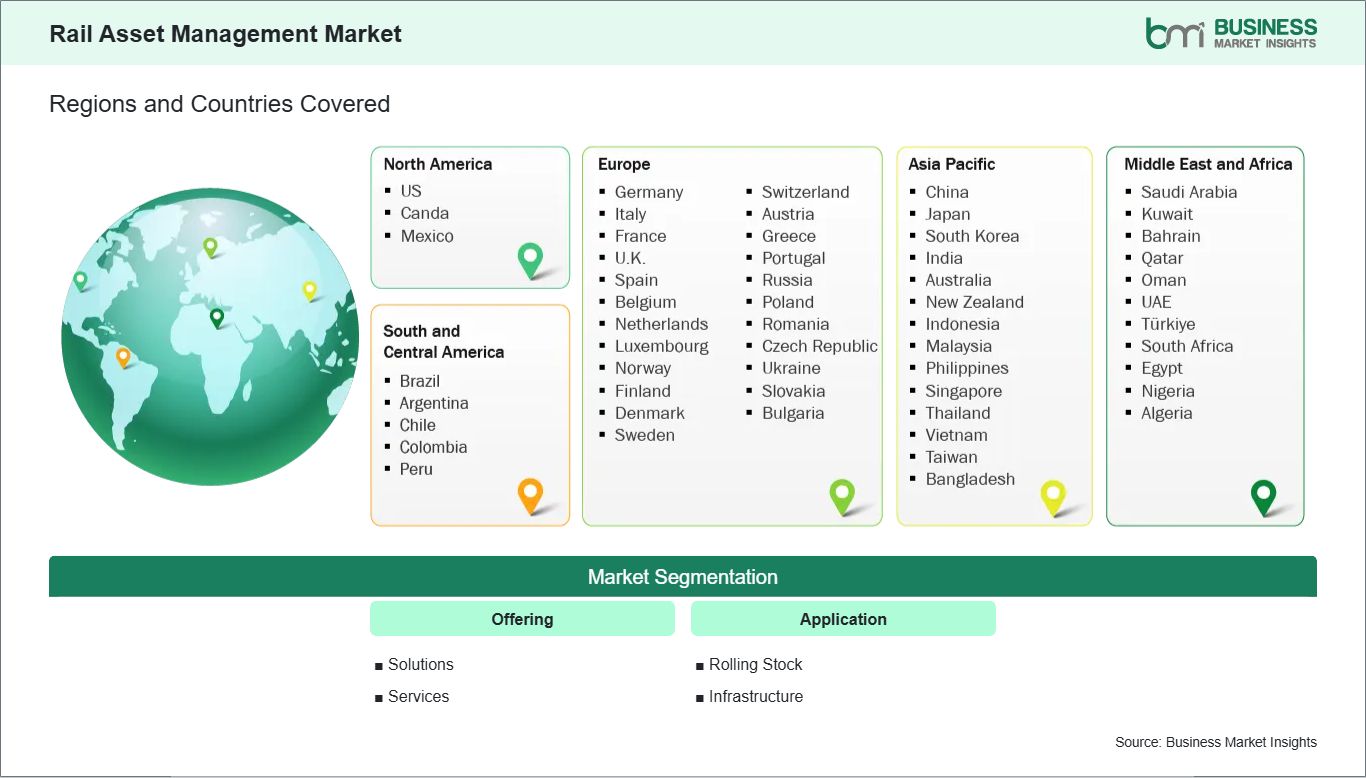
Key segments that contributed to the derivation of the rail asset management market analysis are offering and application.
- By offering, the rail asset management market is segmented into solutions and services. The solutions segment dominated the market in 2025.
- In terms of application, the rail asset management market is segmented into rolling stock and infrastructure. The infrastructure segment dominated the market in 2025.
Market Forces
Rail Asset Management Market Drivers and Opportunities
Increasing Investments in Railway Infrastructure
Governments worldwide are investing significantly in railway infrastructure to support economic growth, urban mobility, and sustainable transportation. Rail networks are expanding to meet rising passenger and freight demand, driving demand for advanced rail asset management solutions.
Railway operators focus on extending asset lifecycles and minimizing operational disruptions. Asset management systems enable real-time monitoring of tracks, signaling systems, and other infrastructure, allowing proactive maintenance planning and optimized investments.
Adoption of Predictive Maintenance Technologies
Predictive maintenance solutions use advanced analytics and sensor technologies to monitor assets continuously, detect early signs of wear, and schedule proactive maintenance. This approach reduces unplanned downtime, extends asset lifespans, and enhances safety. As digital technologies evolve, predictive maintenance is becoming a core component of rail asset management strategies worldwide.
Size and Share Analysis
Rail Asset Management Market Size and Share Analysis
The Rail Asset Management Market demonstrates steady growth, with size and share analysis highlighting evolving trends and competitive dynamics among key players. The report examines subsegments categorized within offering and application, offering insights into their contribution to overall market performance.
By offering, the solutions segment dominated the market in 2025, reflecting the increasing deployment of digital platforms for asset monitoring and maintenance management.
In tgerms of application, the infrastructure segment dominated the market in 2025, driven by large-scale investments in railway track upgrades, signaling systems, and station modernization projects.
Report Coverage
Rail Asset Management Market Report Coverage and Deliverables
The "Rail Asset Management Market Size and Forecast (2022 - 2033)" report provides a detailed analysis of the market covering below areas:
- Rail Asset Management Market size and forecast at global, regional, and country levels for all the key market segments covered under the scope
- Rail Asset Management Market trends, as well as drivers, restraints, and opportunities
- Rail Asset Management Market analysis covering key trends, global and regional framework, major players, regulations, and recent developments
- Industry landscape and competition analysis covering market concentration, heat map analysis, prominent players, and recent developments for the Rail Asset Management Market
- Detailed company profiles, including SWOT analysis
Geographic Insights
Rail Asset Management Market Geographic Insights
The geographical scope of the Rail Asset Management Market report is divided into North America, Asia Pacific, Europe, Middle East & Africa, and South & Central America. North America held the largest share in 2025.
North America also represents a key market supported by the modernization of freight rail networks and growing investments in smart transportation infrastructure. Railway operators in the region are adopting digital asset management platforms to improve operational performance and reduce maintenance costs.
Europe also dominates the rail asset management market due to its extensive railway infrastructure and strong focus on railway modernization initiatives. Countries such as Germany, France, and the United Kingdom are investing heavily in digital rail systems and predictive maintenance technologies to enhance network efficiency and reliability. Asia Pacific is expected to witness significant growth during the forecast period, driven by rapid railway network expansion and increasing investments in high-speed rail projects in countries such as China, India, and Japan. Governments in the region are adopting advanced asset management solutions to support the efficient operation of expanding rail networks.
Emerging markets in Latin America and the Middle East & Africa are gradually adopting rail asset management solutions as governments invest in transportation infrastructure development and railway modernization projects.
Industry Activity
Recent Developments
The Rail Asset Management Market is evaluated by gathering qualitative and quantitative data post primary and secondary research, which includes important corporate publications, association data, and databases. A few of the key developments in the rail asset management market are:
- In September 2025, Siemens Mobility introduced an advanced digital rail asset management platform designed to improve predictive maintenance capabilities and optimize railway infrastructure operations.
- In May 2025, Hitachi Rail announced the expansion of its digital asset management solutions portfolio aimed at improving lifecycle management and operational efficiency for railway networks.
Trust & Transparency
Research Methodology
The market analysis combines proprietary research with secondary data from government agencies, company disclosures, regulatory filings, industry databases and expert interviews. Market estimates are validated through data triangulation, cross-market benchmarking and analyst
review.
View Full Research Methodology
Key Sources Referred:
International Union of Railways (UIC)World Bank GroupOrganisation for Economic Cooperation and Development (OECD)International Transport Forum (ITF)International Energy Agency (IEA)