
Radiotherapy Market Outlook: Size, Share, Trends, Growth Analysis, Competitive Landscape & Forecast, 2026-2033

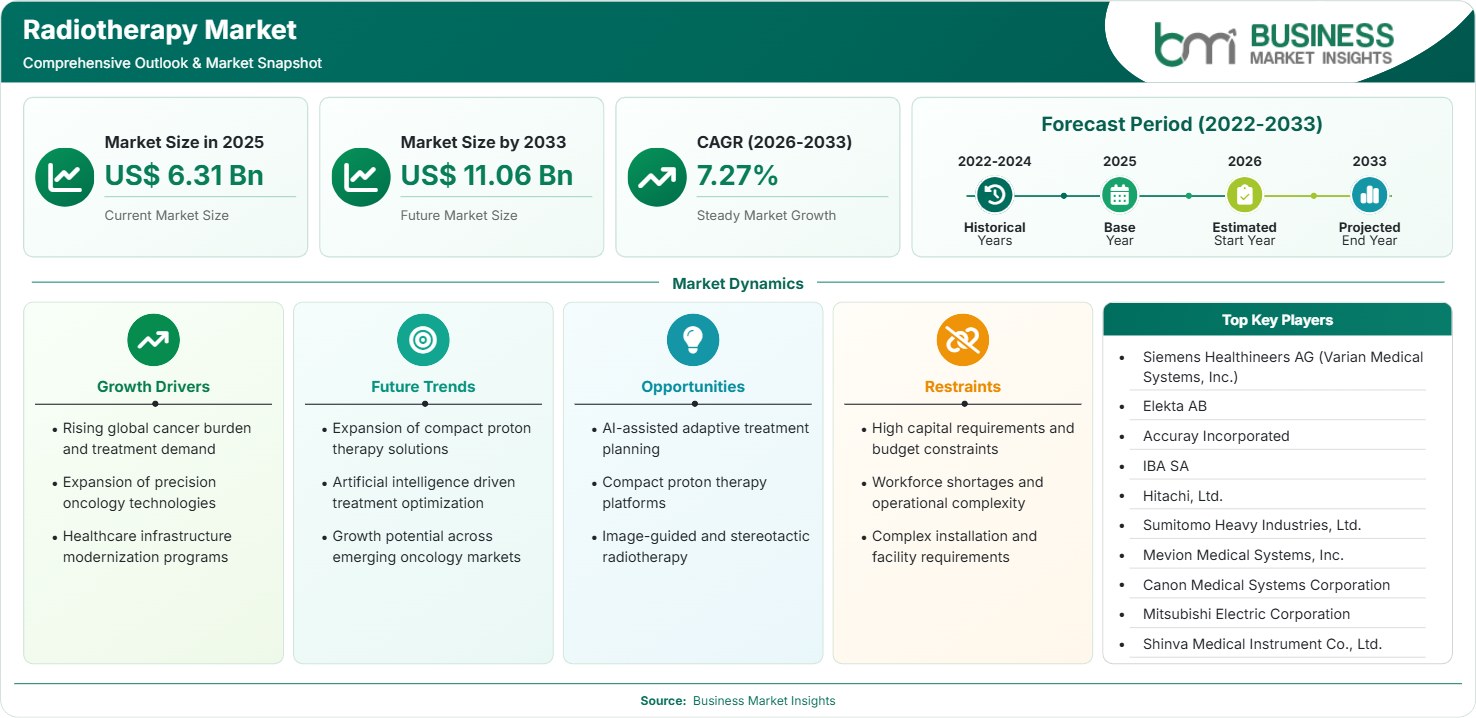
The Radiotherapy Market size was valued at US$ 6.31 Billion in 2025 and is projected to reach US$ 11.06 Billion by 2033, growing at a CAGR of 7.27% during 2026–2033, driven by rising cancer incidence, precision oncology adoption, proton therapy expansion, AI-enabled treatment planning, and investments in advanced radiation infrastructure worldwide.

Report Coverage
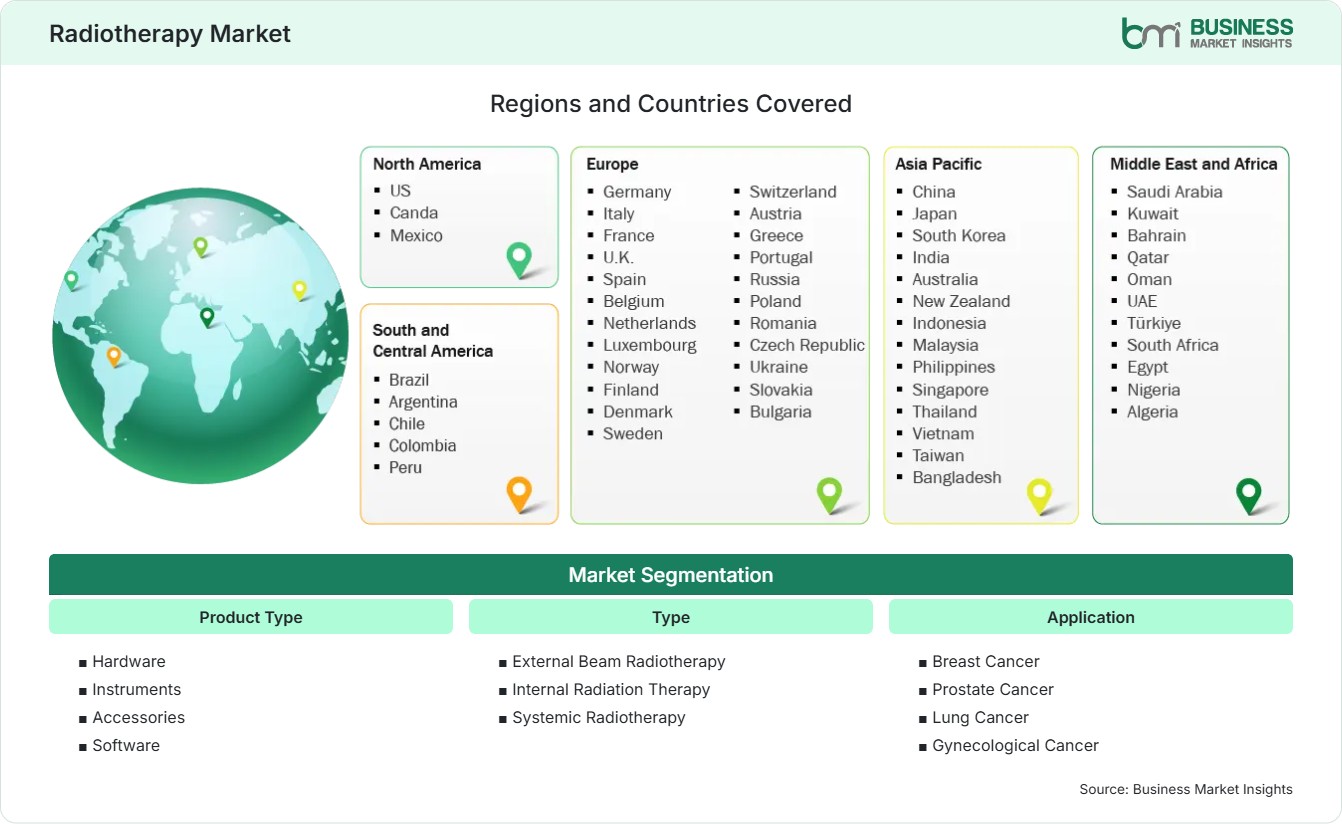
  • Product Type: Hardware, Instruments, Accessories, Software
  • Type: External Beam Radiotherapy, Internal Radiation Therapy, Systemic Radiotherapy
  • Application: Breast Cancer, Prostate Cancer, Lung Cancer, Gynecological Cancer
US$ 6.31 Bn Market size in 2025
US$ 11.06 Bn Market Size by 2033
7.27% CAGR, 2026 - 2033
2026-2033 Forecast Period

AI Overview

Radiotherapy Market Summary

  • North America Region: North America holds a market share of 37%–40% in 2025, growing at a CAGR of 6.5%–7.0% during 2026–2033, supported by cancer center modernization, reimbursement support, adaptive radiotherapy adoption, proton therapy investments, precision oncology integration, AI-enabled planning tools, treatment workflow automation, and replacement demand for aging systems. Brief U.S. market analysis: The U.S. remains the regional leader owing to extensive oncology infrastructure and advanced equipment deployment, expanding at 6.7%–7.2% CAGR.
  • Fastest Growing Region: Asia Pacific holds a market share of 24%–27% in 2025, growing at a CAGR of 8.5%–9.2% during 2026–2033, supported by expanding cancer burden, hospital investments, domestic manufacturing capabilities, government funding initiatives, growing proton centers, medical tourism demand, workforce development programs, and improving accessibility.
  • Leading Segment: External Beam Radiotherapy holds a market share of 68%–72% in 2025, growing at a CAGR of 7.0%–7.5% during 2026–2033, driven by widespread clinical acceptance, treatment precision improvements, image-guided technologies, workflow efficiency, favorable reimbursement pathways, advanced LINAC installations, and expanding oncology capacities.
  • High Growth Segment: Particle Therapy holds a market share of 12%–15% in 2025, growing at a CAGR of 9.5%–10.5% during 2026–2033, supported by superior dose conformity, pediatric treatment advantages, expanding proton facilities, technology innovation, clinical evidence development, government backing, academic collaborations, and specialist center investments.
  • Key Market Opportunity: Expansion of compact proton therapy platforms, AI-assisted adaptive treatment planning, and radiotherapy network development across underserved regions creates scalable opportunities for providers, equipment vendors, software developers, and investors worldwide.
  • Major Market Players: Siemens Healthineers AG (Varian Medical Systems, Inc.), Elekta AB, Accuray Incorporated, IBA SA, Hitachi, Ltd., Sumitomo Heavy Industries, Ltd., Mevion Medical Systems, Inc., Canon Medical Systems Corporation, Mitsubishi Electric Corporation, and Shinva Medical Instrument Co., Ltd.
Strategic Insights

Radiotherapy Market: Strategic Insights

Radiotherapy Market Strategic Framework
FREE PDF
Request your free sample
Request free sample
Stakeholder View

Key Takeaways

  • The value chain is increasingly integrated, with hardware manufacturers, software developers, imaging providers, and oncology centers collaborating to improve treatment precision and operational efficiency.
  • Particle therapy and advanced breast, prostate, and lung cancer treatment applications offer substantial upside due to growing clinical evidence and healthcare investment.
  • Innovation is shifting toward adaptive radiotherapy, AI-based contouring, real-time imaging guidance, and automated treatment planning that reduce clinician workload.
  • Asia Pacific presents the strongest long-term investment potential due to infrastructure expansion, growing cancer incidence, and favorable healthcare modernization programs.
  • Strategic acquisitions, technology partnerships, and oncology platform integration remain central competitive strategies among established vendors and specialist providers.
  • Growing demand for outpatient cancer treatment and decentralized care models is encouraging development of compact, efficient treatment systems.
Geographic Outlook

Radiotherapy Market Regional Highlights

North America Radiotherapy Market

North America accounts for approximately 37%–40% of the Radiotherapy Market share in 2025 and is projected to expand at a CAGR of 6.5%–7.0% through 2033. Regional leadership stems from advanced oncology infrastructure, strong reimbursement systems, early technology adoption, and ongoing replacement demand for legacy radiation equipment. The concentration of comprehensive cancer centers, substantial oncology expenditures, and increasing implementation of adaptive treatment technologies support market expansion across the United States and Canada.

  • AI-enabled treatment planning platforms are improving workflow efficiency and helping providers address workforce shortages while maintaining treatment quality standards.
  • Proton therapy investments continue across academic and specialty centers, expanding access to highly targeted therapies for complex and pediatric oncology cases.
  • Demand for image-guided and stereotactic procedures is increasing as providers pursue precision-focused treatment pathways with shorter treatment schedules.
  • Strategic collaborations among equipment manufacturers and healthcare providers accelerate technology deployment and clinical innovation.

US Radiotherapy Market

The United States represents around 82%–86% of regional revenue and is expected to grow at a CAGR of 6.7%–7.2% during 2026–2033. Strong oncology spending, favorable reimbursement frameworks, and a high installed base of advanced treatment systems underpin expansion. Research institutions and leading cancer centers continue adopting adaptive and AI-assisted therapies, supporting technological advancement and clinical outcomes.

  • Major cancer centers increasingly integrate imaging, planning, and treatment systems into unified oncology workflows.
  • Expanding proton therapy networks strengthen access for pediatric and difficult-to-treat tumor indications.
  • Value-based healthcare initiatives encourage operational efficiency and optimized treatment planning processes.
  • Continued equipment replacement supports recurring demand for advanced radiation platforms.

Europe Radiotherapy Market

Europe captures 28%–31% market share in 2025 and is forecast to register a CAGR of 6.8%–7.4% through 2033. Strong public healthcare systems, mature oncology services, and favorable cancer-care policies support sustained adoption. Germany remains the leading national market, while Central and Eastern European countries demonstrate faster development as infrastructure investment accelerates.

  • Germany leads regional adoption through extensive cancer treatment capacity and ongoing equipment modernization initiatives.
  • The United Kingdom and France emphasize precision oncology and digital health integration within cancer-care pathways.
  • Poland and other Eastern European countries are among higher-growth territories, supported by infrastructure funding programs.
  • Research collaboration strengthens adoption of adaptive radiotherapy and advanced treatment planning technologies.

Asia Pacific Radiotherapy Market

Asia Pacific holds a 24%–27% share in 2025 and records the highest CAGR of 8.5%–9.2% through 2033. Rising cancer incidence, healthcare expansion, and public investment in oncology infrastructure support regional acceleration. China leads the market by scale, while India and Southeast Asian countries exhibit strong growth potential due to expanding treatment accessibility and healthcare modernization.

  • China continues investing in domestic manufacturing and large-scale oncology infrastructure projects.
  • India records strong expansion supported by private healthcare investments and increasing cancer treatment demand.
  • Japan remains a major technology adopter with extensive utilization of advanced radiation modalities.
  • Growing medical tourism supports installation of sophisticated treatment systems across selected regional markets.
  • Workforce training initiatives help improve utilization of complex radiation technologies.

Rest of World Radiotherapy Market

The Rest of World segment holds 8%–10% of the market share by 2025 and is estimated to grow at a CAGR of 7.5%–8.3% during 2024-2033. Expanding private healthcare systems boost the market potential of South and Central America, whereas the Middle East and Africa markets see a push owing to oncology-specific investments, healthcare diversification programs, and infrastructure development initiatives.

  • Brazil remains the leading Latin American market, supported by growing oncology treatment capacity.
  • Mexico experiences rising adoption of advanced radiation systems across private healthcare institutions.
  • Saudi Arabia and the UAE are key Middle Eastern growth markets driven by healthcare transformation strategies.
  • Public-private partnerships accelerate access to specialized cancer treatment services.
  • Increasing awareness supports earlier cancer diagnosis and treatment referrals.
Global Market Geography
FREE PDF
Request your free sample
Request free sample
Segment Analysis

Radiotherapy Market Segmentation

Product Type

Hardware remains the major player, holding a market share of 72% to 76% in 2025 and growing at a CAGR of 7.0% to 7.6%. This market will be fueled by the installation of sophisticated treatment technologies, modernization activities, and an increasing patient population. The Radiotherapy Market scope continues to widen with the inclusion of software intelligence.

  • Hardware: Core revenue contributor supported by replacement cycles, infrastructure investments, and expanding treatment capacities globally.
  • Instruments:
    • Linear Accelerators (LINACs): Most widely deployed systems due to versatility, precision, and suitability across multiple cancer indications.
    • Proton Therapy Systems: Adoption rises as providers pursue targeted treatment capabilities and reduced collateral tissue exposure.
    • Carbon Ion Therapy Systems: Specialist technology gaining attention for resistant tumors and advanced oncology applications.
  • Accessories: Support operational efficiency, safety, quality assurance, and treatment workflow optimization.
  • Software: Increasingly important for adaptive planning, AI-driven contouring, workflow management, and treatment analytics.

Type

External Beam Radiotherapy is projected to have a 68%-72% market share by 2025, with a CAGR of 7.0%-7.5%. Knowledge of clinical practices, applications, and ongoing technological advancements has influenced its use. The Radiotherapy Market trends show a bias towards more accurate treatment techniques that enhance patient outcomes and improve operational efficiency.

  • External Beam Radiotherapy:
    • Photon-based EBRT: Widely utilized across major cancer types because of established clinical evidence and accessibility.
    • Particle Therapy: Experiences strong momentum due to superior dose distribution and expanding specialist treatment centers.
  • Internal Radiation Therapy (Brachytherapy):
    • High-dose rate brachytherapy: Preferred for precision-focused delivery and efficient treatment scheduling.
    • Low-dose rate brachytherapy: Maintains relevance across selected prostate and gynecological indications.
  • Systemic Radiotherapy: Expands through targeted radiopharmaceutical innovation and personalized treatment approaches.

Application

The demand for cancer treatment is continually driving its use across various indications. The sector demonstrates the growing trend towards personalized oncological pathways, comprehensive treatment planning, and multidisciplinary treatment. Breast and prostate cancer indications contribute to a significant volume of treatments, whereas lung cancer indications demonstrate rapid development.

  • Breast Cancer: Strong utilization supported by high diagnosis rates and established radiation treatment protocols.
  • Prostate Cancer: Advanced imaging and precision treatment approaches continue improving therapeutic outcomes.
  • Lung Cancer: Adoption benefits from stereotactic techniques enabling highly focused treatment delivery.
  • Gynecological Cancer: Brachytherapy and external beam combinations remain central therapeutic approaches.
Market Forces

Radiotherapy Market Dynamics

Key Market Drivers

Rising Global Cancer Burden and Treatment Demand

According to the WHO, cancer is believed to be one of the most common causes of death globally, providing constant demand for advanced treatment capabilities. Increased rates of breast, lung, prostate, and colorectal cancers increase the application of radiotherapy treatments. The radiotherapy market can benefit from its contribution to the multidisciplinary approach to cancer treatment when radiotherapy is included in treatment protocols for a substantial proportion of cancer cases. Better screening practices and early diagnosis allow increasing the number of treatable patients, while creating new demands for more precise treatments.

Expansion of Precision Oncology Technologies

The advent of precision oncology technology is revolutionizing the field of radiation oncology by increasing treatment accuracy and efficiency and improving patient health outcomes. With enhanced tumor visualization, monitoring of treatment changes, and personalized treatment through advanced imaging integration, adaptive treatment planning, and AI workflow automation, it becomes easier to ensure successful treatment. Image-guided radiation therapy (IGRT), stereotactic radiosurgery (SRS), stereotactic body radiotherapy (SBRT), and adaptive radiotherapy are among the leading technologies behind radiotherapy market growth. These innovations help reduce treatment variability, improve targeting of complex tumor sites, minimize damage to healthy tissues, and strengthen healthcare providers' confidence in delivering effective cancer care.

Healthcare Infrastructure Modernization Programs

Governments and health institutions are making massive investments in oncology infrastructure owing to the rising burden of cancer globally. The emergence of new centers for cancer treatment, the upgrading of old facilities, and the replacement of obsolete machines present an enduring buying opportunity for radiotherapy machines. Market trends in radiotherapy indicate a rise in the adoption of advanced treatment systems in developing nations, where access to quality cancer care is limited. Besides, initiatives by governments and other health institutions will help deploy technology, improve access to treatment, and drive long-term market growth.

Key Market Opportunities

Expansion of Compact Proton Therapy Solutions

Proton therapy centers developed through traditional methods require significant upfront investment to establish. The novel compact systems lessen infrastructure demands and increase the chances of implementation. For hospitals interested in offering distinctive oncological care services, such systems can be viewed as strategic investments. According to Radiotherapy Market Forecasts, commercial possibilities for such products will grow for companies capable of delivering cost-effective proton technologies, particularly in mid-sized healthcare institutions and rapidly developing healthcare markets.

Artificial Intelligence Driven Treatment Optimization

There are several ways in which artificial intelligence is revolutionizing oncology, including improved contouring, treatment planning, workflow optimization, and decision-making throughout the process. AI-based applications automate tedious tasks, thereby reducing the labor burden while increasing the accuracy and effectiveness of treatment planning. Improved analysis, prediction, and adaptive treatment planning allow healthcare providers to offer personalized treatment to their patients. Companies that combine all these features can have an edge over others. Due to rising cancer incidence and labor shortages, demand for AI-driven oncology platforms is expected to accelerate, driving innovation and improving overall treatment outcomes.

Growth Potential Across Emerging Oncology Markets

There is a significant opportunity for growth in the emerging oncology markets across Asia, the Middle East, Africa, and Latin America, driven by large populations, increased access to healthcare, and improved cancer awareness. Governments and healthcare providers are investing in oncology infrastructure, diagnostics, and capacity building. Such trends are contributing to the high demand for radiation therapy equipment, software solutions, and professional services to build clinical capability. Suppliers of equipment and technology, and providers of professional services, will help improve the accessibility of cancer care and patient outcomes.

Market Restraints and Challenges

High Capital Requirements and Budget Constraints

Advanced radiotherapy devices require substantial investments in purchase, installation, facility modifications, and maintenance. The high capital costs pose substantial financial burdens for healthcare facilities, especially in underdeveloped countries. Financial difficulties can delay decision-making on purchases and innovations in the field. Even though there is always a rising need for an appropriate treatment of cancer, the shortage of finances hinders many healthcare establishments from implementing projects associated with radiation infrastructure. This is why market penetration becomes less efficient, and patients cannot benefit from innovations related to radiation treatment methods.

Workforce Shortages and Operational Complexity

The effective implementation of sophisticated technologies in radiation oncology requires competent radiation oncologists, medical physicists, dosimetrists, and technicians. Chronic staffing shortages may reduce equipment utilization, hinder technology implementation, and limit patient access to appropriate treatment. In many developing health care systems, staffing issues lead to inefficiencies in service delivery. Besides, complex education and certification processes and high levels of technological sophistication play crucial roles in adoption and healthcare practitioners' preparedness.

Company Analysis

Competitive Landscape

Radiotherapy Market analysis shows competition centered on technological innovation, treatment precision, software integration, and global service capabilities.

Company Name

Overview

Products and Services relevant to this market

Siemens Healthineers AG (Varian Medical Systems, Inc.)

Global leader with extensive oncology ecosystem and large installed base.

TrueBeam, Halcyon, Ethos, Eclipse planning software, proton therapy solutions.

Elekta AB

Specialist radiation medicine company with broad international presence.

Versa HD, Unity MR-Linac, Gamma Knife, oncology informatics.

Accuray Incorporated

Focuses on precision radiation delivery technologies.

CyberKnife and TomoTherapy platforms, adaptive treatment tools.

IBA SA

Leading particle therapy technology provider.

Proton therapy systems, dosimetry, accelerator technologies.

Hitachi, Ltd.

Active in advanced particle therapy solutions globally.

Proton therapy systems and healthcare technology services.

Sumitomo Heavy Industries, Ltd.

Key participant in particle therapy infrastructure.

Proton beam delivery systems and accelerator technologies.

Mevion Medical Systems, Inc.

Known for compact proton therapy innovation.

Single-room proton therapy platforms and related services.

Canon Medical Systems Corporation

Healthcare technology company supporting oncology workflows.

Imaging systems integrated with radiation therapy planning.

Mitsubishi Electric Corporation

Participates in advanced medical technology development.

Radiation system components and healthcare engineering solutions.

Shinva Medical Instrument Co., Ltd.

Expanding presence in oncology equipment markets.

Radiation treatment devices and associated clinical systems.

Trust & Transparency

Research Methodology

The market analysis combines proprietary research with secondary data from government agencies, company disclosures, regulatory filings, industry databases and expert interviews. Market estimates are validated through data triangulation, cross-market benchmarking and analyst review.

View Full Research Methodology

Questions Answered

Frequently Asked Questions

Why is a Radiotherapy Market Report important for investors?

A Market Report helps investors assess technology adoption patterns, competitive positioning, regional opportunities, capital expenditure trends, and long-term oncology infrastructure demand.

Which region offers the strongest future expansion potential?

Asia Pacific provides the most compelling growth outlook due to infrastructure development, rising cancer incidence, healthcare modernization, and expanding treatment accessibility.

What factors influence equipment purchasing decisions?

Hospitals evaluate treatment capacity, clinical versatility, software integration, service support, reimbursement conditions, and long-term operating economics before procurement.

How does proton therapy differ from conventional radiation?

Proton therapy delivers radiation with improved dose conformity, potentially reducing exposure to healthy tissues and supporting treatment of complex or pediatric cases.

Which cancer types generate the greatest treatment demand?

Breast, prostate, lung, colorectal, and gynecological cancers represent major treatment volumes because radiation remains an important component of multidisciplinary oncology care.

Access the Full Radiotherapy Market Report

Get segment-level forecasts, regional estimates, competitive benchmarking, company profiles and downloadable Excel datasets.

Access the full Radiotherapy Market Report
350 pages PDF & Excel | 2026-09-02