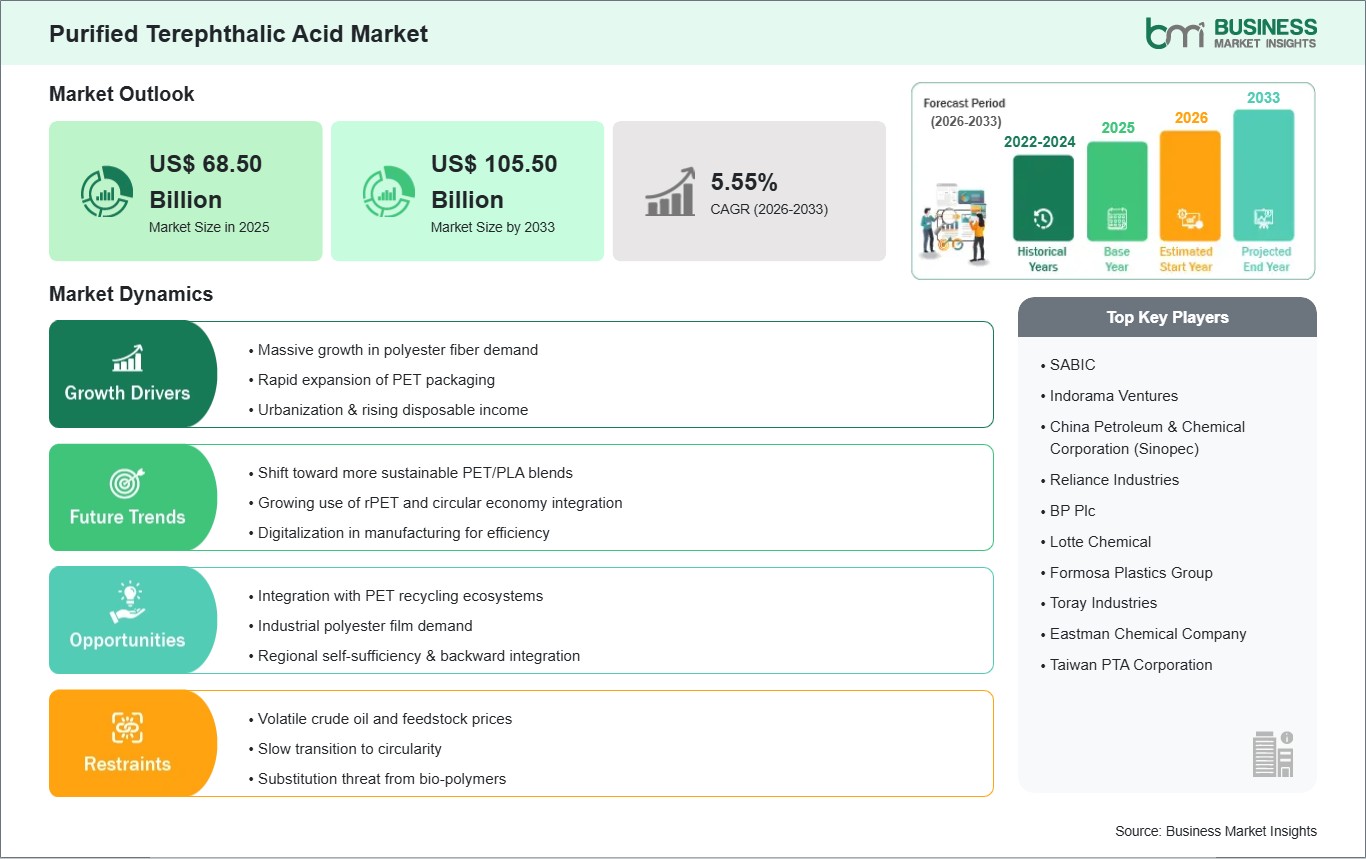
The Purified Terephthalic Acid Market size is expected to reach US$ 105.5 billion by 2033 from US$ 68.5 billion in 2025. The market is estimated to record a CAGR of 5.55% from 2026 to 2033.
The global purified terephthalic acid (PTA) market is witnessing steady growth, driven by its critical role as a raw material in the production of polyester fibers, films, and resins. PTA is a cornerstone chemical in the textile and packaging industries, underpinning the production of PET bottles, polyester fabrics, and flexible packaging materials. The increasing demand for lightweight, durable, and recyclable packaging solutions, along with the global expansion of the textile industry, is driving PTA consumption worldwide. The rise of e-commerce and packaged consumer goods has further fueled the need for polyester-based packaging, increasing the importance of PTA as a reliable feedstock.
Sustainability initiatives are also shaping the market, with manufacturers exploring more energy-efficient production techniques and bio-based alternatives to reduce environmental impact. At the same time, the market faces certain restraints. The production of PTA is energy-intensive and heavily reliant on crude oil derivatives, making it sensitive to fluctuations in raw material costs. Additionally, environmental regulations around emissions and waste management in PTA production pose operational challenges for manufacturers. Despite these constraints, continuous technological advancements in process optimization, catalyst efficiency, and downstream polyester applications are expanding the market’s scope, positioning PTA as an essential chemical in the global polyester and packaging supply chain.

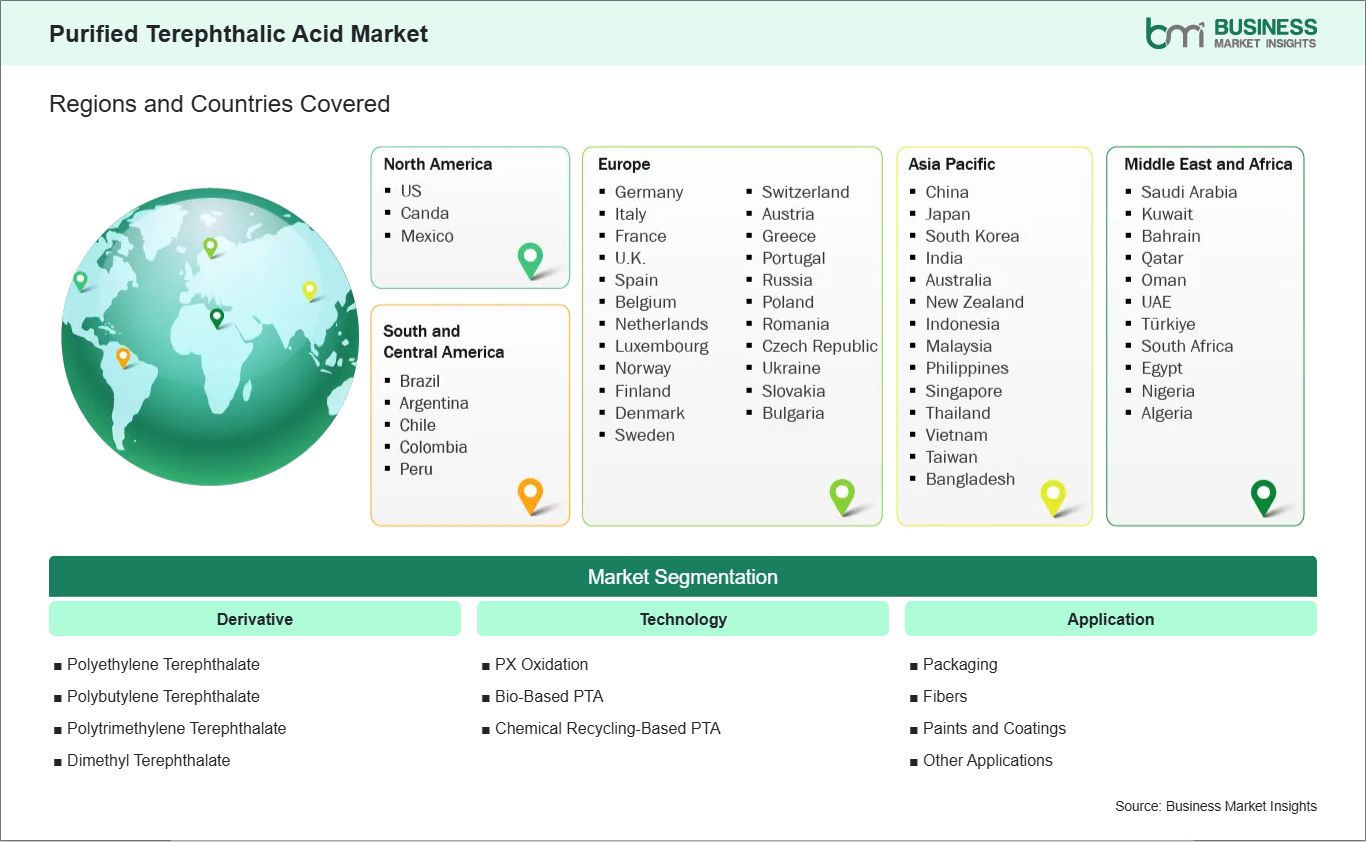
Key segments that contributed to the derivation of the purified terephthalic acid market analysis are derivative, technology and application
Western Europe’s PTA market is seeing robust growth driven by expanding polyester fiber demand across textiles, technical fabrics, and industrial applications. Apparel and athleisure sales have surged in major markets like Germany, France, and the UK, with polyester fiber content now representing more than half of total fabric use in mid‑price segment clothing. This shift is partly attributable to consumer preference for lightweight, durable, and easy‑care garments — qualities that polyester fibers deliver. As PTA is the main building block for polyethylene terephthalate (PET) and polyester, its consumption has grown accordingly; Western European PTA plant utilization rates have climbed from roughly 78% in 2019 to an estimated 87% in 2024, reflecting expanding downstream demand.
Technical textiles is another significant driver of PTA demand in Western Europe. In the region, there is an increasing tendency among Italian, Spanish, and Czech manufacturers of automotive interior parts, industrial filters, and protective clothing to use high-performance polyester fibers for their strength and resistance properties. For instance, suppliers of automotive upholstery materials in the region around Milan note that the level of demand for polyester components in interior parts has risen sharply to almost 65%, up from more than 40% only five years ago. This not only represents a further boost in PTA demand in textiles but also indicates a shift in the overall emphasis in manufacturing.
In addition, the non-apparel market for polyester in Western Europe, such as in home furnishings like curtains, bedding, and upholstery, is still in the process of expanding with urbanization and housing development. In Barcelona and Amsterdam, the sales of polyester rugs, cushions, and drapes have been rising by an average of 6% each year over the past three years, prompting local fabric makers to step up production of polyester fibers. Overall, the cumulative growth of the apparel and technical textiles market is driving the demand for PTA.
integrating it into the PET recycling chain. Countries such as Germany, the Netherlands, and Belgium have established efficient bottle-to-fiber recycling infrastructure, which collects post-consumer PET bottles and recycles the same into recycled polyester resin as well as intermediate feedstock. Sophisticated facilities in Rotterdam, the Netherlands, and Antwerp, Belgium, are now able to manufacture food-grade recycled PET as well as recycled PTA precursors, which are further fed back into the market. Not only is this approach enhancing the strength of the PTA supply chain, but it is also in line with the European Union's goal of enhancing recycled content quotas in various industries.
The use of rPET in automotive and textile products is a strong driver for the integration of the PTA ecosystem. In the region of Baden-Württemberg and the UK, major automakers have adopted interior products containing recycled polyester-based materials. This has minimized their reliance on virgin materials and has fueled growth in the recycled PTA intermediates market. It has also encouraged PTA manufacturers to directly engage in recycling partnerships and align their operations with recyclers to meet their feedstock requirements and brand sustainability targets. In Scandinavia, rPET-based textile products are actively promoted by outdoor and performance clothing brands, which has created a local market for recycled feedstocks that can be used for PTA recycling.
In addition, packaging industry developments are further driving the integration between the PTA and PET recycling sectors. Western Europe’s beverage market has set ambitious recycled content targets for PET bottles. France and Spain have set aspirational recycled content targets of 50 - 60% for PET bottles by the early 2030s. This regulatory push is driving processors to develop depolymerization technologies that can economically recycle used PET bottles to produce PTA. This trend is creating a more integrated industry where PTA producers are increasingly working with chemical recyclers to develop recycling technologies. By driving this trend towards a more integrated industry, Western Europe is creating a more circular economy that can support environmental and growth objectives.

The global Purified terephthalic acid market is experiencing steady growth, with market size and share analysis reflecting evolving treatment preferences and competitive dynamics among key players. The report evaluates important subsegments categorized within derivatives, technology, and application highlighting their respective contributions to overall market performance.
By derivative, the polyethylene terephthalate (PET) subsegment dominated the market in 2025 because it is highly versatile and in massive global demand, especially in bottled beverages, packaging films, and textile fibers. Its recyclability, lightweight nature, and strength make it the preferred derivative over PBT, PTT, or DMT, which are more niche or specialized.
By technology, the PX oxidation subsegment dominated the market in 2025 because it is well-established, highly efficient, and commercially scalable. While bio-based PTA and chemical recycling methods are emerging, they are still limited by higher costs and lower industrial adoption.
By application, the packaging subsegment dominated the market in 2025 because PET produced from PTA is widely used in bottles, films, and containers across the food and beverage, personal care, and industrial sectors. The growing demand for lightweight, durable, and recyclable packaging solutions globally drives this segment, surpassing textiles or coatings in volume.
| Report Attribute | Details |
|---|---|
| Market size in 2025 | US$ 68.50 Billion |
| Market Size by 2033 | US$ 105.50 Billion |
| Global CAGR (2026 - 2033) | 5.55% |
| Historical Data | 2022-2024 |
| Forecast period | 2026-2033 |
| Segments Covered | By Derivative
|
|
Regions and Countries Covered
| |
| North America | US, Canada, Mexico |
| Europe | Belgium, Austria, Finland, Denmark, Greece, Poland, Romania, Russia, Ukraine, Czech Republic, Slovakia, Bulgaria, Italy, Luxembourg, Germany, Switzerland, France, Netherlands, Norway, Portugal, Spain, Sweden, United Kingdom |
| Asia-Pacific | Australia, China, India, Japan, South Korea, Indonesia, Malaysia, Philippines, Singapore, Thailand, Vietnam, Bangladesh, New Zealand, Taiwan |
| South and Central America | Brazil, Argentina, Peru, Chile, Colombia |
| Middle East and Africa | Bahrain, Kuwait, Oman, Qatar, Saudi Arabia, United Arab Emirates, Turkiye, South Africa, Egypt, Algeria, Nigeria |
| Market leaders and key company profiles |
|
The "Purified Terephthalic Acid Market Size and Forecast (2022 - 2033)" report provides a detailed analysis of the market covering below areas:
The geographical scope of the Purified terephthalic acid market report is divided into: North America, Asia Pacific, Europe, Middle East & Africa, and South & Central America. North America held the largest share in 2025.
North America dominates the global PTA market due to its developed industrial infrastructure, advanced manufacturing capabilities, and high demand from the packaging and textile sectors. The United States is the primary driver, leveraging PTA for the production of PET bottles, polyester fibers, and specialty films. The region’s beverage, food packaging, and textile industries are increasingly adopting polyester-based solutions for durability, lightweight performance, and recyclability, fueling PTA demand.
North America’s market is also strengthened by technological innovation and stringent quality standards, ensuring that PTA supplied to downstream polyester manufacturers meets consistent specifications for high-performance applications. Recycling and sustainability initiatives in the region are influencing PTA use, with companies focusing on closed-loop polyester production and bio-based PTA alternatives to meet consumer and regulatory expectations. Challenges include high energy consumption in PTA production and sensitivity to crude oil price volatility, which can impact margins.
Nonetheless, North America continues to lead globally by combining strong industrial demand, innovation in production technologies, and sustainability-driven practices, reinforcing its position as the dominant PTA market with a robust downstream polyester ecosystem.

The purified terephthalic acid market is evaluated by gathering qualitative and quantitative data post primary and secondary research, which includes important corporate publications, association data, and databases. A few of the key developments in the Purified terephthalic acid market are:
The Purified Terephthalic Acid Market is valued at US$ 68.50 Billion in 2025, it is projected to reach US$ 105.50 Billion by 2033.
As per our report Purified Terephthalic Acid Market, the market size is valued at US$ 68.50 Billion in 2025, projecting it to reach US$ 105.50 Billion by 2033. This translates to a CAGR of approximately 5.55% during the forecast period.
The Purified Terephthalic Acid Market report typically cover these key segments-
The historic period, base year, and forecast period can vary slightly depending on the specific market research report. However, for the Purified Terephthalic Acid Market report:
The Purified Terephthalic Acid Market is populated by several key players, each contributing to its growth and innovation. Some of the major players include:
The Purified Terephthalic Acid Market report is valuable for diverse stakeholders, including:
Essentially, anyone involved in or considering involvement in the Purified Terephthalic Acid Market value chain can benefit from the information contained in a comprehensive market report.
Please tell us your area of interest
(Market Segments/ Regions and Countries/ Companies)