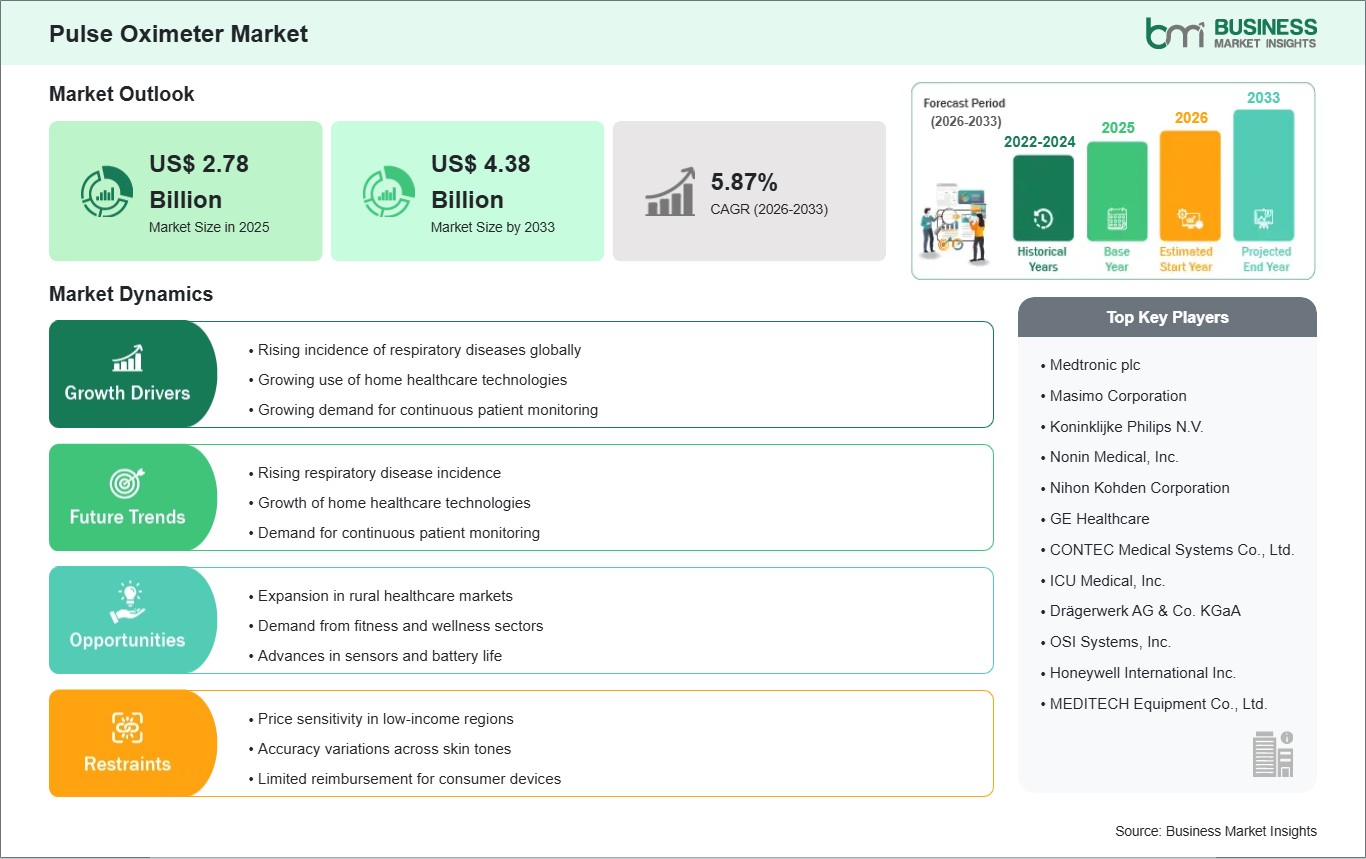
The pulse oximeters market size is expected to reach US$ 4.38 billion by 2033 from US$ 2.78 billion in 2025. The market is estimated to record a CAGR of 5.87 % from 2026 to 2033
Healthcare professionals use pulse oximeters throughout the world because these devices deliver quick non-intrusive assessments of blood oxygen levels and heart rate. The equipment serves vital purposes in various healthcare environments which include hospitals and home care facilities and ambulatory treatment centers and emergency medical organizations. The advantages of pulse oximeters include their capacity to monitor patients continuously with their user-friendly design and their ability to detect hypoxemia and respiratory distress at an early stage. The market experiences growth because respiratory disorders become more common and the elderly population increases while home healthcare device demand rises. Patient safety and monitoring effectiveness receive improvements from recent advances in wearable oximetry and wireless technology and telemedicine system integration.
The market encounters multiple obstacles which include expensive advanced device models and their limited performance during low blood flow conditions and moving situations and the complex regulatory framework which exists between different nations. Supply chain interruptions combined with unstable healthcare funding create problems for the industry. The remote patient monitoring market offers substantial possibilities which result from increasing home healthcare system development and better understanding of chronic respiratory illnesses. The global market will expand through digital health system connections and the creation of devices that monitor multiple parameters.

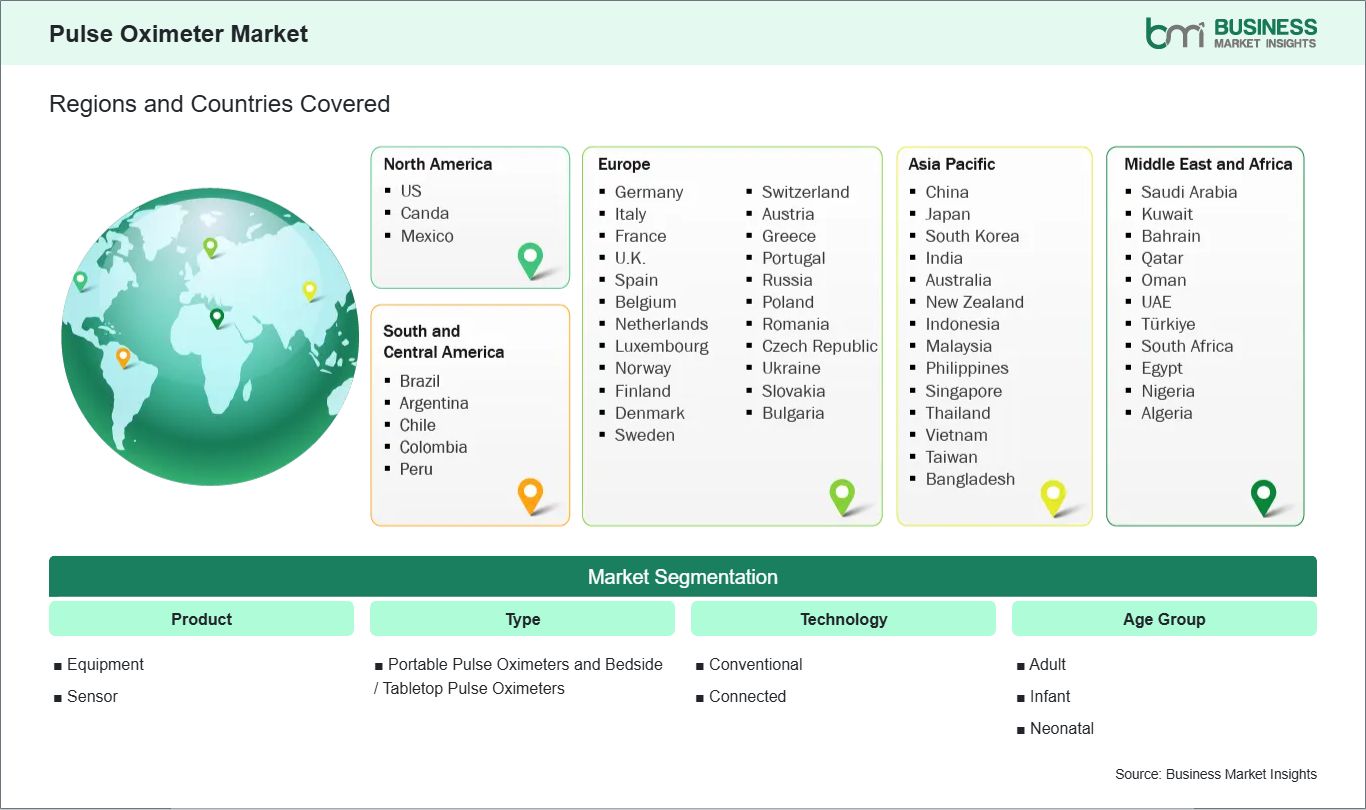
Key segments that contributed to the derivation of the pulse oximeters market analysis are Product, type, technology, age group, end user.
The global rise in respiratory diseases has created a major market opportunity for pulse oximeters which now includes COPD and asthma and COVID-19 as respiratory diseases. Healthcare providers and home-care users require dependable non-invasive devices for their medical needs because better understanding of early detection has made pulse oximeters a vital part of patient treatment. The Global Burden of Disease GBD and WHO 2025 projections show that there will be millions of patients with chronic respiratory conditions who will need SpO₂ and pulse rate monitoring. The demand for real-time monitoring in both home and hospital environments has increased because more elderly people develop cardiovascular diseases. The pulse oximeter market demonstrates strong demand because hospitals and ambulatory centers and home care facilities expand their usage of these devices to enhance patient results and security. Major device manufacturers such as Masimo, Medtronic, Philips, and Nonin have expanded their global presence and significantly influenced clinical and home care practices by introducing wearable, wireless, and multi-parameter oximeters. Healthcare providers require pulse oximeters because these devices provide fast performance and easy operation and accurate continuous monitoring capabilities. Continuous oximetry delivers persistent real-time data which medical professionals need to handle chronic illnesses and treat patients after surgery and respond to emergencies.
Telemedicine and remote patient monitoring systems continue to grow which results in increased demand for pulse oximeters. Clinicians can track patient vital signs from a distance through mobile app and cloud platform and health system integration which leads to better patient care results and fewer hospital visits.
The expansion of wearable and fingertip oximeters together with reimbursement systems in developed nations and the rising usage in developing countries have created fresh business prospects. The market will experience continuous growth because people become more aware of preventive healthcare and neonatal and pediatric care usage increases and multi-parameter monitoring systems adopt the technology.
By product, the pulse oximeters market is bifurcated into equipment and sensor. The equipment segment dominated the market in 2025. The equipment segment dominates due to widespread adoption of standalone pulse oximeters in hospitals and clinics, higher purchase value, broader clinical applications, and durability compared to individual sensors.
By type, the market is segmented into portable pulse oximeters [fingertip, handheld, wearable] and bedside / tabletop pulse oximeters. The portable pulse oximeters segment held the largest share of the market in 2025. Portable pulse oximeters lead because of convenience, ease of use, affordability, rapid deployment in multiple settings, suitability for home care, and increasing demand for continuous or spot-check monitoring.
By technology, the pulse oximeters market is bifurcated into conventional and connected. The conventional segment dominated the market in 2025. The conventional segment dominates due to reliability, proven accuracy, lower cost, widespread availability, minimal technical training required, and strong adoption in hospitals and home care globally.
By age group, the market is segmented into adult, infant, and neonatal. The adult segment held the largest share of the market in 2025. The adult segment holds the largest share due to higher prevalence of chronic respiratory and cardiovascular diseases, larger patient population, frequent hospital monitoring, and widespread use in emergency and critical care.
By end user, the market is segmented into hospitals, home care settings, and ambulatory care centers. The hospitals segment held the largest share of the market in 2025. Hospitals dominate as end users because of high patient volumes, continuous monitoring needs, integration with clinical workflows, availability of trained staff, and large-scale procurement of pulse oximetry devices.
| Report Attribute | Details |
|---|---|
| Market size in 2025 | US$ 2.78 Billion |
| Market Size by 2033 | US$ 4.38 Billion |
| Global CAGR (2026 - 2033) | 5.87% |
| Historical Data | 2022-2024 |
| Forecast period | 2026-2033 |
| Segments Covered | By Product
|
|
Regions and Countries Covered
| |
| North America | US, Canada, Mexico |
| Europe | Belgium, Austria, Finland, Denmark, Greece, Poland, Romania, Russia, Ukraine, Czech Republic, Slovakia, Bulgaria, Italy, Luxembourg, Germany, Switzerland, France, Netherlands, Norway, Portugal, Spain, Sweden, United Kingdom |
| Asia-Pacific | Australia, China, India, Japan, South Korea, Indonesia, Malaysia, Philippines, Singapore, Thailand, Vietnam, Bangladesh, New Zealand, Taiwan |
| South and Central America | Brazil, Argentina, Peru, Chile, Colombia |
| Middle East and Africa | Bahrain, Kuwait, Oman, Qatar, Saudi Arabia, United Arab Emirates, Turkiye, South Africa, Egypt, Algeria, Nigeria |
| Market leaders and key company profiles |
|
The "Pulse Oximeters Market Size and Forecast (2022–2033)" report provides a detailed analysis of the market covering below areas:
The geographical scope of the pulse oximeters market report is divided into five regions: North America, Asia Pacific, Europe, Middle East & Africa, and South & Central America. The pulse oximeters market in North America is expected to grow significantly during the forecast period.
The North American pulse oximeters market is segmented into the United States, Canada, and Mexico. The region is experiencing robust growth, driven by rising prevalence of respiratory and cardiovascular disorders, growing adoption of home healthcare devices, and increasing integration of pulse oximeters with telemedicine and remote patient monitoring systems. Major economies like the United States and Canada are leading the way, supported by advanced healthcare infrastructure, high healthcare expenditure, and favorable reimbursement policies for diagnostic and monitoring devices.
The region is also witnessing increased adoption of wearable, portable, and connected pulse oximetersparticularly relevant for chronic disease management, post-operative care, and emergency services. Expansion of hospitals, diagnostic centers, and home healthcare programs is enhancing accessibility and operational efficiency. Additionally, rising awareness of early detection, continuous patient monitoring, and preventive healthcare practices is positioning North America as a key hub in the global pulse oximeters market. Strong technological innovation, ongoing research, and collaborations between device manufacturers and healthcare providers further solidify the region`s dominant market position

The pulse oximeters market is evaluated by gathering qualitative and quantitative data post primary and secondary research, which includes important corporate publications, association data, and databases. A few of the key developments in the pulse oximeters market are:
The Pulse Oximeter Market is valued at US$ 2.78 Billion in 2025, it is projected to reach US$ 4.38 Billion by 2033.
As per our report Pulse Oximeter Market, the market size is valued at US$ 2.78 Billion in 2025, projecting it to reach US$ 4.38 Billion by 2033. This translates to a CAGR of approximately 5.87% during the forecast period.
The Pulse Oximeter Market report typically cover these key segments-
The historic period, base year, and forecast period can vary slightly depending on the specific market research report. However, for the Pulse Oximeter Market report:
The Pulse Oximeter Market is populated by several key players, each contributing to its growth and innovation. Some of the major players include:
The Pulse Oximeter Market report is valuable for diverse stakeholders, including:
Essentially, anyone involved in or considering involvement in the Pulse Oximeter Market value chain can benefit from the information contained in a comprehensive market report.
Please tell us your area of interest
(Market Segments/ Regions and Countries/ Companies)