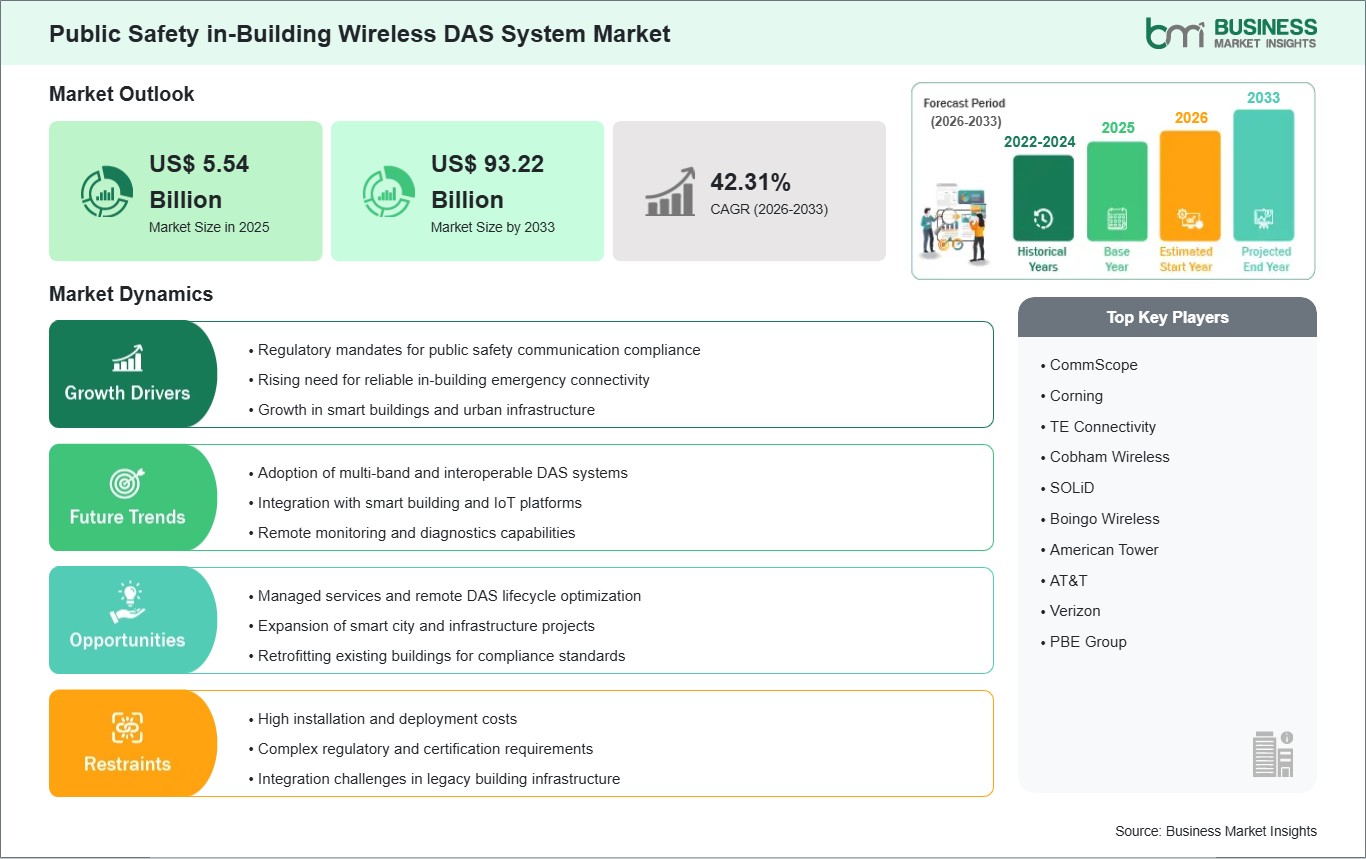
The Public Safety in-Building Wireless DAS System Market size is expected to reach US$ 93.22 billion by 2033 from US$ 5.54 billion in 2025. The market is estimated to record a CAGR of 42.31% from 2026 to 2033.
The global public safety in‑building wireless DAS system market is defined by increasing regulatory mandates for emergency communications, the growing adoption of smart building infrastructure, and heightened focus on life‑safety and first‑responder connectivity. Public safety DAS systems strengthen indoor wireless coverage for mission‑critical communications, enabling first responders (police, fire, emergency medical teams) to maintain reliable two‑way communication inside structures where conventional outdoor networks cannot penetrate.
Innovation in DAS architectures — including scalable headend units, remote modules, and interoperable signal distribution — is enabling flexible deployments that support both narrowband mission‑critical radio and broadband public safety services. Vendors are increasingly offering integrated solutions that combine hardware, software, managed services, and compliance verification to simplify long‑term operations. This shift is accelerating demand from enterprises and carriers seeking robust emergency communication coverage.
Competitive dynamics emphasize multi‑band support, remote diagnostics, and reduced installation complexity. With urbanization driving high-density structures worldwide, and building codes in North America, Europe, and parts of Asia Pacific mandating minimum levels of public safety coverage, the market is positioned for sustained growth through 2033. Strategic investments in training, certification, and systems integration further strengthen adoption.

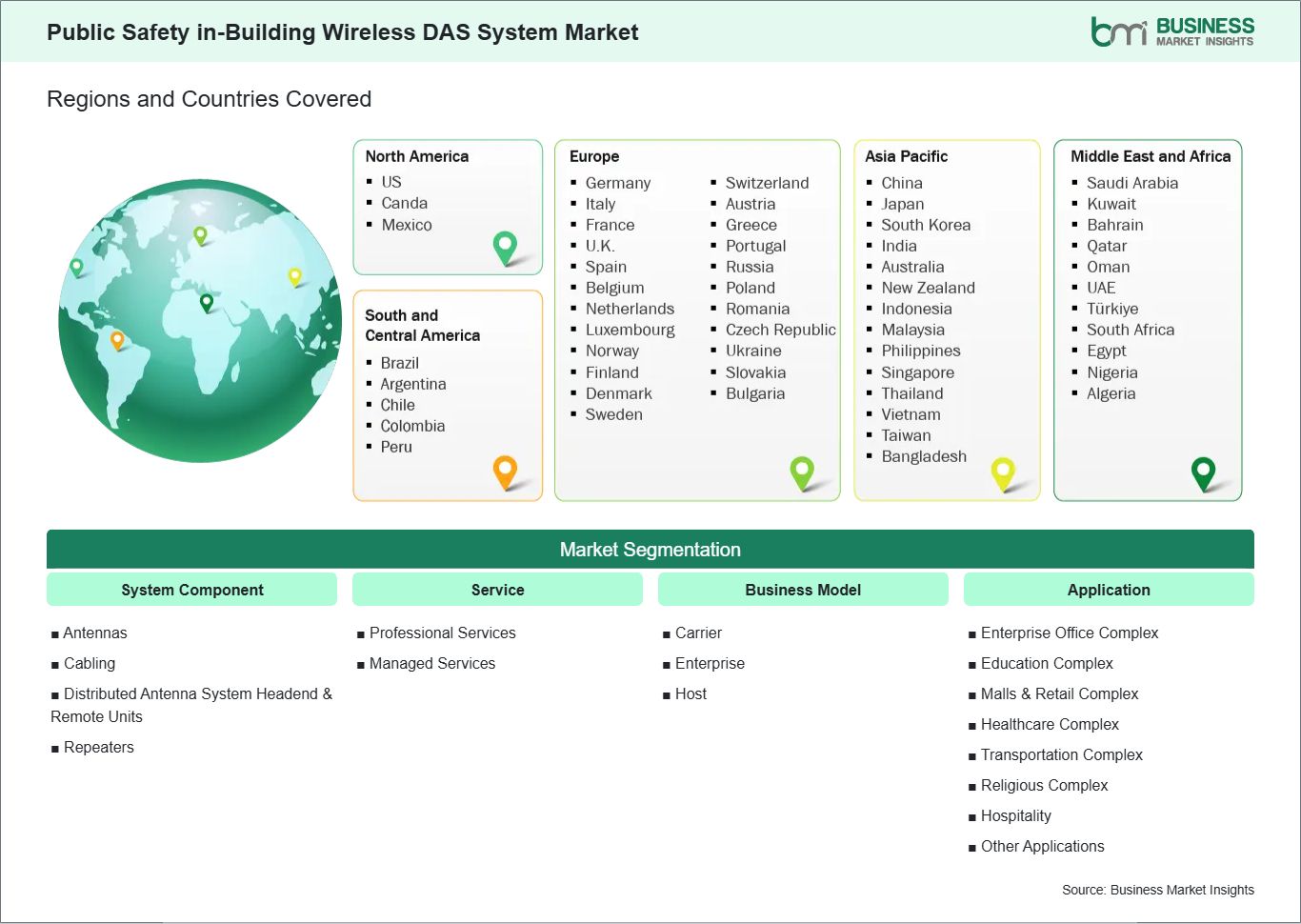
Key segments that contributed to the derivation of the public safety in‑building wireless DAS system market analysis are system component, service, business model, and application.
The adoption of distributed antenna systems (DAS) within buildings is largely influenced by regulations worldwide including building safety standards, fire codes, and communication requirements for first responders. In North America and Europe, authorities have implemented stricter regulations around providing reliable indoor coverage to ensure emergency responders have proper communication as part of life safety provisions. Standards such as NFPA 72 set minimum performance requirements, placing pressure on facility owners to install and maintain compliant DAS systems.
Retrofit projects in existing buildings and new DAS deployments are increasing. Professional services for site assessment, design, integration, and certification are critical, adding substantial project value beyond hardware alone. Government subsidies further incentivize adoption as building owners aim to meet compliance deadlines and avoid penalties.
Managed services and remote optimization cover the full DAS lifecycle, from deployment to ongoing operations. Advanced DAS solutions with multi-band support, digital monitoring, compliance reporting, and integration with building automation systems drive demand for service models that reduce operational burden and ensure system performance over time.
Managed DAS services include remote diagnostics, real-time performance monitoring, proactive maintenance, software updates, and compliance recertification support. These services mitigate signal degradation, meet evolving safety standards, and enable predictable operating expenditures for enterprises with multiple facilities.
As IoT and connected buildings evolve, DAS vendors can integrate coverage data into centralized dashboards, allowing facilities teams to monitor network health, prevent service interruptions, and quickly remediate issues. This integration enhances customer satisfaction and overall business value.
The Public Safety in- Building Wireless DAS System Market demonstrates steady growth, with size and share analysis highlighting evolving trends and competitive dynamics among key players. The report examines subsegments categorized within system component, service, business model, and application, offering insights into their contribution to overall market performance.
By system component, the DAS headend & remote units subsegment dominated the market in 2025, driven by its ability to centralize signal processing and support multi‑band public safety communication, which is critical for first responder connectivity and regulatory compliance.
By service, the professional services subsegment dominated the market in 2025, driven by the technical requirements for design, deployment, certification testing, and integration of DAS systems to meet stringent safety codes and performance standards.
By business model, the enterprise subsegment dominated the market in 2025, driven by broad adoption across commercial, institutional, transportation, and healthcare facilities that require robust high‑reliability indoor communication for occupant safety and first responder support.
In terms of application, the transportation complexes and healthcare complexes subsegments dominated the market in 2025, driven by regulatory mandates, high occupancy, and critical life‑safety communication requirements in these environments.
| Report Attribute | Details |
|---|---|
| Market size in 2025 | US$ 5.54 Billion |
| Market Size by 2033 | US$ 93.22 Billion |
| Global CAGR (2026 - 2033) | 42.31% |
| Historical Data | 2022-2024 |
| Forecast period | 2026-2033 |
| Segments Covered | By System Component
|
|
Regions and Countries Covered
| |
| North America | US, Canada, Mexico |
| Europe | Belgium, Austria, Finland, Denmark, Greece, Poland, Romania, Russia, Ukraine, Czech Republic, Slovakia, Bulgaria, Italy, Luxembourg, Germany, Switzerland, France, Netherlands, Norway, Portugal, Spain, Sweden, United Kingdom |
| Asia-Pacific | Australia, China, India, Japan, South Korea, Indonesia, Malaysia, Philippines, Singapore, Thailand, Vietnam, Bangladesh, New Zealand, Taiwan |
| South and Central America | Brazil, Argentina, Peru, Chile, Colombia |
| Middle East and Africa | Bahrain, Kuwait, Oman, Qatar, Saudi Arabia, United Arab Emirates, Turkiye, South Africa, Egypt, Algeria, Nigeria |
| Market leaders and key company profiles |
|
The "Public Safety in- Building Wireless DAS System Market Size and Forecast (2022 - 2033)" report provides a detailed analysis of the market covering below areas:
The geographical scope of the Public Safety in- Building Wireless DAS System Market report is divided into North America, Asia Pacific, Europe, Middle East & Africa, and South & Central America. North America held the largest share in 2025.
North America held the largest share in 2025 due to established regulatory frameworks, advanced infrastructure, and high adoption of safety‑critical communication systems across public and private sectors. The U.S. and Canada, with stringent building codes and public safety requirements, continue to lead in DAS deployments for transportation hubs, healthcare campuses, and commercial complexes.
In Europe, market growth is supported by harmonized safety standards and emphasis on life‑safety communication across densely built environments. Countries such as the UK, Germany, and France demonstrate strong adoption in major office environments, transit systems, and mixed‑use developments. Regulatory alignment across the EU enables wider deployment strategies and cross‑border vendor participation.
The Asia Pacific region is experiencing rapid expansion, driven by urbanization, modernization of transportation infrastructure, and increased safety investments in hospitality and retail complexes. Markets such as China, Japan, South Korea, and India are integrating public safety DAS as part of broader smart building initiatives, though adoption levels vary based on regulatory maturity and infrastructure spend.
In Middle East & Africa and South & Central America, early growth is concentrated in major urban centers and industrial corridors where stakeholder focus on first responder communication and large‑venue safety is rising. Public‑private partnerships and infrastructure modernization programs are facilitating initial DAS deployments, though pricing sensitivity and uneven regulatory enforcement remain challenges. Across regions, local safety codes, infrastructure priorities, and fiscal frameworks shape competitive strategies, with vendors customizing offerings to match regional needs and compliance landscapes.

The Public Safety in- Building Wireless DAS System Market is evaluated by gathering qualitative and quantitative data post primary and secondary research, which includes important corporate publications, association data, and databases. A few of the key developments in the public safety in- building wireless DAS system market are:
The Public Safety in-Building Wireless DAS System Market is valued at US$ 5.54 Billion in 2025, it is projected to reach US$ 93.22 Billion by 2033.
As per our report Public Safety in-Building Wireless DAS System Market, the market size is valued at US$ 5.54 Billion in 2025, projecting it to reach US$ 93.22 Billion by 2033. This translates to a CAGR of approximately 42.31% during the forecast period.
The Public Safety in-Building Wireless DAS System Market report typically cover these key segments-
The historic period, base year, and forecast period can vary slightly depending on the specific market research report. However, for the Public Safety in-Building Wireless DAS System Market report:
The Public Safety in-Building Wireless DAS System Market is populated by several key players, each contributing to its growth and innovation. Some of the major players include:
The Public Safety in-Building Wireless DAS System Market report is valuable for diverse stakeholders, including:
Essentially, anyone involved in or considering involvement in the Public Safety in-Building Wireless DAS System Market value chain can benefit from the information contained in a comprehensive market report.
Please tell us your area of interest
(Market Segments/ Regions and Countries/ Companies)